




Lipoma removal in London: excision and liposuction
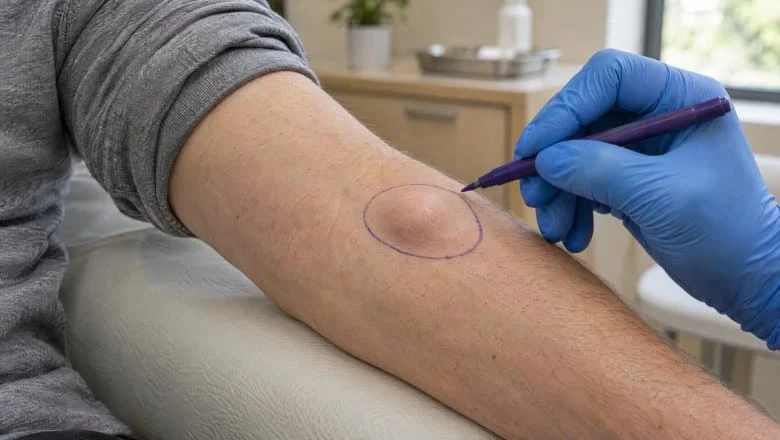
Lipoma removal is minor surgery to take out a lipoma, the soft, fatty lump that grows slowly under the skin. At Centre for Surgery it is carried out by our team of consultant plastic surgeons, usually as a lipoma excision under local anaesthetic: the lump is lifted out whole, inside its thin capsule, through an incision planned along the natural skin lines. For selected large lipomas, liposuction through a small puncture leaves a shorter scar.
Most people ask about lipoma removal because a lump on the neck, back, shoulder or arm has become visible or uncomfortable, or because they want to know for certain what it is. Lipomas are harmless in the great majority of cases, so lipoma treatment is a choice rather than a necessity. They are among the common skin lumps and bumps we see, alongside cysts and moles.
Private lipoma removal differs from other lump treatments in two ways. First, a lipoma sits in the fat beneath the skin rather than in the skin itself, so it cannot be shaved off or lasered like a skin tag or a mole: it has to be removed through an incision. Second, a soft lump is not always a lipoma: a cyst sits higher, in the skin (our guide to lipoma vs cyst explains how to tell them apart), and a few lumps need a scan before anyone removes them.
We treat lipomas at our Baker Street hospital in Marylebone, alongside all the lumps and bumps we remove. Every excised lipoma is sent to the laboratory to confirm the diagnosis.
Lipoma removal at a Glance
Lipoma removal suits most adults with a soft, mobile lump that looks like a typical lipoma; a lump that is hard, fixed, deep or growing quickly is scanned first, and your surgeon confirms the plan at your assessment.
Considering lipoma removal?Book a consultation to have your lump examined by a plastic surgeon and to talk through whether, and how, to remove it. No obligation, and no pressure to book.
Lipoma removal before and after photos
These photos show a real Centre for Surgery patient before and after lipoma removal from the arm, published with their consent.
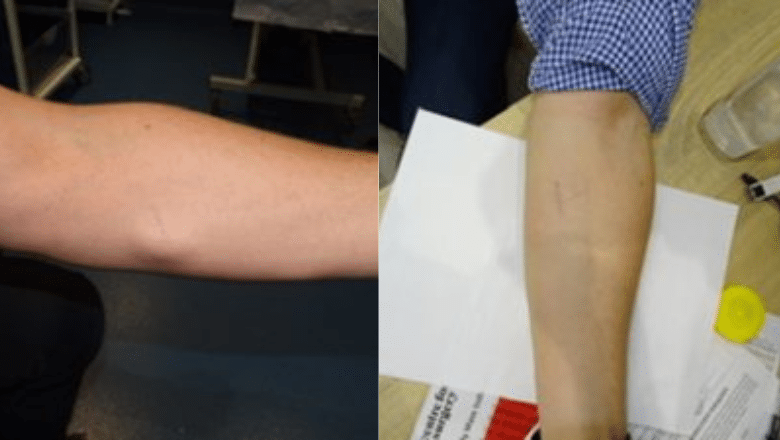
Individual results vary. How your scar looks depends on the size, depth and site of the lipoma and on how your skin heals, and it keeps fading for 6–12 months after surgery.
What is a lipoma? Signs of a fatty lump under the skin

A lipoma is a benign (non-cancerous) growth of mature fat cells inside a thin fibrous capsule. It sits in the subcutaneous fat, between the skin and the muscle beneath, so it feels like a separate, movable lump rather than a bump in the skin. The NHS describes lipomas as soft, fatty lumps that grow under the skin. They grow slowly over months or years, from pea-sized to several centimetres, occasionally more than 10 cm, and rarely shrink or go away on their own.
How to recognise a lipoma
A typical lipoma is:
- Soft and doughy: it gives way under gentle finger pressure.
- Mobile: it slips slightly under the skin when you press it from different sides.
- Usually not painful: most cause no symptoms at rest, although some are tender.
- Slow-growing: it changes over months or years, not weeks.
- Smooth and rounded: round or oval, with an edge you can feel.
A lump with these features is very likely to be a lipoma, and examination alone is often enough to make the diagnosis. Our guide to what a lipoma feels like describes the typical texture in more detail.
Where lipomas grow
The most common sites are the shoulders and upper back, the neck, the arms, the thighs and buttocks, and the abdomen and flanks; the face, scalp, hands and feet are less common. Most people have a single lipoma, while some have many, a pattern called familial multiple lipomatosis that runs in families.

Types of lipoma
Several subtypes look and feel much the same, so the subtype is usually confirmed only when the pathologist examines the removed tissue. Knowing it confirms the benign diagnosis but rarely changes treatment.
- Conventional lipoma: mature fat cells only, by far the most common type.
- Angiolipoma: fat with a richer blood supply, which can be tender even when small.
- Fibrolipoma: fat mixed with fibrous tissue, so it can feel firmer.
- Spindle cell lipoma: more common in older men, usually on the upper back or neck.
- Hibernoma: a rare lipoma made of brown fat.
Lipoma vs cyst

A lipoma sits deeper, in the fat, feels soft and doughy and has no opening on the skin. An epidermoid (often called sebaceous) cyst sits higher, in the skin itself, feels firmer or rubbery and often has a small dark opening called a punctum.
Cysts can become inflamed or infected and discharge; lipomas rarely do, although some become tender. Where examination leaves doubt, an ultrasound scan helps. If your lump turns out to be a cyst, our cyst removal page explains how it is treated.
Should a lipoma be removed? When lipoma removal makes sense
Most lipomas do not need to be removed. They are benign and usually stable, so removal is a personal decision.
Reasons people choose lipoma removal
- Appearance: a visible lump on the neck, shoulder, arm, face or scalp.
- Rubbing or pressure: a lipoma that catches on clothing, sits under a bra strap, rubs against a belt or watch, or makes lying on it uncomfortable.
- Tenderness: angiolipomas in particular can hurt when pressed; our article on whether a lipoma can become painful explains why.
- Restricted movement: a large lipoma in the armpit, groin or behind a joint can get in the way.
- Certainty: some people would rather have a laboratory diagnosis than keep watching an undiagnosed lump.
When a lipoma is better left alone
Many people come for an assessment, hear that the lump looks like a typical lipoma, and decide to leave it. That is reasonable when the lump is small, stable for years, hidden or symptom-free, or when you would rather not have a scar: every excision leaves one, so the trade-off is a lump you can feel against a line you can see. If you are unsure, our guide on whether a lump needs to be removed sets out the questions to ask, and a consultation gives you a clear answer about your own lump.
When removal is advised rather than optional
A scan, and often removal, is more strongly advised when a lump:
- has grown noticeably over a few months
- has recently become painful
- feels firm or hard, or is fixed to the tissue beneath
- is larger than 5 cm
- sits deep, within or beneath a muscle
These features are unusual in an ordinary lipoma, so they are a reason to look more carefully before anything is done, as the next section explains.
Can a lipoma be cancerous? Lipoma vs liposarcoma
An ordinary lipoma does not turn into cancer. The concern is a different and rare tumour called a liposarcoma, a cancer of fat cells that can look and feel like a lipoma from the outside. A liposarcoma is not a lipoma that has changed: it is a different disease from the start. The two can be hard to tell apart by touch, so the size, depth and behaviour of a lump decide how it is assessed.
A 2018 review in the Journal of the American Academy of Orthopaedic Surgeons notes that unplanned removal of sarcomas commonly happens because they were presumed to be lipomas, and recommends MRI for any soft-tissue lump lying deep to the muscle covering (fascia), or larger than 5 cm in the fat under the skin.[1] That is why we scan first, rather than simply removing the lump to see what it is, when it has any of the warning features listed above.

The 2024 update of the UK guidelines on soft tissue sarcoma, written by the British Sarcoma Group and published in the British Journal of Cancer (Hayes et al.), advises that anyone with a suspected sarcoma is referred to a regional sarcoma service, where the diagnosis is confirmed with imaging and a biopsy before the main operation.[2] We do not treat sarcoma at Centre for Surgery. If a lump looks as though it could be a sarcoma, or a scan or histology suggests one, your surgeon explains the findings and we refer you through your GP to an NHS sarcoma team, on the urgent suspected cancer pathway where that applies.
The British Association of Dermatologists’ patient guide to lipoma lists the features that need a doctor’s opinion: fast growth, a lump that cannot be moved, bleeding, ulceration or significant pain. A soft, mobile lump is reassuring, while a hard, fixed one deserves a prompt check; our article on soft vs hard lumps under the skin explains the difference.
Your lipoma removal consultation, scan and histology
Your consultation takes about 30 minutes, face to face at our Baker Street hospital, with one of our plastic surgeons. We see and treat adults aged 18 and over only. You are asked when you first noticed the lump, whether it has grown or changed, whether it hurts, about your general health and medicines, and whether anyone in your family has several lipomas.
The surgeon then examines the lump for size, position, depth, mobility, firmness and tenderness, and can check any other lumps you are worried about at the same visit. Our page on how skin lumps are assessed and removed describes the diagnosis-first approach we use for every lesion.
Ultrasound and MRI before lipoma removal
Where a lump has any of those warning features, or sits in a demanding position, we arrange an ultrasound scan before deciding on removal. Ultrasound is a useful first test: a 2017 systematic review in Acta Radiologica Open (Rahmani et al.), which pooled six studies, found that it correctly identified about 87% of lipomas and correctly ruled out about 96% of lumps that were not lipomas, and recommended it as the first investigation for superficial lipomas.[3]
Occasionally an MRI scan is needed as well. Both ultrasound and MRI scans are arranged at an outside imaging centre, not done at Baker Street.
Histology: checking the lipoma under the microscope
Tissue that is cut out (an excision, shave, punch or biopsy) is sent to an accredited laboratory for histology, where a pathologist examines it under the microscope. For a lipoma, histology confirms the benign diagnosis and the subtype, and picks up the rare lump that turns out to be something else.
Results usually take 3–4 weeks, and we contact you with the result. Where tissue is sent for analysis, the laboratory invoices you directly. Our guide to skin lesion histology results explains what happens to your sample and what the report means.
Deciding when to have it done
For cosmetic removal, we recommend a two-week cooling-off period between your consultation and treatment. If you have had a virtual consultation first and sent us photos of the lump, treatment can take place at the same visit as your in-clinic assessment, as long as the surgeon is happy it is suitable to treat on the day.
Stop aspirin 2 weeks before your procedure, unless it was prescribed by your doctor, in which case ask them first; tell us about any blood thinner you take.
How is a lipoma removed? Lipoma excision or liposuction

Lipoma excision, cutting the lump out whole, is the standard treatment and the one we recommend for almost every lipoma. Liposuction is kept for selected large lipomas, where a shorter scar matters more than certainty that every trace of capsule has gone. The choice is made with you at consultation.
Lipoma excision step by step

Once the skin is numb, the surgeon makes an incision over the lipoma along the natural skin tension lines. The lump is freed and lifted out in one piece, capsule included, because capsule left behind is the main reason a lipoma comes back. The space is closed in layers, with dissolving stitches underneath and fine stitches in the skin, and a dressing goes on.
The incision does not always need to be as long as the lump. In a 2021 series of 112 lipomas published in BioMed Research International (Park et al.), surgeons removed every palpable lipoma through an incision about one third of its diameter, and scar quality did not differ between small, medium and large lumps.[4] It was a single-centre retrospective study with no comparison group, but it shows a lipoma can often come out through a shorter cut than you might expect. Excision suits any size or site and gives a complete specimen for histology; the trade-off is a fine line scar.
Liposuction for lipoma

For selected large lipomas, typically larger than 5–6 cm, where an excision scar would be long, liposuction can be used instead. A small puncture of 3–5 mm is made next to the lipoma and a fine cannula suctions out the fatty tissue.
The evidence comes from small case series. In one American series of 25 patients with 48 lipomas, liposuction followed by removal of the leftover tissue through the same small incision gave results patients were pleased with, and none of the 23 who replied to long-term follow-up reported a recurrence, although recurrence was self-reported.[5]
The drawbacks are that some capsule is more likely to be left behind, so the lipoma is more likely to come back, and the fat comes out in fragments, so histology is less informative. Liposuction is not suitable for fibrous, deep, unusual or fast-growing lumps, or wherever there is a question of liposarcoma.
Lipoma removal under local anaesthetic or TIVA
Most lipoma removals are done under local anaesthetic as a day case. The anaesthetic is injected around the lump and takes effect within 2–3 minutes, and you stay awake while the area is numb.
For a very large lipoma where the safe dose of local anaesthetic would be exceeded, several lipomas in one session, a lump deep in the back or buttock, or if you would rather be asleep, we offer total intravenous anaesthesia (TIVA) in our on-site theatres, given by a consultant anaesthetist. After TIVA, a responsible adult must take you home and stay with you for 24 hours.
Removing multiple lipomas
Several small lipomas can usually be removed under local anaesthetic in one session; how many depends on their size, position and the safe dose of local anaesthetic. Larger numbers, or very large lipomas, can be removed together under TIVA.
Lipoma removal on the face, neck, back and armpit

Where a lipoma sits changes how the incision is planned, how deep the lump may go and how soon you can exercise again.
Lipoma on the face, forehead or scalp
Facial lipomas are uncommon but do occur, particularly on the forehead, temple and cheek. Some sit deeper than expected: on the forehead a lipoma often lies beneath the muscle, and on the scalp it can sit beneath the tough layer over the skull (a subgaleal lipoma). Incisions are placed along facial skin lines, in the hairline or in natural creases such as around the ear, to hide the scar where possible.
A hard lump on the forehead may be a bony forehead osteoma instead; our article on whether a hard lump on the forehead is an osteoma explains the difference.
Lipoma on the neck
A lipoma at the back of the neck is often large by the time it is treated and can be removed through a horizontal incision hidden in a skin crease; at the front or side, incisions in the natural creases heal well. A rare condition called Madelung disease (multiple symmetric lipomatosis) causes several symmetrical neck lipomas and is often treated in stages. A broad, soft pad of fat across the base of the back of the neck, rather than a separate lump, may be a buffalo hump, which is treated differently.
Lipoma on the back and shoulder
Lipomas on the upper back and shoulders often grow larger before people notice them. Stitches here usually stay in for 10–14 days. A deep back lipoma, or one beneath a shoulder muscle, may need a scan first and is sometimes better removed under TIVA.
Lipoma in the armpit
A lipoma in the armpit is easy to mistake for a bulge of armpit fat or a swollen gland. A lipoma is a separate, movable lump with a clear edge. A large armpit lipoma can restrict arm movement, and because lymph glands sit in the armpit, a new lump here may be checked with ultrasound before removal.
Lipoma on the arm, leg, chest or breast
Lipomas on the arms, thighs, upper chest and abdomen are common and usually straightforward to remove. A lump in the breast itself is different: it needs careful assessment, with imaging and sometimes a biopsy, to tell a lipoma from other breast lumps before anything is removed.
Lipoma removal side effects and risks
Lipoma removal is minor surgery, but every operation carries some risk. Most people have nothing more than soreness, bruising and a scar. Possible problems include:
- Bruising and swelling: common, and usually settles within 1–2 weeks.
- Bleeding or haematoma: a collection of blood under the wound, which may need draining.
- Seroma: a collection of clear fluid in the space the lipoma left, sometimes drawn off with a needle.
- Infection: redness, heat, increasing pain or discharge, treated with antibiotics if it occurs.
- Nerve injury: a patch of numbness around the scar can occur and usually improves over months; damage to a larger nerve is uncommon, but more of a concern with deep lumps and on the face and neck.
- Scarring: a scar that stretches, thickens or darkens, covered in the next section.
- Recurrence: the lipoma growing back, discussed below.
In the 2021 series of 112 excised lipomas described above, there were two seromas, two haematomas and one nerve injury, and complication rates did not differ between size groups.[4] Your surgeon explains your own risks, which depend on the size, depth and site of the lump.
Can a lipoma come back after removal?
Once it has been fully removed with its capsule, a lipoma is unlikely to come back in the same place, but new ones can form. DermNet describes local recurrence after surgical excision as rare, and a higher recurrence rate after liposuction because the capsule is not completely removed.
Deeper lumps behave a little differently. In a Danish cohort of 141 intramuscular lipomas (lipomas inside a muscle) removed surgically, an estimated 97% were free of local recurrence at 5 years; atypical lipomatous tumours, which can look like lipomas but behave differently, recurred more often in the same study, which is one reason histology matters.[6]
New lipomas can also appear elsewhere, especially if you have familial multiple lipomatosis; these are new growths rather than a failure of the operation. Our article do lipomas come back after removal looks at this in more detail.
Will lipoma removal leave a scar?
Yes. Lipoma excision always leaves a scar, and planning it is part of the operation. The scar is a fine line, usually about the length of the lump’s long axis or shorter, placed along the natural skin tension lines, in a crease or in the hairline where possible. It starts pink and slightly raised, then gradually fades and flattens over 6–12 months into a pale line. After liposuction, the scar is a small dot from the 3–5 mm puncture.
How a scar heals also depends on the site and on your skin. Scars on the back, shoulders and chest are more likely to stretch or thicken. If you have darker skin (Fitzpatrick types IV–VI), there is a higher risk of post-inflammatory hyperpigmentation (darkening) and keloid scarring; this is discussed at consultation and your aftercare is adapted to reduce both. Our article on whether lipoma removal leaves a scar shows what to expect at each stage.
Silicone-based scar care (a gel or sheets, bought separately) is part of your aftercare advice. If a scar is still prominent after 6 months, options include scar revision or erbium laser resurfacing on our Fotona SP Dynamis Pro.
Lipoma removal recovery and aftercare

Most people have a straightforward recovery and are back to normal daily activities within a few days. Our guide to lipoma removal recovery time covers healing week by week.
The first 48 hours
You go home with a dressing over the wound. The local anaesthetic wears off after 2–4 hours, and mild to moderate soreness is common; paracetamol or ibuprofen, if suitable for you, usually controls it well.
Keep the dressing clean and dry for 48 hours. After that you can shower gently, pat the area dry and put on a fresh small dressing if you prefer.
The first two weeks
Bruising and swelling usually settle within 1–2 weeks, and most people no longer need pain relief by day 5–7. Desk-based work is usually possible the next day.
Stitch removal
The deeper stitches dissolve on their own. Skin stitches are removed at the clinic at around:
- 7 days for the face or scalp
- 10 days for the neck and upper trunk
- 14 days for the back, abdomen, arms and legs
Exercise and activity
Avoid strenuous exercise, heavy lifting, swimming and saunas for 2–3 weeks while the wound heals. After a lipoma on the upper back or shoulder, avoid full upper-body workouts for 3–4 weeks; after one on the buttock or thigh, avoid running and intense lower-body exercise for 3 weeks. Full healing of the wound takes 3–4 weeks.
After liposuction for lipoma
Recovery after liposuction is generally quicker. The small puncture heals in 5–7 days, usually with no skin stitches to remove, although bruising can spread further than after excision because the cannula passes through more tissue.
Sun protection
If the lipoma was on a sun-exposed area such as the face, neck, upper chest, shoulders or forearms, apply SPF 50+ over the scar every day for the first 6 months. Sun on a healing scar can cause lasting darkening.
When to contact us
Call the clinic on 020 7993 4849 if you notice increasing pain after the first 48 hours, spreading redness, pus, a fever, significant bleeding, or the wound starting to open. Out of hours, call NHS 111, or 999 in an emergency.
How much does lipoma removal cost in London?
The cost of lipoma removal depends mainly on the size and depth of the lipoma, the technique, how many lumps you have removed and whether the procedure is done under TIVA. Our price list has separate options for a small lipoma under 3 cm, a medium lipoma of 3–5 cm, and a large lipoma over 5 cm or a deep one, as well as liposuction removal for selected large lipomas.
There is also an option for each additional small lipoma removed in the same session, and one for several or very large lipomas removed under TIVA. An ultrasound scan, where you need one, is listed separately.
Your surgeon confirms your price after assessing you at consultation. The consultation fee is redeemable against your treatment. Every option is in the lipoma section of our Skin & Aesthetics price list. Where tissue is sent for analysis, the laboratory invoices you directly.
Finance is available through Chrysalis Finance, subject to status; see our finance options page. M Sarwar Limited, trading as Centre for Surgery, is a credit broker, not a lender.
Why choose Centre for Surgery for lipoma removal

Every lipoma removal here is carried out by one of our plastic surgeons: a GMC-registered consultant plastic surgeon experienced in skin and soft-tissue surgery, who plans the incision around your skin lines, removes the capsule completely and sends every excised lipoma for histology.
You get honest advice. If your lump looks like a typical lipoma that is not bothering you, we will tell you it can be left alone; if it needs a scan first, we arrange one before any removal. There is no obligation and no pressure to book. Both excision and liposuction are available, and lumps that need it can be removed under TIVA in our on-site theatres.
Centre for Surgery is rated Good overall by the CQC, and you can read what patients say in our lipoma removal reviews. Treatment takes place at our private hospital at 95–97 Baker Street in Marylebone. To book, request a consultation using the form on this page or call 020 7993 4849.
Lipoma removal research and references
The studies cited on this page:
- Johnson CN, Ha AS, Chen E, Davidson D. Lipomatous soft-tissue tumors. J Am Acad Orthop Surg. 2018;26(22):779-788. doi:10.5435/JAAOS-D-17-00045
- Hayes AJ, Nixon IF, Strauss DC, et al. UK guidelines for the management of soft tissue sarcomas. Br J Cancer. 2024;132(1):11-31. doi:10.1038/s41416-024-02674-y
- Rahmani G, McCarthy P, Bergin D. The diagnostic accuracy of ultrasonography for soft tissue lipomas: a systematic review. Acta Radiol Open. 2017;6(6):2058460117716704. doi:10.1177/2058460117716704
- Park JK, Kim J, Kim JH, Eun S. Minimal one-third incision and four-step (MOTIF) excision method for lipoma. Biomed Res Int. 2021;2021:4331250. doi:10.1155/2021/4331250
- Copeland-Halperin LR, Pimpinella V, Copeland M. Combined liposuction and excision of lipomas: long-term evaluation of a large sample of patients. Plast Surg Int. 2015;2015:625396. doi:10.1155/2015/625396
- Presman B, Jauffred SF, Kornø MR, Petersen MM. Low recurrence rate and risk of distant metastases following marginal surgery of intramuscular lipoma and atypical lipomatous tumors of the extremities and trunk wall. Med Princ Pract. 2019;29(3):203-210. doi:10.1159/000503621
What To Expect
Your lipoma removal consultation
You meet one of our plastic surgeons at Baker Street for about 30 minutes. They ask how the lump has behaved, examine it and any other lumps you want checked, and tell you whether it looks like a typical lipoma.
If it is large, deep, hard or changing, an ultrasound scan comes first. You then agree a plan together: excision or liposuction, local anaesthetic or TIVA, or simply leaving it alone. There is no obligation to go ahead.
On the day of your procedure
Your surgeon checks the plan, confirms your consent and marks the outline of the lump. The area is numbed with local anaesthetic, or you are put to sleep with TIVA for larger or multiple lipomas.
The lipoma is lifted out through an incision planned along your skin lines, the wound is stitched and dressed, and the tissue goes to the laboratory. Most people go home soon afterwards; after TIVA, a responsible adult takes you home.
After your lipoma removal
Keep the dressing dry for two days, then shower gently. Expect soreness for a few days and bruising that fades within a fortnight; a desk job is usually fine the next day.
Skin stitches come out at 7–14 days, depending on the site. Hold off the gym, swimming and saunas for 2–3 weeks, and call us if the wound becomes red, hot or increasingly painful.
Your histology result and final result
A pathologist examines your lipoma under the microscope. Results usually take 3–4 weeks, and we contact you with the result; if it shows anything unexpected, your surgeon explains what it means and the next step.
Your scar starts pink and slightly raised, then fades and flattens over 6–12 months. Protect it from the sun, and if it is still prominent at 6 months, ask us about scar treatment.
FAQs
-
Usually not, unless there is a medical reason. The NHS says a lipoma would only be removed on the NHS if it was growing or causing symptoms because of where it is, and the British Association of Dermatologists notes that removal, which is usually for cosmetic reasons, is not routinely offered on the NHS. Your GP can examine a lump and refer you if it has worrying features, and local rules and waiting times vary. If you are not eligible, or would rather not wait, private lipoma removal is the alternative.
-
Most lipomas are harmless, and removing one swaps a lump for a scar. A typical lipoma is benign, grows slowly and rarely causes problems, so there is usually no clinical need to take it out, and NHS funding is generally limited to lumps that are growing or causing symptoms. Doctors also weigh the small risks of surgery, such as bleeding, infection and a visible scar, against a lump that would do no harm if left. That changes when a lump is growing, painful, hard or deep, which is when a scan or removal is advised.
-
Sometimes, but usually not when removal is for appearance alone. Private medical insurers generally exclude cosmetic procedures, while some may cover a lump that needs a diagnosis or is causing symptoms, often only with a GP referral and authorisation in advance. Policies differ, so check with your insurer before you book: ask whether lipoma removal is covered, what referral they need and whether scans and histology are included. If you pay for treatment yourself, finance is available, subject to status.
-
The exact cause is not fully understood, but genes play a clear part. Lipomas often run in families, and some conditions cause several of them, including familial multiple lipomatosis and Gardner syndrome, which are inherited, and Madelung disease. Minor injury to an area has been suggested as a trigger in some cases. Lipomas are slightly more common in people who are overweight, but slim people get them too, so weight is not the main factor. A lipoma is also different from lipoedema, where fat builds up symmetrically in the legs and sometimes the arms.
-
Usually very little. Most lipomas stay the same size or grow slowly over years and rarely cause harm. They seldom shrink or disappear on their own, so a lump you leave alone is likely to stay; our article on whether a lipoma can go away on its own explains why. A lipoma that keeps growing can become more noticeable, need a longer incision to remove, or start to press on nearby tissue. See a doctor if a lump grows quickly, becomes painful, feels hard or stops moving.
-
A single ordinary lipoma is not usually a sign of illness elsewhere in the body, and it does not turn into cancer. The NHS advises seeing a GP if a lump is painful, red or hot, is hard and does not move, or keeps getting bigger, because those features are not typical of a lipoma. Having several lipomas often runs in families and is usually harmless, although occasionally it is part of an inherited condition, which your doctor may ask about.
-
There is no reliable way to get rid of a lipoma without a procedure. Creams, supplements, diets and home remedies have no good evidence of shrinking one. Fat-dissolving injections have been tried in small studies and case reports, but lipomas can come back afterwards, and we do not offer them. Excision remains the effective treatment, with liposuction through a small puncture as the least invasive option for selected large lipomas. If a lipoma is not bothering you, leaving it alone is also a reasonable choice.
-
The procedure itself should not be painful, because the area is numbed first. The local anaesthetic injection stings for a few seconds; after that you feel pressure and movement but not sharp pain. If you have TIVA, you are asleep throughout. Once the anaesthetic wears off, the wound is usually sore for a few days, and paracetamol or ibuprofen, if suitable for you, is normally enough. If your lipoma is already painful, mention it at your consultation.
-
The operation usually takes 30–45 minutes for a small lipoma under 3 cm and 45–60 minutes for a medium one of 3–5 cm, from numbing to dressing. A large, deep or awkwardly placed lipoma, or several removed together, can take 60–120 minutes. For a single small or medium lipoma, allow around 1.5 hours at the clinic in total, to include checking your details, consent, the procedure and your aftercare instructions.
-
Yes, for most people. A typical lipoma is removed under local anaesthetic as a day-case procedure: you stay awake and go home with a dressing the same day. It is still an operation, with an incision, stitches and a small risk of complications, so it is carried out by a surgeon in a procedure room. Very large, deep or multiple lipomas may be removed under TIVA in our theatres, which takes longer and means a responsible adult must take you home.
-
Most people go back to desk-based work the next day. If your job is physical or involves lifting, you may need longer, because strenuous activity and heavy lifting should be avoided for 2–3 weeks while the wound heals, or 3–4 weeks for upper-body effort after a lipoma on the back or shoulder. You also need to come back to have your stitches removed. Our guide to how long lipoma removal takes to heal covers each stage.
-
The price depends on the size and depth of the lipoma, whether it is removed by excision or liposuction, how many you have removed and whether TIVA is needed, so it is confirmed after your surgeon has assessed you. Every option is listed in the lipoma section of our Skin & Aesthetics price list. An ultrasound scan, if you need one, is priced separately, and where tissue is sent for analysis the laboratory invoices you directly.
-
Yes, it can be, if you plan ahead. Start with a virtual consultation and send us photos of the lump; it can then be removed at your first visit to the clinic, once the surgeon has examined it and is happy to go ahead. It is not possible when the lump needs an ultrasound scan first or needs TIVA, and it is not the right choice if you would like longer to think. Our article on same-day lipoma removal explains how to plan for it.





