


In this guide12 sections
- What Are the NHS Criteria for a Tummy Tuck?
- How Does the NHS Tummy Tuck Referral Process Actually Work?
- Diastasis Recti and the NHS: A Different Pathway
- How to Strengthen Your NHS Referral
- What Happens If Your ICB Declines the Request?
- What Is the Ideal BMI for a Tummy Tuck, NHS or Private?
- How Long Is the Wait for a Tummy Tuck on the NHS?
- NHS vs Private Tummy Tuck: A Direct Comparison
- Can My Loose Skin Be Removed on the NHS?
- How Much Does a Tummy Tuck Cost Privately?
- Frequently Asked Questions
- Tummy Tuck Surgery at Centre for Surgery
Tummy tuck surgery is generally considered a type of cosmetic surgery, as it’s usually performed to improve appearance rather than to treat disease or injury — and the NHS does not fund procedures considered purely cosmetic, including tummy tucks, breast reductions, and aesthetic rhinoplasty. But “generally” isn’t “never” — there are specific, genuine medical circumstances where a tummy tuck on the NHS is funded, and this guide covers exactly what they are, including the one condition (diastasis recti) that has its own distinct NHS pathway most guides don’t explain properly, the actual referral process step by step, how to strengthen your case, realistic wait times, BMI thresholds for both NHS and private surgery, and honest pricing if you decide private surgery is the right route for you.
A tummy tuck, or abdominoplasty surgery, is one of our most commonly performed procedures at Centre for Surgery in London. The procedure can be genuinely life-changing, with a significant boost in confidence and self-esteem — tummy tuck surgery has one of the highest patient satisfaction rates of any cosmetic surgery. For further information on tummy tuck and how it could benefit you, we’d recommend speaking to one of our patient coordinators to book a face-to-face consultation with an expert tummy tuck surgeon in London.
What Are the NHS Criteria for a Tummy Tuck?
The tummy tuck NHS criteria come down to clear medical need, not just aesthetic preference — an abdominoplasty NHS referral is possible where you meet them. If you have any of the following genuine concerns, it’s worth speaking to your GP:
- Loose, hanging skin causing chronic skin infections, rashes, or breakdown in the folds — a genuine hygiene and medical issue, not just an appearance concern
- Excess skin causing significant functional limitation — difficulty walking, exercising, or carrying out everyday activities
- Weakened or separated abdominal muscles (diastasis recti) causing pain, poor posture, or an increased hernia risk — see the dedicated section below, since this has its own distinct NHS pathway
- Psychological distress that’s been formally assessed and documented as significant
Meeting one of these criteria doesn’t guarantee NHS funding — it means you have grounds to ask your GP to refer you, after which your local Integrated Care Board (ICB) makes the actual funding decision based on your individual circumstances and the resources available in your area at that time.
How Does the NHS Tummy Tuck Referral Process Actually Work?
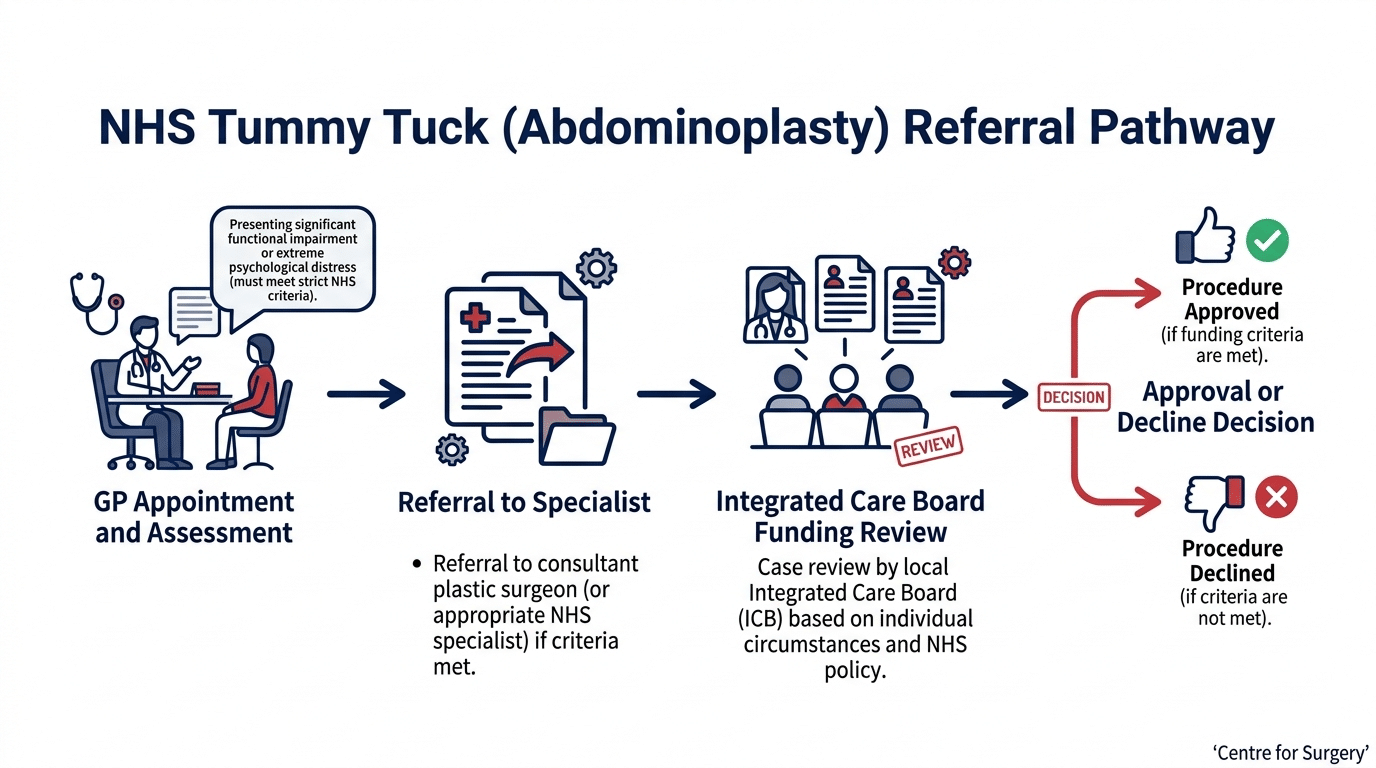
Getting a tummy tuck on the NHS is a genuine process with several distinct stages, and knowing what each one involves helps set realistic expectations from the start.
- GP appointment and assessment. Your GP examines your concern, discusses your history, and decides whether it meets the threshold to justify a referral. This is the gatekeeping step — without a supportive GP, the process doesn’t move forward.
- Referral to a specialist. If your GP agrees to refer you, you’re seen by a plastic surgeon or relevant specialist, who assesses your case clinically and, if appropriate, recommends the specific surgical approach.
- Integrated Care Board funding review. Your case is submitted as a formal Individual Funding Request to your local ICB, who scrutinise it against their published criteria and the funding available in your area at that time. This is where most rejections happen — not because the surgeon disagrees with the need, but because the case doesn’t meet the ICB’s specific written threshold.
- Approval or decline. If approved, you’re added to the NHS surgical waiting list. If declined, you can request a review or explore private options — most patients who are declined go on to consider private surgery rather than repeatedly appeal.
Opting for a tummy tuck on the NHS can be a genuinely arduous process — your previous treatments, your specific reasons for surgery, and how well you meet your ICB’s written criteria all get scrutinised. For many patients, the length of this process, combined with NHS waiting times once approved, leads them to consider private healthcare instead.
Diastasis Recti and the NHS: A Different Pathway
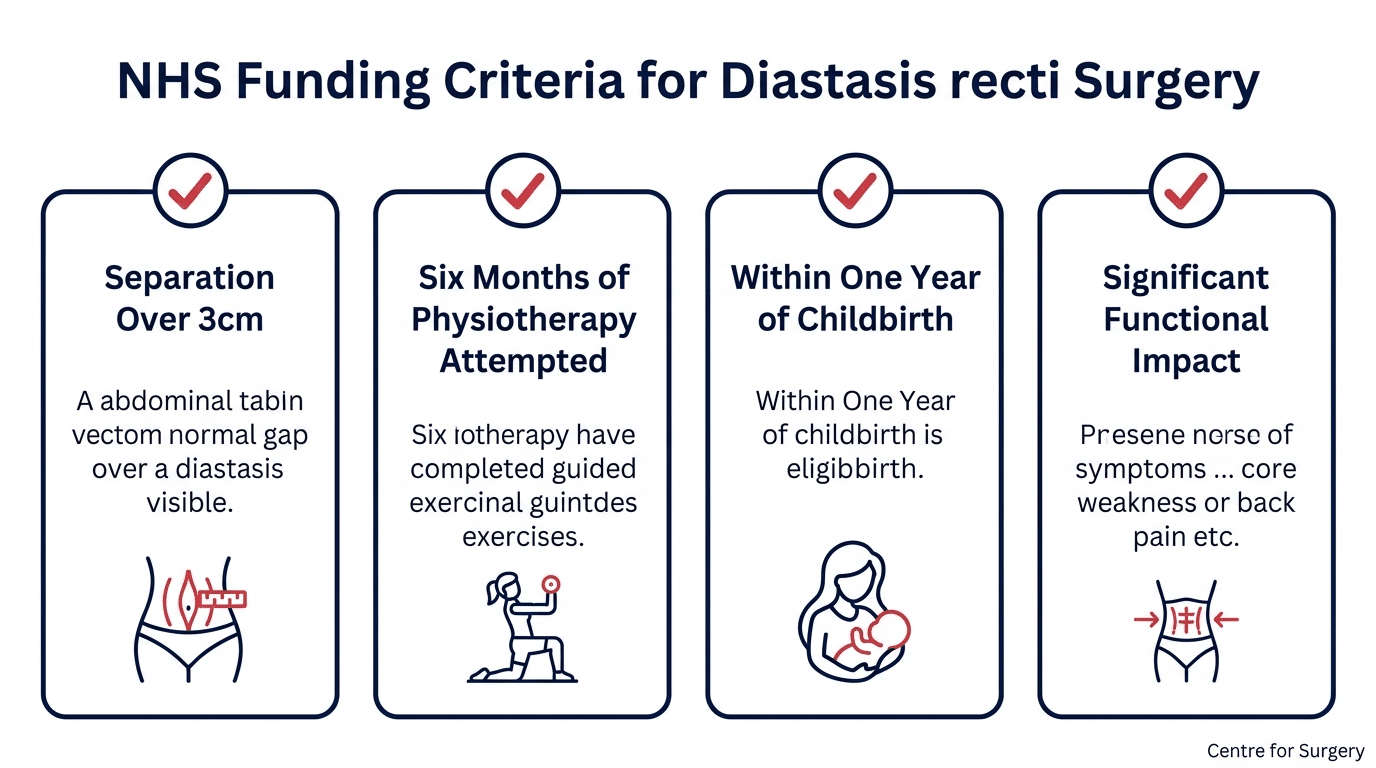
If your main concern is diastasis recti — separated abdominal muscles, most often after pregnancy — the NHS pathway is genuinely different from a standard tummy tuck referral, and worth understanding in its own right rather than assuming the general criteria above apply.
The NHS doesn’t jump straight to surgery for diastasis recti. You’re typically referred for abdominal physiotherapy first, and surgical funding for muscle repair is only considered where several specific conditions are met together:
- The separation measures more than 3cm — a smaller gap generally isn’t considered to meet the surgical threshold
- You’ve completed a minimum of six months of dedicated abdominal physiotherapy without it resolving the separation
- You’re within roughly one year of giving birth — outside this window, funding becomes considerably harder to secure through the postpartum pathway specifically
- The separation is causing significant functional issues — pain, incontinence, or a genuine impact on daily activity, not just appearance
Outside of pregnancy, diastasis recti funding may also be considered following abdominal wall trauma, previous abdominal surgery, or a genuine congenital abnormality of the rectus muscles. If you believe you may qualify, the right first step is the same as for any tummy tuck referral — book an appointment with your GP and discuss your specific circumstances, since eligibility genuinely does depend on your individual case and the physiotherapy you’ve already tried.
How to Strengthen Your NHS Referral
Since the GP appointment is the gatekeeping step in the whole process, walking in prepared genuinely improves your chances of a supportive referral. It’s worth bringing:
- A written symptom diary — specific examples of skin infections, rashes, or functional limitations, with dates, rather than a general description
- Photographic evidence of the physical concern, particularly for skin folds or visible muscle separation, taken consistently over time
- Documentation of any physiotherapy you’ve already completed for diastasis recti, including how many sessions and the outcome — the NHS will specifically want to see this before considering surgical funding
- A record of any GP visits, pharmacy treatments, or specialist input already sought for related skin infections or pain, showing this isn’t a new or one-off concern
GPs see a high volume of referral requests and have to weigh each one against their local ICB’s published criteria — a well-documented, specific case is genuinely easier for them to support and for the ICB to approve than a general request based on how you feel about your appearance, even where the underlying concern is entirely genuine.
What Happens If Your ICB Declines the Request?
A decline isn’t necessarily final. Your GP or specialist can request the specific reason for the decision in writing, which often reveals a criteria gap that can be addressed — for example, insufficient documented physiotherapy for diastasis recti, or a BMI just above the local threshold. Where the gap is addressable, your GP can resubmit once it’s resolved. Where you believe the decision itself was wrong given the criteria, most ICBs have a formal review or appeal process, though this can add further months to an already lengthy timeline. In practice, most patients who are declined — particularly where the case is borderline against a strict written threshold rather than clearly ineligible — choose to explore private surgery rather than pursue a lengthy appeal, especially where the underlying functional or medical concern is causing ongoing distress.
What Is the Ideal BMI for a Tummy Tuck, NHS or Private?
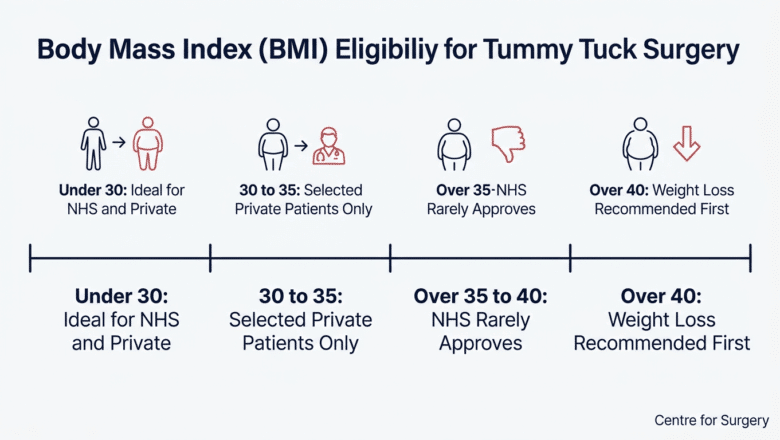
Although not considered major surgery, a tummy tuck is still an invasive cosmetic procedure with genuine risks, and BMI is one of the clearest predictors of complication risk. Both the NHS and private clinics use BMI thresholds, though private clinics generally have somewhat more flexibility to assess individual cases.
At Centre for Surgery, we’d advise patients to have a BMI below 30 to minimise the risk of complications and achieve the best possible outcome. In selected patients — particularly those considered “bottom heavy” with fat distributed away from the abdomen itself — we can safely treat up to a BMI of 35. Patients who are significantly overweight with a large amount of generalised body fat generally aren’t the best candidates for a tummy tuck, and we’d recommend healthy lifestyle changes to optimise BMI before proceeding, since a tummy tuck removes excess skin and fat, not underlying obesity.
The reasoning behind this threshold is physical, not arbitrary. Patients with a lower BMI generally have thinner skin flaps, which lowers the risk profile of the procedure. Thicker skin folds usually indicate a thicker underlying fat layer, which can increase the risk of complications during surgery — there’s a higher risk of blood loss as the surgeon separates thicker skin and fat from the underlying abdominal muscles, and larger patients generally have larger blood vessels requiring more precise cautery. All patients having surgery under anaesthetic at Centre for Surgery undergo a face-to-face, nurse-led pre-operative assessment as standard.
How Long Is the Wait for a Tummy Tuck on the NHS?
Wait times for a tummy tuck on the NHS depend heavily on your personal circumstances, and the NHS doesn’t publish a single average wait time for this specific procedure — anyone giving you a precise national figure is guessing. Several factors genuinely influence how long your particular wait will be:
- Severity of your case: more extensive excess skin or a more complex muscle repair generally increases the clinical priority assigned to your case
- Regional capacity: different NHS trusts and ICBs have different surgical capacity and waiting lists, which genuinely varies by where you live
- Surgeon availability: the number of surgeons with the specific reconstructive training this procedure requires varies by region and affects scheduling
In practice, most patients pursuing an NHS route should expect a process measured in many months to a year or more from initial GP appointment through to surgery, once you account for the referral, the funding decision, and the surgical waiting list itself. This is the single biggest reason patients who are eligible on paper still choose to go private.
NHS vs Private Tummy Tuck: A Direct Comparison
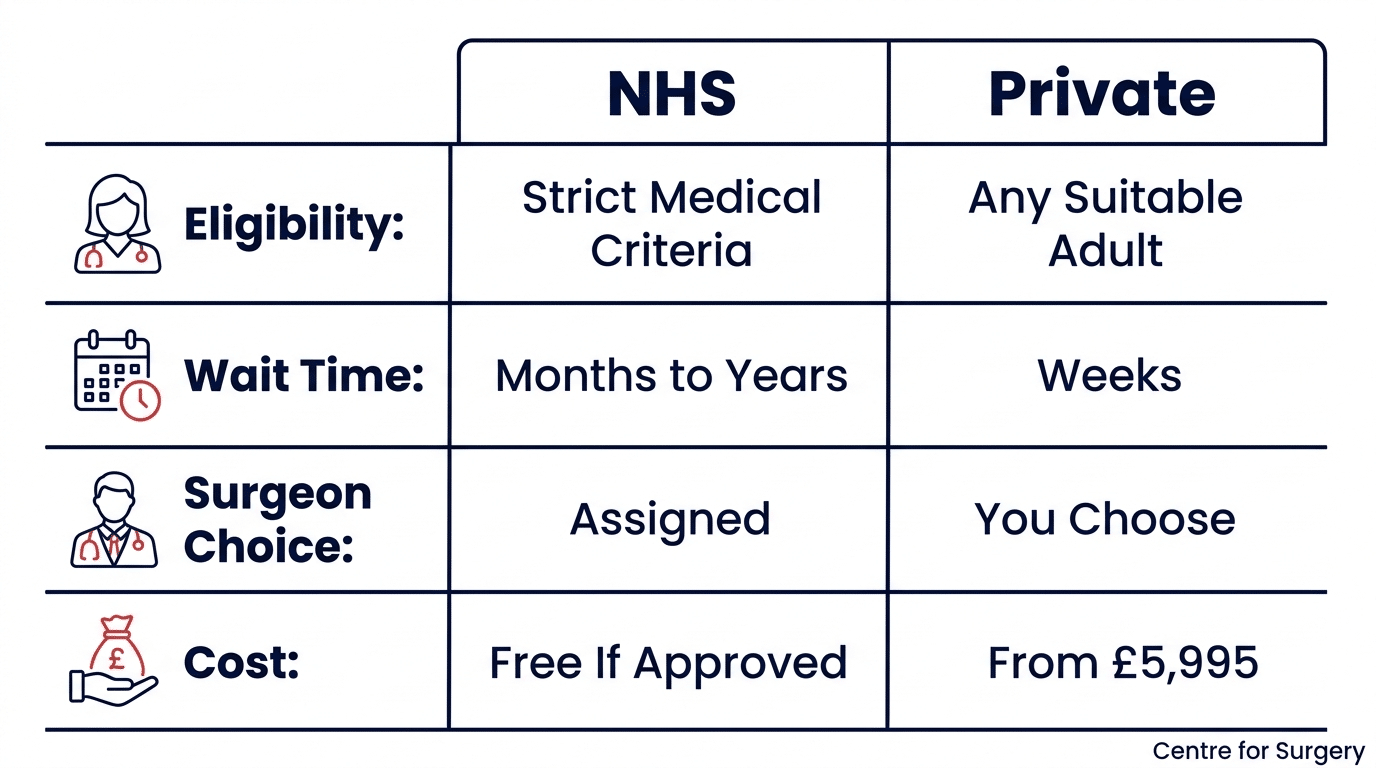
Beyond the criteria and wait times already covered, the practical difference between the two routes comes down to control. On the NHS, you’re assigned a surgeon based on availability rather than choice, and the specific technique used is decided clinically rather than to your aesthetic preference. Privately, you choose the hospital, discuss your specific goals in detail with your surgeon, and the procedure is planned around your priorities rather than purely functional necessity — which is part of why patients with a genuine medical need but a long NHS wait, or those who don’t meet the strict NHS threshold despite a real functional issue, often choose private surgery instead.
Can My Loose Skin Be Removed on the NHS?
Excess skin removal more broadly is also considered a type of cosmetic surgery and therefore isn’t routinely performed on the NHS outside the specific criteria covered above. Many patients who’ve undergone significant weight loss and developed excess skin will need to have this removed privately. There are several types of excess skin removal surgery beyond a standard tummy tuck, including arm lift, thigh lift, and body lift (belt lipectomy) — each following broadly similar NHS eligibility logic to what’s covered here.
How Much Does a Tummy Tuck Cost Privately?

If NHS funding isn’t available to you, or you’d rather not wait, current private prices for mini, full and extended tummy tucks are set out in our tummy tuck cost guide. Tummy tucks after massive weight loss, where much more skin and fat is removed, cost more because of the complexity involved. Where you have the procedure and your surgeon’s experience both genuinely affect pricing, and mini tummy tucks cost meaningfully less than full or Brazilian tummy tucks.
You’ll receive an accurate, written cost for your specific procedure after a face-to-face consultation with an expert tummy tuck surgeon in London — your dedicated patient coordinator confirms this with you after your consultation. Finance is available through Chrysalis Finance, subject to status, so cost doesn’t need to be a barrier to addressing a genuine functional or medical concern even where NHS funding isn’t an option.
Frequently Asked Questions
Can excess skin be removed on the NHS?
It depends on your personal circumstances. Your GP can advise on the criteria you need to meet locally, and the NHS will consider factors such as the severity of your excess skin and whether it’s causing other health issues such as chronic skin infections or functional limitation.
Is diastasis recti NHS surgery available?
Yes, in specific circumstances. Diastasis recti NHS surgery is typically only funded after physiotherapy has been tried first — the NHS will look for a separation of more than 3cm, at least six months of documented physiotherapy that hasn’t resolved it, and, for postpartum patients, being within roughly a year of giving birth. Outside pregnancy, trauma or a congenital abnormality of the rectus muscles can also be grounds for funding. See our dedicated diastasis recti guide for more detail on the condition itself.
Can diastasis recti be repaired on the NHS?
Yes, in specific circumstances — the NHS typically refers you for physiotherapy first, and will only consider funding surgical repair where the separation is over 3cm, six months of physiotherapy hasn’t resolved it, you’re within around a year of giving birth, and there’s a genuine functional impact.
Has anyone actually had a tummy tuck on the NHS?
Yes — patients who meet their local ICB’s criteria are able to have this surgery funded. The criteria are genuinely strict though, and waiting times can be long, which is why many eligible patients still choose to go private for speed and choice of surgeon.
What are the NHS tummy tuck costs if I’m approved?
If you meet the NHS criteria and are approved for funding, there’s no cost to you at the point of treatment — the procedure is funded in full, same as any other NHS surgery.
What’s the ideal BMI for an abdominoplasty on the NHS?
The NHS generally looks for a BMI below 30, with some regional variation. A BMI above 40 is usually considered too high for safety reasons, and NHS funding is very unlikely to be approved at that threshold. Privately, Centre for Surgery can treat carefully selected patients up to a BMI of 35.
What should I do if the NHS declines my tummy tuck request?
You can ask your ICB for the specific reason and request a review if you believe your case wasn’t correctly assessed. Most patients who are declined choose to explore private surgery instead of repeatedly appealing, particularly where the functional or medical impact is genuine but doesn’t meet the ICB’s specific written threshold.
Tummy Tuck Surgery at Centre for Surgery
Whichever route brings you to us, tummy tuck surgery at Centre for Surgery is performed by GMC-registered plastic surgeons at our CQC-regulated Baker Street facility, rated Good overall. Surgery is carried out under TIVA (Total Intravenous Anaesthesia) as a day case, one of only a handful of UK providers offering day-case abdominoplasty rather than the 2–3 night inpatient stay most tummy tuck patients experience elsewhere. Our medical content is reviewed by Specialist Plastic Surgeon Dr Spyridon Vlachos (GMC 7522950).
If you’d like an honest, personalised assessment of your options — NHS or private — please get in touch to book a face-to-face consultation with an expert tummy tuck surgeon at our Baker Street clinic in London.







