



In this guide11 sections
- Key Points
- What Is a Belt Lipectomy?
- Belt Lipectomy vs Tummy Tuck vs Extended Tummy Tuck
- Am I a Candidate for a Belt Lipectomy?
- Why We Perform Belt Lipectomy as a Staged, Two-Session Procedure
- Anaesthesia and Where Belt Lipectomy Surgery Takes Place
- Recovery After a Belt Lipectomy
- Belt Lipectomy Cost
- Frequently Asked Questions
- Why Choose Centre for Surgery for Your Belt Lipectomy
- References
Key Points
- A belt lipectomy, also called a lower body lift, removes loose skin around the whole lower torso: the abdomen, flanks, lower back, buttocks and outer thighs.
- It suits people whose excess skin is visible from the front, sides and back. If the excess is only at the front, a tummy tuck or extended tummy tuck is a smaller operation.
- Your weight should be stable for 12 months, your BMI ideally below 30, and you must stop smoking before and after surgery.
- At Centre for Surgery it is done in two stages under TIVA, at least 6–12 weeks apart. Each stage is often a day case, though some patients stay overnight.
- Expect around 2–3 weeks off desk-based work after each stage, and a permanent scar that fades over 6–12 months.
- Each stage is quoted separately at consultation.
A belt lipectomy — also called a lower body lift — removes excess skin left behind after significant weight loss, addressing the abdomen, flanks, lower back, buttocks and outer thighs in a single circumferential procedure. It’s a bigger operation than a standard tummy tuck, and at Centre for Surgery we also approach it differently: rather than one long combined surgery, we perform it as a staged, two-session procedure. This guide covers exactly what a belt lipectomy involves, who it’s suitable for, why the staged approach exists, and what recovery and cost look like.
What Is a Belt Lipectomy?
A belt lipectomy takes its name from the shape of the incision — a circumferential line that runs around the entire lower torso like a belt, roughly at hip level. It’s also known by several other names that all describe the same procedure: lower body lift, circumferential abdominoplasty, circumferential lipectomy, and 360 abdominoplasty.
Unlike a standard tummy tuck, which addresses only the front of the abdomen through a single horizontal incision, a belt lipectomy treats the entire circumference of the lower body in one operation (performed at Centre for Surgery across two staged sessions — more on that below). It removes the overhanging abdominal skin apron (sometimes called a pannus), the excess skin rolls along the flanks and waist, the skin fold that develops across the lower back above the buttocks, and the sagging skin on the outer thighs — while also lifting the buttocks, which commonly flatten and descend after major weight loss.
The procedure is most often performed after substantial weight loss, whether through bariatric surgery, sustained diet and exercise, or weight-loss medication. Once fat is lost quickly or in large volume, skin that was stretched to accommodate the previous body size often can’t retract to match the new one — no non-surgical treatment can meaningfully correct this once it’s established; surgical excision is the only way to remove the tissue.
Belt Lipectomy vs Tummy Tuck vs Extended Tummy Tuck
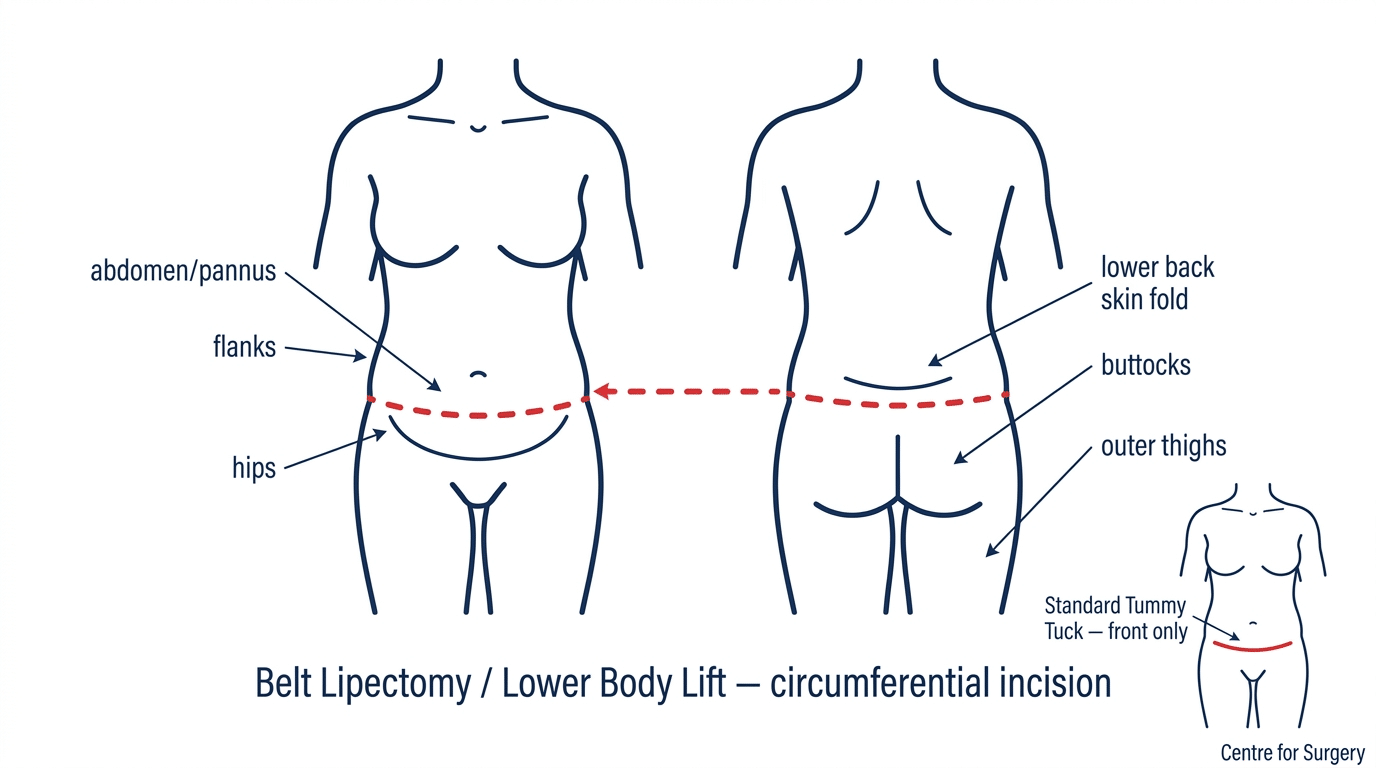
Choosing between these three procedures comes down to where your skin laxity actually sits:
- Standard tummy tuck — treats the front of the abdomen only, through a horizontal hip-to-hip incision. Appropriate where excess skin is confined to the front of the abdomen, with no significant laxity around the sides or back.
- Extended tummy tuck — extends that same incision further around the hips to also treat the upper flanks and waist. Appropriate where laxity spreads from the abdomen into the flanks but doesn’t meaningfully affect the lower back or buttocks.
- Belt lipectomy (lower body lift) — the full circumferential incision, treating the abdomen, flanks, lower back and buttocks together. This is the appropriate choice specifically where skin excess is visible from the front, sides, and back — a standard or extended tummy tuck simply can’t reach the posterior.
The key question your surgeon will assess at consultation is whether your skin laxity is genuinely circumferential. If it’s confined to the front of the abdomen, a shorter-incision tummy tuck will likely give you an equivalent result with a smaller scar and a more contained recovery — there’s no benefit to a bigger operation than you need. See our Lower Body Lift service page for the full comparison, including current pricing for each option.
Am I a Candidate for a Belt Lipectomy?
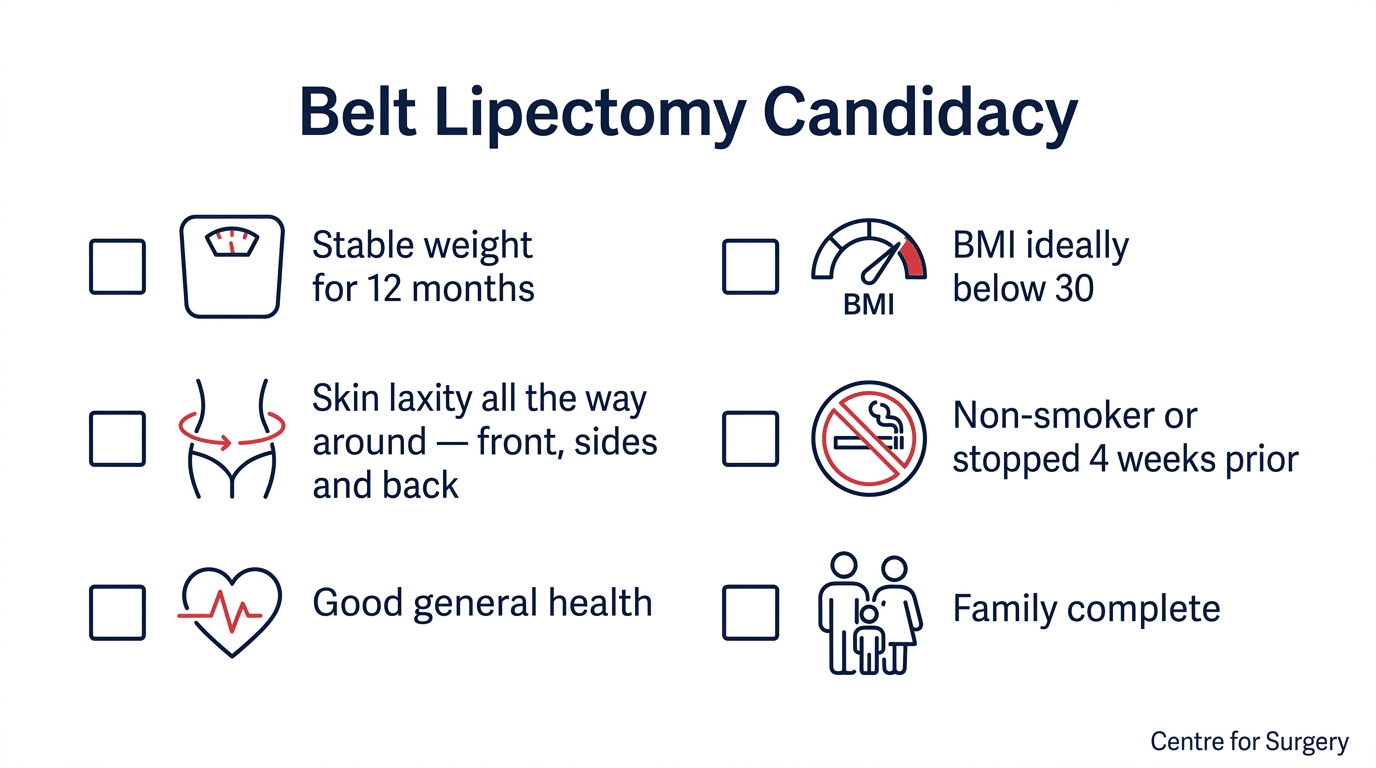
Belt lipectomy is a significant undertaking, and candidacy criteria are correspondingly more stringent than for a standard tummy tuck:
- Stable weight for at least twelve months. This is the standard requirement for post-bariatric patients specifically. Operating before your weight has genuinely settled risks new skin laxity developing if you lose more weight afterwards, and compromised healing if weight is regained during recovery.
- At or close to your target weight — ideally within 5–10kg. If you’re planning significant further weight loss, it’s worth delaying surgery until that’s complete.
- BMI ideally below 30. A BMI between 30 and 35 may still be considered at consultation; above 35, the risk of wound-healing complications in this kind of circumferential skin excision rises significantly, and weight reduction beforehand is generally recommended.
- Circumferential skin laxity — visible excess skin from the front, sides, and back. If your laxity is genuinely confined to the front of the abdomen, a standard or extended tummy tuck may achieve an equivalent result with a smaller, more contained procedure.
- Good general health, with no significant uncontrolled medical conditions. Patients with type 2 diabetes should have well-controlled blood sugar levels, and post-bariatric patients should have their nutritional status — protein, B12, iron, vitamin D, zinc — checked and any deficiencies corrected before surgery.
- Non-smoker, or willing to stop smoking for at least four weeks before and after each stage of surgery. This is mandatory — smoking significantly increases the risk of wound breakdown and infection along a circumferential incision line.
- Realistic expectations about scarring. A belt lipectomy leaves a permanent circumferential scar. Most patients accept this readily as the necessary trade-off for comprehensive skin removal, and the scar is positioned to be concealable within standard underwear and swimwear in most cases.
- Family complete, since a future pregnancy can compromise the result.
- Aged 18 or over.
Your surgeon will assess all of this in detail at consultation, including whether a belt lipectomy is genuinely the right procedure for your anatomy or whether a less extensive option would serve you just as well.
Why We Perform Belt Lipectomy as a Staged, Two-Session Procedure
Belt lipectomy is often described elsewhere as a single, very long operation — the patient positioned face-down for the posterior work, then rotated onto their back for the abdominal component, all within one extended session under anaesthesia. At Centre for Surgery, we don’t do it this way. Given the sheer extent of tissue involved — a circumferential incision addressing the front, sides, and back of the lower body in one sitting is a genuinely long single procedure — we perform belt lipectomy as a staged approach across two separate sessions.
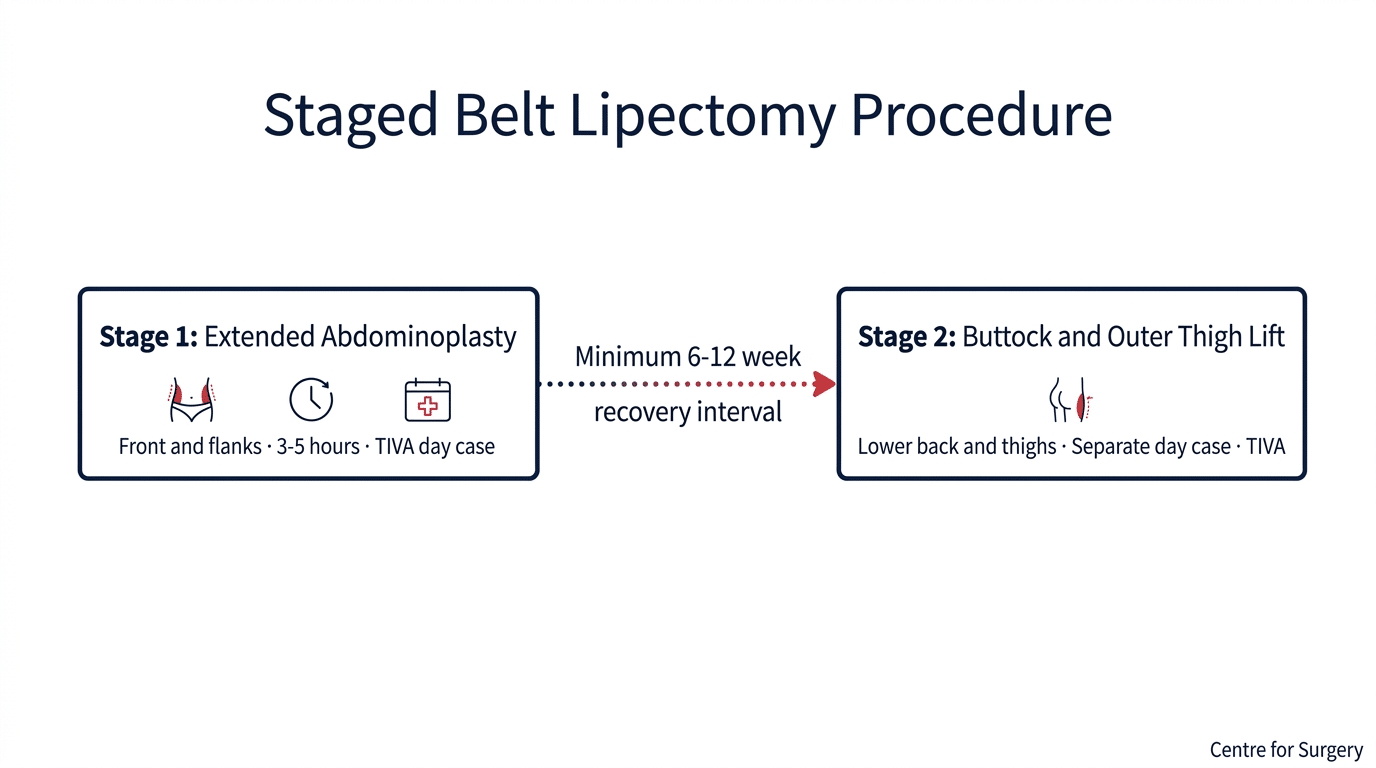
Splitting the procedure shortens each operation and lets you recover from one stage before the next begins, rather than facing the strain of both at once. There is evidence behind this. In a study of 609 patients having body contouring after massive weight loss ↗, seroma and wound separation became more common as more procedures were combined in one operation, while second-stage operations had complication rates similar to first-stage ones.[1]
Stage 1 — Extended Abdominoplasty (Front and Flanks)
With you standing, your surgeon marks the incision line, the extent of planned skin removal at the front and flanks, and the new position for your umbilicus. TIVA is administered by a consultant anaesthetist, and where liposuction is being combined — typically to the flanks, waist, or lower abdomen — this is carried out first. A horizontal incision runs from hip bone to hip bone just above the pubic hairline, extending around toward the flanks. The skin flap is lifted, the umbilicus carefully preserved and later repositioned, and the abdominal muscles repaired where they’ve separated (diastasis recti). Excess skin is removed, the incision closed with dissolvable sutures, and drains placed. This stage typically takes three to five hours.
Stage 2 — Buttock and Outer Thigh Lift (Posterior)
Performed as a separate operation, a minimum of six to twelve weeks after Stage 1. You begin face-down, allowing your surgeon to address the lower back and buttocks through an incision made across the lower back, just above the buttocks. Excess skin from the lower back and upper buttock region is removed, tightening and lifting the buttock contour. You’re then repositioned to address the outer thighs, where skin laxity often extends downward, treated through extensions of the same circumferential incision.
The Interval Between Stages
A gap of at least six to twelve weeks between Stage 1 and Stage 2 gives your body genuine time to heal from the first procedure before undergoing the second. You’re not required to commit to Stage 2 at your first consultation — each stage is discussed, consented, and quoted separately, so you can make that decision once you’ve seen how you recover from the first.
Anaesthesia and Where Belt Lipectomy Surgery Takes Place
Both stages of a belt lipectomy are performed under TIVA (Total Intravenous Anaesthesia) — delivered entirely intravenously without inhaled anaesthetic gases, which usually means a smoother, faster recovery — administered throughout by a consultant anaesthetist. Both sessions are carried out at our CQC-regulated Baker Street facility. Each stage is often a day case, but this isn’t always the case: your surgeon will advise whether an overnight stay is sensible for you, and overnight nursing can be arranged if you are staying locally. You have your surgeon’s direct number for the first 24 hours after each stage.
Recovery After a Belt Lipectomy
The procedure is staged, so you recover from each session in turn rather than from one long combined operation. After Stage 1, a slightly flexed posture for the first one to two weeks is normal as abdominal tension eases; most patients take two to three weeks off desk-based work. After Stage 2, avoiding sitting directly on the buttocks for the first week or two helps healing, with most patients again taking around two weeks off desk-based work. Compression garments are worn continuously for six weeks after each stage, and swelling from each stage settles gradually over three to six months, with the circumferential scar maturing over six to twelve months.
This is only a brief overview — for the full week-by-week recovery timeline, exercise progression, and a much deeper FAQ, see our dedicated guide: Body Lift Recovery and Aftercare.
Belt Lipectomy Cost
A belt lipectomy is staged across two sessions and the extent of skin removal varies considerably between patients, so the cost is priced individually at consultation rather than as a fixed figure — each stage is quoted and consented separately. A belt lipectomy, addressing considerably more tissue across two sessions, is priced above a full or extended tummy tuck (see our tummy tuck cost guide). Your initial consultation is £100, redeemable against the cost of your procedure if you proceed, and finance is available through Chrysalis Finance for amounts over £1,500, subject to status.
Frequently Asked Questions
Is a belt lipectomy the same as a lower body lift?
Broadly, yes — belt lipectomy, lower body lift, circumferential abdominoplasty and 360 abdominoplasty are used interchangeably by surgeons and clinics. Strictly, they describe slightly different techniques. A systematic review of 42 studies found that a belt lipectomy places the back scar at the waistline and corrects rolls over the hips and back better, while a lower body lift sits lower and lifts the buttocks and outer thighs more. Patient satisfaction and quality-of-life scores were high with both.[3] Your surgeon chooses the scar position to suit your anatomy.
Is a belt lipectomy done in one operation or two?
At Centre for Surgery, it’s performed as a staged, two-session procedure — Stage 1 addresses the abdomen and flanks, Stage 2 addresses the buttocks and outer thighs, with a minimum six-to-twelve-week gap between them. This differs from how the procedure is sometimes described elsewhere as a single combined operation; we stage it specifically to reduce operative time per session and lower overall complication risk.
How long do I need to wait between Stage 1 and Stage 2?
A minimum of six to twelve weeks, to allow your body to genuinely heal from the first stage before undergoing the second. Your surgeon will confirm timing based on how your individual recovery is progressing.
What’s the difference between a belt lipectomy and a tummy tuck?
A standard tummy tuck addresses only the front of the abdomen through a single horizontal incision. A belt lipectomy is circumferential — it also treats the flanks, lower back, and buttocks through an incision that runs all the way around the lower torso. It’s the appropriate choice when skin excess is visible from the front, sides, and back, not just the front.
Am I a candidate if I’ve only lost a moderate amount of weight?
Possibly not for a full belt lipectomy specifically. This procedure is designed for genuinely circumferential skin laxity, most commonly seen after substantial or massive weight loss. If your excess skin is confined mainly to the front of your abdomen, a standard or extended tummy tuck may give you an equivalent result through a smaller procedure — your surgeon will advise honestly at consultation rather than recommending a bigger operation than you need.
Does the NHS or private insurance cover belt lipectomy?
Generally no — belt lipectomy is considered a cosmetic procedure. In rare cases where excess skin is causing significant, documented functional problems such as recurrent infection, NHS referral for assessment may be possible via your GP, though NHS criteria are stringent. See our guide on skin removal surgery on the NHS after weight loss for the full eligibility picture.
Will I have a visible scar?
Yes — a belt lipectomy always leaves a permanent circumferential scar, since removing this much tissue requires a correspondingly long incision. The scar is positioned to sit within the underwear and bikini line wherever possible, and while it never disappears completely, it typically matures and fades considerably over six to twelve months.
Can I combine a belt lipectomy with other procedures?
Yes, though because it’s already staged across two sessions, further procedures such as an arm lift or breast surgery are typically planned as additional separate sessions rather than added into Stage 1 or Stage 2, to keep each individual operative time within safe limits. Your surgeon will discuss the safest overall sequencing for your goals.
What are the main risks of a belt lipectomy?
As with any major surgery, risks include infection, bleeding or haematoma, wound healing problems, seroma (fluid accumulation), changes in skin sensation, and the general risks associated with anaesthesia. Wound-healing problems are the most frequent. A 2016 meta-analysis of 28 studies and 1,380 patients ↗ reported wound separation in 17% and seroma in 13% of circumferential lower body procedures, with 5% needing a revision for a complication.[2] Most wound problems are minor and heal with dressings. Following your surgeon’s post-operative guidance closely and attending every follow-up appointment lowers these risks.
How much does a belt lipectomy cost?
Cost is priced individually at consultation, since it depends on the extent of skin laxity and whether liposuction is combined, and each stage is quoted separately. For reference, belt lipectomy is priced above a full or extended tummy tuck, given the additional tissue addressed across two sessions; current tummy tuck prices are in our tummy tuck cost guide.
Is belt lipectomy surgery painful?
Some pain and discomfort at the incision sites is normal after each stage, generally well managed with prescribed pain relief. Most patients describe the first week of each stage as the most uncomfortable, with symptoms easing steadily from there.
How long until I see the final results?
Swelling from each stage takes three to six months to fully resolve, and your circumferential scar continues maturing and fading for six to twelve months. Since the procedure itself spans two stages several weeks apart, the complete final result — from both stages combined — is generally visible around twelve months after Stage 1.
Why Choose Centre for Surgery for Your Belt Lipectomy
Every belt lipectomy at Centre for Surgery is performed by a GMC-registered plastic surgeon at our purpose-built, CQC-regulated Baker Street clinic, rated “Good” overall. We approach belt lipectomy as a staged, two-session procedure specifically to optimise safety, so your surgeon can give you an honest assessment of whether this comprehensive approach genuinely suits your anatomy, or whether a smaller procedure would serve you just as well.
Every package includes a thorough pre-operative consultation for each stage, a recommended two-week cooling-off period, full pre-operative medical assessment, a dedicated patient coordinator throughout, and structured aftercare through your follow-up reviews.
Book Your Consultation
Phone: 020 7993 4849
Email: contact@centreforsurgery.com
Address: 95-97 Baker Street, London W1U 6RN
Your initial consultation is £100, redeemable against the cost of your procedure if you proceed. Finance is available through Chrysalis Finance for amounts over £1,500 — see our Finance Options page for details.
References
- Coon D, Michaels J, Gusenoff JA, et al. Multiple procedures and staging in the massive weight loss population. Plast Reconstr Surg. 2010;125(2):691-698. doi:10.1097/PRS.0b013e3181c87b3c ↗
- Carloni R, Naudet F, Chaput B, et al. Are there factors predictive of postoperative complications in circumferential contouring of the lower trunk? A meta-analysis. Aesthet Surg J. 2016;36(10):1143-1154. doi:10.1093/asj/sjw117 ↗
- Carloni R, De Runz A, Chaput B, et al. Circumferential contouring of the lower trunk: indications, operative techniques, and outcomes — a systematic review. Aesthetic Plast Surg. 2016;40(5):652-668. doi:10.1007/s00266-016-0660-7 ↗







