


In this guide21 sections
- Key Points
- What Is Nostril Reduction Surgery?
- Alarplasty vs Alar Base Reduction vs Nostril Reduction: What Is the Difference?
- Why Do I Have Big Nostrils?
- Am I Suitable for Nostril Surgery?
- What Does Nostril Reduction Surgery Involve?
- Alar Base Reduction Techniques: Wedge, Sill and Combined Excision
- Does Nostril Reduction Leave Scars?
- Does Nostril Reduction Hurt?
- Recovery After Nostril Reduction: How Long Does It Take?
- Nostril Reduction Before and After: What Results Can You Expect?
- Nostril Reduction Risks and Complications
- Does Nostril Reduction Improve Breathing?
- Nostril Reduction vs Rhinoplasty: Can a Nose Job Make Nostrils Smaller?
- Can You Reduce Nostril Size Without Surgery?
- Can Nostril Reduction Be Revised or Reversed?
- Is Nostril Reduction Worth It?
- How Much Does Nostril Reduction Cost in the UK?
- Frequently Asked Questions
- Nostril Reduction in London
- References
Key Points
- What is nostril reduction surgery? A small operation, also called alar base reduction or alarplasty, that narrows the base of the nose by removing a measured amount of skin and soft tissue where the nostril meets the cheek, inside the nostril floor, or both.
- It changes width, not the airway. Nostril reduction is a cosmetic procedure. It is not a treatment for a blocked nose, and over-narrowing can make breathing worse.
- It is usually done under local anaesthetic when carried out alone, or as the final step of a rhinoplasty when the nose is being reshaped more widely.
- There is a scar, placed in the natural crease beside the nostril or inside it. Published case series describe scars that are well hidden in most patients, but no scar disappears completely.
- Recovery is short. Many people return to desk work within about a week, and the final shape settles over several months as swelling resolves.
- Fillers, exercises and taping do not narrow the nostril base. Only surgery changes the actual width, and the evidence for it comes from case series rather than controlled trials.
Nostril reduction is one of the smallest operations on the nose, yet it is surrounded by confusion: is it the same as alarplasty, will it leave a scar, and can it help breathing? This guide explains what nostril reduction surgery is, how the different techniques work, who it suits, what recovery involves and where its limits lie, using published surgical research rather than marketing claims.
If your concern is a nose that looks wide overall, our guides to how to make a wide nose smaller and flared nostrils explain which part of the nose is responsible. If your concern is breathing rather than appearance, read about narrow nostrils and breathing difficulty first, because nostril reduction goes in the opposite direction.
What Is Nostril Reduction Surgery?
Nostril reduction surgery narrows the base of the nose. The surgeon removes a carefully planned amount of skin and soft tissue from the alar base, the area where the flare of the nostril (the ala, or wing of the nose) meets the cheek and the floor of the nostril. Closing the gap draws the nostril wing inwards, so the nose looks narrower from the front and the flare is less pronounced.
The operation is performed through small incisions, either in the fold beside the nostril, on the floor of the nostril (the sill), or both. It can be done on its own, usually under local anaesthetic, or as the last step of a rhinoplasty performed under TIVA. It changes nostril width and flare only. It does not alter the bridge, the tip or the profile, and it is not designed to change how air moves through the nose.
Alarplasty vs Alar Base Reduction vs Nostril Reduction: What Is the Difference?
There is no practical difference. Alarplasty, alar base reduction, alar reduction, nostril reduction, nostril narrowing and nostril base reduction are different names for the same family of operations, and clinics use them interchangeably. Surgeons tend to say alar base reduction or alarplasty, while patients usually search for nostril reduction.
Two neighbouring terms do mean something different. Alar rim correction repositions the edge of the nostril, usually with a cartilage graft, when the rim has been pulled upwards after injury or previous surgery; our guide to alar rim retraction covers it. Nostril base lowering repositions the base of the nostril downwards. Neither makes the nostril narrower, which is the job of nostril reduction.
Why Do I Have Big Nostrils?
Nostril width is mainly inherited. The alar base is made of skin, fibrofatty tissue and the lower lateral cartilage that gives the nostril its shape, and its width varies naturally between individuals and between populations. A study of 100 young adults in Iran, for example, recorded an average alar base width of 37 mm, and its authors noted that many nasal measurements differ from those reported in other groups, which is why surgical planning should take account of each person’s own proportions rather than a single ideal[10].
Other factors can make nostrils look wider than they are. A low or under-projected tip makes the nostrils splay outwards, thick skin and a bulky alar lobule add width, and the tip often drops with age. A wide alar base is a normal anatomical variant, not a defect, and nobody needs surgery because of their background. Surgeons who work across different nose types now describe the alar base in terms of the specific pattern present, such as a wide base, an isolated flare, both together, or a thick base, and plan the operation around that pattern while keeping the natural character of the nose[7]. Our guides to nose shapes and African and Black rhinoplasty show how nostril proportions fit into the wider picture.
Am I Suitable for Nostril Surgery?
Nostril reduction suits adults whose main concern is the width, flare or symmetry of the nostril base, and who are otherwise happy with their nose. Surgeons usually look for the following:
- Concerns limited to the nostril base. If the bridge is wide, the tip is bulbous or there is a hump, nostril reduction alone will not fix it; see nose bridge and nose tip surgery.
- Good general health and stable weight, with no active sinus infection.
- Non-smoking, or willing to stop nicotine for about four weeks before and after surgery, because smoking impairs wound healing.
- No tendency to keloid or thickened scars, which is worth mentioning at consultation.
- Realistic expectations. The change is a refinement of a few millimetres, not a new nose.
A surgeon will also check the inside of the nose. If you have a deviated septum or a weak nasal valve, a narrower nostril base may make those problems more noticeable, so they are assessed first. We recommend a cooling-off period of around two weeks between the consultation and booking.
What Does Nostril Reduction Surgery Involve?
At the start of the operation your surgeon marks the tissue to be removed while you sit upright, because the nostril changes shape when you lie down. The amount is measured to the millimetre, as there is little room for error. Local anaesthetic is injected around the nose. A small segment of tissue is then removed on each side, the edges are brought together with fine stitches, and the nostrils are checked for symmetry.
On its own, nostril reduction usually takes between half an hour and an hour, and most people go home soon afterwards. When it is part of a rhinoplasty, it is normally the final step, because the tip and the base of the nose influence one another and the surgeon wants to judge the width once the rest of the nose has been reshaped[1]. Stitches are either dissolvable or removed at a check-up about a week later.
Alar Base Reduction Techniques: Wedge, Sill and Combined Excision
There is no single technique. The choice depends on what is wide, and the main options are these:
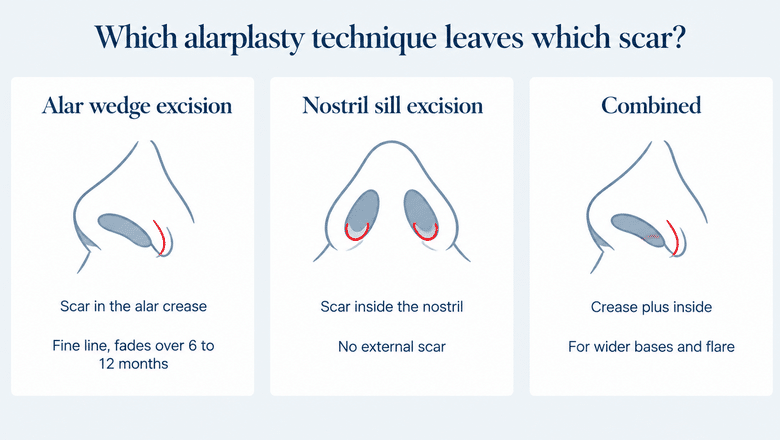
- Alar wedge excision (Weir excision): a wedge of skin is removed from the outer nostril wall where it meets the cheek. This reduces the flare of the nostril wing and leaves a fine scar in the alar crease.
- Nostril sill excision: tissue is removed from the floor of the nostril, through an incision inside the nostril, with no external scar. It narrows the distance between the two nostrils’ outer walls and is the main driver of narrowing in many patients.
- Combined sill and alar excision: both are used together, which is common when both the base and the flare contribute to width.
- Flap and suture techniques: a single advancement flap, internal sutures or alar release are sometimes used alongside or instead of excision to control the shape of the nostril.
What does the research say? A 2007 case series of 60 patients in Archives of Facial Plastic Surgery ↗ combined an external alar wedge with an internal sill excision and followed patients for an average of 32 months. The external wedge averaged 7.2 mm and the sill excision 3.1 mm, and the authors reported no bleeding, infection or keloid, with the external scar well hidden in the alar crease[1]. A later series of 35 patients used a single advancement flap and reported an average narrowing of the alar flap of 6.3 mm[2].
A larger 2026 study of 268 patients in Plastic and Reconstructive Surgery ↗ measured how much tissue was removed against how much narrowing resulted. Sill excision was the dominant factor in narrowing the base, and on average about 3.2 mm of sill removal produced roughly 1 mm of narrowing of the external flare, so surgeons need to remove more than patients might expect to see a small visible change[3]. These are surgeon-reported series without control groups, so they show what is achievable in experienced hands rather than what every patient will get.
Does Nostril Reduction Leave Scars?
Yes, every technique that removes tissue leaves a scar. What differs is where it sits and how visible it becomes. Wedge excision leaves a fine line in the alar crease, the natural fold between nostril and cheek, where light and shadow help to hide it. Sill excision leaves a scar inside the nostril that cannot be seen from the outside.
Placement matters. A 2026 technical report in the Journal of Craniofacial Surgery ↗ noted that conventional excisions placed in front of the alar-facial groove frequently produce conspicuous scars and distorted nostrils, and described an approach with the incision placed exactly in the groove and closed with buried sutures. Most patients in that series rated their scars as imperceptible or nearly so, and none developed hypertrophic scarring[4].
Scars are pink and slightly firm for the first few months, then fade. Sun protection, gentle care and silicone gel when your surgeon advises it all help, and patients with a history of keloid scarring need extra caution. Our dedicated guide answers whether you will have visible scars after alar base reduction in more detail.
Does Nostril Reduction Hurt?
Not during the operation. Local anaesthetic numbs the area, and you may feel pressure or tugging but no pain. Afterwards, discomfort is usually mild and described as tightness or tenderness around the nostrils, and simple painkillers recommended by your surgeon are normally enough. Having both nostrils stitched can make the upper lip and cheek feel stiff for a few days, and sneezing or smiling widely may feel uncomfortable at first.
Recovery After Nostril Reduction: How Long Does It Take?
Recovery is among the shortest in nose surgery, but the healing continues for months. A typical timeline looks like this:
- Days 1 to 3: swelling and tenderness peak. Keep the area clean, avoid pulling or touching the stitches and sleep with your head raised.
- Days 5 to 7: many people are back at desk work. Stitches are removed around this point if they are not dissolvable.
- Weeks 2 to 4: bruising settles and the nostrils look much more natural. Your surgeon will advise when to resume exercise, which is usually gentle activity first and strenuous exercise and swimming later.
- Months 3 to 6: the scar moves from pink towards pale and the last swelling fades.
- Months 6 to 12: the final shape is clear.
If nostril reduction is part of a rhinoplasty, recovery follows the longer timeline of the rhinoplasty. Our detailed guide covers how long alarplasty takes to heal, week by week. Follow your surgeon’s instructions on smoking, aspirin and ibuprofen, alcohol and sun exposure, as these affect bruising and scarring.
Nostril Reduction Before and After: What Results Can You Expect?
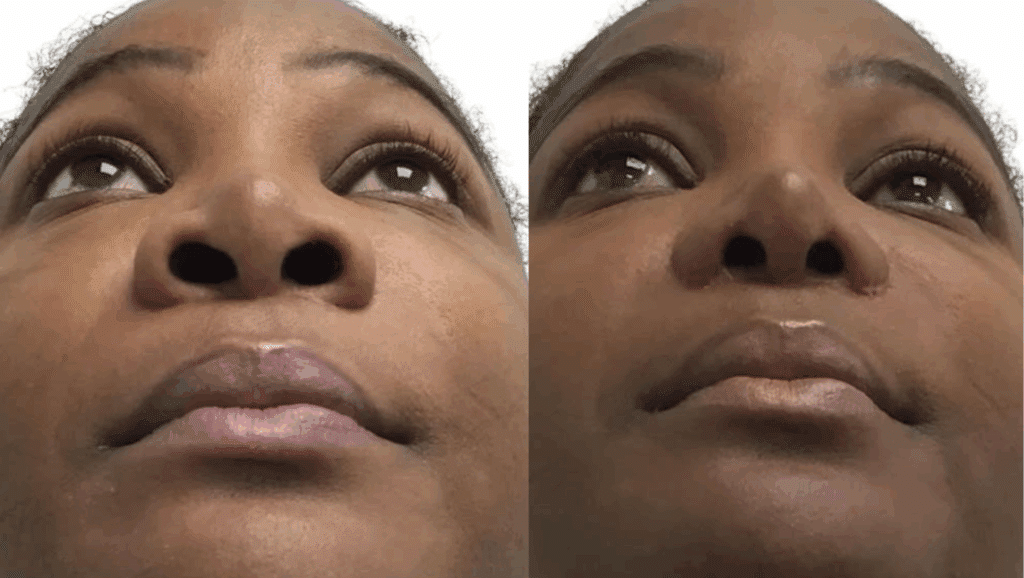
Expect a subtle change. The nostril base becomes a few millimetres narrower, the flare is less obvious from the front and the two sides are usually more even. The nose itself does not shrink, and the face looks more balanced rather than different.
The patient-reported evidence is encouraging but should be read with care. In the 268-patient series above, the proportion of patients who were extremely dissatisfied with the width of their nasal base fell from 66.1% before surgery to 4.3% afterwards, and satisfaction with the nostrils on a validated scale rose significantly[3]. Another review of 423 patients treated with a staged resection technique reported high satisfaction and no complication specific to the technique[5]. Both are retrospective series from specialist centres, so results in your own case will depend on your anatomy, skin thickness and healing. When you view before and after photographs, check that the lighting, angle and expression are matched, because small differences in any of them can change how wide a nostril appears. See also our guide to how to make your nose smaller for what each procedure can and cannot achieve.
Nostril Reduction Risks and Complications
As with any surgery, risks include bleeding, infection, wound-healing problems and an adverse reaction to anaesthetic. The risks particular to nostril reduction are these:
- Visible or widened scarring, including thickened scars, more likely in people prone to keloids.
- Asymmetry. The two sides rarely heal identically, and small differences can persist.
- Under-correction. Too little tissue removed gives too little change, which is a common reason for dissatisfaction[3].
- Over-correction, notching or distortion. Removing too much, or taking tissue from inside the nostril opening, can leave pinched nostrils, a notch in the nostril rim or a blunted crease. Surgeons use a two-layer closure of the nostril floor to reduce notching[1].
- Narrowing of the nostril opening, which can affect airflow. One report on alar release found a partial airway obstruction in one of twelve patients[8].
- Recurrence. Some techniques that rely on sutures alone can loosen with time, which is why excision remains the mainstay[8].
In one comparison of 927 rhinoplasty patients, minor asymmetry occurred in 4.2% and revision surgery in 3.1% of those treated using a landmark-guided technique, against 8% and 7% with ruler-based planning[6]. Those figures come from a single series and should not be treated as a general rate, but they show that careful planning matters and that a small proportion of patients do need a touch-up.
Does Nostril Reduction Improve Breathing?
No, and it would be misleading to suggest that it does. Alar base reduction is a cosmetic operation on the outside of the nose. The structures that usually cause a blocked nose, the septum, the turbinates and the internal and external nasal valves, lie further inside and are not treated by narrowing the nostril base. Wide nostrils are, if anything, mechanically good for airflow.
It can go the other way. Taking too much tissue, or cutting into the nostril opening, can reduce the space for air or weaken the sidewall of the nose. Where breathing is the problem, the right first step is an assessment of the airway: see our guides to narrow nostrils and breathing and the causes of a collapsed nostril. Nostril reduction can be combined with airway surgery, but it should not be presented as part of the solution to nasal obstruction.
Nostril Reduction vs Rhinoplasty: Can a Nose Job Make Nostrils Smaller?
Often, but not by itself. Rhinoplasty reshapes the bone and cartilage of the bridge and tip. Changing the tip can alter how the nostrils sit, yet it does not remove tissue from the alar base, so wide nostrils usually need alar base reduction in addition. That is why the two are so often combined, and why rhinoplasty surgeons commonly treat the nostril base last. Our overview of the different types of rhinoplasty shows where each fits.
In practice the choice looks like this:
- Nostril width or flare is the only concern: nostril reduction alone is usually enough.
- A hump, wide bridge or bulbous tip is also present: rhinoplasty, with or without nostril reduction.
- The nostrils look wide because the tip is low: raising the tip may help more than narrowing the base.
What looks like a wide nostril is sometimes a tip issue, which is why a full nasal assessment comes before any decision.
Can You Reduce Nostril Size Without Surgery?
Not permanently. Exercises, nose clips and taping do not change the cartilage and skin that form the nostril base. Make-up contouring can narrow the nostrils in photographs, and some people find it enough.
Dermal filler is sometimes suggested as a non-surgical nostril reduction. It does not narrow the nostrils themselves. When a tip is low, filler can add projection so that the nostrils appear less prominent, but the effect is temporary and the actual width does not change. Our comparison of non-surgical and surgical rhinoplasty sets out what filler can and cannot do. Only alar base reduction changes the real width of the nostril base.
Can Nostril Reduction Be Revised or Reversed?
Tissue that has been removed cannot be put back, so the aim is always to be conservative, because it is easier to take a little more later than to restore what has gone. Under-correction can often be revised with a small further excision once the nose has healed, usually after several months. Notching, pinching and rim retraction are more complex and may need cartilage grafts; see our guide to alar rim retraction.
Residual asymmetry can sometimes be improved with additional techniques, such as a fine suture to adjust the shape of the nostril. In one series of 32 primary and revision patients, such a suture was used for refinement, and one patient needed a further adjustment when it loosened early[9]. If you are unhappy with a previous result, a specialist assessment is the first step, and uneven nostrils have their own guide in why one nostril is bigger than the other.
Is Nostril Reduction Worth It?
For the right person, the published evidence suggests it is. Patients who are bothered mainly by nostril width or flare, who understand that the change is subtle and who are prepared for a permanent scar tend to report high satisfaction[3][5]. It is not worthwhile if the real issue is the tip, the bridge or breathing, or if the hope is for a dramatic change. The most useful test is whether the nostrils bother you in photographs and mirrors enough that you would accept a scar to change them, and a consultation helps you answer that without pressure.
How Much Does Nostril Reduction Cost in the UK?
The cost depends on whether the operation is done alone under local anaesthetic or as part of a rhinoplasty, on the anaesthetic used, the facility and the follow-up included. A written quote is given after an in-person consultation, so you know what is covered. Be cautious about unusually low prices, and always ask who will carry out the operation, where, and what aftercare is provided if you need a review or a revision. Our rhinoplasty cost guide explains how nose surgery is priced.
Frequently Asked Questions
What is the difference between nostril reduction and alarplasty?
None in practice. Nostril reduction, alarplasty and alar base reduction describe the same operation, which narrows the base of the nose by removing tissue where the nostril meets the cheek, inside the nostril floor, or both.
Can you make your nostrils smaller?
Yes, with surgery. Alar base reduction removes tissue to narrow the nostril base by a few millimetres. Exercises, taping and make-up do not permanently change nostril size, and fillers only change how prominent the nostrils look.
Does nostril reduction leave a scar?
Yes. The scar sits in the fold beside the nostril, inside the nostril, or both, depending on the technique. Studies describe well-hidden scars in most patients, but a scar will always be present and can be more visible in people prone to thickened scarring.
Can a nose job make nostrils smaller?
Rhinoplasty alone does not remove tissue from the nostril base, so it does not reliably narrow wide nostrils. Surgeons usually add alar base reduction, often as the final step of the same operation, when narrower nostrils are part of the goal.
Is nostril reduction permanent?
The tissue removed does not grow back, and series report stable results over follow-up periods of around two to three years. The nose still changes with ageing and weight, so the result is long-lasting rather than frozen in time.
How long does nostril reduction surgery take?
When done on its own it usually takes between 30 minutes and an hour, followed by a short period of observation before you go home. As part of a rhinoplasty it adds a little time to a longer operation.
Will nostril reduction make my nose look smaller?
It makes the base of the nose look narrower and less flared, which can make the whole nose look more balanced. It does not shorten the nose or change the bridge or tip, so a bigger change needs rhinoplasty.
Does nostril reduction change your breathing?
It is not designed to, and it does not treat a blocked nose. If too much tissue is removed it can narrow the nostril opening and make breathing harder, which is why the airway is assessed before surgery.
Nostril Reduction in London
If you are considering nostril reduction or alarplasty, a consultation with a plastic surgeon will establish whether your nostrils, your tip or your airway are the real issue, and what a realistic change looks like. Find out more about alar base reduction at Centre for Surgery.
Phone: 020 7993 4849 | Address: 95–97 Baker Street, Marylebone, London W1U 6RN
Contact us to schedule a consultation
References
- Foda HM. Nasal base narrowing: the combined alar base excision technique. Archives of Facial Plastic Surgery 2007;9(1):30–34. doi:10.1001/archfaci.9.1.30 ↗
- Ismail AS. Nasal base narrowing: the alar flap advancement technique. Otolaryngology–Head and Neck Surgery 2011;144(1):48–52. doi:10.1177/0194599810390891 ↗
- Chen J, Zhang F, Li C, et al. Quantitative analysis of tissue excision and alar base reduction in combined sill and alar excision. Plastic and Reconstructive Surgery 2026. doi:10.1097/PRS.0000000000012872 ↗
- Yu BF, Wei J, Dai CC. Modified technique for simultaneous alar base narrowing and nostril reduction in Asian rhinoplasty. Journal of Craniofacial Surgery 2026. doi:10.1097/SCS.0000000000013158 ↗
- Pozzi M, Susini P, Losco L, et al. Sequential alar base resection in primary and secondary rhinoplasty. Plastic and Reconstructive Surgery 2026. doi:10.1097/PRS.0000000000013363 ↗
- Mahmood BJ. The balanced aesthetic yielding of alar design (BAYAD) technique: a rulerless, visual landmark guided approach for alar base reduction in rhinoplasty cases. Journal of Plastic, Reconstructive & Aesthetic Surgery 2026;114:266–272. doi:10.1016/j.bjps.2026.01.031 ↗
- Alp A, Ozbay I. Refined classification and surgical techniques for alar base reduction in rhinoplasty: a stepwise approach for optimal aesthetic outcomes. American Journal of Otolaryngology 2026;47(6):104954. doi:10.1016/j.amjoto.2026.104954 ↗
- Gruber RP, Freeman MB, Hsu C, Elyassnia D, Reddy V. Nasal base reduction: a treatment algorithm including alar release with medialization. Plastic and Reconstructive Surgery 2009;123(2):716–725. doi:10.1097/01.prs.0000345598.95343.63 ↗
- Soylu E, Yenigun A, Aksoy F, Ozturan O. X suture technique for alar base contouring and nostril symmetry in rhinoplasty. Journal of Craniofacial Surgery 2026. doi:10.1097/SCS.0000000000013046 ↗
- Fariaby J, Hossini A, Saffari E. Photographic analysis of faces of 20-year-old students in Iran. British Journal of Oral and Maxillofacial Surgery 2005;44(5):393–396. doi:10.1016/j.bjoms.2005.07.029 ↗