

In this guide15 sections
- Key Points
- Does Alarplasty Leave Visible Scars?
- Where Is the Alarplasty Scar?
- What Do Alarplasty Scars Look Like at Each Stage?
- Alarplasty Before and After: What Do Healed Scars Look Like?
- What Affects How Visible an Alarplasty Scar Is?
- How Can I Minimise Alarplasty Scars?
- Can Alarplasty Scars Be Removed or Treated?
- Is There an Alarplasty Without Visible Scars?
- What Other Problems Can Follow Alarplasty Besides Scarring?
- Do Scars Change If Alarplasty Is Combined With Rhinoplasty?
- What Happens at an Alarplasty Consultation in London?
- Frequently Asked Questions
- Alarplasty in London
- References
Key Points
- Will I have visible scars after alar base reduction? Usually only a fine one. An external incision leaves a small scar in the natural crease where the nostril meets the cheek, and an incision inside the nostril leaves no outer scar at all.
- The alarplasty scar changes over a year. It is pink and slightly firm for the first 3 to 6 months, then softens and fades. Most people see a fine, pale line by 6 to 12 months.
- Which technique you have decides where the scar sits: alar wedge excision (crease), nostril sill excision (inside the nostril) or a combination of the two.
- Your risk is not the same as everyone else’s. Darker skin, a personal or family history of keloid or thickened scars, smoking and sun exposure all raise the chance of a more visible scar.
- You can influence the result. Silicone gel or tape from week 2, SPF 30 or higher every day for a year, and no nicotine around surgery are the steps with the strongest evidence behind them.
- A scar that heals badly can be treated. Options exist for raised, red or widened scars, and your surgeon reviews your scar at one week and again at six weeks.
Scars are the first thing most people ask about before alar base reduction, and it is a fair question, because the operation is done on the most visible part of the face. Alarplasty, also called nostril reduction surgery, narrows wide or flared nostrils by removing a small piece of skin and soft tissue at the base of the nose. It always involves an incision, so an alarplasty scar is part of the trade, but where the incision sits, and how well it heals, is what decides whether anyone ever notices it.
This guide covers what an alarplasty scar looks like, where each technique places it, how it changes from the first week to the first year, what raises the risk of a poor scar and what can be done about one. If you want the week-by-week recovery instead, our companion guide to how long alarplasty takes to heal covers swelling, stitches and restrictions, and our guides to nostril reduction and flared nostrils explain who the operation suits.
Does Alarplasty Leave Visible Scars?
Alarplasty leaves a scar, but in most people it is small, pale and hard to spot. The incisions are placed where the skin already folds or where nobody can see them, which is the main reason the operation is considered a low-profile one.
The main published evidence is reassuring without being a promise. In a 2007 case series of 60 patients in Archives of Facial Plastic Surgery ↗, the external wedge incision healed with an inconspicuous scar hidden in the depth of the alar-facial crease, and no keloid scars formed during follow-up that averaged 32 months[2]. That matches what we see, but it does not mean every scar behaves the same. A small number of people develop a scar that stays pink, raised or slightly wider than expected, and the later sections explain who is more likely to and what happens next.
Where Is the Alarplasty Scar?
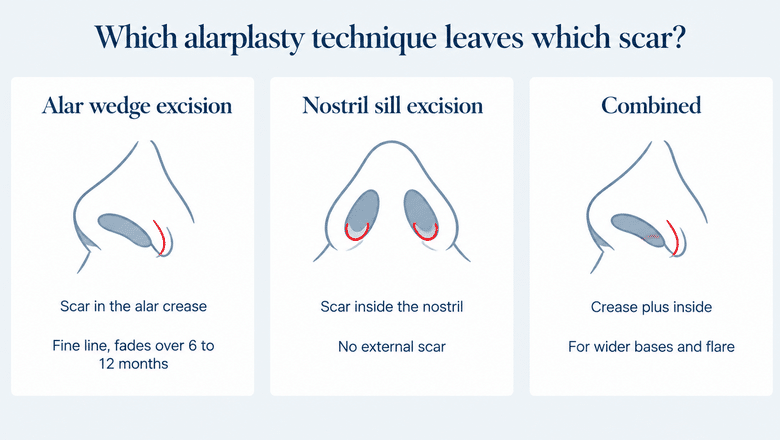
Three basic ways of narrowing the alar base are described in a 2022 review in Clinics in Plastic Surgery ↗: an alar wedge excision, a nostril sill excision and a combination of the two[1]. Each leaves the scar in a different place, which is why your surgeon chooses the technique from your anatomy before anything else.
Alar wedge excision: the scar in the nostril crease
A small wedge of skin is removed from the crease where the nostril wing meets the cheek, and the edges are stitched together. This is the technique used to reduce flare, and it leaves a fine scar, usually only a few millimetres long, tucked into the natural groove. When the nostril is viewed from the front, the scar sits in a shadowed fold, which is why it is so well hidden.
Nostril sill excision: no scar on the outside
For a wide nasal base without much flare, tissue is removed from the floor of the nostril, inside the nostril where it meets the upper lip. The scar is internal, so nothing shows on the skin. The limit is that it narrows the base but does not reduce flaring much, so it suits a narrower set of problems.
Combined excision: two scars, one inside and one in the crease
When the base is wide and the nostrils also flare, both are used together. The Foda series described above used this approach and reported that doing the inside excision first allowed a more conservative outside one, which protected the crease from blunting[2].
What Do Alarplasty Scars Look Like at Each Stage?
A scar looks worst before it looks good, and knowing that stops most of the unnecessary worry. A 2024 study of 20 patients in the Journal of Craniofacial Surgery ↗ scored external alar reduction scars over time: at 3 months the scars were assessed as raised and thickened, but by 12 months scarring was insignificant and had improved markedly[3]. A pink, firm line at 3 months is therefore a normal stage, not a failure.
The first week: what do fresh alarplasty scars look like?
The incision is a thin, red line with fine stitches, with some swelling and bruising around the nostril and upper lip. At Centre for Surgery the stitches are dissolvable, so none need removing, and your wound is checked at about one week.
Weeks 2 to 6: pink and sealed
Once the incision has sealed, the line is pink and may feel slightly ridged. This is when scar care begins, and swelling is mostly settled by two to three weeks. Your surgeon reviews the nose at six weeks.
Months 3 to 6: firm and at its most noticeable
This is the stage people often panic about. The scar can be pink or slightly darker than the surrounding skin, slightly raised and firm to touch, as collagen is still being laid down. Sun exposure at this point can darken it further.
Months 6 to 12: fading and flattening
The scar softens, flattens and fades towards the colour of your skin, and most people are left with a fine, pale line that is hard to see at conversation distance. Some small differences, such as a slightly lighter or darker line, can continue for longer.
Alarplasty Before and After: What Do Healed Scars Look Like?
The photographs below show alar base reduction results from the base view at Centre for Surgery. They show the change in nostril width; scars are fine lines in the crease and are easier to judge in person at your consultation. You can see more in our nose surgery before and after photos.


What Affects How Visible an Alarplasty Scar Is?
Two people can have the same operation and heal differently. The factors below matter most, and most of them are discussed at consultation.
- Where the incision is placed. A cut within the natural alar-facial groove, closed in layers and without tension, heals more finely than one that strays onto the flat skin of the cheek or nostril wing.
- How much is removed. Taking out too much tissue pulls the nostril and tightens the wound, which widens the scar and can distort the nostril shape. A conservative plan is safer and easier to add to than to undo.
- Your skin and scarring history. See the next section.
- Smoking and nicotine. A 2012 systematic review and meta-analysis in Archives of Surgery ↗ pooled 140 studies and nearly 480,000 patients and found that smokers had about twice the odds of delayed healing or wound separation as non-smokers[8]. On a facial scar, that matters.
- Sun, infection and picking. Early sun exposure darkens a young scar, and an infected or picked wound heals with a wider, more visible scar.
Does skin tone or ethnicity affect alarplasty scars?
Yes. Keloid scarring, where a scar grows beyond the original wound, is more common in people of African, Asian and Hispanic descent, according to a 2014 review of scarring disorders in skin of colour in the American Journal of Clinical Dermatology ↗[9]. Darker skin can also develop a lighter or darker line after healing, called dyspigmentation. Alarplasty is a common operation in several of these groups, and a fine crease scar in darker skin often fades well, but the risk is real and is covered at consultation. Our guide to ethnic rhinoplasty explains how surgeons plan around different skin types.
Can I have alarplasty if I am prone to keloid scars?
Not automatically ruled out, but it needs an honest discussion. If you have ever had a keloid or thickened scar after a piercing, an injury or an operation, tell your surgeon. A nostril sill excision, which leaves no scar on the skin, may be a safer option than an external wedge, or surgery may be advised against. Our guide to hypertrophic scars and the overview of types of scars explain the difference between thickened and keloid scars.
How Can I Minimise Alarplasty Scars?
There is no way to guarantee a scar-free result, but the steps below have good evidence behind them. International guidelines from a group of 24 scar experts recommend avoiding sun exposure, keeping the wound hydrated and using silicone, and note that these measures apply from before surgery onwards[4]. Our general guides on how to minimise scars after cosmetic surgery and scar management cover the principles in more depth.

Which scar cream or gel helps after alarplasty?
Silicone gel or tape is the standard first-line choice. The guidelines call silicone the gold-standard, first-line option for preventing and treating scars[5], and a 2020 meta-analysis of six randomised trials in the International Wound Journal ↗ found that topical silicone gel significantly reduced scar pigmentation and height and improved pliability after surgery[7]. The trials were small and silicone does not erase a scar, but it is low-risk. At Centre for Surgery it is started from around week 2, once the incision has sealed, and our guide to silicone strips explains how to use them.
Do I need sun protection on an alarplasty scar?
Yes. Wear SPF 30 or higher on the scar every day for at least 12 months, and keep a young scar out of direct sun. Ultraviolet light can darken a fresh scar, and a nose is one of the most sun-exposed parts of the face. Our guide to the effects of tanning on cosmetic surgery scars explains why.
Should I stop smoking before alarplasty?
Yes, and it is one of the most effective things you control. We ask you to stop smoking, vaping and all nicotine 4 weeks before surgery and stay stopped for 4 weeks after, because nicotine narrows the blood vessels that feed the healing skin. Our guide to preparing for cosmetic surgery lists what else to stop, including aspirin, ibuprofen and some supplements, before your operation.
What should I avoid doing to the scar?
Do not pick scabs or crusts, do not apply creams or makeup to the incision until your surgeon agrees at the one-week check, and avoid blowing your nose for two weeks and wearing glasses for four weeks, since both can strain the healing skin.
Can Alarplasty Scars Be Removed or Treated?
A scar cannot be removed completely, but most can be improved. Treatment depends on whether the problem is colour, thickness or width, and your surgeon will assess it first. The guidelines recommend regular re-evaluation every four to eight weeks to decide whether more treatment is needed[5].
What if my alarplasty scar is red, raised or itchy?
Persistent redness, thickness or itching at 3 to 6 months is the usual sign of a scar that is maturing slowly. Most settle with continued silicone and sun protection. If a scar is still raised and symptomatic, speak to your surgeon rather than waiting, because earlier treatment works better.
What treatments exist for a scar that heals badly?
For raised, keloid or hypertrophic scars, options described in the international guidelines include steroid injections, 5-fluorouracil, cryotherapy and laser therapy, often used in combination[4]. A review in Dermatologic Surgery noted that laser therapy has moved to the forefront of scar treatment over the last decade, and that combining treatments tends to improve outcomes[6]. In darker skin, some of these treatments carry a risk of changing the skin colour[9], so they are chosen carefully. Your surgeon will advise which, if any, suit your scar and arrange them or refer you.
Can an alarplasty scar be revised surgically?
Sometimes, once the scar has fully matured, usually after 12 months. Revision removes the old scar and re-closes the wound, but it cannot guarantee a better scar and the nostril has less tissue to work with the second time. See our guides to revision rhinoplasty and what happens if you are not happy with your results.
Is There an Alarplasty Without Visible Scars?
Sometimes. A nostril sill excision, made entirely inside the nostril, leaves no scar on the skin. It suits people whose main concern is a wide nasal base rather than flared nostrils, and the amount of narrowing it can achieve is limited. If your nostrils flare outwards, a crease incision is usually needed to reduce that flare, and the aim then is a scar so fine it does not draw the eye. A good surgeon will tell you honestly which of these your nose needs, rather than choosing the approach that sounds more appealing on paper.
What Other Problems Can Follow Alarplasty Besides Scarring?
Scarring is the most common concern, but not the only one. Our alarplasty service page lists the main risks as asymmetry between the two sides, under-correction, and over-correction, where the nostrils are narrowed too far or lose their natural curve. Removed tissue cannot be put back, which is why a conservative plan matters. Infection, bleeding and wound separation are uncommon, and numbness at the nostril base usually settles within two to three months. A nostril rim that pulls upwards is a separate problem, covered in our guide to alar rim retraction, and if one nostril looks bigger than the other, see why that happens.
Do Scars Change If Alarplasty Is Combined With Rhinoplasty?
The alarplasty scar itself is the same, but there may be other scars. Alarplasty is often combined with tip rhinoplasty or full rhinoplasty, and an open approach adds a small scar across the central strip between the nostrils, which also heals well in most people. If your breathing needs attention, septoplasty is done through incisions inside the nose with no external scar. Recovery follows the larger operation, as described in our rhinoplasty recovery and aftercare guide.
What Happens at an Alarplasty Consultation in London?
At your consultation at our CQC-regulated hospital on Baker Street, the GMC-registered surgeon who assesses you is the surgeon who operates. They measure your nostril width against your facial proportions, choose between a wedge excision, a sill excision or both, ask about your skin type, keloid history and smoking, and show you where the scar would sit. Local anaesthetic, with or without sedation, is usual for alarplasty on its own. You leave with a written plan, and we recommend a two-week cooling-off period after consent. Costs are confirmed at consultation, and finance options are available subject to status. Read our guide on whether your rhinoplasty expectations are realistic before you book, and find out about Centre for Surgery here.
Frequently Asked Questions
Does alarplasty leave scars?
Yes, but they are small. A wedge excision leaves a fine scar in the crease where the nostril meets the cheek, and a sill excision inside the nostril leaves none on the skin. Most scars fade to a pale line over 6 to 12 months.
Are alarplasty scars permanent?
Yes, any incision leaves a permanent scar, but it fades. In the 2007 series of 60 patients, the external scar healed inconspicuously in the alar-facial crease[2]. Permanent does not mean visible: in most people the line becomes pale, flat and hard to see.
How long do alarplasty scars take to fade?
Expect pink and slightly firm for the first 3 to 6 months, then gradual softening and fading until 6 to 12 months. A small number of people carry on changing for longer. Using silicone and SPF throughout helps the scar settle.
Is scarring normal after nose surgery?
Some scarring is normal, but where it shows depends on the approach. Closed rhinoplasty and septoplasty leave no outer scar, open rhinoplasty leaves a small one between the nostrils, and alarplasty leaves one in the nostril crease unless a sill excision alone is used.
Can alarplasty scars be removed?
Not completely, but many can be improved. Silicone and sun protection come first, and for raised or widened scars, options such as steroid injections, laser and scar revision exist. Your surgeon assesses the scar after it has had time to mature before recommending any of these.
Is alarplasty noticeable?
The change to the nostrils is clear but subtle, and the scar is usually hardest to see once it has faded. Alarplasty narrows the nostrils without changing the bridge, tip or profile, so most people say their nose looks more balanced rather than different.
Can alarplasty be reversed?
No. Tissue removed from the nostril base cannot be put back, so the narrower shape is permanent. Revision is possible but harder, with less tissue to work with and a higher risk of a visible scar, which is why conservative surgery and an unhurried decision make sense.
How risky is alarplasty?
It is a small operation on soft tissue, but still surgery. The main risks are a visible scar, asymmetry, under-correction and over-correction. Infection, bleeding and wound separation are uncommon, and numbness at the nostril base usually settles within two to three months.
Alarplasty in London
If scars are the thing holding you back, a consultation lets you see where the incision would sit, discuss your skin type and scarring history, and decide whether alarplasty is right for you. Find out more about alarplasty at Centre for Surgery.
Phone: 020 7993 4849 | Address: 95–97 Baker Street, Marylebone, London W1U 6RN
Contact us to schedule a consultation
References
- Cerkes N. Alar base reduction: nuances and techniques. Clinics in Plastic Surgery 2022;49(1):161–178. doi:10.1016/j.cps.2021.08.007 ↗
- Foda HMT. Nasal base narrowing: the combined alar base excision technique. Archives of Facial Plastic Surgery 2007;9(1):30–34. doi:10.1001/archfaci.9.1.30 ↗
- Yang J, Dai CC, Yu BF. Three-part analysis for designing nasal alar reduction surgery in Asian patients. Journal of Craniofacial Surgery 2025;36(3):952–955 (published online 2024). doi:10.1097/SCS.0000000000010701 ↗
- Monstrey S, Middelkoop E, Vranckx JJ, et al. Updated scar management practical guidelines: non-invasive and invasive measures. Journal of Plastic, Reconstructive & Aesthetic Surgery 2014;67(8):1017–1025. doi:10.1016/j.bjps.2014.04.011 ↗
- Meaume S, Le Pillouer-Prost A, Richert B, Roseeuw D, Vadoud J. Management of scars: updated practical guidelines and use of silicones. European Journal of Dermatology 2014;24(4):435–443. doi:10.1684/ejd.2014.2356 ↗
- Gold MH, Berman B, Clementoni MT, Gauglitz GG, Nahai F, Murcia C. Updated international clinical recommendations on scar management: part 1, evaluating the evidence. Dermatologic Surgery 2014;40(8):817–824. doi:10.1111/dsu.0000000000000049 ↗
- Wang F, Li X, Wang X, Jiang X. Efficacy of topical silicone gel in scar management: a systematic review and meta-analysis of randomised controlled trials. International Wound Journal 2020;17(3):765–773. doi:10.1111/iwj.13337 ↗
- Sørensen LT. Wound healing and infection in surgery: the clinical impact of smoking and smoking cessation. A systematic review and meta-analysis. Archives of Surgery 2012;147(4):373–383. doi:10.1001/archsurg.2012.5 ↗
- Madu P, Kundu RV. Follicular and scarring disorders in skin of color: presentation and management. American Journal of Clinical Dermatology 2014;15(4):307–321. doi:10.1007/s40257-014-0072-x ↗