


In this guide10 sections
- Key Points
- Will My Skin Tighten After Gynecomastia Surgery?
- What Decides Whether Skin Tightens?
- How Long Does It Take for Skin to Tighten After Gyno Surgery?
- Loose Skin, Swelling or Leftover Tissue?
- How Is Loose Skin After Gynecomastia Surgery Treated?
- Can You Prevent Loose Skin After Gyno Surgery?
- Frequently Asked Questions
- Gynecomastia Surgery at Centre for Surgery
- References
Key Points
- Most men do not get loose skin after gynecomastia surgery. In mild to moderate gyno, the skin usually shrinks back to the new chest shape over the following months.
- Whether the skin tightens depends on three things: how large the chest was, how elastic the skin is, and whether the chest already sagged before surgery.
- Skin keeps tightening for six to twelve months. Swelling in the first few months can look like loose skin, so the final result is judged later.
- Large weight loss, older age, smoking and a low nipple position all make loose skin more likely.
- When excess skin is expected, it can be removed at the same operation. When it is borderline, many surgeons wait to see how much the skin tightens before removing any.
- An honest skin assessment at consultation helps avoid surprises.
A question many men ask before gynecomastia surgery is whether they will be left with loose, saggy skin once the tissue is removed. For most men the answer is no. Skin is elastic, and once the gland and fat stretching it have gone, it gradually shrinks back. It does not always, though, and knowing in advance whether your skin is likely to tighten changes how the operation is planned.
This guide explains when skin tightens after gyno surgery and when it does not, how long it takes, how loose skin is treated, and what you can do to give your skin a good chance.
Will My Skin Tighten After Gynecomastia Surgery?
In most cases, yes. Surgeons have graded gynecomastia by size and skin excess since the 1970s. In the original Simon classification, grades I and IIa have no excess skin, while grades IIb and III have increasing amounts of loose skin.[1] Men with no excess skin before surgery rarely have a problem with it afterwards: once the gland and fat are removed, the skin retracts to fit the flatter chest.[2]
As the chest gets larger and the skin more stretched, retraction becomes less reliable. A review of surgical trends noted that liposuction techniques, including power-assisted and ultrasound-assisted liposuction, are limited where there is marked skin excess and drooping, and that these cases usually need some skin removed.[3] Our guide to the grades of gynecomastia explains what each grade looks like.
What Decides Whether Skin Tightens?
How large the chest was
The more tissue there was, the more the skin has been stretched and the more it has to shrink. Small and moderate amounts of gland and fat usually leave skin that retracts well. A large chest, particularly one that has been large for many years, leaves more skin than the new shape needs.
Skin elasticity
Skin elasticity is highest when you are young and falls with age. Sun damage, smoking and repeated weight gain and loss all reduce it further, as does genetics. Two men with the same size chest can have very different results for this reason. Your surgeon will assess it by pinching and stretching the skin at consultation and seeing how quickly it springs back.
Sagging before surgery
If the nipple already sits at or below the crease under the chest, the skin has stretched downwards as well as outwards. Removing tissue reduces the volume but does not lift the skin, so the chest can look flatter but still droop. This is a strong sign that skin removal is likely to be needed.[3]
Weight loss
Men who have lost a lot of weight, through diet, weight-loss medicines or bariatric surgery, often have chest fullness that is mostly loose skin and residual fat rather than gland. This is usually called pseudogynecomastia. In a study of men treated after massive weight loss, most needed skin removal and repositioning of the nipple, and patient satisfaction was high.[4]
How Long Does It Take for Skin to Tighten After Gyno Surgery?
Skin tightening is gradual. Most of the visible change happens in the first three months as swelling settles, but the skin carries on contracting for six to twelve months. In the early weeks, swelling and fluid can make the chest look soft or slightly baggy, which men sometimes mistake for loose skin. Wearing your compression vest as instructed, usually for about six weeks, helps the skin settle onto the new contour.
For this reason, the final result of gynecomastia surgery is usually judged at three to six months, and any decision about further skin tightening is normally left until at least six months. Our gynecomastia recovery guide sets out what to expect at each stage.
Loose Skin, Swelling or Leftover Tissue?
A chest that does not look flat after surgery is not always loose skin. In the first few months the common causes are:
- Swelling: soft, sometimes firm or lumpy, worse at the end of the day and improving week by week.
- Fluid collection: a soft swelling that may slosh or feel tight, which should be checked by your surgical team.
- Remaining gland or fat: a firm area that stays the same once swelling has settled.
- Loose skin: thin, soft skin that folds or creases, especially when you lean forward, with no firmness underneath.
Your surgeon can tell these apart at your follow-up appointments. If too much tissue is taken from behind the nipple, the area can sink inwards instead, which is a different problem explained in our guide to crater deformity after gynecomastia surgery.
How Is Loose Skin After Gynecomastia Surgery Treated?
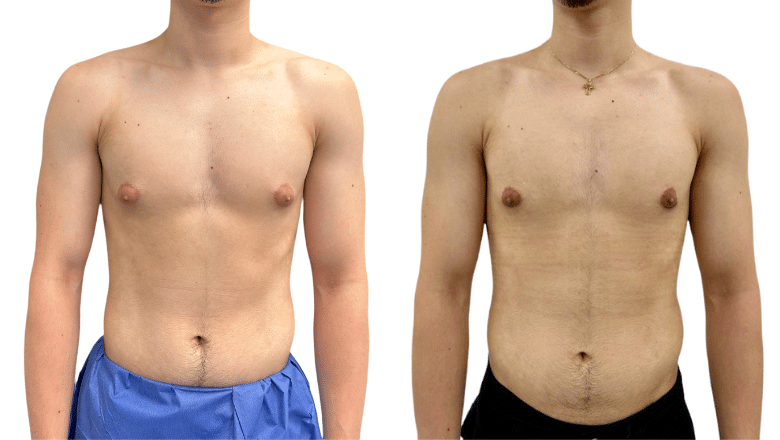
Treatment depends on how much skin there is and where it sits.
Waiting
For mild looseness, the first option is time. Skin often continues to improve for up to a year, and many men who are worried at six weeks are happy at six months.
Skin tightening alongside liposuction
Some clinics use energy-based devices during liposuction to heat the tissue under the skin and encourage it to contract. At Centre for Surgery, BodyTite radiofrequency-assisted liposuction may be suggested for selected men with mild to moderate laxity. It does not replace skin removal where there is a significant excess.
Skin reduction around the areola
A small amount of excess skin can be removed in a ring around the areola, leaving a scar at its edge. This can also reduce a stretched, enlarged areola at the same time; see our page on areola reduction.
Skin removal with nipple repositioning
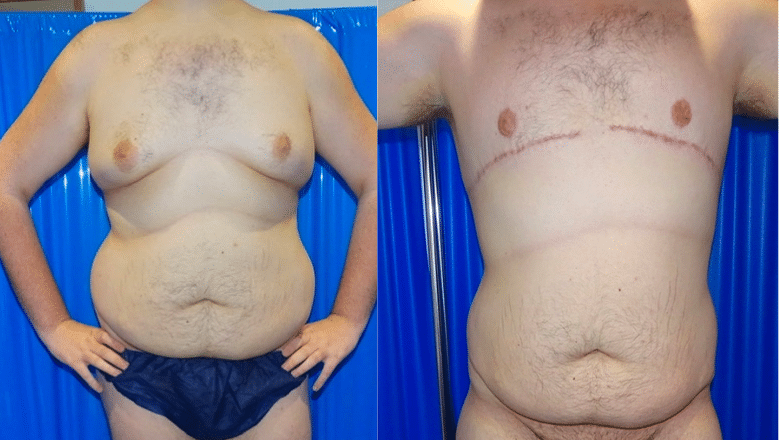
Larger amounts of loose skin need longer incisions, usually running across the lower chest or in the crease below it, with the nipple and areola moved to a higher, more natural position. For very large, drooping chests, the nipple and areola may be removed and replaced as a graft. In a ten-year series of 128 men, this was needed in 12.5%, mostly men with advanced gyno.[5]
These operations leave longer scars than standard gynecomastia surgery, and the trade-off between scar and contour is something to talk through at consultation. Our guide to gynecomastia scars explains how scars heal and fade. If loose skin remains after previous surgery elsewhere, our page on gynecomastia revision surgery explains the options.
Can You Prevent Loose Skin After Gyno Surgery?
You cannot change your age or genetics, but you can improve your chances:
- Reach a stable weight first. Losing a lot of weight after surgery can leave new loose skin. If you are planning to lose weight, it usually makes sense to do so before surgery.
- Stop smoking. Smoking damages the collagen that keeps skin elastic and slows healing.[6]
- Wear your compression vest. It supports the skin while it settles onto the new contour.
- Have an honest assessment. If your skin is unlikely to tighten, removing it at the first operation usually gives a better result than hoping it will retract.
Our guide on how to prepare for gynecomastia surgery covers the weeks before your operation in more detail.
Frequently Asked Questions
Will my chest sag after gynecomastia surgery?
Most men’s skin tightens well after surgery. Sagging is more likely if the chest was large or already drooping, if you have lost a lot of weight, or if your skin has lost elasticity with age.
How long does loose skin take to tighten after gyno surgery?
Skin carries on tightening for six to twelve months. Most change happens in the first three months as swelling settles.
Can exercise tighten loose skin after gynecomastia surgery?
Building the chest muscle can fill out the area under the skin and improve the shape, but exercise does not shrink loose skin itself. Wait until your surgeon clears you for chest training, usually at about six weeks.
Does BodyTite or radiofrequency tighten chest skin?
Radiofrequency-assisted liposuction can help mild to moderate laxity in selected men. It does not remove significant excess skin, which needs surgical removal.
Will I need skin removed during gynecomastia surgery?
Only if your surgeon expects your skin not to tighten enough on its own. This is usually men with a large or drooping chest, or after major weight loss. Most men do not need it.
Can loose skin be removed later?
Yes. If skin has not tightened enough after six to twelve months, a second, smaller procedure can remove it.
Gynecomastia Surgery at Centre for Surgery
Centre for Surgery treats gynecomastia in adults aged 18 and over, including men with loose skin after weight loss. Surgery is performed by GMC-registered plastic surgeons as a day case under TIVA at our Baker Street hospital, rated Good by the Care Quality Commission. Skin quality is assessed at every consultation so that the plan fits your chest. Our gynecomastia surgery cost guide sets out the prices, and finance options are available.
Phone: 020 7993 4849 | Email: contact@centreforsurgery.com | Address: 95–97 Baker Street, London W1U 6RN
References
- Simon BE, Hoffman S, Kahn S. Classification and surgical correction of gynecomastia. Plastic and Reconstructive Surgery 1973;51(1):48–52. doi:10.1097/00006534-197301000-00009 ↗
- Rohrich RJ, Ha RY, Kenkel JM, Adams WP Jr. Classification and management of gynecomastia: defining the role of ultrasound-assisted liposuction. Plastic and Reconstructive Surgery 2003;111(2):909–923. doi:10.1097/01.PRS.0000042146.40379.25 ↗
- Brown RH, Chang DK, Siy R, Friedman J. Trends in the surgical correction of gynecomastia. Seminars in Plastic Surgery 2015;29(2):122–130. doi:10.1055/s-0035-1549053 ↗
- Gusenoff JA, Coon D, Rubin JP. Pseudogynecomastia after massive weight loss: detectability of technique, patient satisfaction, and classification. Plastic and Reconstructive Surgery 2008;122(5):1301–1311. doi:10.1097/PRS.0b013e3181881df4 ↗
- Lehmann L, Kara P, Bodin F. Ten-year single-center experience in the surgical management of gynecomastia: comparative outcomes of four techniques. Aesthetic Plastic Surgery 2026; published online August 2026. doi:10.1007/s00266-026-05974-1 ↗
- Sørensen LT. Wound healing and infection in surgery: the clinical impact of smoking and smoking cessation: a systematic review and meta-analysis. Archives of Surgery 2012;147(4):373–383. doi:10.1001/archsurg.2012.5 ↗







