


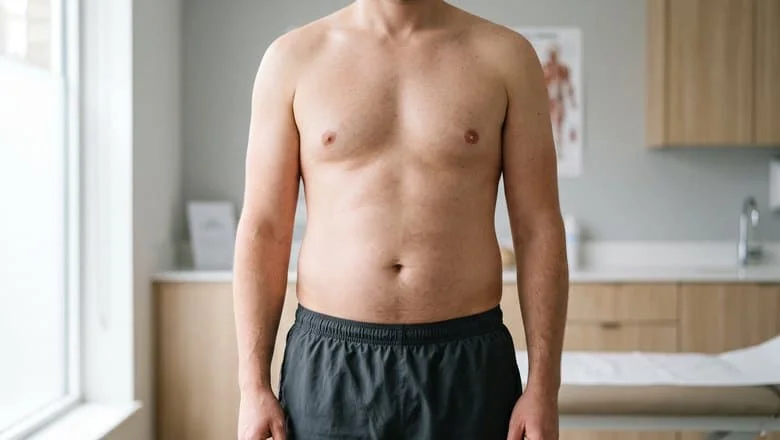
In this guide12 sections
- Key points
- What is pseudogynecomastia?
- Pseudogynecomastia vs gynecomastia: what is the difference?
- How to tell if you have pseudogynecomastia: the pinch test
- What causes pseudogynecomastia?
- Can pseudogynecomastia go away on its own?
- Pseudogynecomastia treatment options
- Do I need surgery for pseudogynecomastia?
- Who performs male chest surgery at Centre for Surgery
- Frequently asked questions
- Why choose Centre for Surgery
- Further reading
Key points
- Pseudogynecomastia — also spelled pseudogynaecomastia — is chest enlargement caused by subcutaneous fat rather than glandular breast tissue. It is sometimes called false gynecomastia, fatty gynecomastia or lipomastia.
- It is more common than true gynaecomastia, and the two are frequently confused because they look similar in a mirror and in clothing.
- The difference is what the tissue is. Fat is soft and evenly distributed. Glandular tissue forms a firm, rubbery disc directly beneath the nipple.
- That distinction determines treatment entirely: fat responds to weight loss and liposuction; glandular tissue does not respond to either and requires surgical excision.
- Most men have some of both, which is why an accurate assessment matters more than a self-diagnosis. If you are trying to work out which you have, start with our guide to gyno vs chest fat.
- Building the pectoral muscle underneath glandular tissue can make it look more prominent, not less.
- Where the tissue is genuinely fat, weight loss should be tried first — and if it works, no surgery is needed at all.
What is pseudogynecomastia?
Pseudogynecomastia is enlargement of the male chest caused by an accumulation of subcutaneous fat over the pectoral muscle, without any increase in glandular breast tissue. The prefix “pseudo” means false — the chest has the appearance of gynaecomastia without the underlying glandular change that defines it.
You will see it written both ways. Pseudogynecomastia is the American spelling used in most of the medical literature; pseudogynaecomastia is the British form. They describe the same thing. Informally it is called fatty gynecomastia, false gynecomastia, lipomastia, or simply chest fat.
Most men do not arrive using any of those words. They arrive asking whether they have gyno — the everyday shorthand for gynaecomastia — and the honest answer for a good proportion of them is that they do not. What they have is fat on the chest, which looks similar and behaves entirely differently.
It is a normal consequence of carrying excess body fat rather than a disease. The chest is one of the areas where men store subcutaneous fat, and when overall body fat rises, the chest is often among the first places it becomes visible — particularly in men who store fat centrally.
Pseudogynecomastia vs gynecomastia: what is the difference?
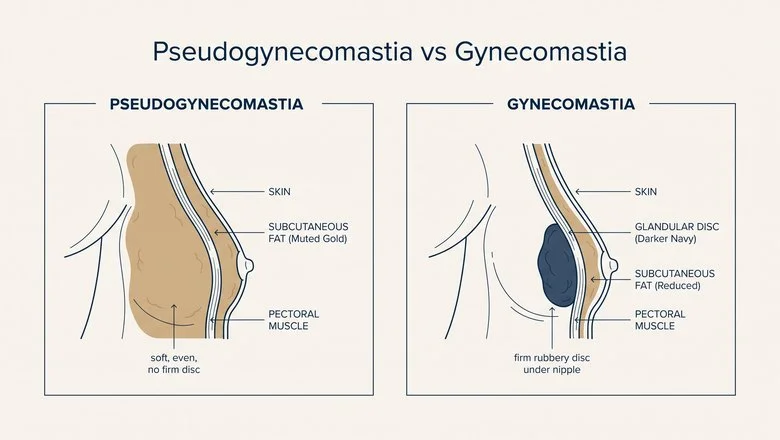
The difference is the tissue itself. Fat sits diffusely over the muscle; glandular tissue forms a discrete disc beneath the nipple.
The two conditions produce a similar outward appearance and are routinely mistaken for one another, but they are different tissues with different causes and different treatments.
True gynaecomastia is proliferation of glandular breast tissue, driven by a relative imbalance between oestrogen and androgen activity. The tissue is firm to rubbery, sits as a discrete disc concentrically beneath the nipple-areola complex, and is often tender — particularly in the early inflammatory phase. It does not respond to diet, exercise or weight loss, because it is not fat.
Pseudogynecomastia is fat. It is soft, distributed diffusely across the chest rather than concentrated under the nipple, and is not usually tender. It rises and falls with overall body fat.
Practical differences that matter to you:
- Texture — glandular tissue feels firm and distinctly different from the surrounding tissue; fat feels uniform
- Location — glandular tissue is centred on the nipple; fat spreads across the whole chest and typically into the armpit and flank
- Tenderness — glandular tissue can be sore or sensitive; fat generally is not
- Response to weight loss — fat reduces; glandular tissue stays exactly as it was
- Nipple appearance — glandular tissue often causes puffy nipples, where the areola itself projects forward
If you are still working out whether you have gyno or just chest fat, our detailed comparison guide — gyno vs chest fat: how to tell the difference — covers the self-assessment in more depth, with photographs.
How to tell if you have pseudogynecomastia: the pinch test
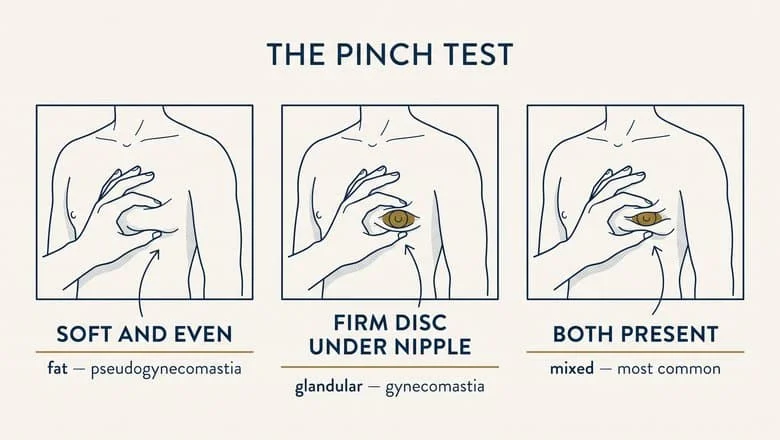
The pinch test gives you a reasonable indication, though it is not a substitute for examination.
Lie on your back — this lets fat fall away to the sides while glandular tissue stays put, which makes the two easier to distinguish. Pinch the tissue beneath and around the nipple between your thumb and forefinger.
Soft and even throughout. No firm structure, tissue feels the same across the whole chest. This suggests fat — pseudogynecomastia.
A firm, rubbery disc under the nipple. Distinctly different in texture from the tissue around it, roughly concentric with the areola, possibly tender. This suggests glandular tissue — true gynaecomastia.
Both. A firm central disc with softer fatty tissue around it. This is the most common finding in men who present to clinic, and it is why treatment often involves both excision and liposuction.
Two honest caveats. The pinch test is indicative rather than diagnostic — in men carrying more body fat, a glandular disc can be difficult to feel through the overlying tissue, and it is entirely possible to have gynaecomastia you cannot detect this way. And a new, firm, one-sided lump is a different matter altogether: that needs assessment by your GP rather than a self-test, because male breast cancer, while uncommon, does exist and typically presents as a hard, fixed, unilateral mass.
What causes pseudogynecomastia?
The direct cause is subcutaneous fat accumulation over the chest. What drives that varies.
Overall body fat. The most common factor by a wide margin. Chest fat generally tracks total body fat, and the chest is a common storage site in men.
Fat distribution pattern. Where you store fat is largely inherited. Two men at the same body fat percentage can carry it quite differently, and some store noticeably more on the chest. A soft chest is also common in men who are a normal weight but carry little muscle, a pattern known as being skinny fat, where strength training and fat loss often flatten the chest without surgery. This is why some men develop a visible chest at a body fat level where others do not.
Age. Body composition shifts with age — muscle mass falls and fat proportion rises, often without a change in weight. Testosterone declines gradually from the thirties onward, which alters where fat is stored.
Weight fluctuation. Repeated gain and loss can leave the chest with a stretched skin envelope even once the fat has gone. After significant weight loss the result is often loose skin rather than fat, which is a different problem again.
Alcohol. Regular heavy intake contributes both through calories and through effects on liver function and hormone metabolism.
Worth noting: several factors that cause true gynaecomastia — anabolic steroid use, certain medications, hormonal conditions — do not cause pseudogynecomastia, because they act on glandular tissue rather than fat. If your chest changed after starting a medication or a steroid cycle, that points toward glandular tissue rather than fat. Our guide to steroids and gynaecomastia covers that specifically.
Can pseudogynecomastia go away on its own?
Yes — and this is the single most important difference from true gynaecomastia. Pseudogynecomastia is fat, so it responds to the things that reduce fat anywhere else on the body.
Sustained overall fat loss through a calorie deficit will reduce chest fat. There is no way to target it specifically — spot reduction is not physiologically possible, and no chest exercise burns fat from the chest — but as total body fat falls, chest fat falls with it.
Two realistic qualifications.
The chest may be among the last areas to change. Fat loss follows an inherited pattern, and for some men the chest is stubborn. It is common to lose visible fat elsewhere before the chest changes appreciably.
Chest training alone will not fix it, and can make it look worse. Building the pectoral muscle underneath a layer of fat pushes that fat forward, which can increase projection rather than reduce it. Where glandular tissue is also present, the effect is more pronounced — several men arrive at consultation having trained chest hard for a year and found exactly that.
By contrast, true gynaecomastia does not resolve with weight loss at any body fat percentage, and pubertal gynaecomastia that has persisted beyond about two years is unlikely to resolve spontaneously. Our guide to whether gynaecomastia goes away on its own covers that in detail.
Pseudogynecomastia treatment options
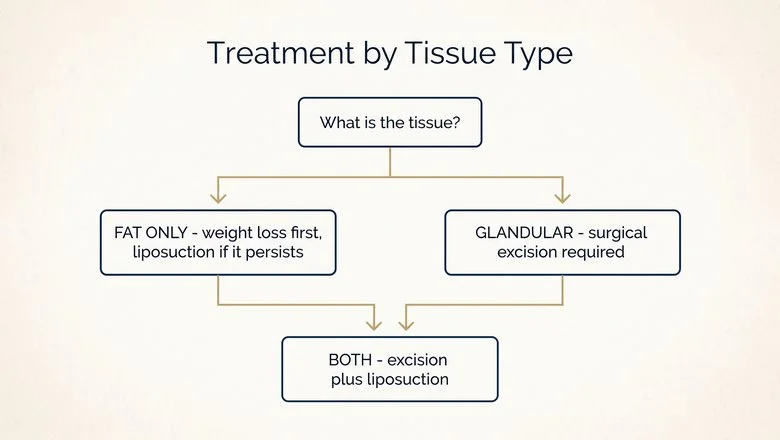
Treatment follows the tissue. This is why an accurate assessment comes before any decision about surgery.
Weight loss first
Where the tissue is genuinely fat and you are above your target weight, this is the first step, and we will say so at consultation rather than book you for surgery. If sustained fat loss resolves the appearance, no procedure is needed — and operating on a patient who is still actively losing weight produces an unpredictable result in any case.
The honest caveat: for some men the chest does not change proportionately, and after a genuine and sustained effort the appearance remains. That is the point at which surgery becomes a reasonable conversation.
Liposuction
Where localised chest fat persists at a stable, healthy weight, liposuction removes it permanently — the fat cells are taken out and do not regenerate. This is the definitive treatment for true pseudogynecomastia.
At Centre for Surgery this is performed with either power-assisted liposuction (PAL) or VASER lipo depending on tissue quality. Male chest fat is frequently more fibrous than fat elsewhere on the body, which is one of the clearest indications for VASER — the ultrasonic energy breaks down dense tissue with less physical force. VASER also promotes some skin retraction, which matters where the skin envelope has been stretched.
Liposuction alone is appropriate only where there is no significant glandular component. Where a glandular disc is present, liposuction will remove the fat around it and leave the disc behind — which can make it more obvious than before. That outcome is one of the more common reasons for revision surgery.
Surgical excision — where glandular tissue is also present
Where assessment finds glandular tissue as well as fat, that tissue must be excised. Male breast reduction (gynaecomastia surgery) removes the glandular disc through a small incision at the border of the areola, usually combined with liposuction of the surrounding chest fat in the same operation.
This combination is the most common procedure performed for male chest concerns, precisely because most men have both tissues.
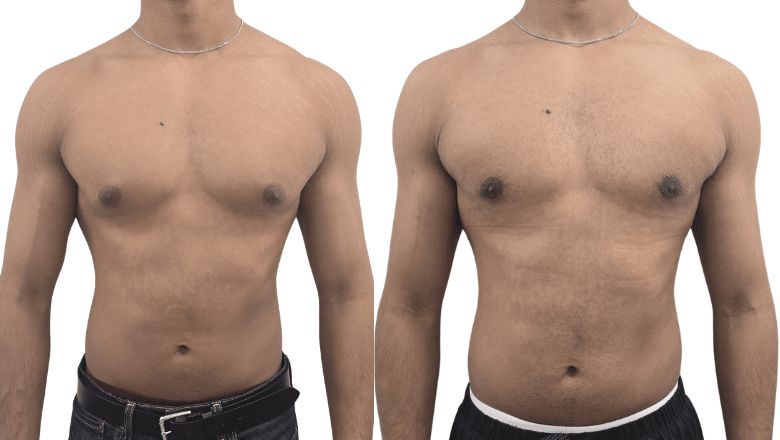
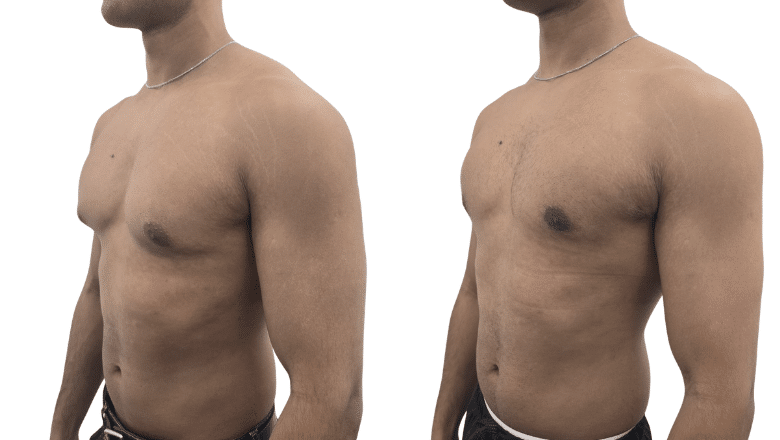
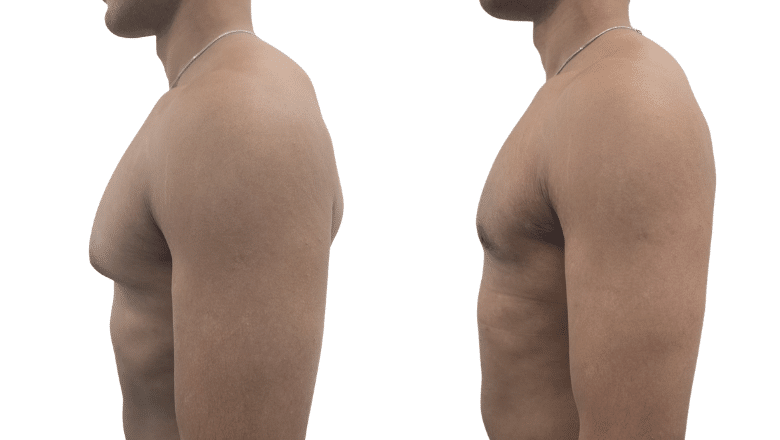
Combined glandular excision with liposuction of the surrounding chest fat, shown in anterior, oblique and lateral views. This is the most common operation for male chest concerns, because most men present with both tissues rather than one. Individual results vary.
A fuller set is available in our gynaecomastia before and after photos gallery, including cases treated with VASER liposuction alone where the tissue was predominantly fatty rather than glandular — pseudogynecomastia examples in the strict sense, since no glandular tissue needed excising.
Looking at examples is useful, but read them with the same caution you would apply to any before and after. Photographs cannot show you what the tissue was — a chest treated by liposuction alone and a chest treated by excision plus liposuction can look similar afterwards while having required entirely different operations. What determines your own result is what an examination finds, not which images most resemble your chest.
Non-surgical options
Radiofrequency skin tightening such as BodyTite can address mild skin laxity but does not remove meaningful fat volume, and does nothing at all to glandular tissue. It has a role as an adjunct rather than as a primary treatment. We cover the evidence in non-surgical treatments for gynaecomastia.
Do I need surgery for pseudogynecomastia?
Often not, and we would rather set that out than have you book a consultation you do not need. Where the tissue is genuinely fat and you have weight to lose, the appearance may resolve without any procedure at all. Surgery becomes the reasonable answer when the fat persists at a stable, healthy weight, or when glandular tissue is present alongside it.
There are four situations where we would not operate.
If you are significantly above your target weight. Liposuction contours localised fat; it is not a weight-loss procedure. Lose the weight first and reassess — the appearance may resolve entirely.
If your weight is still changing. Results are unpredictable in a patient who is actively gaining or losing. Stability for at least three to six months is the usual requirement.
If you have not had it assessed. A self-diagnosis of pseudogynecomastia that turns out to be gynaecomastia leads to the wrong operation. An examination takes minutes.
If a new firm lump has appeared on one side. See your GP first. That presentation needs investigating rather than contouring.
Who performs male chest surgery at Centre for Surgery
Mr Metin Nizamoglu is one of several plastic surgeons performing male chest surgery here. The full range of relevant techniques is available in-house — gynaecomastia surgery, liposuction with power-assisted lipo (PAL) and VASER, HD lipo, and fat transfer to the chest.
All are registered with the General Medical Council. You will meet the surgeon who will carry out your operation at consultation, and that same surgeon performs your surgery and reviews you afterwards. You can check any surgeon’s registration and specialist status directly on the GMC medical register.
That range matters here specifically. The commonest error in male chest surgery is treating the wrong tissue — removing fat and leaving a glandular disc, or excising glandular tissue without addressing the surrounding fat. Having every technique available in-house means the operation follows the assessment rather than being shaped by what a clinic happens to offer.
Frequently asked questions
Do I have gyno or just chest fat?
That is the question this whole distinction turns on, and it cannot be answered reliably from a photograph or a mirror. Gyno — true gynaecomastia — means glandular tissue, which feels like a firm disc beneath the nipple. Chest fat is soft and even. Most men who ask have some of both. An examination settles it in minutes, and the answer determines which operation you need.
Is pseudogynecomastia the same as chest fat?
Yes. Pseudogynecomastia is the clinical term for chest enlargement caused by subcutaneous fat rather than glandular tissue. Chest fat, fatty gynecomastia, false gynecomastia and lipomastia all describe the same thing.
Can you have both pseudogynecomastia and gynecomastia?
Yes, and this is the most common presentation in men who come to clinic. Where both are present, treatment usually involves excision of the glandular tissue combined with liposuction of the surrounding fat in one operation.
Will losing weight get rid of pseudogynecomastia?
Usually, though the chest may be one of the last areas to change and some men find it persists at a stable, healthy weight. If it does persist, liposuction removes it permanently.
Does pseudogynecomastia cause puffy nipples?
Not typically. Areolar puffiness — where the areola itself projects forward — is more characteristic of glandular tissue sitting directly beneath the nipple. See our guide to puffy nipples.
How much does treatment cost?
Liposuction of the chest and gynaecomastia surgery are priced following consultation, since the cost depends on which tissues need treating and the volume involved. Chest fat alone is not funded by the NHS, which usually requires mostly glandular tissue; our guide to gynaecomastia surgery on the NHS explains the criteria. The £100 consultation fee is redeemable against your procedure.
Is chest fat dangerous?
Subcutaneous chest fat is not itself harmful. Where it reflects a higher overall body fat percentage, the associated metabolic risks are the general risks of excess weight rather than anything specific to the chest.
Why choose Centre for Surgery
Centre for Surgery is a CQC-regulated cosmetic surgery clinic at 95–97 Baker Street in London’s medical district.
- Several plastic surgeons performing male chest surgery — you meet yours at consultation
- All procedures by GMC-registered plastic surgeons
- TIVA administered by a consultant anaesthetist — not gas-based general anaesthetic
- Power-assisted liposuction (PAL) and VASER both available, chosen on tissue quality rather than price
- Day-case surgery with same-day discharge
- Two-week cooling-off period from the date of consent
- Your surgeon’s direct number for the first 24 hours
- Honest assessment — including when weight loss rather than surgery is the answer

Phone: 020 7993 4849
Address: 95–97 Baker Street, London W1U 6RN
Further reading
- Gyno vs chest fat: how to tell the difference
- Does gynaecomastia go away on its own?
- The different grades of gynaecomastia
- How to get rid of man boobs
- What are puffy nipples?
- Male breast reduction (gynaecomastia surgery)
- Can gynaecomastia come back after surgery?
- Male liposuction | Male liposuction cost
- V-taper body: shoulder-to-waist ratio explained
- Male body contouring


