


In this guide15 sections
- What Causes Man Boobs?
- True Gynaecomastia vs Pseudogynaecomastia: Why the Distinction Matters
- Is Gynaecomastia Dangerous?
- The Impact on Quality of Life
- Non-Surgical Options: Diet and Exercise
- How to Hide Man Boobs in the Meantime
- A Note on Herbal Supplements
- When Non-Surgical Options Aren’t Enough
- Surgical Treatment Options for Man Boobs Removal
- What to Expect During Surgery
- Recovery After Male Breast Reduction
- Risks of Male Breast Reduction Surgery
- How Much Does Male Breast Reduction Cost?
- Frequently Asked Questions
- Man Boobs at Centre for Surgery

Man boobs and gynaecomastia treatment at Centre for Surgery, London.
Man boobs — the enlargement of male breast tissue, medically known as gynaecomastia — affect roughly a third of adult men at some point in their lives, and the majority of boys to some degree during puberty. The condition can involve excess fat alone (pseudogynaecomastia), true glandular breast tissue, or a combination of both, and the distinction matters because it determines what will actually work. If you’re asking how do I get rid of man boobs, the honest first question isn’t which exercise or supplement to try — it’s which of the two you actually have. Diet and exercise can meaningfully improve fat-based chest fullness; they very rarely resolve true glandular tissue. This guide covers what causes man boobs, when non-surgical approaches are genuinely worth trying, and what male breast reduction surgery actually involves at Centre for Surgery, from technique through to recovery and cost.
What Causes Man Boobs?
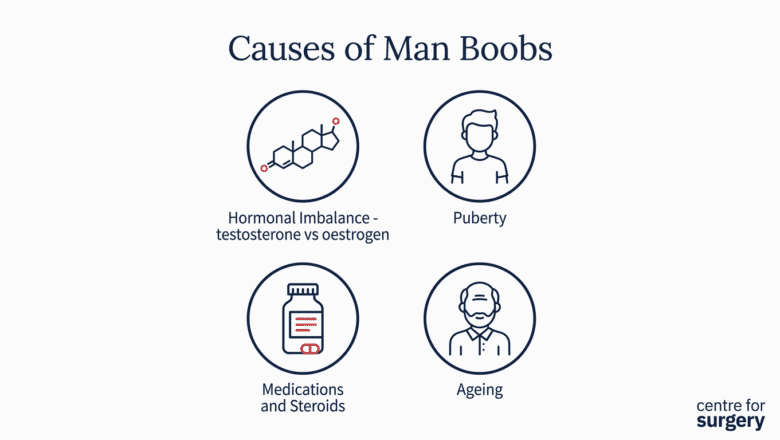
The main contributing causes of man boobs and gynaecomastia — Centre for Surgery, London.
At the core of most gynaecomastia is a shift in the balance between testosterone and oestrogen. Breast tissue is more sensitive to oestrogen, and when its relative effect increases — for whatever reason — glandular tissue can develop. The most common contributing factors include:
- Puberty — the hormonal surge of adolescence is by far the most common trigger, and in the large majority of cases it resolves on its own within one to two years without any treatment.
- Ageing — testosterone naturally declines with age, shifting the balance toward oestrogen; this is often compounded by gradual weight gain.
- Anabolic steroid use — steroids disrupt the body’s natural hormone production and are a well-recognised cause of gynaecomastia, including in otherwise lean, fit men.
- Certain medications — some blood pressure treatments, antidepressants, and drugs such as finasteride (commonly prescribed for hair loss) are associated with gynaecomastia as a side effect; if you suspect a medication is responsible, speak to your GP before stopping anything yourself.
- Excess body fat — higher body fat is linked with lower testosterone and increased oestrogen activity, and can also independently cause chest fullness through simple fat accumulation (pseudogynaecomastia) rather than true gland growth.
- Alcohol misuse — sustained heavy drinking affects liver function, and the liver plays a direct role in regulating circulating hormone levels.
- Underlying medical conditions — less commonly, conditions such as hypogonadism (low testosterone), hyperthyroidism, kidney or liver disease, or, rarely, a hormone-producing tumour can be responsible. This is one reason a proper medical assessment matters before assuming the cause.
In many cases, no single dominant cause is ever identified, and that’s a normal, unremarkable outcome of assessment rather than a gap in the process. Some men also notice related nipple changes alongside chest enlargement — if that’s your main concern, our guide to puffy nipples covers that specific presentation in more depth.
Gynaecomastia at Different Life Stages
Gynaecomastia genuinely follows a pattern across three distinct life stages, and understanding which one applies to you helps set realistic expectations. In newborns, mild breast swelling from maternal hormones is common and resolves within weeks. During puberty, it’s the most frequent of all — the majority of boys experience some degree of it, and it typically settles on its own within one to two years as hormone levels stabilise; persistence beyond this point, or a case that’s unusually painful or rapidly growing, is worth a GP assessment. In older men, prevalence rises again, driven by the natural age-related decline in testosterone, often alongside gradual weight gain. Adult gynaecomastia that develops outside these typical windows — particularly suddenly, or in only one breast — is more likely to warrant a fuller medical work-up to rule out an identifiable cause.
True Gynaecomastia vs Pseudogynaecomastia: Why the Distinction Matters
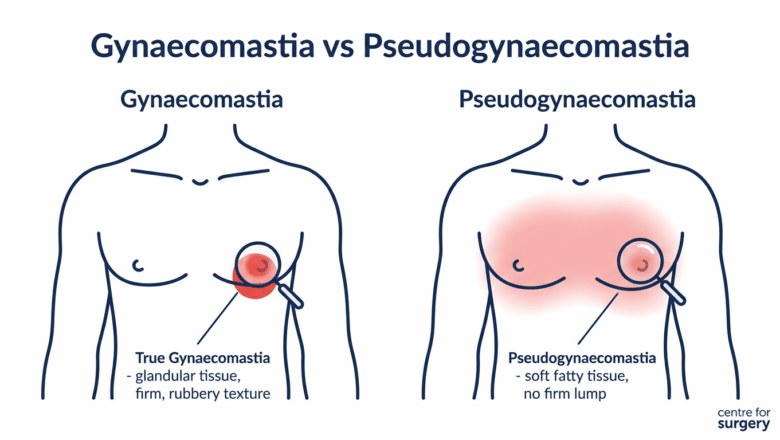
True gynaecomastia (firm glandular tissue beneath the nipple) versus pseudogynaecomastia (soft, diffuse fat) — Centre for Surgery, London.
Not all “man boobs” are the same condition, and confusing the two leads to a lot of wasted effort on the wrong solution. We cover this distinction in more visual detail in our dedicated gynaecomastia vs chest fat guide, but the short version is below.
Pseudogynaecomastia is simply fat accumulation in the chest, with no true glandular growth. It typically feels soft and uniform across the chest, without a distinct lump, and is more common in men carrying excess weight generally. It’s fat, so it responds — at least partially — to the same measures that reduce fat anywhere else on the body: a calorie deficit and consistent exercise.
True gynaecomastia involves actual growth of the glandular breast tissue itself, and on self-examination typically feels like a firm, rubbery, sometimes tender disc of tissue directly beneath the nipple, distinct from the surrounding fat. This tissue does not respond to diet or exercise in the way fat does, because it isn’t fat — it’s glandular tissue, structurally similar to the tissue in a female breast. Many men have a genuine mix of both.
Your surgeon will assess which you have — or what combination — at consultation, since it directly determines which treatment, if any, is likely to work.
Is Gynaecomastia Dangerous?
This is a fair question to ask directly, and it deserves a direct answer. In the large majority of cases, gynaecomastia is a benign condition and not a sign of anything serious. That said, it’s not something to self-diagnose from a description online. A GP assessment is genuinely worthwhile if you notice a lump that’s hard rather than firm and rubbery, one-sided rather than developing gradually on both sides, associated with skin changes, nipple discharge, or has appeared suddenly — these features don’t necessarily mean anything serious, but they’re the specific features that warrant ruling out rarer causes rather than assuming. For the substantial majority of men whose gynaecomastia doesn’t have these features, the honest answer is that it’s a common, benign, cosmetically and sometimes emotionally significant condition rather than a dangerous one.
The Impact on Quality of Life
Man boobs are not usually a serious physical health concern, but the emotional impact is frequently significant and shouldn’t be minimised. Many men avoid going shirtless, wearing fitted clothing, swimming, or certain gym and social activities because of self-consciousness about their chest. For some, this extends into a broader loss of confidence that affects relationships and social participation more generally, and it’s genuinely common for men to have lived with this for years, sometimes decades, before ever discussing it with anyone — reaching out for an honest gynaecomastia consultation is often the hardest part, not the treatment itself. If you’re experiencing physical discomfort, tenderness, or a lump that’s new, painful, or one-sided, it’s worth seeing a GP for assessment before anything else — most gynaecomastia is benign, but a proper examination is the right first step rather than an assumption.
Non-Surgical Options: Diet and Exercise
For pseudogynaecomastia specifically — also spelled pseudogynecomastia, and meaning chest fat rather than glandular tissue — or as a genuinely worthwhile first step before considering surgery for any cause, a sustained combination of diet and exercise can produce a real improvement — and it’s the right place to start before you look any further into how to get rid of man boobs surgically.
Man Boobs Exercise: What Actually Works
There’s no shortage of advice online claiming to reveal the single best exercise to lose man boobs, or the best workout for man boobs, and most of it oversimplifies a genuinely nuanced picture. The honest answer is that there is no exercise that spot-reduces fat from the chest specifically — that isn’t how fat loss works anywhere on the body, and any programme sold on that premise is overstating what training can do. What actually helps:
- A calorie-controlled, balanced diet — plenty of vegetables, fruit, whole grains and lean protein, with reduced intake of processed and high-sugar foods, supports overall fat loss including in the chest.
- Cardiovascular exercise — around 150 minutes a week, split across several sessions of running, cycling, swimming or similar, is the most effective way to reduce overall body fat, which in turn tends to reduce man boobs where the underlying cause is fat rather than gland.
- Chest-focused resistance training — exercises such as bench presses, push-ups and cable flies won’t remove fat from a specific spot, but they do build and firm the underlying pectoral muscle. These are also the exercises to get rid of man boobs at home that most guides recommend, and push-ups, dips and resistance-band flies genuinely need no equipment. One caveat is worth stating plainly, because it is the opposite of what most gym advice assumes: where the tissue is glandular, building the pectoral muscle underneath pushes the breast tissue further forward and can make it look more prominent rather than less. Several men arrive at consultation having trained hard for a year and found exactly that. Building the muscle, which can improve the overall contour and appearance of the chest. Many men trying to lose man boobs through the gym alone find progress plateaus at exactly the point where fat ends and glandular tissue begins — that plateau is itself useful diagnostic information.
It’s important to be realistic about what this achieves, and about the timeframe involved — meaningful change from lifestyle measures alone typically takes several months of consistent effort, not weeks. Where the underlying cause is genuinely fat (pseudogynaecomastia), a sustained diet and exercise routine can genuinely reduce man boobs over that time. Where true glandular tissue is present, these measures will not remove it — the tissue simply isn’t fat, and no amount of training changes that, however disciplined the approach. If you’ve genuinely tried this route without success, it’s a good sign the underlying cause may be glandular rather than fat, and worth raising directly at a gynaecomastia surgery consultation.
How to Hide Man Boobs in the Meantime
Whether you are working through the non-surgical route, waiting for a consultation, or have simply decided against surgery, there is nothing wrong with wanting the chest less visible day to day. A few things genuinely help.
Compression vests worn under clothing flatten the chest contour and are the most effective single option — they are sold as men’s shapewear or compression base layers and are unremarkable under a shirt. Beyond that: darker colours and patterns disguise contour better than pale plain fabrics; structured shirts and jackets in a slightly heavier weight hang away from the chest rather than clinging to it; layering with an open overshirt breaks up the outline; and avoiding thin, clingy jersey fabrics makes more difference than most men expect.
We would rather set that out than pretend surgery is the only answer. For some men, managing the appearance is enough, and a clinic telling you otherwise is selling something. But it is worth being straight about the limits too: none of this changes the underlying tissue, and if you are structuring your wardrobe, your swimming, or your relationships around concealing your chest, that is worth discussing with someone — either your GP or a surgeon who will tell you honestly whether a procedure would help.
A Note on Herbal Supplements
Some herbal supplements — including devil’s claw, milk thistle and red clover — are sometimes suggested as a way to influence hormone levels and improve the appearance of man boobs. It’s worth being direct about this: there is no robust clinical evidence that any herbal supplement meaningfully treats gynaecomastia, and some can interact with prescribed medication. If you’re considering one, speak to your GP first, and treat any claims of dramatic results with appropriate scepticism.
When Non-Surgical Options Aren’t Enough
For true glandular gynaecomastia, or pseudogynaecomastia that hasn’t responded to a genuinely sustained effort with diet and exercise, surgery for man boobs is the only reliable, permanent solution. You may be a suitable candidate for male breast reduction surgery if:
- You’re in good general health, ideally a non-smoker
- Your weight is stable, and diet and exercise haven’t resolved the concern
- Your chest enlargement has persisted for 12 months or more
- You have realistic expectations of what surgery can achieve for your specific anatomy
At consultation, your surgeon will assess the type and cause of your gynaecomastia, discuss the surgical options genuinely suited to your anatomy, and talk through recovery, risks and realistic outcomes in full before you make any decision.
Surgical Treatment Options for Man Boobs Removal
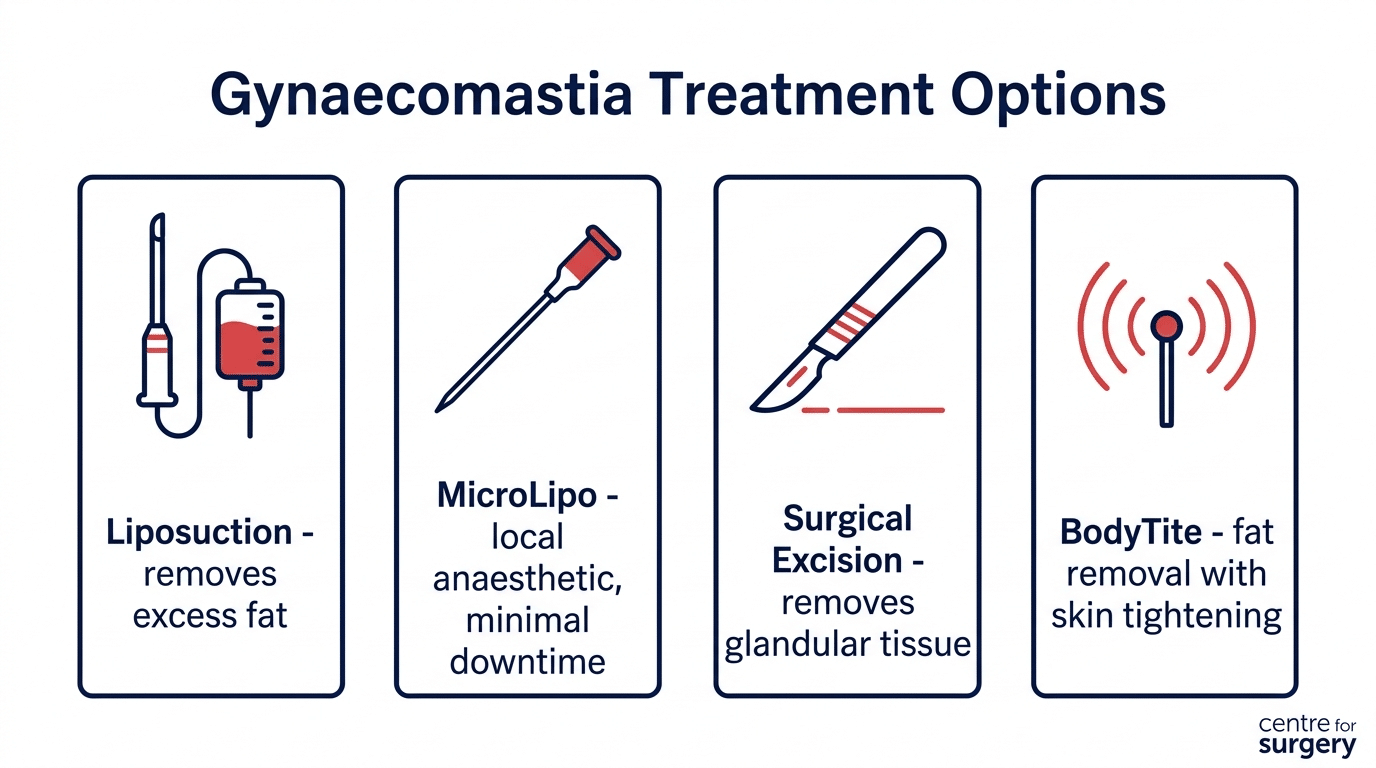
Gynaecomastia treatment options at Centre for Surgery, London — chosen according to whether fat, glandular tissue, or both are present.
There’s no single “gynaecomastia surgery” — man boobs removal depends entirely on what’s actually present in your chest, and the right approach is built around that, not a fixed package.
Liposuction is effective where the concern is predominantly excess fat. A specialised cannula breaks up and removes fat cells through small incisions, reshaping the chest contour. Chest fat can be more fibrous than fat elsewhere on the body, so this requires a technique suited to that tissue specifically.
MicroLipo (tumescent liposuction) uses finer cannulas, no larger than 3mm, and can often be performed under local anaesthetic alone. You’re awake throughout, so recovery tends to be faster, and the smaller cannula reduces the risk of contour irregularity. VASER liposuction is equally available as an alternative: it uses ultrasound energy to loosen fat before removal, and your surgeon will advise which of the two suits your chest.
Surgical excision is required where true glandular tissue is present, since liposuction alone cannot remove it. A small incision, usually around the lower half of the areola, allows the surgeon to remove the firm glandular tissue directly. Where the areola itself has stretched and looks puffy, it can be reduced through the same incision; our guide to areola reduction cost explains what that adds. This is very commonly combined with liposuction in the same procedure, addressing both fat and gland together for a complete result.
BodyTite combines fat removal with radiofrequency skin tightening in one step, and is a useful option for patients with mild to moderate skin laxity who want to avoid the more visible scarring associated with surgical skin excision.
Your surgeon will recommend the combination genuinely suited to your anatomy — for most patients with a mix of fat and glandular tissue, this means liposuction and excision performed together.
What to Expect During Surgery
Male breast reduction at Centre for Surgery typically takes between one and two hours, depending on complexity and whether both fat removal and gland excision are needed. For straightforward liposuction or MicroLipo cases, the procedure can often be performed under local anaesthetic with sedation. Where surgical excision is involved, or where the procedure is more extensive, we recommend TIVA (Total Intravenous Anaesthesia) — delivered entirely intravenously without inhaled anaesthetic gases, allowing continuous monitoring of anaesthetic depth and a faster, more comfortable recovery with less postoperative nausea than a traditional inhalational general anaesthetic. Which approach is right for your specific procedure is confirmed and explained clearly at consultation.
Small incisions — around the lower areola for excision, or via tiny cannula entry points for liposuction — are used throughout, and your surgeon will discuss realistic scar expectations for your specific procedure before you consent.
Recovery After Male Breast Reduction
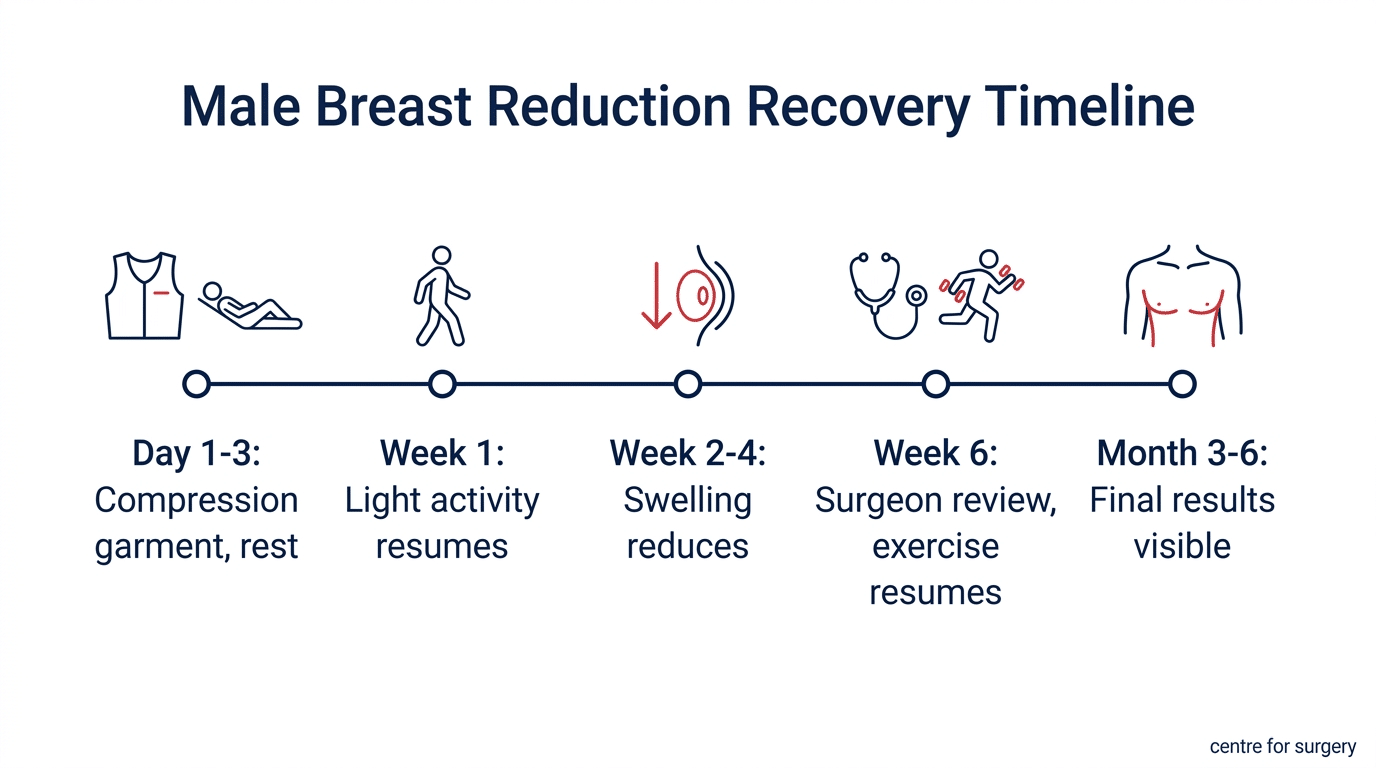
Male breast reduction recovery timeline — Centre for Surgery, London.
Most patients wear a compression garment continuously for the first one to two weeks, tapering to part-time wear as advised, which supports the chest as it heals and helps minimise swelling. Bruising and swelling are normal in the first couple of weeks and gradually resolve. Most patients return to light daily activity within a few days and desk-based work within a week to ten days, while strenuous exercise and heavy lifting should be avoided for three to four weeks. Your surgeon reviews progress at around six weeks, by which point initial results are usually visible, though final, fully settled results take three to six months to appear as deeper swelling fully resolves. Following your compression garment and activity guidance closely has a real, direct effect on how smooth your final result is, particularly where surgical excision has been performed, since the skin needs consistent support to retract evenly over the newly flattened chest. Our full gynaecomastia recovery and aftercare guide covers this in more detail, including what to expect week by week.
Risks of Male Breast Reduction Surgery
As with any surgical procedure, male breast reduction carries risks, which your surgeon will discuss in full before you consent to proceed:
- Anaesthetic risks — minimised through TIVA, continuous monitoring, and thorough pre-operative assessment.
- Bruising, swelling and scarring — expected and typically settle well; scars from excision are positioned around the areola to minimise visibility.
- Asymmetry or contour irregularity — minor differences are common initially and usually settle; more noticeable asymmetry can occasionally require a touch-up.
- Altered nipple sensation — usually temporary, resolving over weeks to months.
- Infection or seroma — uncommon, and most cases respond well to standard treatment.
Choosing an experienced, GMC-registered surgeon meaningfully reduces the overall risk profile — the technical judgement involved in distinguishing fat from glandular tissue during surgery, and removing exactly the right amount of each, is genuinely surgeon-dependent.
How Much Does Male Breast Reduction Cost?
Current prices are set out in our gynaecomastia surgery cost guide. The exact price depends on which combination of liposuction, MicroLipo, surgical excision and BodyTite your surgeon recommends for your anatomy, and is confirmed in writing after your face-to-face consultation. Pricing includes your surgeon’s fee, anaesthetist’s fee, facility fees at our CQC-regulated Baker Street clinic, and your follow-up care. Your compression garment and any prescribed medications are purchased separately and confirmed in advance. Male breast reduction is not available on the NHS for cosmetic reasons, and most men self-fund privately; our guide to gynaecomastia surgery on the NHS explains the narrow criteria some NHS areas use. Finance is available, subject to status; see our finance options.
Frequently Asked Questions
How is gynaecomastia different from just having chest fat?
Gynaecomastia is the growth of actual glandular breast tissue, usually due to a hormonal imbalance. Chest fat (pseudogynaecomastia) is simply fat accumulation, most often linked to weight gain. Both can look similar on the surface, but the underlying cause — and therefore the effective treatment — is different. See our gynaecomastia vs chest fat guide for a fuller comparison.
How do I get rid of man boobs without surgery?
Where the cause is genuinely fat rather than glandular tissue, a sustained combination of a calorie-controlled diet and regular cardiovascular exercise, kept up consistently for several months, is the most effective non-surgical route. It won’t work for true glandular gynaecomastia, which is why identifying which type you have matters more than which exercise or diet plan you choose.
What’s the best exercise to reduce man boobs?
There’s no single exercise that spot-reduces chest fat specifically — fat loss doesn’t work that way anywhere on the body. A combination of overall cardiovascular exercise to reduce total body fat, alongside chest-focused resistance training to build and firm the underlying muscle, is the most effective realistic combination.
Can exercise alone get rid of man boobs?
It depends on the cause. If your chest is enlarged mainly due to fat, a combination of cardio and chest-focused strength training can produce a genuine improvement. If true glandular tissue is present, exercise alone will not resolve it, regardless of how consistent or intense the training is.
Is living with gynaecomastia okay if I don’t want treatment?
Yes. If it isn’t causing you physical discomfort or significant distress, there’s no medical requirement to treat it, and many men live with it without seeking treatment. Whether to pursue treatment is a personal decision based on how it’s affecting you.
What risks are associated with male breast reduction surgery?
As with any surgery, risks include infection, scarring, bleeding, asymmetry, altered nipple sensation, and fluid collection (seroma). Your surgeon will discuss every risk relevant to your specific procedure in full at consultation before you consent.
What should I avoid after gynaecomastia surgery?
Heavy lifting and strenuous activity should be avoided for three to four weeks. Limit sun exposure on the treated area, as it can darken scars, and avoid smoking, which slows healing. Wear your compression garment as advised and attend all follow-up appointments — see our recovery guide for the full week-by-week breakdown.
How do I choose the right surgeon for man boobs removal?
Choose a plastic surgeon on the GMC Specialist Register with genuine experience treating gynaecomastia specifically, operating at a CQC-regulated facility. The technical demands of distinguishing fat from glandular tissue, and achieving an even result, are genuinely different from general liposuction, so specific experience matters.
Can gynaecomastia come back after surgery?
True glandular tissue that’s been surgically removed doesn’t grow back. However, significant future weight gain can cause new fat accumulation in the chest, which can look similar to a recurrence even though the original glandular tissue hasn’t returned. Maintaining a stable weight afterwards is the best way to protect your result long-term.
Will I need to stay overnight after gynaecomastia surgery?
No. Male breast reduction at Centre for Surgery is performed as a day-case procedure, and the large majority of patients go home the same day once a recovery nurse confirms they’re fit for discharge with a responsible adult.
Man Boobs at Centre for Surgery
- GMC-registered plastic surgeons, experienced across liposuction, MicroLipo, surgical excision and BodyTite for gynaecomastia specifically
- A CQC-regulated clinic on Baker Street in Marylebone, rated “Good” across its inspected domains
- Honest assessment of fat versus glandular tissue at consultation, rather than a one-size-fits-all recommendation
- Specialist expertise in TIVA anaesthesia for a more comfortable recovery
- Finance available through Chrysalis Finance, subject to status
To discuss your options for treating man boobs or gynaecomastia, call 020 7993 4849 or complete the form below to arrange a face-to-face gynaecomastia consultation. Your initial consultation is £100, redeemable against the cost of surgery if you proceed.

Learn More
- Gynaecomastia Surgery
- Gynaecomastia vs Chest Fat
- Gynaecomastia Recovery and Aftercare
- BodyTite
- Puffy Nipples: Causes and Treatment
- Liposuction


