

Real eyelid surgery results from patients treated at our Baker Street day surgery unit, grouped by concern — UK patients, upper and lower eyelid, male and female. Jump to Upper Blepharoplasty (Hooded Eyes), Lower Blepharoplasty & Eye Bags, Asian Blepharoplasty or Male Blepharoplasty.
Results vary from patient to patient. All photos are published with written patient consent and are examples of outcomes achieved at Centre for Surgery, not guaranteed results. After photos were taken at least six months after surgery unless the caption says otherwise. No photograph has been retouched or filtered; some are cropped or masked only to protect patient privacy. Full disclaimer below, and how to read these photos — including the one variable that makes most upper eyelid before-and-afters misleading.
Hooded upper blepharoplasty before and after
14 photographs
Upper eyelid surgery removes the fold of excess skin that sits on or over the lash line. Read more about what causes hooded eyes and the difference between upper and lower blepharoplasty.
Upper eyelid surgery removes excess hooded skin from the upper lid, opening the eye and giving a more rested appearance. It is the most commonly requested eyelid procedure and the standard surgical treatment for hooded upper eyelids. Read more about upper eyelid surgery and the difference between upper and lower eyelid surgery.
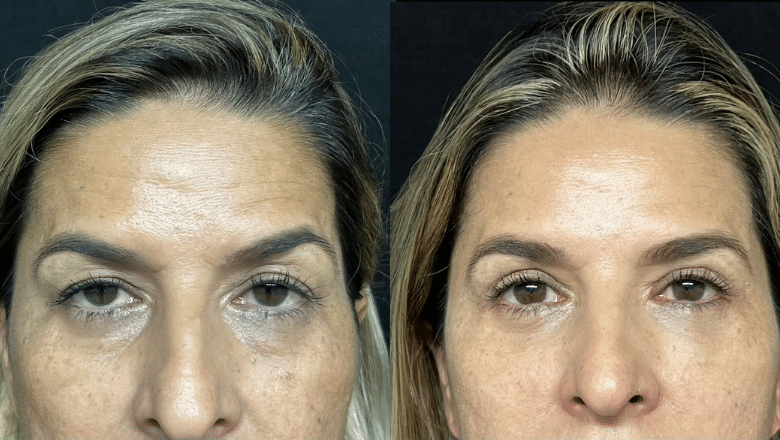


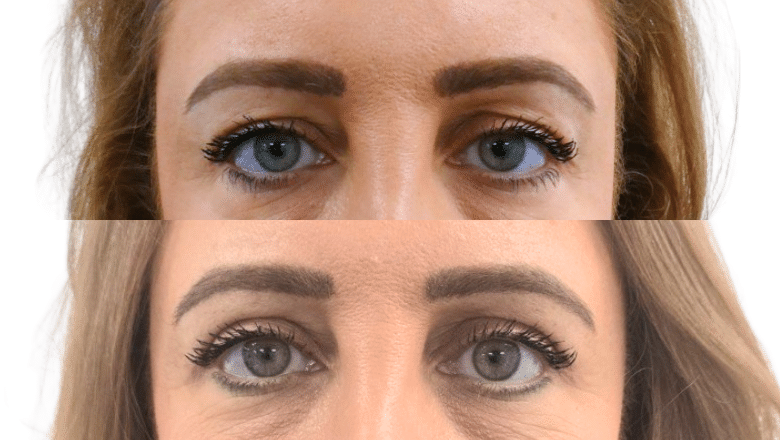

Lower blepharoplasty before and after — eye bag removal
2 photographs
Lower eyelid surgery addresses bags, hollowing and loose skin beneath the eye. Read more about how to get rid of eye bags and what lower blepharoplasty can and cannot do.
Lower eyelid surgery — commonly called under-eye bag removal — addresses prolapsed fat, crepey lower lid skin, and lid laxity. Modern technique favours repositioning fat into the tear trough rather than aggressive removal, smoothing the lid-cheek junction. Read more about lower eyelid surgery and eye bag removal, or the choice between transconjunctival and transcutaneous approaches.


Asian blepharoplasty before and after — double eyelid surgery
2 photographs
Asian blepharoplasty creates a defined supratarsal crease in the monolid while preserving the natural eye shape and inner canthal region. It is a technique-specific procedure distinct from Western upper blepharoplasty. Read more about Asian blepharoplasty and double eyelid surgery.


Blepharoplasty men before and after — male eyelid surgery
1 photograph
Male blepharoplasty is conservative by design: the goal is to look rested rather than to change the eye shape. Read more about male eyelid surgery and how the approach differs between men and women.
Male eyelid surgery preserves the heavier upper lid and lower brow position characteristic of male anatomy, removing hooded skin without feminising the eye. Read more about cosmetic surgery for men.

About These Blepharoplasty Before and After Photos
These images are being presented for educational purposes only and should be interpreted subjectively. They are not intended to represent the opinion or view of any patient regarding their results, nor are they intended to suggest that any other patient can achieve similar results. These images are designed to serve as factual guidelines and demonstrate the results achieved by other patients. It is important to note that every patient is unique, and individual results may vary. Therefore, only a personal consultation with a qualified surgeon can provide you with a reasonable expectation of the results that you may achieve from any specific procedure. We only publish photographs of patients who have given written consent for their images to be used.
How to Read Eyelid Surgery Before and After Photos
Eyelid photographs are harder to read honestly than almost any other cosmetic result, because the eye region is mobile. A patient can change how their own eyelids look without moving a muscle they’re aware of. Knowing what to control for is worth more than looking at a hundred galleries.
Watch the eyebrows — this is the big one
People with heavy, hooded upper lids unconsciously lift their eyebrows all day, using the forehead muscle to hold the skin off their lashes. It becomes habitual. After surgery, when the weight is gone, the forehead relaxes and the brows settle back down to their natural resting position.
The consequence is counter-intuitive: in a genuine upper blepharoplasty before-and-after, the brows are often *lower* in the after photo. Less brow elevation, but a more open eye. If you see an after photo where the brows have visibly risen, you are looking at a brow lift, at forehead muscle activation held for the camera, or at both — not at what the eyelid surgery alone achieved. Ask which.
Check where the patient is looking
Gaze direction changes upper lid position. Looking slightly up raises the lid and shows more iris; looking down covers it. Both frames should show a relaxed, level, straight-ahead gaze. A “before” taken looking down and an “after” taken looking up is not a result.
Check the lighting on the lower lid
Under-eye bags are shadows as much as they are anatomy. Light from above deepens the tear trough and casts a dark crescent that reads as a bag; flat, frontal light erases it. A lower blepharoplasty result can be manufactured with a lamp. Look for the same light direction and the same shadow behaviour across the cheek in both frames.
Look for the crease, not just the skin
A well-executed upper blepharoplasty preserves or restores a natural lid crease. Over-resection produces a hollowed, skeletonised upper lid and a startled look — visible in a photograph if you know to look for a lid that no longer has any soft fullness above the lash line. More skin removed is not a better operation.
Look at both eyes
Mild eyelid asymmetry is normal, and most people have it before surgery. A good result respects the patient’s existing asymmetry rather than erasing it. Photographs cropped to one eye hide the comparison that matters.
What Stage of Healing You’re Looking At
Eyelid surgery settles faster than most facial procedures, but not as fast as the photographs imply.
Bruising and swelling around the eyes are at their most obvious in the first week to ten days, and the majority resolves over the following weeks. What takes longer is the scar. The upper lid incision is placed in the natural crease, where it typically becomes very difficult to see — but it passes through a pink, slightly firm phase first, and softening and fading continue over months rather than weeks. Lower lid work, particularly where fat has been repositioned, can hold subtle swelling at the lid-cheek junction for longer still.
The practical consequence: an early photograph shows a result that is still settling, and a late one shows a scar that has had every chance to fade. Neither is dishonest. But a gallery that never states the interval is asking you to assume the best case, and you are entitled to ask.
You should also know that eyelid surgery does not stop the ageing that produced the hooding. Skin continues to change. The longevity of eyelid surgery results is a fair question to put to your surgeon before you book, not after.
The after photographs in this gallery were taken at least six months after surgery, unless the caption says otherwise. For what to expect at each stage before then, see our blepharoplasty recovery guide.
What These Photographs Cannot Show You
There is a limit to what any gallery can tell you, and a clinic that pretends otherwise is selling rather than informing.
- Whether the eyes close properly. This is the single most important thing about an eyelid operation, and it is invisible in a photograph of open eyes. Take too much skin from an upper lid and the patient cannot fully close it. Every image here shows a patient looking at a camera — none of them shows what happens when that patient goes to sleep.
- Comfort. Temporary dryness, grittiness and watering are common after eyelid surgery as the tear film adjusts. A photograph of a refreshed-looking eye tells you nothing about how that eye feels.
- Vision. Where hooded skin has been obstructing the upper field of view, its removal can widen what the patient can see. That is often the change they value most, and it does not photograph at all.
- The scar. The upper lid incision sits in the crease and is largely hidden when the eye is open — which is to say, hidden in exactly the view every before-and-after photograph uses. Its absence from these images is not evidence of its absence from the patient.
- Whether the eyelid was the problem. A tired appearance can come from brow descent, midface volume loss, or tear-trough hollowing rather than the lid itself. Operating on the lid in those cases disappoints. This is a diagnosis, and it cannot be made from a photograph of somebody else.
None of this is a reason to distrust before and after photographs. It is a reason to treat them as the beginning of a conversation with a surgeon rather than the end of one.
Blepharoplasty Results: Common Questions
How long does it take to recover from blepharoplasty?
Most bruising and swelling settles within two weeks, and many people return to desk work and social plans at around 10 to 14 days. Stitches are usually removed after about a week. Subtle swelling can last several weeks, and the scars continue to fade over the following months.
Will people notice I have had blepharoplasty?
For the first two weeks, yes, because bruising and swelling are visible. Once healed, the aim is for people to notice that you look rested rather than operated on. Upper eyelid scars sit in the natural crease and lower eyelid scars sit just below the lashes or inside the eyelid, so they are hard to see once mature.
Why do some people look older after blepharoplasty?
Early on, swelling and bruising can make the eyes look tired or uneven. In the long term, the usual cause is removing too much: taking out excess fat can leave the upper eyelid or under-eye area hollow, which reads as older. A conservative approach that preserves or repositions fat helps avoid this, and it is worth asking your surgeon how they approach it.
Blepharoplasty at Centre for Surgery
Centre for Surgery is a private hospital for plastic and cosmetic surgery on Baker Street in Marylebone, London, registered with and independently inspected by the Care Quality Commission. Our plastic surgeons perform upper and lower eyelid surgery, and each operation is tailored to the individual patient’s anatomy and aesthetic goals rather than to a standard technique.
Specialist Eyelid Surgeons
Every surgeon on our team is GMC-registered and independently verifiable on the General Medical Council register. Our surgeons work across the full range of blepharoplasty techniques, including upper eyelid reduction, lower eyebag removal, Asian double eyelid surgery, and combined procedures.
Our Baker Street Day Surgery Facility
All procedures are carried out at our purpose-built day surgery unit on Baker Street, Marylebone, which is registered with and independently inspected by the Care Quality Commission. Patients are cared for by a dedicated team of specialist cosmetic surgery nurses.
Personalised Care from Consultation to Recovery
From your first consultation through to your post-operative follow-ups, you will have direct access to your surgeon and our nursing team. For the first 24 hours after surgery you have your surgeon’s direct number, and after that you can call us on 020 7993 4849 (9am to 6pm, Monday to Saturday) if you have any concerns.
Verified Patient Reviews
We invite you to read what our blepharoplasty patients say on independent, verified review platforms. Every review is publicly verifiable, dated, and linked to a real named patient.
- Google Reviews: Read our Google reviews ↗ — rated 4.6 stars based on hundreds of verified patient reviews.
- Patient reviews page: Read patient reviews by procedure — Google and Trustpilot reviews brought together on our own site.
As a CQC-regulated provider, every surgeon on our team is GMC-registered and independently verifiable. View our CQC rating.
Related Reading
- What Is The Difference Between Upper And Lower Eyelid Surgery?
- Are Results From Eyelid Surgery Permanent?
- Can Eyelid Surgery Help With Asymmetrical Eyes?
Explore More Before and After Galleries
View our full collection of plastic surgery before and after photos, or browse related facial procedure galleries: Rhinoplasty Before and After Photos | Facelift Before and After Photos | Neck Lift Before and After Photos
Subject to status, we offer finance options with Chrysalis Finance. For a full price breakdown, see our blepharoplasty cost guide. Learn more on our About Us page, browse our Plastic Surgery Blog, or find answers in our Clinic FAQs.
To book a face-to-face consultation with an expert blepharoplasty surgeon, call us on 020 7993 4849 or complete the contact form below.