

In this guide16 sections
- Key Points
- What Does “Feeding the Fat” After BBL Mean?
- Does Feeding the Fat After BBL Actually Work?
- How Does Transferred Fat Survive After a BBL?
- How Much Fat Survives After BBL?
- What Kills Fat Cells After BBL?
- Why Is Smoking the Biggest Risk to Your BBL Results?
- What to Eat After BBL to Support Healing
- What Not to Eat or Drink After BBL
- How Long Should You Feed the Fat After BBL?
- Does Gaining Weight Make Your BBL Bigger?
- Can You Diet or Lose Weight After a BBL?
- Other Ways to Protect Your BBL Results
- Frequently Asked Questions
- Brazilian Butt Lift in London
- References
Key Points
- There is no good human evidence that “feeding the fat” works. No clinical study shows that a calorie surplus or a high-fat diet makes more transferred fat survive after a Brazilian butt lift. The only supportive data come from small mouse experiments.
- Grafted fat survives by growing a new blood supply. In the first days it relies on oxygen and nutrients seeping in from the surrounding tissue, so pressure, smoking and poor technique matter far more than what is on your plate.
- Smoking is the biggest risk you can control. Stop smoking, vaping and all nicotine for at least 4 weeks before and 4 weeks after surgery.
- Eat a sensible, balanced diet with enough protein. Protein, fruit, vegetables, wholegrains and fluids support wound healing. You do not need to eat more than usual, count calories or follow a special BBL diet.
- Keep your weight stable. Fat that survives behaves like normal body fat: it grows if you gain weight and shrinks if you lose weight.
- Around 50 to 70% of transferred fat usually survives. Your surgeon plans for the rest by placing extra fat, and the fat that is still there at about 6 months is long lasting.
Feeding the fat after a BBL means eating well enough for your body to heal, not eating extra calories or extra fat to “grow” your result. There is no good evidence in people that a calorie surplus or a high-fat diet improves how much transferred fat survives. What genuinely helps is a balanced diet with enough protein, no smoking or vaping, a stable weight, and keeping pressure off your buttocks while the fat grows a new blood supply.
This guide explains what the research shows about eating after a Brazilian butt lift, how transferred fat survives, what kills it, what to eat and avoid, and why weight stability matters more than any food. Our week-by-week BBL recovery guide covers sitting, sleeping, garments and exercise.
What Does “Feeding the Fat” After BBL Mean?
In a BBL, fat is removed by liposuction from areas such as the abdomen, flanks and back, purified and injected into the buttocks. “Feeding the fat” is a phrase used online to describe eating more after surgery, often with an emphasis on fatty foods such as avocado, nuts, salmon, full-fat dairy, peanut butter or even weight gain shakes, in the belief that the newly injected fat cells need extra calories to survive.
The theory sounds logical: if fat cells store energy, surely more energy will help them? In practice, transferred fat survives or dies according to whether it can connect to a blood supply quickly enough, not according to how many calories you eat. A balanced diet supports the healing that allows this to happen, but no food or supplement makes grafted fat more likely to take. Being told not to lose weight after a BBL also does not mean you should gain weight. The goal is steady, healthy eating and a stable weight.
Does Feeding the Fat After BBL Actually Work?
The honest answer is that there is very little evidence either way, and none of it in BBL patients. The claim is usually repeated by patient groups and some clinics without any supporting study.
The closest research comes from animal experiments. In a 2022 laboratory study, 54 mice received small fat grafts of 0.3 ml and were then fed a normal diet, a high-carbohydrate diet or a high-fat diet. At 90 days, grafts in the mice on the high-energy diets kept slightly more volume and had fewer oil cysts, and the authors linked this to more new blood vessel growth[1]. This is interesting biology, but it does not translate into a diet plan for people: a tiny graft placed under the skin of a mouse eating a laboratory high-fat diet is not comparable to a woman recovering from a 3 to 4 hour operation. The high-carbohydrate diet also improved retention, which suggests that total energy, not dietary fat itself, was the factor.
In people, the evidence points the other way. A 2024 study measured 204 breasts in 3D before and 1, 3 and 6 months after fat grafting, and looked at age, body mass index, smoking, previous pregnancy, processing technique and weight change after surgery. Only the starting breast volume significantly predicted how much fat was retained; weight change over the first six months did not[2]. In other words, modest changes in eating after surgery did not measurably change graft take.
So a sensible eating plan is fine and helps you heal well. Eating far more than you need will not make your result bigger. It will add fat to your whole body, including the abdomen, flanks and back that were treated with liposuction, and that can undo part of your contouring.

How Does Transferred Fat Survive After a BBL?
Fat injected into the buttocks arrives with no blood supply of its own. For the first few days it depends on oxygen and nutrients diffusing in from the tissue around it, until new capillaries grow into the graft. This process is called revascularisation.
A 2012 experimental study in Plastic and Reconstructive Surgery ↗ showed how this works at cell level. Most fat cells in a graft began to die from the first day, and only those within about 0.3 mm of the graft’s edge survived intact. Behind that edge was a regenerating zone, where the original fat cells died but the stem cells and stromal cells around them survived and produced new fat cells from about day 3 to 7. At the centre of thicker deposits was a necrotic zone where everything died[3].
This explains what really decides graft take:
- How the fat is placed. Fat survives best when it is injected in many fine threads, so that each one sits close to healthy, well-supplied tissue. Large pools of fat are more likely to have a dead centre, which can later form an oil cyst or a firm lump.
- Where the fat is placed. At Centre for Surgery, fat is injected only into the subcutaneous layer above the gluteal muscle, never into or beneath the muscle, under real-time ultrasound guidance on every BBL. Our article on ultrasound-guided BBL explains why this matters for safety.
- Pressure on the buttocks. Sitting or lying directly on fresh grafts compresses the tiny new vessels and reduces the oxygen reaching the fat.
- Blood flow. Anything that narrows small blood vessels, especially nicotine, slows revascularisation.
Subcutaneous-only grafting holds up well. In a prospective study of 50 women who had fat injected only into the subcutaneous layer of the buttocks, ultrasound showed the fat layer was on average 56% thicker straight after surgery, and at 12 months it had settled by an average of about 18%, with the rest of the gain maintained[4]. None of this depends on eating extra calories.
How Much Fat Survives After BBL?
Not all of the fat that is injected survives. In a typical BBL, around 50 to 70% of the transferred fat survives and the remaining 30 to 50% is gradually reabsorbed by the body. Surgeons plan for this by placing slightly more fat than the final volume you want. Our guide to how much fat is transferred in a BBL explains how the volume is planned for your frame.
The buttocks change in shape over several months:
- First week: swelling peaks around days 3 to 5, so the buttocks look larger than the final result.
- Weeks 2 to 8: swelling settles and some fat is reabsorbed, so some shrinking is expected.
- Around 6 to 8 weeks: the skin softens and the shape looks more natural, often called “fluffing”. Our article on when fluffing happens after BBL describes what to look for.
- Around 3 months: you can see most of your result.
- 3 to 6 months: the final shape is established. The fat that has survived by around 6 months is long lasting and behaves like the rest of your body fat.
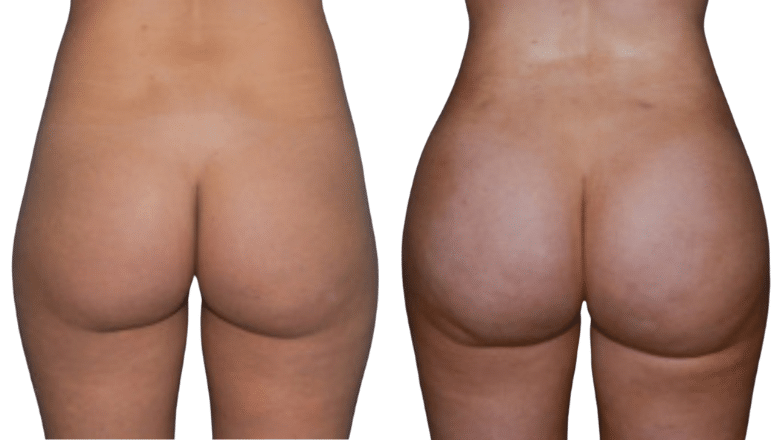

Real Centre for Surgery patients before and after BBL surgery. Individual results vary. See more results in our BBL before and after photos.
What Kills Fat Cells After BBL?
To protect grafted fat, focus on the things that reduce its blood supply:
- Smoking, vaping and nicotine. Nicotine narrows small blood vessels and carbon monoxide reduces the oxygen carried in the blood, at exactly the time the graft needs both. This is covered in detail below.
- Pressure on the buttocks. Do not sit directly on your buttocks for 2 weeks after surgery. If sitting cannot be avoided, use a BBL cushion that takes the weight on your thighs, and from week 3 you can sit normally for short spells. Our guide on when you can sit after BBL explains how to manage travel, work and the toilet.
- Sleeping on your back. Sleep on your front or side for 2 weeks, not on your back. These BBL sleeping tips show how to set up pillows.
- Infection and fluid collections. These can damage nearby fat. Keep incisions clean, take any prescribed medication as directed, and report a red, hot or discharging wound or a fever.
- Significant weight loss. Losing a lot of weight shrinks every fat cell, including the transferred ones, so the buttocks get smaller too.
When areas of fat do not survive, the body can form firm lumps or oil cysts. These are usually harmless and often soften with time, and our article on fat necrosis after BBL explains how they are assessed and treated.
Why Is Smoking the Biggest Risk to Your BBL Results?
Of everything you can change yourself, stopping smoking makes the biggest difference. A 2012 systematic review and meta-analysis in Archives of Surgery ↗ pooled 140 studies of 479,150 surgical patients. Smokers were 3.6 times more likely to develop tissue necrosis than non-smokers, about twice as likely to have delayed healing or wound breakdown, and 1.8 times more likely to have a wound infection. Former smokers still did slightly worse than people who had never smoked, and in randomised trials, stopping smoking around the time of surgery reduced wound infections[5].
Fat grafts are especially vulnerable. In a 2026 animal study, six weeks of cigarette smoke exposure before grafting reduced fat graft retention and increased fibrosis and necrosis in the grafted fat[6].
At Centre for Surgery we ask you to stop smoking and all nicotine, including vaping, for at least 4 weeks before and 4 weeks after your BBL. Your GP or local NHS stop smoking service can help you quit.
What to Eat After BBL to Support Healing
Good nutrition after a BBL gives your body what it needs to heal wounds, fight infection and recover from liposuction. The European Society for Clinical Nutrition and Metabolism (ESPEN) guideline on nutrition in surgery recommends eating normally again as early as possible after an operation and getting moving early, and identifies poor nutrition and underfeeding as risk factors for complications[7]. For most healthy BBL patients, that simply means returning to regular, balanced meals.
A sensible plate after a BBL includes:
- Protein at every meal. Protein is needed to make collagen, grow new blood vessels and support the immune system, and a shortfall is a recognised risk factor for poor wound healing[8]. Good sources include eggs, chicken, fish, lean meat, Greek yoghurt, milk, cheese, tofu, beans and lentils.
- Fruit and vegetables. These provide vitamin C, vitamin A, folate and other micronutrients involved in healing. Aim for a variety of colours.
- Wholegrains and other high-fibre foods. Oats, wholemeal bread, brown rice, potatoes with skins, fruit and pulses help prevent constipation, which is common after surgery.
- Healthy fats as part of a normal diet. Olive oil, oily fish, nuts, seeds and avocado are good foods, but they are not a special fuel for the buttocks. Include them in normal portions, not on top of everything else.
- Plenty of fluids. Liposuction causes fluid shifts and swelling, and water helps you stay hydrated and keeps your bowels moving.
For breakfast after a BBL, try eggs on wholemeal toast, porridge made with milk and topped with berries, or Greek yoghurt with fruit and nuts.
If your appetite is poor at first, smaller, more frequent meals are easier. You do not need to count calories or follow a set BBL diet plan. If you take a GLP-1 weight loss medicine, have had weight loss surgery, follow a restricted diet or have a medical condition that affects how you eat, tell your surgeon at consultation, as these can reduce protein and vitamin intake and may need a tailored plan[8].
What Not to Eat or Drink After BBL
There are no banned foods after a BBL, but a few things are worth limiting in the first weeks:
- Alcohol. Have little or none in the week before and the week after surgery. Alcohol dehydrates you and can interact with pain relief.
- Very salty, heavily processed food. Ready meals, crisps and takeaways can make you feel more bloated and swollen while your body is clearing fluid.
- Supplements that thin the blood. Before surgery we ask you to stop aspirin 2 weeks beforehand, and to stop anti-inflammatory painkillers and supplements such as fish oil, vitamin E, ginkgo, garlic and St John’s wort. Paracetamol is fine. Check with your surgeon before restarting any of these.
- “BBL supplements” and weight gain powders. Products marketed to grow your bum or feed your BBL have no evidence behind them. Weight gain shakes add calories to your whole body, not just your buttocks, and unregulated “booty” pills can contain ingredients that are unlabelled or unsafe.
A multivitamin is reasonable if your diet is limited, but your body cannot direct extra nutrients or calories to the buttocks.
How Long Should You Feed the Fat After BBL?
There is no fixed “feeding” period, as there is no feeding protocol to follow. Instead, think of two overlapping phases.
The healing phase (roughly the first 6 to 8 weeks). The grafts are establishing their blood supply and your liposuction areas are healing. Eat regular, balanced meals with enough protein, avoid crash dieting or fasting, and stay off cigarettes and vapes completely.
The settling phase (up to about 6 months). Fat that will not survive is reabsorbed and the final shape emerges. The most useful thing you can do now is keep your weight steady, and after this a stable weight becomes a lifelong habit rather than a recovery rule.
Is it too late to feed the fat at 3 months? By then, most of the fat that is going to survive has already established a blood supply. Eating more will not bring back fat that has been reabsorbed; it will simply add weight across your body. If you are unhappy with your volume once the result has settled, the answer is a review with your surgeon, not a change of diet.
Does Gaining Weight Make Your BBL Bigger?
Fat that survives a BBL behaves like normal fat. It grows with weight gain and shrinks with weight loss. So yes, if you gain weight, your buttocks will usually get a little bigger, but so will your abdomen, flanks, back and thighs, including the areas that were slimmed with 360 liposuction. The result is a larger body overall, not a more defined shape.
Grafted fat can also respond more than you expect. A 2023 systematic review in Aesthetic Surgery Journal ↗ found that transferred fat keeps the characteristics of the area it was taken from and can grow disproportionately when patients gain weight. All the reports described poor cosmetic outcomes from fat that enlarged out of proportion after weight gain[9]. Those reports involved facial fat grafting, but the same principle applies to the buttocks.
Weight loss works in reverse. Losing a lot of weight after a BBL, whether through diet, illness or weight loss medication, shrinks the transferred fat along with the rest, and the buttocks lose volume and projection. Our guide to what happens if you gain weight after a BBL explores both directions in more detail.
Can You Diet or Lose Weight After a BBL?
Avoid dieting while you heal. Cutting calories sharply in the first weeks can leave you short of protein and other nutrients when your wounds and grafts need them most[7]. If you want to lose weight later, aim for slow, steady change once you have fully recovered, and talk to your surgeon first, as large losses will reduce your result.
The best time to reach your target weight is before surgery. We look for a weight that has been stable for at least 3 months, or 6 to 12 months after major weight loss, and a body mass index of about 23 to 28 usually provides enough donor fat. If you are slim, our article on what happens if you don’t have enough fat for a BBL explains the options. Gaining weight just before surgery is not recommended, as the result shrinks if your weight drifts back down afterwards.
Other Ways to Protect Your BBL Results
These steps do more to protect grafted fat than any food:
- Wear your compression garment day and night for 6 weeks. It compresses the liposuction donor areas while leaving the buttocks free.
- Walk from day 1. Short, regular walks help circulation and reduce the risk of blood clots. Light cardio such as walking (not cycling) can build up from week 3, and full exercise, including weights, can usually restart from 6 weeks. Our guide to working out after BBL sets out the stages.
- Know the warning signs. Call 999 for breathlessness, chest pain or coughing up blood. For calf pain or swelling, a fever or a red, hot incision, call us or NHS 111 out of hours.
Frequently Asked Questions
How long do I need to feed the fat after BBL?
There is no set period, as there is no proven feeding protocol. Eat regular, balanced meals with enough protein through the first 6 to 8 weeks while you heal, and avoid dieting or fasting. After that, the priority is keeping your weight stable, especially for the first 6 months while the fat settles. Eating extra calories at any stage will not make more fat survive.
How do I maintain fat after a BBL?
Keep your weight stable, do not smoke or vape, and follow your aftercare closely in the first weeks: no sitting directly on your buttocks or sleeping on your back for 2 weeks, and wear your compression garment for 6 weeks. Long term, the surviving fat behaves like normal fat, so gaining or losing a lot of weight will change your result.
When does BBL fat stop dying?
Most fat that is going to be lost is reabsorbed in the first 2 to 3 months. By about 6 months the fat that remains is long lasting, and after that, changes in buttock size come mainly from changes in your weight.
How long does it take for BBL fat to settle?
Swelling peaks in the first 3 to 5 days, and the skin usually softens around 6 to 8 weeks, which patients often call fluffing. Most of the result is visible at about 3 months, and the final shape is established between 3 and 6 months after surgery.
Does alcohol kill fat cells after BBL?
There is no evidence that a single drink kills grafted fat, but alcohol does not help healing. It dehydrates you and can interact with pain relief. We advise little or no alcohol in the week before and the week after surgery, and moderation while you recover.
Will my BBL get bigger after 6 weeks?
Not usually. Your buttocks may look rounder and softer as swelling settles and fluffing happens, but the volume of fat does not increase unless you gain weight. Some reduction between 6 weeks and 3 months is normal as non-surviving fat is reabsorbed.
Do BBL supplements or weight gain powders work?
No. There is no evidence that any supplement, shake or weight gain powder increases fat graft survival or makes a BBL bigger. Extra calories are stored as fat across your whole body, including liposuction areas, so check anything you plan to take with your surgeon.
How do I poop after BBL surgery?
Constipation is common after surgery, from painkillers and moving less. Drink plenty of water, eat fibre from fruit, vegetables, wholegrains and pulses, and walk regularly. Keep toilet visits short in the first 2 weeks, and ask your pharmacist about a gentle laxative if needed.
Brazilian Butt Lift in London
At Centre for Surgery, BBL is performed by GMC-registered surgeons at our Baker Street hospital, rated Good overall by the CQC. Fat is harvested by power-assisted liposuction or VASER and injected only into the subcutaneous layer, under real-time ultrasound guidance. Surgery is a day case under TIVA (total intravenous anaesthesia). The consultant who assesses you performs your surgery, and follow-up appointments are included. We recommend a two-week cooling-off period before you go ahead. Your initial consultation is £100, redeemable against the cost of surgery if you go ahead. Finance isn’t available for BBL at Centre for Surgery, so the procedure is self-funded, and our guide to BBL cost in London explains what is included.
Phone: 020 7993 4849 | Address: 95–97 Baker Street, Marylebone, London W1U 6RN
Contact us to schedule a consultation
References
- Niu X, Lai Z, Chen X, et al. A short-term high-fat diet improved the survival of fat grafts in mice by promoting macrophage infiltration and angiogenesis. Frontiers in Cell and Developmental Biology 2022;10:856839. doi:10.3389/fcell.2022.856839 ↗
- Utsunomiya H, Maruyama N, Onodera T. What patient-related factors most strongly influence autologous fat grafting volume retention in breast augmentation? Plastic and Reconstructive Surgery Global Open 2024;12(9):e6194. doi:10.1097/GOX.0000000000006194 ↗
- Eto H, Kato H, Suga H, et al. The fate of adipocytes after nonvascularized fat grafting: evidence of early death and replacement of adipocytes. Plastic and Reconstructive Surgery 2012;129(5):1081–1092. doi:10.1097/PRS.0b013e31824a2b19 ↗
- Cansancao AL, Condé-Green A, David JA, et al. Subcutaneous-only gluteal fat grafting: a prospective study of the long-term results with ultrasound analysis. Plastic and Reconstructive Surgery 2019;143(2):447–451. doi:10.1097/PRS.0000000000005203 ↗
- Sørensen LT. Wound healing and infection in surgery. The clinical impact of smoking and smoking cessation: a systematic review and meta-analysis. Archives of Surgery 2012;147(4):373–383. doi:10.1001/archsurg.2012.5 ↗
- Naghizade B, Özyazgan İ, Bozkurt F, et al. Platelet-rich plasma versus plasma gel for fat graft survival under cigarette smoke exposure: an experimental study. Journal of Plastic, Reconstructive and Aesthetic Surgery 2026;118:275–283. doi:10.1016/j.bjps.2026.05.060 ↗
- Weimann A, Bezmarevic M, Braga M, et al. ESPEN guideline on clinical nutrition in surgery: update 2025. Clinical Nutrition 2025;53:222–261. doi:10.1016/j.clnu.2025.08.029 ↗
- Mehta M, Rometo D, Gusenoff J, et al. Nutritional challenges in post-massive weight loss body contouring: guidance for plastic surgeons on GLP-1 agonists and sleeve gastrectomy. Plastic and Reconstructive Surgery 2025;158(3):398–413. doi:10.1097/PRS.0000000000012672 ↗
- Anderson L, Nguyen CDT, Trinh K, et al. Facial hypertrophy as a complication of weight gain in autologous fat graft patients: considerations and recommendations. Aesthetic Surgery Journal 2023;43(10):NP738–NP747. doi:10.1093/asj/sjad196 ↗

Related Articles
- BBL Recovery and Aftercare: A Week-by-Week Guide
- What Happens if I Gain Weight After A BBL?
- Fat Necrosis after BBL – Causes & Solutions
- When Can I Sit Normally After a Brazilian Butt Lift?