


In this guide19 sections
- Key Points
- What Are Puffy Nipples?
- How Can I Tell If I Have Puffy Nipples?
- Are Puffy Nipples Normal for Men?
- What Is Under a Puffy Nipple? Gland, Fat or Both
- What Causes Puffy Nipples?
- Puffy Nipples vs Gynaecomastia: How to Tell the Difference
- Can You Have Puffy Nipples Without Gynaecomastia?
- When Should You See a GP About Puffy Nipples?
- Do Puffy Nipples Go Away With Weight Loss?
- How to Get Rid of Puffy Nipples Without Surgery
- Puffy Nipple Surgery: Options, Risks and Results
- Can Loose Skin Be Tightened After Gynaecomastia Surgery?
- What Happens on the Day of Surgery?
- Recovery After Puffy Nipple Surgery
- Puffy Nipples in Women: Causes and Treatment
- Frequently Asked Questions
- Puffy Nipple Treatment at Centre for Surgery
- References
Key Points
- Puffy nipples are common and usually harmless. Gynaecomastia, meaning enlarged breast gland tissue in men, is found in an estimated 32 to 65% of men depending on age and definition, and in around half of boys in mid-puberty.
- In puberty, most settle without treatment: more than 90% within 24 months. Surgery is rarely the first answer in a teenager, and our guidance on the right age for gynaecomastia surgery explains why waiting is usually advised.
- Puffy nipples are not always gynaecomastia. The fullness can be fat (pseudogynaecomastia) or simply a naturally domed areola, and each has a different answer.
- Weight loss helps fat, not gland. Fat responds to diet and exercise; established glandular tissue does not, and guidelines do not recommend tablets such as tamoxifen or anastrozole for most men.
- Some changes need a GP check first. A hard or one-sided lump, nipple discharge, skin changes, rapid growth or new enlargement in an adult man should be examined promptly.
- Surgery is an option when tissue persists. It usually means removing the gland through a small cut at the edge of the areola, often with liposuction, as a day case. Bleeding and bruising are the most often reported complications.
What Are Puffy Nipples?
Puffy nipples are nipples where the areola (the darker skin around the nipple) and the nipple itself bulge forward into a soft dome, rather than sitting flat against the chest. Surgeons sometimes describe this as a protuberant, domed or “herniated” nipple-areola complex, and it can affect both men and women[1]. People also search for it as a puffy areola or “puffies”.
In men, puffy nipples are most often a mild form of gynaecomastia (also spelled gynecomastia), which means enlargement of the glandular breast tissue. They can also be caused by fat alone, or simply by the natural shape of the areola. They are especially common during the teenage years, when hormonal changes drive breast development.
Puffy nipples are usually harmless and are not dangerous in themselves. In teenagers they are almost always part of normal development. In adult men, a new enlargement is worth checking with a GP, because investigation finds an underlying cause, such as a medicine or a hormone problem, in a large share of cases[2]. Puffy nipples can also be a real source of self-consciousness, enough to stop someone taking their shirt off at the beach or the gym. Where lifestyle measures do not help, they can be treated surgically, and a small correction limited to the nipple and areola can often be carried out under local anaesthetic.
This guide explains what puffy nipples are, what causes them, how to tell them apart from ordinary chest fat and from the less common problems that do need medical attention, what genuinely helps, and how they are treated.
How Can I Tell If I Have Puffy Nipples?
Puffy nipples usually show as a visible mound where the nipple and areola stand out from the flat plane of the chest, most noticeable through thin or fitted clothing. There is often no pain. Small, separate bumps around the edge of the areola are something different: these are usually Montgomery glands, normal oil glands that men and women both have. If you are unsure whether what you have is puffy nipples, gynaecomastia or simply chest fat, an examination by your GP or a GMC-registered plastic surgeon can establish the cause and, with it, the right treatment.
Are Puffy Nipples Normal for Men?
Yes, they are common. Gynaecomastia, meaning glandular breast tissue in men, has a reported prevalence of 32 to 65% depending on age and on how it is defined, according to the European Academy of Andrology’s 2019 clinical practice guidelines ↗[2]. During puberty it is very common: around half of boys in mid-puberty are affected, and in more than 90% of cases it settles on its own within 24 months[2]. It becomes more common again in older men[2].
The figures depend heavily on how gynaecomastia is counted. Studies that examine boys pick up even small amounts of breast tissue, while health records only capture boys who were formally diagnosed. A 2024 population study of 531,686 boys aged 12 to 15 ↗ in Israel found a recorded diagnosis of gynaecomastia in just 1.08%, far lower than the 4 to 69% range reported across earlier studies[3]. In other words, some breast tissue behind the nipple is a normal part of growing up for many boys, and only a small minority are ever formally diagnosed. Not every puffy nipple is glandular either: where the fullness is fat rather than gland, the condition is called pseudogynaecomastia, a different problem with a different answer.
None of this makes it trivial if it bothers you. Adolescent gynaecomastia can have a significant negative effect on self-esteem, and doctors are advised to ask about its effect on mental health[4].
What Is Under a Puffy Nipple? Gland, Fat or Both

To understand why nipples become puffy, it helps to know what sits beneath them. The nipple-areola complex is made up of several structures:
- The nipple: the raised projection at the centre, containing nerve endings and, in women, the openings of the milk ducts.
- The areola: the circular pigmented area around the nipple, which varies naturally in size and colour from person to person.
- Glandular tissue: hormone-sensitive breast tissue beneath the areola. In men this is normally minimal; when it enlarges, it pushes the nipple forward.
- Fatty tissue: adipose tissue that adds volume and can build up in the chest with weight gain.
A puffy nipple happens when what lies beneath the areola increases in volume and pushes the nipple-areola complex outward. That extra volume can be glandular tissue, fat, or a combination of the two, and which one it is determines the right treatment. In true gynaecomastia, a firm mass of tissue can usually be felt directly beneath the nipple and areola, which is how doctors tell it apart from fat[5]. This distinction, glandular versus fatty, is the most important thing to establish, and it is why a proper assessment matters.
What Causes Puffy Nipples?
Puffy nipples arise from a handful of recognised causes, often acting together. Underneath most of them is an imbalance between the hormones that stimulate breast tissue (oestrogens) and those that hold it in check (androgens such as testosterone)[5].
Hormonal changes during puberty
This is the most common cause in teenage boys. Oestrogen stimulates breast tissue to grow, and testosterone normally holds that in check. During puberty the balance can shift for a while, so glandular tissue develops beneath the nipple and pushes it outward. Most cases settle on their own as hormones stabilise[2].
Excess body fat
Higher body fat deposits fat directly in the chest, and fat tissue can convert some testosterone into oestrogen, both of which contribute to a puffy appearance. Body weight and gynaecomastia are linked: in the 2024 population study, boys with a BMI of 25 or below had a lower recorded incidence of gynaecomastia (0.7%) than the group as a whole (1.08%)[3]. Where the fullness is fat rather than gland, it is called pseudogynaecomastia, and it is the type that responds to diet and exercise.
Medicines, anabolic steroids and alcohol
Medicines are estimated to cause around 10 to 25% of all cases of gynaecomastia[6]. Those with the clearest link include spironolactone (used for heart failure and high blood pressure), cimetidine (an anti-reflux medicine), anti-androgens and other hormone treatments for prostate cancer, and 5-alpha reductase inhibitors such as finasteride. Others, including some antipsychotics, calcium channel blockers and omeprazole, are probably linked. Anabolic steroids, often used by men who train, are also on the list of substances probably associated with it, along with alcohol and opioids[6]. If you take a regular medicine, do not stop it without talking to the doctor who prescribed it.
Medical conditions
Conditions that disturb hormone balance can also cause gynaecomastia, including long-term liver disease, an overactive thyroid and problems with the testicles that lower testosterone[5]. Guidelines also recommend checking kidney function and examining the testicles, because kidney disease and, rarely, a testicular tumour can be responsible[2]. This is one reason a new, one-sided or persistent change in an adult is worth having assessed rather than assumed.
Age
Testosterone falls gradually with age, and gynaecomastia becomes more common in older men[2].
The natural shape of the areola
The size and shape of the areola vary naturally from person to person. In some people the areola is domed even when there is little gland or fat beneath it, which is covered in more detail below.
Puffy Nipples vs Gynaecomastia: How to Tell the Difference
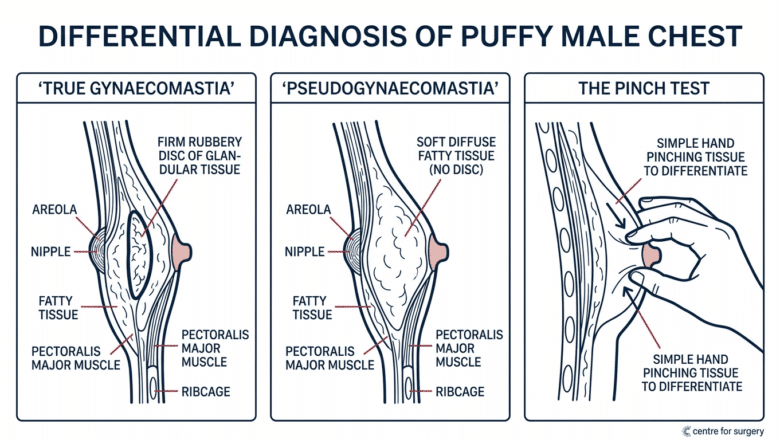
These terms are often used interchangeably, but they are not the same thing, and the difference changes the treatment.
- Puffy nipples describe the appearance: a nipple and areola that bulge forward, whatever the cause.
- True gynaecomastia is enlargement of the glandular breast tissue itself, driven by hormones. It often feels like a firm, rubbery disc directly beneath the areola. Established glandular tissue does not shrink with diet or exercise. Guidelines recommend surgery for long-lasting gynaecomastia that has not settled on its own[2].
- Pseudogynaecomastia is chest enlargement caused by fat, with no excess gland. It is soft and diffuse rather than a firm disc, and it responds to weight loss.
- Chest fat is fatty tissue across the whole chest, part of overall body fat.
A simple first check many men use is to pinch the tissue just beneath the areola between finger and thumb. A firm, rubbery, disc-like mass under the nipple (what many men describe as a hard nipple) points towards glandular gynaecomastia; soft, even fullness that feels the same as fat elsewhere points towards fat. Gynaecomastia tissue usually sits centrally behind the nipple, so a hard lump that is off to one side or fixed in place needs checking (see below). The pinch test is not a diagnosis, and the two often coexist, but it explains why some men do everything right in the gym and see no change. Guidelines recommend that a doctor’s examination confirms whether glandular tissue is present, both to tell gynaecomastia apart from fat and to rule out other breast lumps[2]. Our guide to gyno vs chest fat covers this distinction in more detail.
How is gynaecomastia graded?
Surgeons commonly grade gynaecomastia using the Simon classification, which sorts it by size and by whether there is excess skin: small enlargement without excess skin, moderate enlargement without excess skin, moderate enlargement with some excess skin, and marked enlargement with excess skin (often written as grades 1, 2a, 2b and 3). In a 2022 systematic review of surgical studies, most patients treated were grade 2[7]. The grade matters for treatment: where there is a lot of excess skin, liposuction and gland removal alone may not be enough, and skin removal is often needed[8]. Our guide to gynaecomastia grades explains each stage and what it usually needs.
Can You Have Puffy Nipples Without Gynaecomastia?
Yes. Puffy nipples without gynaecomastia are common, and there are two main reasons.
The first is fat. Fat beneath and around the areola can push it forward without any excess gland, which is why doctors examine the chest to tell the two apart[2].
The second is the shape of the areola itself. In some people the areola bulges forward as a soft dome above the rest of the chest, even when there is little gland or fat beneath it. Surgeons call this a herniated or pseudoherniated nipple-areola complex, also known as a protuberant or domed nipple. It can occur on its own, as part of another breast shape such as tuberous breasts, or after pregnancy[1]. In one published series of 125 patients treated for it, 87 were women and 38 were men[1]. Where treatment is wanted, the technique depends on the anatomy, for example removing a small amount of tissue from beneath the areola, reducing the areola, or both[1].
A puffy areola can also occur with a nipple that is flat or turns inward; our guide to inverted nipples covers that combination.
When Should You See a GP About Puffy Nipples?
Puffy nipples are usually harmless. But some changes need a doctor’s assessment rather than reassurance, so that other causes can be ruled out. Your GP can carry out the first check: guidelines suggest that this initial screening, to rule out fat, obvious breast cancer and testicular cancer, can be done by a GP before any specialist referral[2].
See your GP promptly if you notice any of the following:
- A hard or firm lump, especially one that is off-centre or fixed in place, rather than the soft or rubbery fullness of ordinary gynaecomastia
- Enlargement affecting only one side, especially if it is new or growing
- Rapid growth, or new breast enlargement as an adult man
- Discharge from the nipple, particularly if blood-stained
- Skin changes over the area, such as dimpling, puckering or ulceration
- A nipple that has newly turned inward
- Swollen lymph nodes in the armpit
- A lump, swelling or change in a testicle
In adult men, proper investigation finds an underlying cause in around 45 to 50% of cases, so a new enlargement is worth checking even if it seems minor[2]. Male breast cancer is rare, accounting for about 1% of all breast cancers[9], and gynaecomastia itself is not considered a pre-cancerous condition[2]. But the early signs of cancer can overlap with a benign lump, so a change with the features above should be examined before it is assumed to be cosmetic. Our guide on whether gynaecomastia increases breast cancer risk in men explains more. At consultation, any lump with concerning features is investigated rather than simply operated on.
Do Puffy Nipples Go Away With Weight Loss?
Sometimes. It depends on what the puffiness is made of. If it is mainly fat, losing weight usually reduces it, and for some men that is all that is needed. If it is mainly glandular tissue, weight loss may slim the chest overall, but the firm disc beneath the nipple usually stays, and it can look more obvious as the surrounding fat shrinks. Many men have a mix of the two, so weight loss often helps partly.
Higher body weight is linked with gynaecomastia[3], so it makes sense to reach a stable, healthy weight before deciding on surgery. Give a steady, sustainable programme several months. If a firm disc remains once you are at a healthy weight, it is likely to be gland rather than fat.
How to Get Rid of Puffy Nipples Without Surgery
What helps depends entirely on which of the two problems you have. If the fullness is fat rather than gland, it responds to the measures below. If it is glandular, it usually will not: training and dietary change do not remove established glandular tissue, and persisting with them for years is a common reason men arrive at consultation frustrated. Our guide to man boobs and what actually shifts them covers the distinction in more detail, and if the enlargement affects one side only, unilateral gynaecomastia explains why that happens and when it warrants assessment.
Give it time if you are still in puberty
In teenagers, puffy nipples caused by pubertal gynaecomastia settle on their own within two years in more than 90% of cases, so waiting is usually the right first step[2].
Lose body fat if the cause is fat
Fat on the chest is part of overall body fat, so the effective approach is a balanced, calorie-controlled diet with regular exercise, rather than chest exercises alone. Chest-focused training such as press-ups, bench press and dips builds the muscle underneath, which can improve the shape of the chest, but it will not remove glandular tissue or burn fat from one chosen spot.
Cut down on alcohol
Alcohol is one of the substances linked to gynaecomastia[6], and long-term heavy drinking can lead to liver disease, which is itself a recognised cause[5]. Keeping within recommended limits helps.
Review medicines and stop anabolic steroids
If a medicine may be contributing, discuss it with the doctor who prescribed it; never stop prescribed medication without advice. Stopping anabolic steroids removes one clear driver. Guidelines recommend a period of watchful waiting after an underlying cause is treated or a substance is stopped, because the tissue can settle[2].
Can tablets or supplements get rid of puffy nipples?
Tablets such as tamoxifen, raloxifene, anastrozole and letrozole are often recommended on forums and bodybuilding sites. The European Academy of Andrology guidelines do not recommend selective oestrogen receptor modulators, aromatase inhibitors or non-aromatisable androgens for treating gynaecomastia in general[2]. Specialists occasionally consider tamoxifen for gynaecomastia at an early stage, before the tissue becomes fibrous[5], but that is a decision for a doctor after assessment. Testosterone is recommended only for men with a proven testosterone deficiency on blood testing[2]. Buying any of these online to self-treat is a poor idea: they have real side effects, they are being taken without a diagnosis, and the underlying cause goes uninvestigated.
The same applies to supplements and creams marketed for the purpose, including turmeric. We are not aware of good evidence that any of them reduces glandular breast tissue.
Puffy Nipple Surgery: Options, Risks and Results
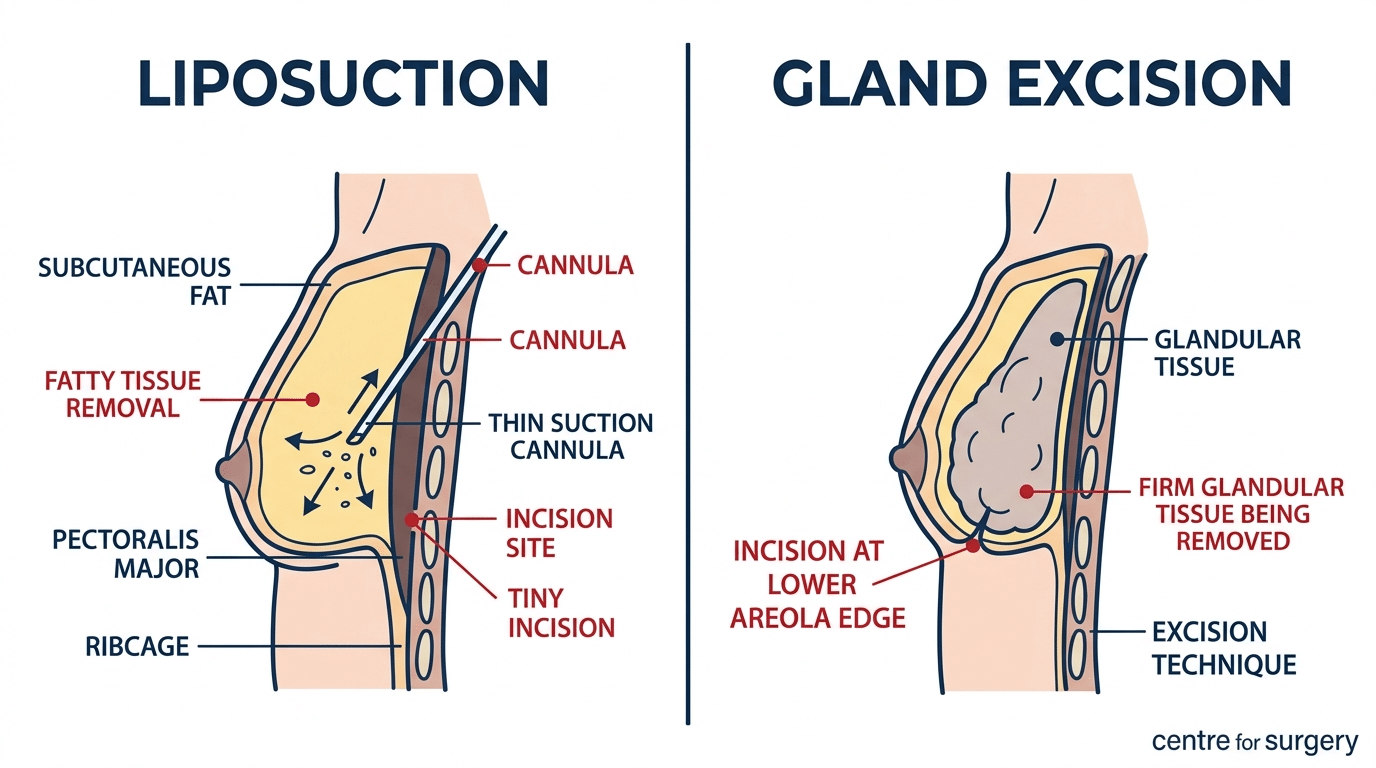
When puffy nipples persist despite lifestyle measures, or when the cause is glandular from the outset, surgery is the treatment guidelines recommend for long-lasting gynaecomastia that has not settled on its own. The type and extent of surgery depend on the size of the enlargement and the amount of fat[2].
Liposuction
Where the puffiness is largely fatty, liposuction removes the excess fat through tiny incisions using a fine cannula. Power-assisted and VASER liposuction are both available and suit the fibrous tissue of the male chest, and your surgeon will advise which suits you. Removing the fat beneath the areola can also make the areola itself smaller: in one study of 30 men, ultrasound-assisted liposuction alone reduced the average areola diameter from 35.4 mm to 28.6 mm at six months[10]. Liposuction alone, however, often cannot remove firm glandular tissue.
Gland removal through the edge of the areola
Where firm glandular tissue is responsible, as in true gynaecomastia, it is removed directly through a small incision along the lower edge of the areola (a periareolar or Webster incision), placed where the darker skin of the areola meets the chest skin so that the scar is less noticeable. Many gynaecomastia operations combine liposuction for the fatty component with direct removal of the gland. In a 2022 systematic review, minimally invasive approaches were the most commonly used and had the lowest complication rates[7].
Nipple and areola reduction
Where an enlarged or stretched areola accompanies the puffiness, nipple reduction or areola reduction can be performed at the same time to give a more proportionate result. Nipple reduction is often carried out under local anaesthetic.
What are the risks of puffy nipple surgery?
Like any operation, gynaecomastia and puffy nipple surgery carries risks. A 2022 systematic review of 53 studies including 5,345 patients ↗ found complication rates of roughly 12 to 22% across the different surgical approaches, with bleeding into the tissues (haematoma) and bruising the most commonly reported problems[7]. Other possible complications include a collection of fluid (seroma), infection, changes in nipple sensation, contour irregularities, a dip beneath the nipple if too much tissue is removed, asymmetry, noticeable scarring, and some tissue remaining that may need a further procedure. Your surgeon will go through these with you at consultation.
What results can you expect?
The same review found that most patients were satisfied with their results, although the authors noted a relatively high risk of bias in the underlying studies[7]. Results vary between individuals, and swelling takes several months to settle fully.
For a dedicated overview of surgery to correct enlarged male breast tissue, see our gynaecomastia surgery page.
Can Loose Skin Be Tightened After Gynaecomastia Surgery?
In some men, particularly after significant weight loss or where larger volumes of tissue are removed, the chest skin has lost elasticity and may not fully retract once the gland and fat are gone. Where there is a lot of loose skin, surgical skin removal is often still needed, which leaves longer scars[8].
Argo Plasma skin tightening may help in selected men with milder laxity. A fine probe delivers plasma energy beneath the skin, heating the deeper layers in a controlled way so that the tissue contracts and new collagen forms over the following months. Used alongside liposuction and gland removal, it aims to improve skin contraction on the male chest without open skin removal. Evidence for skin-tightening techniques after gynaecomastia surgery is still limited and controlled studies are lacking[8], so it is not suitable for everyone and does not replace skin removal where laxity is marked. Your surgeon will advise whether it is appropriate for you.
What Happens on the Day of Surgery?
Correction of puffy nipples is a day-case procedure. Minor cases limited to nipple or areola reshaping are often performed under local anaesthetic alone. More extensive gynaecomastia correction, combining liposuction with gland removal, is usually carried out under total intravenous anaesthesia (TIVA), in which the anaesthetic medicines are given through a drip, or under local anaesthetic with sedation.
The operation itself generally takes one to two hours, depending on the extent of correction. Incisions are small and positioned at the edge of the areola to keep scarring discreet, and are closed with fine stitches. You return home the same day.
Recovery After Puffy Nipple Surgery
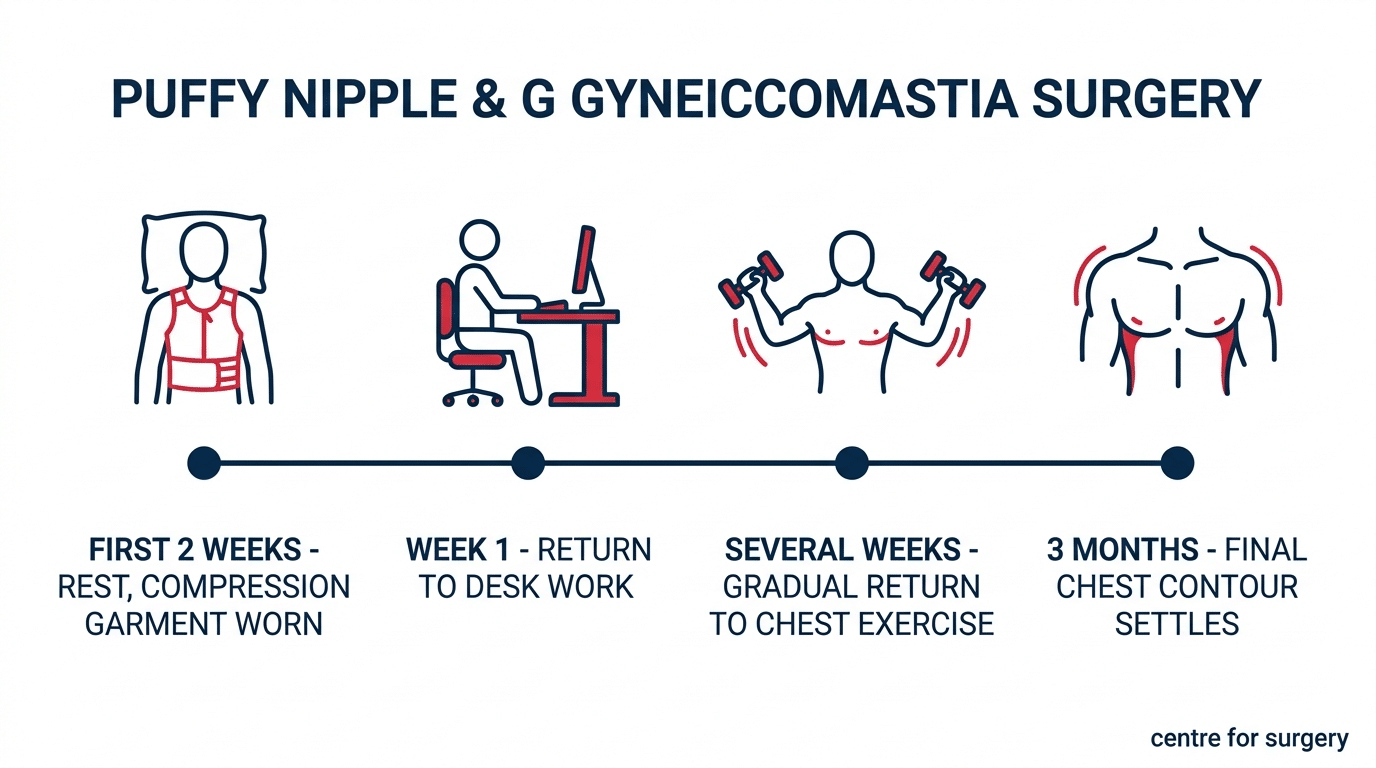
Recovery from gynaecomastia and puffy nipple surgery is usually manageable:
- Take the first two weeks gently, avoiding strenuous activity and heavy lifting.
- A compression garment is worn to reduce swelling and support the healing contour.
- Discomfort in the early days is usually controlled with simple pain relief.
- Many people return to desk-based work within one to two weeks.
- Chest exercise is reintroduced gradually, on your surgeon’s advice, usually after several weeks.
- Swelling settles over weeks, with the final contour emerging over about three months, and sometimes longer.
Following your surgeon’s aftercare instructions closely helps your recovery go smoothly. Our guide to gynaecomastia recovery and aftercare covers each stage in more detail.
Puffy Nipples in Women: Causes and Treatment
Women can have puffy nipples too, and the causes differ. In women a puffy nipple or areola is often linked to the natural shape of the breast, hormonal changes across the menstrual cycle, pregnancy and breastfeeding, hormonal contraception or weight change.
One recognised cause is a herniated nipple-areola complex, where breast tissue pushes forward into the areola to form a dome. It can occur on its own, but it is most often found as part of another breast shape such as tuberous breasts, and it can also appear after pregnancy[1]. Tuberous breasts are a developmental variation in breast shape that often includes a widened, puffy areola; our guide to tuberous breasts explains the grades and correction options.
Many of the other causes are temporary: puffiness linked to the menstrual cycle, pregnancy or breastfeeding often settles without any treatment, and adjusting hormonal contraception or body weight can help. Where the change is permanent and unwanted, surgical options such as nipple or areola reduction, and in some cases a breast lift or breast reduction, can change the shape. As in men, the right approach depends on an accurate assessment of the cause.
Which cosmetic surgery for men is right for you?
A few short questions, including a simple pinch test if stomach fat is your concern. You will get a suggested procedure, realistic recovery times, and an honest answer if surgery is not what you need.
Frequently Asked Questions

Do puffy nipples go away on their own?
Sometimes. Puffy nipples that appear during puberty settle on their own in most boys, usually within two years[2]. Those linked to weight gain or a medicine can improve when the cause is addressed. Established glandular tissue in an adult usually does not go away without treatment.
What do puffy nipples mean in men?
In most men they mean a small amount of glandular breast tissue, extra fat beneath the areola, or simply a naturally domed areola. They are usually harmless. A new, one-sided, hard or rapidly growing change should be checked by a GP.
How do I get rid of puffy nipples as a man?
Start by working out the cause. If it is fat, steady weight loss through diet and exercise is the answer; if a medicine or anabolic steroids may be involved, review them with a doctor. If a firm disc of gland remains after that, surgery to remove the gland, often combined with liposuction, is the usual treatment.
How do I get rid of puffy nipples naturally?
Natural approaches work on the fat component only: losing body fat, cutting down on alcohol and stopping anabolic steroids. We are not aware of any food, supplement, cream or exercise that has been shown to remove glandular breast tissue.
Can exercise get rid of puffy nipples?
Only if the cause is fat. Chest exercise builds the muscle beneath, and reducing body fat helps where the puffiness is fatty. If the cause is glandular gynaecomastia, exercise will not remove it, however consistent you are, which is why some men train hard and see no change.
How do I know if it’s gland or fat?
Firm, rubbery, disc-like tissue directly beneath the areola suggests gland; soft, even fullness suggests fat. The two often coexist. A doctor can tell them apart on examination, which is what determines whether liposuction, gland removal, or both are needed.
Is puffy nipple surgery painful?
Minor corrections under local anaesthetic usually involve little discomfort. You will not feel more extensive surgery under TIVA, and discomfort in the following days is usually mild and controlled with simple pain relief.
How long does the surgery take?
Typically one to two hours, depending on the extent of correction. Smaller corrections under local anaesthetic can take less time.
Will I have visible scars?
Incisions are small and placed at the edge of the areola, where they usually heal discreetly. Scars fade over the months after surgery, although how well they settle varies from person to person.
Can puffy nipples come back after surgery?
Gland and fat cells that are removed do not grow back, so results are usually long-lasting. Significant weight gain, anabolic steroids or some medicines can cause new tissue to develop. If a small amount of tissue remains after healing, a minor revision can sometimes be performed, and your surgeon will assess this at follow-up.
How should I prepare for surgery?
You will be given detailed instructions. Typically this includes stopping smoking for several weeks before and after, avoiding aspirin-containing medications that increase bleeding risk, arranging time off work, and fasting beforehand if your procedure is under TIVA. Following the preparation advice helps reduce the risk of complications.
What type of doctor treats puffy nipples?
Your GP is the right first step, especially for a new change in an adult, and may refer you to an endocrinologist if a hormone problem is suspected. Surgery is carried out by a plastic surgeon; at Centre for Surgery, correction is performed by GMC-registered plastic surgeons.
Why is my areola so big?
Areola size varies widely, and a large areola on its own is a normal variation rather than a sign of illness. The usual reasons are genetics, puberty, pregnancy and breastfeeding, overall breast size and weight change, which stretches the skin around the nipple. In men, a disc of gland or fat beneath the areola can push it forward and make it look wider. A sudden change on one side, a new lump, nipple discharge or skin changes should be checked by your GP. If the size simply bothers you, areola reduction can make it smaller.
Does gynaecomastia hurt when you touch it?
It can. Tenderness or soreness is common while breast tissue is actively growing, which is why it is typical during puberty or after starting a medicine or anabolic steroids that trigger it; the NHS ↗ lists tender or painful breast tissue among the symptoms. Long-standing gynaecomastia is usually painless, as the tissue becomes firmer and more fibrous with time, and puffiness caused by fat alone is usually not tender. A hard lump that feels fixed, or one-sided swelling with discharge, should be seen by a GP rather than waited out.
Will losing weight reduce areola size?
Sometimes, a little. If fat behind the nipple is pushing the areola outward, losing body fat can flatten it and make it look smaller. Weight loss does not shrink glandular tissue, and stretched areolar skin does not always tighten back, so after a large weight loss the areola can stay wide or even look looser. If a firm disc remains once your weight is stable, gynaecomastia surgery to remove the gland, with areola reduction where needed, is the usual option.
Puffy Nipple Treatment at Centre for Surgery
Centre for Surgery is a private hospital at 95–97 Baker Street in London, rated “Good” overall by the Care Quality Commission. Treatment for puffy nipples and gynaecomastia is carried out by GMC-registered plastic surgeons.
At consultation, your surgeon will examine the chest, establish whether the cause is glandular, fatty or both, and, where a lump has any concerning features, arrange appropriate assessment rather than proceeding straight to surgery. Where surgery is appropriate, the technique is matched to the cause, and the risks and recovery are discussed with you before you decide.
We recommend a two-week cooling-off period between consultation and surgery. For procedures over £1,500, finance is available through Chrysalis Finance, subject to status. See our finance options for details.
Phone: 020 7993 4849
Email: contact@centreforsurgery.com
Address: 95–97 Baker Street, London W1U 6RN
References
- Andjelkov K, Music N, Mosahebi A, et al. Management of nipple-areola deformity. Aesthetic Plastic Surgery 2021;45(4):1407–1415. doi:10.1007/s00266-021-02308-1 ↗
- Kanakis GA, Nordkap L, Bang AK, et al. EAA clinical practice guidelines: gynecomastia evaluation and management. Andrology 2019;7(6):778–793. doi:10.1111/andr.12636 ↗
- Berger O, Hornik-Lurie T, Talisman R. Pubertal gynecomastia incidence among 530,000 boys: a cross sectional population based study. Frontiers in Pediatrics 2024;12:1367550. doi:10.3389/fped.2024.1367550 ↗
- Guss CE, Divasta AD. Adolescent gynecomastia. Pediatric Endocrinology Reviews 2017;14(4):371–377. doi:10.17458/per.vol14.2017.GD.Gynecomastia ↗
- Baumann K. Gynecomastia: conservative and surgical management. Breast Care 2018;13(6):419–424. doi:10.1159/000494276 ↗
- Deepinder F, Braunstein GD. Drug-induced gynecomastia: an evidence-based review. Expert Opinion on Drug Safety 2012;11(5):779–795. doi:10.1517/14740338.2012.712109 ↗
- Prasetyono TOH, Andromeda I, Budhipramono AG. Approach to gynecomastia and pseudogynecomastia surgical techniques and its outcome: a systematic review. Journal of Plastic, Reconstructive & Aesthetic Surgery 2022;75(5):1704–1728. doi:10.1016/j.bjps.2022.02.008 ↗
- Frigerio G, Serre A, Engels PE, et al. Available techniques to minimize scars in surgical management of gynecomastia: a comprehensive review. JPRAS Open 2024;42:256–267. doi:10.1016/j.jpra.2024.09.011 ↗
- Gucalp A, Traina TA, Eisner JR, et al. Male breast cancer: a disease distinct from female breast cancer. Breast Cancer Research and Treatment 2019;173(1):37–48. doi:10.1007/s10549-018-4921-9 ↗
- Keskin M, Sutcu M, Hanci M, et al. Reduction of the areolar diameter after ultrasound-assisted liposuction for gynecomastia. Annals of Plastic Surgery 2017;79(2):135–138. doi:10.1097/SAP.0000000000000994 ↗