



In this guide10 sections
- What Is Gynecomastia?
- At What Age Does Gynecomastia Typically Occur?
- Is Surgery the Right Solution?
- Gynecomastia Surgery Age: The Minimum Age and Why It Exists
- Persistent Gynecomastia in Adulthood: When Surgery Becomes a Viable Option
- Does Age Affect Gynecomastia Surgery Recovery or Results?
- Alternatives to Surgery — What Can Help at Any Age
- Who Is a Suitable Candidate for Gynecomastia Surgery?
- Frequently Asked Questions
- Gynecomastia Surgery at Centre for Surgery: Expert Care You Can Trust
Quick answer: At Centre for Surgery, we only treat adults aged 18 and over, which is also the standard minimum age for elective cosmetic surgery in the UK. We do not operate on anyone under 18. For teenagers, the right first step is to see a GP, who can check for an underlying cause and refer to NHS paediatric or endocrine services if needed. Pubertal gynecomastia usually settles on its own as hormones stabilise. Most men who have gynecomastia surgery are aged 20–39, addressing tissue that developed during puberty and never resolved on its own.
Gynecomastia is a condition that causes the enlargement of breast tissue in males. It can develop at any stage of life, often due to hormonal changes, weight fluctuations, medication side effects, or underlying health conditions. While some cases resolve on their own, others persist and may require surgical intervention. One of the most common questions we’re asked — both at consultation and searched online as “what age does gyno go away” or “when does gynecomastia go away” — is about the appropriate age for undergoing the procedure.
What Is Gynecomastia?
Gynecomastia is a condition that leads to the enlargement of breast tissue in men. It is relatively common — estimated to affect between one and two thirds of men at some point in their lives, though exact figures are difficult to pin down as many cases go unreported due to embarrassment. It can be triggered by a range of factors, including hormonal imbalances, the use of certain medications, obesity, or genetic predisposition. While not usually harmful in a medical sense, gynecomastia can cause significant physical and psychological discomfort, often leading individuals to seek treatment to restore a more masculine chest appearance.
Gynecomastia vs Pseudogynecomastia
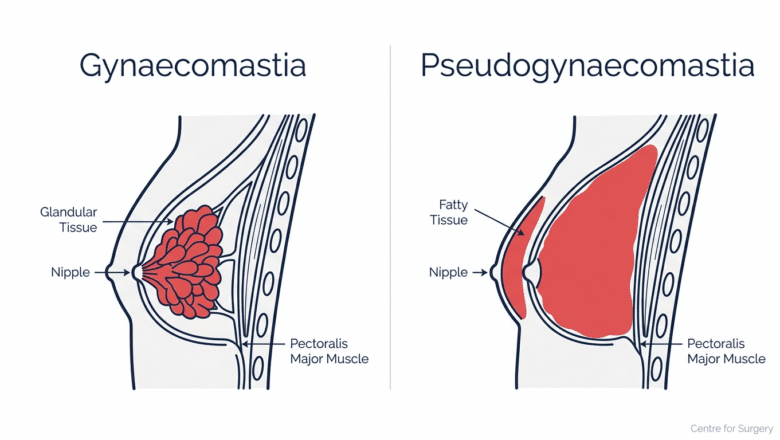
Gynecomastia is firm glandular tissue behind the nipple; pseudogynecomastia is soft, evenly distributed fat — the distinction affects which technique treats it, and at what age it’s likely to respond to non-surgical measures.
It’s worth being precise about terminology, since the two are often confused and respond differently to treatment:
- True gynecomastia — firm, glandular tissue that develops directly behind the nipple, often causing tenderness or a pointed, puffy appearance. This doesn’t reliably respond to weight loss, since it isn’t fat.
- Pseudogynecomastia — soft, fatty tissue distributed evenly across the chest, more closely linked to overall body weight, and more likely to improve with weight loss alone at any age.
Our dedicated guide on gynecomastia vs chest fat covers this distinction in full detail, including how your surgeon assesses which one you have at consultation.
What Causes Gynecomastia?
At its core, gynecomastia is the result of an imbalance between testosterone and oestrogen. During puberty, hormonal fluctuations are common, and many teenage boys experience temporary breast enlargement. In most cases, as hormone levels stabilise with age, the condition resolves on its own. However, for some, the excess breast tissue does not disappear, leading to persistent gynecomastia into adulthood.
Beyond puberty, other factors can contribute to gynecomastia. Obesity can lead to higher oestrogen production, promoting breast tissue growth. Certain medications, including anabolic steroids, antidepressants, and drugs used to treat heart conditions, can also disrupt hormonal balance. Medical conditions such as liver disease, thyroid disorders, and kidney problems may also contribute.
At What Age Does Gynecomastia Typically Occur?
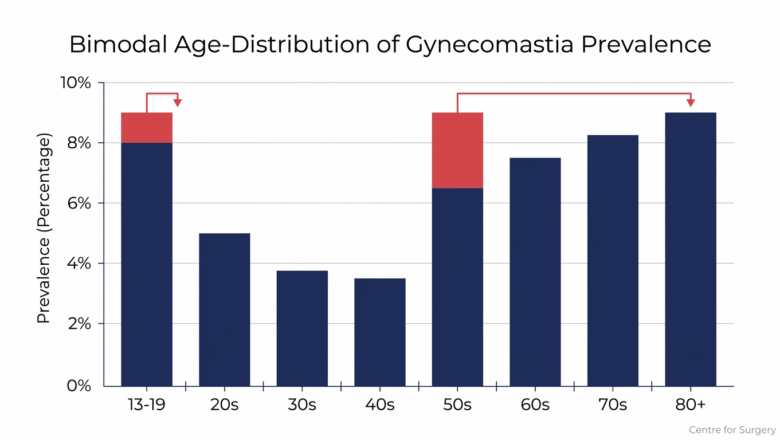
Gynecomastia prevalence follows a bimodal pattern — peaking during puberty, dipping through early-to-mid adulthood, and rising again from around age 50.
Gynecomastia is fundamentally hormonal, so it tends to cluster around two life stages where hormone levels are naturally in flux:
- Adolescence — a substantial proportion of teenage boys experience some degree of gynecomastia during puberty, most commonly resolving without treatment as hormone levels settle, typically by around age 18.
- Older age — a significant proportion of men develop gynecomastia again between roughly ages 50 and 80, as testosterone naturally declines relative to oestrogen.
Interestingly, the age at which men actually have surgery doesn’t map directly onto the age at which gynecomastia is most prevalent. Most gynecomastia surgery patients are aged 20 to 39 — typically addressing tissue that developed during adolescence and never fully resolved, rather than gynecomastia that developed later in life. Fewer older men choose surgery, likely for a mix of personal, aesthetic, and health-related reasons.
Is Surgery the Right Solution?
For men who experience long-term or severe gynecomastia, surgery can be an effective treatment to restore a flatter, more masculine chest contour. The procedure typically involves the removal of excess glandular tissue, fat, or a combination of both. Many men who undergo gynecomastia surgery report a significant improvement in their self-confidence and overall quality of life.
Surgical Techniques
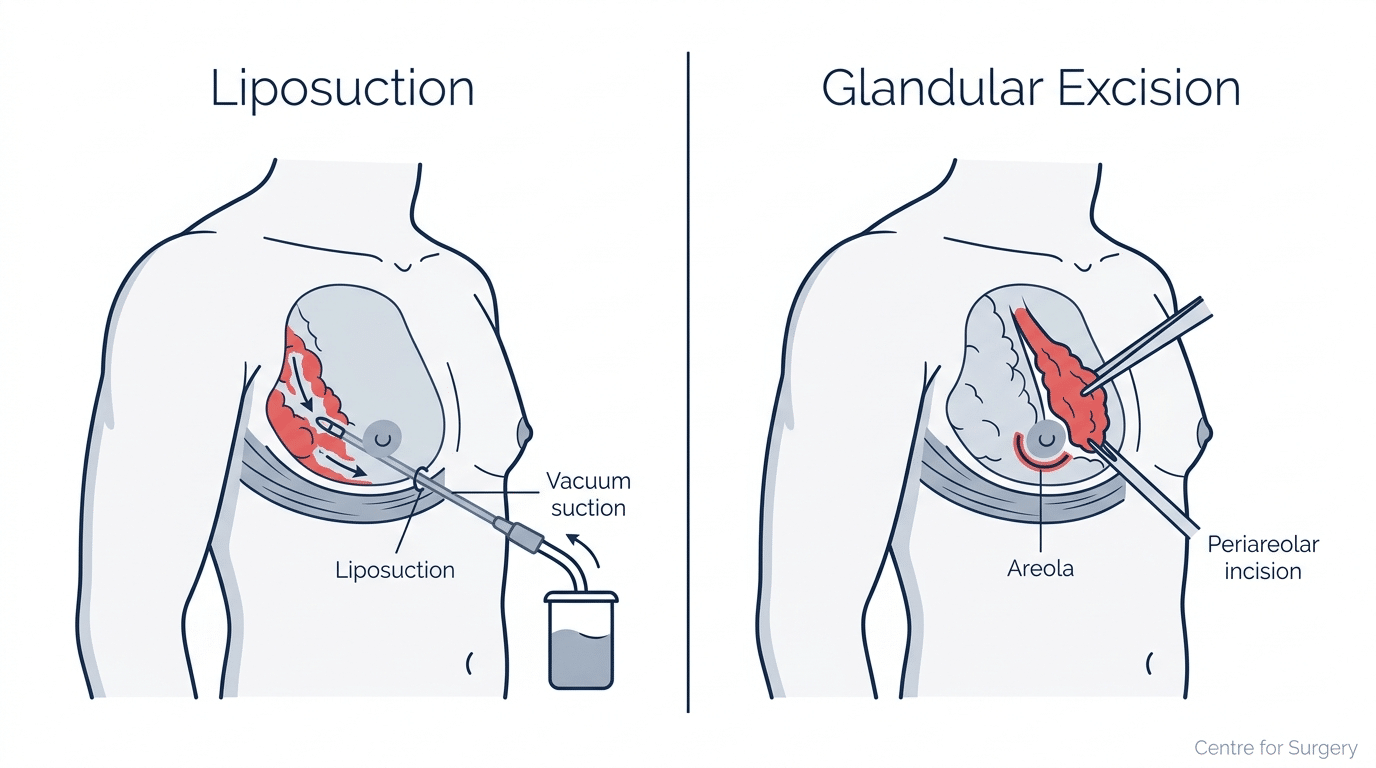
Liposuction removes fatty tissue; glandular excision removes the firm glandular tissue behind the nipple — many cases combine both for a complete result.
- Liposuction — removes fatty tissue via a fine cannula, effective for pseudogynecomastia and the fatty component of mixed cases.
- Glandular excision — a small periareolar incision allows direct surgical removal of firm glandular tissue that liposuction alone cannot address.
Many patients need a combination of both, since gynecomastia is frequently a mix of glandular and fatty tissue in varying proportions. Your surgeon will assess your specific composition at consultation to determine the right approach.
Gynecomastia Surgery Age: The Minimum Age and Why It Exists
In the UK, 18 is the standard minimum age for gynecomastia surgery, as it is for elective cosmetic surgery generally, and UK professional guidance for doctors sets a very high bar for cosmetic procedures in anyone younger. At Centre for Surgery, we only treat adults aged 18 and over, and we do not operate on anyone under 18 in any circumstances. This isn’t an arbitrary cut-off: it reflects clinical reality, as significant physical growth and hormonal change can continue into the early twenties, meaning chest development genuinely isn’t always complete at 18 either.
During adolescence, gynecomastia is common and, for most teenagers, temporary — resolving on its own as hormone levels stabilise. For this reason, surgeons generally recommend waiting before considering surgical treatment. Performing gynecomastia surgery too early risks operating on tissue that would have resolved naturally, and risks recurrence if hormonal fluctuations are still ongoing.
Gynecomastia Surgery Under 18: What to Do Instead
Centre for Surgery only treats adults aged 18 and over. We do not operate on anyone under 18 or assess them for surgery. If you are a teenager with gynecomastia, or the parent of one, the right first step is to see your GP. A GP can check for an underlying cause, such as a medication side effect or a hormonal problem, and refer to NHS paediatric or endocrine services if needed. Most pubertal gynecomastia settles on its own as hormones stabilise, and you are welcome to book a consultation with us once you are 18.
More generally in the UK, younger patients with a genuine medical need are assessed and managed through the NHS, usually by specialist paediatric teams, rather than through private cosmetic surgery. For adults, our guide to gynecomastia surgery on the NHS explains the funding criteria, which usually include being 18 or over.
Some situations mean a teenager should see their GP promptly rather than simply waiting:
Abnormal Tissue Development
Though gynecomastia is usually benign, any breast tissue change carries a small associated risk of more serious underlying pathology, and this shouldn’t be assumed away in a younger patient. Signs that warrant prompt medical review — rather than waiting — include a firm or hard lump, dimpled or textured skin, or nipple discharge. A GP can arrange the right investigations and, where needed, a referral to NHS specialist services.
Physical Discomfort
Glandular tissue growth can genuinely hurt — tenderness, pain, increased nipple sensitivity causing painful rubbing against clothing, and skin irritation or rashes in the affected area are all recognised physical symptoms. Where these are significantly affecting a teenager’s daily life, it’s worth raising with a GP, who can look for the cause and advise on managing the symptoms.
Psychological Impact
Embarrassment and self-consciousness are common with gynecomastia at any age, and in more severe cases this can develop into anxiety, depression, or body dysmorphia. If a teenager is struggling, a GP is a good first port of call and can arrange support, including a referral to NHS mental health services where appropriate. Adolescent self-image is shaped by many factors, and talking things through early can make a real difference.
None of these situations changes our age policy: Centre for Surgery only treats adults aged 18 and over. If gynecomastia is still present once you turn 18, you are welcome to book a consultation with one of our surgeons.
Persistent Gynecomastia in Adulthood: When Surgery Becomes a Viable Option
When gynecomastia persists into adulthood — particularly in the early 20s and beyond — it is much less likely to improve without medical intervention. By the time a man reaches his 20s, hormone levels have generally stabilised. If gynecomastia remains, it is unlikely that the condition will resolve on its own, and surgery often becomes the most effective treatment option.
When consulting with a plastic surgeon, candidates are often advised to undergo medical tests to determine whether any specific underlying causes need to be addressed. If a clear underlying cause is identified, managing or treating this issue is usually recommended before proceeding with surgery. However, if the glandular tissue has already become well-established, surgical removal remains the only definitive solution.
As men age, testosterone levels naturally decline, leading to changes in body composition and potential breast tissue growth. Regardless of when the condition occurs, gynecomastia surgery remains an effective option at any adult age, provided the patient is otherwise fit for surgery.
Does Age Affect Gynecomastia Surgery Recovery or Results?
This is a genuinely useful question that doesn’t get asked as often as it should, since age affects more than just eligibility — it can influence the recovery experience and final result too.
Skin elasticity is the biggest factor. Younger patients typically have more elastic skin, which retracts more readily over the newly flattened chest contour once glandular tissue and fat are removed. Older patients — particularly those with longstanding gynecomastia and reduced skin elasticity — are more likely to have a degree of residual skin laxity after surgery, since the skin has less natural ability to shrink back down. This doesn’t mean surgery is any less effective; it simply means your surgeon may discuss the possibility of a combined skin-tightening approach, or occasionally a formal chest lift, for older patients with significant excess skin.
Healing speed also varies somewhat with age and general health, though the difference is generally modest for otherwise fit, healthy adults across a wide age range. What matters more than age alone is overall physical condition — a fit 55-year-old will typically heal faster than an unfit 25-year-old.
Recovery expectations are broadly similar regardless of age: most patients return to light activity within a few days, wear a compression garment for around 4 to 6 weeks, and see final results settle over 3 to 6 months as swelling fully resolves.
Recurrence risk is arguably the area where age matters most. In younger patients whose hormones are still settling, there’s a genuine (if generally low) risk that gynecomastia could return if underlying hormonal factors aren’t fully resolved — one of the key reasons surgeons are cautious about operating too early. In adult patients with stable, well-established gynecomastia, recurrence after properly performed surgery is uncommon.
Alternatives to Surgery — What Can Help at Any Age
For men not yet ready for, or not suitable for, surgery, several non-surgical approaches can help manage gynecomastia — though none match the permanence of surgical correction for established glandular tissue:
- Weight loss — where excess weight contributes to the appearance of enlarged breasts (particularly relevant for pseudogynecomastia), a structured diet and exercise programme can meaningfully help, and can also influence hormone levels that contribute to true gynecomastia.
- Hormonal medication — for gynecomastia caught within its first 12 months of development, medication may help slow progression or reduce existing tissue in some cases. This requires assessment by a GP or specialist.
- Compression garments — a compression vest worn under clothing can reduce the visible appearance of gynecomastia day-to-day, offering a temporary confidence boost rather than a permanent solution.
Who Is a Suitable Candidate for Gynecomastia Surgery?
At Centre for Surgery, we only treat adults aged 18 and over, so the minimum age for gynecomastia surgery with us is 18, with no exceptions. Beyond age, several other factors must be considered. Being in good physical health is essential, and a stable body weight is also important — while gynecomastia surgery removes excess glandular tissue and fat, it is not a substitute for weight loss, particularly where pseudogynecomastia is a significant contributing factor.
Hormonal stability is another key factor. Your surgeon may recommend hormone tests to rule out any underlying medical causes. If an imbalance is detected, addressing the issue first may help to prevent gynecomastia from recurring after surgery.
Smoking and excessive alcohol consumption can significantly impact healing and increase the risk of complications. For those who use anabolic steroids or other substances known to contribute to gynecomastia, stopping their use is essential before considering surgery.
As with any type of plastic surgery, having realistic expectations is crucial. Gynecomastia surgery at Centre for Surgery is performed under TIVA (Total Intravenous Anaesthesia) — delivered entirely intravenously without inhaled anaesthetic gases, for a smoother, faster recovery than traditional inhalational general anaesthesia. Your surgeon will explain the expected results, recovery process, and potential risks in full during your consultation.
Frequently Asked Questions
What age does gynecomastia (gyno) go away?
For many teenage boys, gynecomastia that develops during puberty resolves on its own as hormone levels stabilise, typically by around age 18. There’s no single age that applies to everyone, and gynecomastia that persists into the early-to-mid 20s is significantly less likely to resolve without treatment.
At what age is gynecomastia considered permanent?
There’s no fixed age at which gynecomastia becomes permanent, but the likelihood of natural resolution drops considerably once hormone levels have stabilised in early adulthood. For men over roughly 50 developing gynecomastia for the first time, it’s less likely to resolve on its own without treatment.
Does gynecomastia get worse with age?
Without treatment, established glandular gynecomastia doesn’t typically improve on its own once hormone levels have settled — it generally either stays stable or can gradually become more noticeable, particularly if accompanied by weight gain. Surgery, involving removal of the tissue and glands responsible for the growth, remains the most effective way to address this permanently.
Can you get gynecomastia surgery under 18 in the UK?
Not at Centre for Surgery. We only treat adults aged 18 and over and do not operate on anyone under 18 in any circumstances. In the UK, 18 is the standard minimum age for elective cosmetic surgery. If you are under 18, the right first step is to see your GP, who can check for an underlying cause and refer to NHS paediatric or endocrine services if needed. Most pubertal gynecomastia settles on its own as hormones stabilise, and you are welcome to book a consultation with us once you are 18.
Does gynecomastia surgery work as well at any age?
Yes — surgery is effective at any adult age, though skin elasticity (generally better in younger patients) can influence how smoothly the skin retracts afterwards, and recurrence risk is somewhat higher in younger patients whose hormone levels haven’t fully settled. Your surgeon will factor this into your individual assessment and aftercare plan.
How much does gynecomastia surgery cost?
At Centre for Surgery, gynecomastia surgery costs are confirmed following a face-to-face consultation, based on the specific technique required (liposuction, glandular excision, or a combination) and individual case complexity. See our dedicated gynecomastia surgery cost guide for full pricing information.
Gynecomastia Surgery at Centre for Surgery: Expert Care You Can Trust
At Centre for Surgery, we specialise in advanced gynecomastia surgery, offering tailored solutions for men seeking to restore a flatter, more masculine chest. Our team of highly experienced, GMC-registered plastic surgeons, based at our CQC-regulated Baker Street clinic in London — rated “Good” overall — are dedicated to providing exceptional patient care with a focus on safety, precision, and good results. We provide personalised treatment plans to ensure every patient achieves their desired outcome, from initial consultation through to post-operative aftercare.
Our surgeons are highly skilled in both liposuction and glandular excision techniques, using the latest approaches to minimise scarring and enhance recovery. We understand the psychological impact of gynecomastia, which is why we prioritise a discreet and professional service throughout.
To book your consultation: 95-97 Baker Street, London W1U 6RN | 020 7993 4849 | contact@centreforsurgery.com
Learn more about us on our About Us page, meet our expert surgeons, explore our finance options, read our Plastic Surgery Blog, and browse our Clinic FAQs.

Related Articles
- Will I Develop Loose Skin After Gynecomastia Surgery?
- Can Antidepressants Cause Gynecomastia?
- Celebrities With Gynecomastia
- What Causes Gynecomastia?
- Does Gynecomastia Go Away?
- UK Gynecomastia Clinics
- Does Exercise Prevent Gynecomastia?
- Steroid Gyno: Why Steroids Cause Gynecomastia and What Fixes It


