


In this guide19 sections
- Key Points
- What Is a Lower Facelift?
- What Causes Jowls?
- How Is a Jowl Lift Performed?
- Lower Facelift vs Mini Facelift vs Neck Lift
- Lower Face and Neck Lift
- Jowl Lift Before and After
- Who Is a Good Candidate for a Lower Facelift?
- What Is the Best Age for a Lower Face Lift?
- Lower Facelift Recovery
- How Long Does a Jowl Lift Last?
- Lower Facelift Risks
- Is a Jowl Lift Worth It?
- How to Lift the Lower Face Without Surgery
- What Is a Cinderella Facelift?
- How Much Does a Lower Facelift Cost?
- Frequently Asked Questions
- Lower Facelift at Centre for Surgery
- References
Key Points
- A lower facelift is a jowl lift. It tightens the deeper tissue and skin of the lower third of the face to lift the jowls, sharpen the jawline and smooth the upper neck.
- Jowls have a clear anatomical cause. Jowl fat sits in its own compartment, held at the jaw by a fibrous band, and drops forward as the supporting tissue weakens with age.
- It sits between a mini facelift and a full facelift. A mini facelift treats early jowls through a shorter incision; a lower facelift reaches further into the neck; a full facelift also lifts the cheeks.
- The neck is often treated at the same time. A lower face and neck lift corrects jowls and a sagging neck together.
- Recovery takes about two weeks socially. Most patients go home the same day, return to desk work at around two weeks and see the final result at three to six months.
- Non-surgical treatments can soften early jowls. Fillers, skin tightening and anti-wrinkle injections help, but they cannot lift loose skin and tissue in the way surgery does.
A lower facelift, also called a lower face lift or jowl lift, is surgery that lifts sagging jowls, restores a clean jawline and tightens the top of the neck. It works on the deeper supporting layer of the face as well as the skin, which is why it gives a natural and long-lasting result. At Centre for Surgery it sits alongside the mini facelift, full facelift and neck lift, and the right choice depends on how far the ageing has progressed.
This guide explains what a lower facelift is, what causes jowls in the first place, how the operation is performed, how it compares with a mini facelift and a neck lift, what results and recovery look like, and when a non-surgical approach is enough. If you are not yet sure whether your concern is jowls or something else, our guide to sagging jowls is a good place to start.
What Is a Lower Facelift?
A lower facelift is a facelift that concentrates on the lower third of the face: the jowls, the jawline, the corners of the mouth and the upper neck. Through an incision that runs in front of the ear, around the earlobe and behind the ear, the surgeon lifts the SMAS (the layer of muscle and fibrous tissue beneath the facial fat), repositions it upwards and backwards, and then redrapes the skin over it without tension.
The lift is done in the deeper layer rather than by pulling the skin, so the face looks rested rather than stretched. It is sometimes called a lower face and neck lift when the neck is treated through the same incisions. Surgeons who use the term “jowl lift” usually mean the same operation, and the terms are used interchangeably by patients. Our guide to the types of facelift shows where it fits among the other options.
What Causes Jowls?
Facial fat is not one continuous layer. It is divided into separate compartments, and the jowl is the lowest of them.[1] Two pieces of research explain why this compartment drops.
In a 2008 cadaver study in Plastic and Reconstructive Surgery, researchers dyed and dissected 16 half-faces and found that jowl fat sits in two compartments above the jawbone, separated from the fat of the neck by a fibrous band called the mandibular septum. This band is fixed to the jawbone and tethers the skin to it.[2] As the jowl fat above it descends, the tethered point stays put, which is why jowls form a bulge beside the chin with a dip in front of them, rather than the whole jawline sagging evenly.
A 2008 study in Aesthetic Plastic Surgery, based on 16 fresh cadavers and several hundred facelifts, identified a natural space over the lower jaw muscle called the premasseter space. With age, the collagen in its roof thins and its front and lower borders weaken, so the space expands and the tissue above it bulges forward and down as a jowl.[3] The authors recommended this space as the preferred plane for lower facelifts, because it can be opened safely with the facial nerve branches lying outside it.
Genetics, weight changes, sun damage and smoking all affect how early this happens. Jowls often appear alongside deepening marionette lines and nasolabial folds, because the same tissues are descending.
How Is a Jowl Lift Performed?
A lower facelift takes about two to three hours and is carried out while you are asleep. Most patients go home the same day. The main steps are:
- The incision: starts at the top of the ear, runs down in front of it, around the earlobe and back behind the ear, and sometimes into the hairline when neck skin needs to be redraped.
- Lifting the deeper layer: the SMAS is tightened by folding and stitching it (plication), by removing a strip and closing the gap (a technique called lateral SMASectomy),[4] or by releasing it and lifting it as one unit with the skin in a deep plane facelift.
- The neck: if needed, the platysma muscle is tightened and fat is removed through a small incision under the chin.
- The skin: redraped over the lifted tissue, trimmed and closed with fine stitches, without tension on the scar.
Which technique your surgeon uses matters less than you might think. In a 1996 prospective split-face study in Plastic and Reconstructive Surgery, surgeons performed a different SMAS technique on each side of the same patients’ faces and found no significant difference between the two sides at one year.[5] Matching the operation to the patient and performing it well are what drive the result. Our guide to deep plane vs SMAS facelift compares the approaches in more detail.
Lower Facelift vs Mini Facelift vs Neck Lift

These three operations overlap, and the names are used loosely, so it helps to compare what each one actually treats.
Lower Facelift vs Mini Facelift
A mini facelift uses a shorter incision, mostly in front of the ear, and a smaller lift of the deeper tissue. It suits early jowls in people in their 40s and early 50s with good skin, and recovery is a little quicker. A lower facelift continues the incision behind the ear, which lets the surgeon lift further and redrape the skin of the upper neck. It suits moderate jowls, a softer jawline and early neck laxity, and it lasts longer when more lift is needed. Our facelift vs mini facelift guide explains the trade-offs.
Lower Facelift vs Neck Lift
A neck lift treats the area below the jawline: loose skin, muscle bands and fat under the chin. A lower facelift treats the jawline itself and the jowls above it. If your jawline is still clean and the problem starts below it, a neck lift may be enough. If the jawline has broken into jowls, a neck lift alone can make them look heavier, and a lower facelift, often with neck work, is the better choice. Our guide to the different types of neck lift covers the neck side of the decision.
Lower Facelift vs Full Facelift
A full facelift lifts the cheeks and mid-face as well as the jowls and neck. If your cheeks have flattened and the folds beside your nose have deepened, a lower facelift alone will not correct them. A mid facelift, a full facelift or fat transfer to the face may be added, and an upper facelift treats the brow and forehead.
Lower Face and Neck Lift
Many people who notice jowls also notice loose skin or bands under the chin, because the jawline and neck age together. Combining a lower facelift with a neck lift treats both through the same incisions behind the ears, with a small extra incision under the chin to tighten the platysma muscle and remove fat. The aim is a continuous, clean line from chin to ear and a defined angle between the chin and the neck, which surgeons have described as roughly 105 to 120 degrees in a youthful neck.[6] If neck bands are your main concern, our guide to platysmal bands explains how they are corrected.

Jowl Lift Before and After
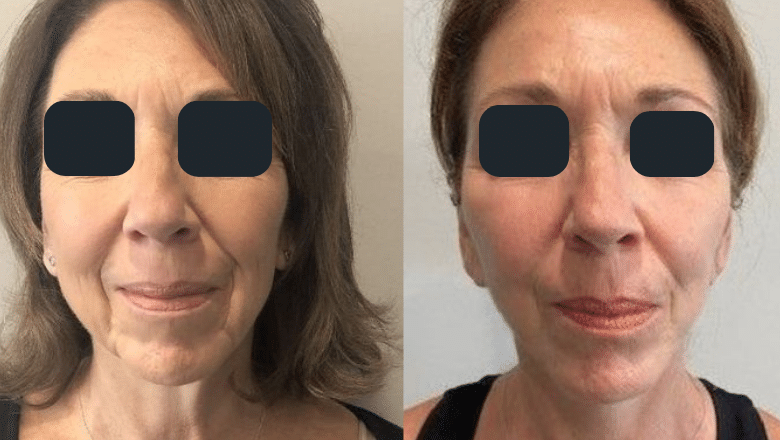
The most visible changes after a jowl lift are a straighter jawline, a smaller or absent jowl beside the chin, softer marionette lines and a tidier upper neck. Swelling hides the result for the first few weeks, and the final shape settles at three to six months. The photographs below show real Centre for Surgery patients after a mini facelift, the shorter-scar lift for the lower face.

Who Is a Good Candidate for a Lower Facelift?
You may be a good candidate if you have:
- jowls that have softened or broken the line of the jaw
- loose skin along the jawline or at the top of the neck
- a mid-face that is still reasonably well supported
- good general health, and you do not smoke or are willing to stop
- realistic expectations of a refreshed rather than a different face
It is less suitable if your main concern is the cheeks or eyes, if your jowls are very mild and your skin firm (a non-surgical approach or mini facelift may be enough), or if fat under the chin is the real problem, in which case chin liposuction may be simpler. A receding chin also makes jowls look heavier; our guide to a weak jawline explains when chin augmentation helps.
What Is the Best Age for a Lower Face Lift?
There is no ideal age. Most people who have a lower facelift are in their late 40s to 60s, because that is when jowls usually become noticeable, but the right time is when the change bothers you and your health allows surgery. Having it earlier, when the skin is still elastic, tends to give a more natural result and a longer-lasting one. Having it later is perfectly safe for healthy patients; in a large study of facelift patients, the average age was 59.[7]
Lower Facelift Recovery
Expect swelling and bruising around the jaw and neck for the first one to two weeks, and a feeling of tightness under the chin. You will sleep with your head raised and may wear a supportive garment for the first few days. Stitches in front of the ear usually come out at around one week, and those behind the ear a little later. Most people feel comfortable in public and return to desk-based work after about two weeks. Light exercise can restart at three to four weeks and full exercise at around six weeks. Numbness in front of the ears and along the jaw is normal and settles over a few months, and the final result shows at three to six months. Our guide to facelift recovery covers each stage.
How Long Does a Jowl Lift Last?
A lower facelift that tightens the SMAS gives a long-lasting result, and most patients enjoy the improvement for many years. The face keeps ageing from its new starting point, so you will continue to look younger than you would have without surgery. A skin-only lift relaxes sooner, which is why lifting the deeper layer matters. Stable weight, sun protection and not smoking all help results last. Our guide on how long a facelift lasts has more detail.
Lower Facelift Risks
A lower facelift is a safe operation in properly trained hands, but it carries the risks of any facial surgery. In a study of 11,300 facelift patients, 1.8% had a major complication within 30 days; the most common was a haematoma (a collection of blood under the skin) in 1.1%, and men had a higher risk than women.[7] Other risks include visible or stretched scars, prolonged swelling or numbness, temporary weakness of the muscles of the lower lip, asymmetry and the need for revision. Your surgeon will go through each of these at your consultation.
Is a Jowl Lift Worth It?
For the right person, yes. A lower facelift is one of the few treatments that genuinely lifts jowls rather than disguising them, and the result lasts for years rather than months. It is worth it if your jowls are clearly visible, they bother you, and you are healthy enough for surgery. It may not be worth it yet if your jowls are mild, in which case non-surgical treatment or a mini facelift may meet your goals with less downtime. Over several years, repeated non-surgical treatment can also add up to more than a single operation.
How to Lift the Lower Face Without Surgery
You can soften early jowls without surgery, but non-surgical treatments cannot lift loose skin and tissue in the way surgery does. They work best for mild changes, or to maintain a surgical result. The main options are:
- Dermal fillers: placed in the cheeks, chin or in front of the jowl to restore support and straighten the jawline.
- Anti-wrinkle injections: relax the muscles that pull the corners of the mouth and the jawline downwards.
- Morpheus8: radiofrequency microneedling to tighten mild skin laxity along the jaw.
- 4D laser: layered laser treatment to firm and resurface the skin.
- Thread lifts: dissolvable threads give a modest, temporary lift for mild jowls.
Our guide to the best non-surgical treatments for jowls compares them in more detail. If drooping at the corners of the mouth is your main concern, a corner lip lift may help.
What Is a Cinderella Facelift?
“Cinderella facelift” is a marketing name used by some clinics, usually for a short-scar lift of the lower face with a quick recovery. It is not a recognised medical term, and different clinics use it for different operations. If you see the name, ask exactly which layers are tightened, where the incisions go and how much of the neck is treated. Those answers tell you far more than the name does.
How Much Does a Lower Facelift Cost?
The cost depends on how much is being done. A mini facelift costs less, a lower facelift more, and combining it with a neck lift, fat transfer or eyelid surgery adds to the total. Your surgeon will give you a fixed, itemised quote after your consultation. Our facelift cost guide explains what is included and what affects the price. Finance is available through Chrysalis Finance, subject to status.
Frequently Asked Questions
Is a lower facelift the same as a mini facelift?
Not quite. Both treat the lower face, but a mini facelift uses a shorter incision mostly in front of the ear and suits early jowls. A lower facelift continues the incision behind the ear, lifts further and treats the upper neck as well.
Does a jowl lift leave scars?
Yes, but they are placed in the natural creases in front of the ear, around the earlobe and behind the ear, where they are hard to see. Most fade to fine lines over 12 to 18 months, and they can usually be hidden by hair.
Can you get rid of jowls without surgery?
You can soften mild jowls with fillers, skin tightening and anti-wrinkle injections, but you cannot remove loose skin without surgery. For moderate or heavy jowls, a lower facelift is the only treatment that genuinely lifts them.
Does a lower facelift help marionette lines?
It softens them, because lifting the jowls reduces the heaviness beside the mouth. Deep marionette lines may also need filler or fat transfer for the best result.
Does a lower facelift tighten the neck?
It tightens the upper neck just below the jaw. If you have loose skin or bands lower down the neck, a neck lift is usually added through the same incisions.
Is a jowl lift painful?
Most people describe tightness and discomfort rather than sharp pain, and it is well controlled with simple painkillers. Discomfort is greatest in the first two to three days and eases steadily after that.
Can men have a jowl lift?
Yes. Men develop jowls in the same way, and a lower facelift restores a strong jawline. Surgeons take care to place incisions around the beard line and to control blood pressure, because men have a higher risk of bleeding after surgery. See our male facelift page for more.
Lower Facelift at Centre for Surgery
At Centre for Surgery, a lower facelift starts with a consultation with a GMC-registered plastic surgeon, who examines your face and neck to work out whether a mini facelift, lower facelift, neck lift or full facelift will give you the result you want. The surgeon who assesses you is the surgeon who performs your surgery. We recommend a two-week cooling-off period before any surgery.
Surgery takes place at our CQC-regulated hospital at 95–97 Baker Street, London, which is rated Good overall and has been caring for patients for over 10 years. We publish our clinical outcomes and patient safety data, and finance is available through Chrysalis Finance, subject to status (see our finance options).
Phone: 020 7993 4849 | Address: 95–97 Baker Street, Marylebone, London W1U 6RN
Contact us to schedule a consultation
References
- Rohrich RJ, Pessa JE. The fat compartments of the face: anatomy and clinical implications for cosmetic surgery. Plastic and Reconstructive Surgery 2007;119(7):2219–2227. doi:10.1097/01.prs.0000265403.66886.54
- Reece EM, Pessa JE, Rohrich RJ. The mandibular septum: anatomical observations of the jowls in aging — implications for facial rejuvenation. Plastic and Reconstructive Surgery 2008;121(4):1414–1420. doi:10.1097/01.prs.0000302462.61624.26
- Mendelson BC, Freeman ME, Wu W, Huggins RJ. Surgical anatomy of the lower face: the premasseter space, the jowl, and the labiomandibular fold. Aesthetic Plastic Surgery 2008;32(2):185–195. doi:10.1007/s00266-007-9060-3
- Baker DC. Lateral SMASectomy. Plastic and Reconstructive Surgery 1997;100(2):509–513. doi:10.1097/00006534-199708000-00039
- Ivy EJ, Lorenc ZP, Aston SJ. Is there a difference? A prospective study comparing lateral and standard SMAS face lifts with extended SMAS and composite rhytidectomies. Plastic and Reconstructive Surgery 1996;98(7):1135–1143. doi:10.1097/00006534-199612000-00001
- Ellenbogen R, Karlin JV. Visual criteria for success in restoring the youthful neck. Plastic and Reconstructive Surgery 1980;66(6):826–837. doi:10.1097/00006534-198012000-00003
- Gupta V, Winocour J, Shi H, Shack RB, Grotting JC, Higdon KK. Preoperative risk factors and complication rates in facelift: analysis of 11,300 patients. Aesthetic Surgery Journal 2016;36(1):1–13. doi:10.1093/asj/sjv162



