



In this guide14 sections
- What is a belly overhang after a C-section? (C-section shelf explained)
- What causes a hanging belly after a C-section?
- Will a C-section shelf go away on its own?
- How to get rid of a C-section shelf without surgery
- Signs of a Belly Overhang or Hanging Belly After C-Section
- Is a C-section shelf fat, loose skin, or scar adhesion?
- C-section shelf surgery — surgical treatment options
- Am I a suitable candidate for C-section shelf surgery?
- How Is Treatment Performed?
- Recovery
- How much does C-section shelf removal cost in London?
- Why Choose Centre for Surgery?
- Frequently Asked Questions
- Learn More
A belly overhang after a C-section — also called a C-section overhang, C-section scar overhang, hanging belly after C-section, hanging stomach after C-section, post C-section belly overhang, or C-section shelf — is a fold of loose, sagging skin and fat sitting above or over the C-section scar. This guide covers exactly what causes it, whether a hanging belly after C-section can improve naturally, and every treatment option available at Centre for Surgery — from lifestyle measures through to tummy tuck surgery — with honest, transparent pricing throughout, and real before-and-after context on what to expect.
What is a belly overhang after a C-section? (C-section shelf explained)
A belly overhang after a C-section is a fold of skin, and sometimes underlying fat, that sits above or drapes over the horizontal C-section scar line, often described as a hanging or sagging belly rather than a smooth abdominal contour. It happens because the scar itself sits like a fixed band across the lower abdomen, while the skin and tissue above it can remain loose or stretched — creating the distinct hanging, pouch-like, or shelf-like appearance many women notice. You’ll see this same concern referred to by several different names depending on who you ask: stomach overhang after C-section, tummy overhang after C-section, C-section scar overhang, hanging stomach after C-section, C-section shelf, or mummy tummy overhang — they’re all describing the same underlying issue. It’s also closely related to what’s often called a mummy tummy or C-section pouch more broadly — see our dedicated guide on C-section pouch causes and treatment for the fuller picture of that related concern.
What causes a hanging belly after a C-section?
- Stretched skin from pregnancy: the abdominal skin stretches substantially to accommodate a growing pregnancy, and doesn’t always retract fully afterwards, particularly with multiple pregnancies or a pregnancy involving significant weight gain.
- The scar itself: the C-section incision sits horizontally across the lower abdomen and can act almost like a tight belt line — tissue above it has nowhere to go but forward and down, creating the characteristic overhang.
- Diastasis recti: separation of the abdominal muscles along the midline, which commonly accompanies pregnancy and a C-section, reduces the underlying support that would otherwise help the abdomen sit flat. See our dedicated guide: diastasis recti.
- Residual fat: fat gained during pregnancy that hasn’t fully resolved adds volume to the overhang alongside the skin laxity itself.
- Scar adhesion: in some cases the healing scar tissue adheres to the underlying abdominal wall, which can pull the scar inward while skin above bulges outward — a specific pattern that typically needs surgical revision rather than lifestyle measures to resolve.
- Genetics and skin elasticity: some people are simply more predisposed to reduced skin elasticity, meaning the same degree of stretching produces more visible overhang than it would for someone else.
Will a C-section shelf go away on its own?
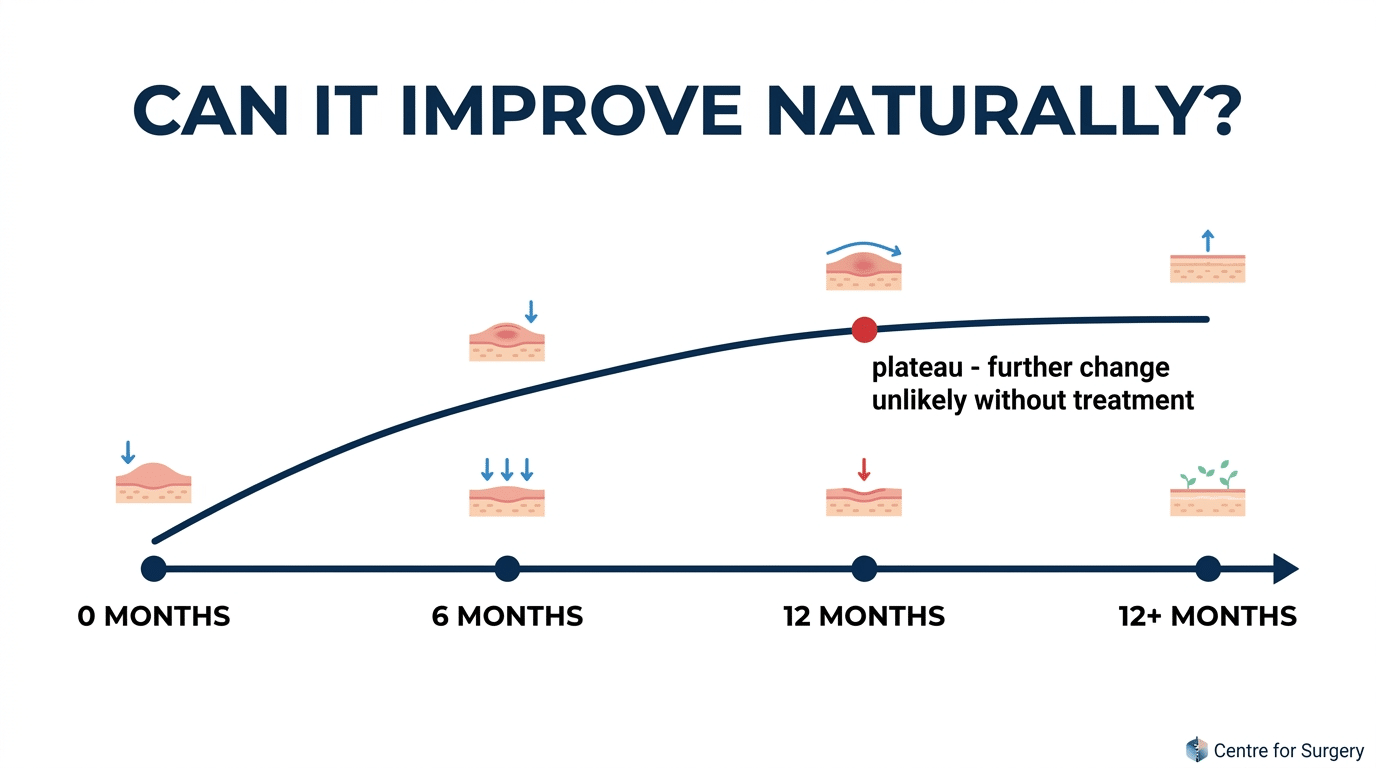
Sometimes, yes — but not always, and it’s worth being honest about what “naturally” can and can’t fix. In the first 12 months after a C-section, ongoing healing, gradually improving skin elasticity, and continued fat loss can genuinely reduce a mild overhang or hanging belly. Beyond that window, further natural improvement becomes far less likely, and what remains tends to be a stable combination of loose skin, scar adhesion, and residual fat that lifestyle measures alone won’t resolve.
Whether it resolves naturally depends heavily on which underlying cause is driving it. An overhang that’s mostly swelling and residual fat in the first few months has a real chance of settling. A hanging or sagging belly caused by significant skin laxity or scar adhesion won’t — skin that has lost its elastic recoil doesn’t regain it through time or exercise alone, and adhered scar tissue needs to be surgically released to fully resolve. If you’re weighing up whether to wait or seek treatment, our before-and-after gallery for tummy tuck shows the realistic range of results surgery can achieve where lifestyle measures alone haven’t been enough.
How to get rid of a C-section shelf without surgery
These are worth pursuing in the first year, both for their own sake and to establish whether they resolve the overhang before considering surgery.
Postnatal-Safe Core Exercise
Once cleared by your GP or a postnatal fitness specialist — typically from around 6-8 weeks for gentle work and 12 weeks for more comprehensive core training — exercises that engage the deep core (pelvic tilts, modified planks) can improve muscle tone and support. It’s important to check for diastasis recti before attempting traditional crunches or sit-ups, since these can worsen an existing separation.
Diet and Weight Management
A balanced, calorie-conscious diet supports loss of the residual fat component. This won’t address skin laxity or scar adhesion, but it genuinely helps where fat is contributing meaningfully to the overhang.
Time and Patience
Continued healing over the first 12 months allows swelling to fully resolve and gives skin the maximum opportunity to retract naturally. Judging the overhang before this point often overstates how much will remain long-term.
Signs of a Belly Overhang or Hanging Belly After C-Section
The presentation varies, but common signs include a pouch-like or shelf-like bulge in the lower abdomen just above the scar line, loose or sagging skin around the C-section scar that doesn’t sit flat, a visible change in stomach shape compared to before pregnancy, a gap or doming along the midline suggesting diastasis recti, and general discomfort — physical or emotional — with how the area looks or feels. Recognising which of these applies to you helps clarify whether you’re dealing with a hanging belly driven mainly by skin, fat, or muscle separation.
Is a C-section shelf fat, loose skin, or scar adhesion?
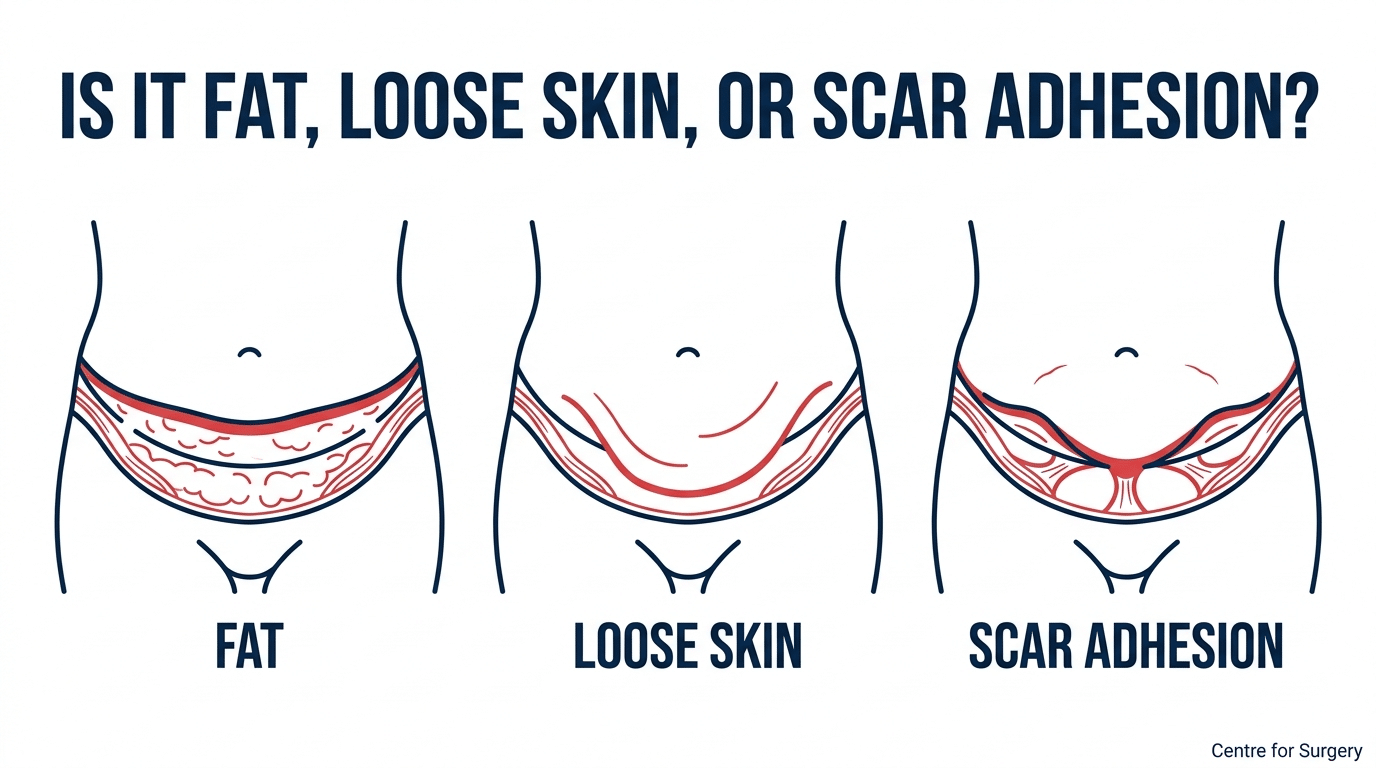
This is the single most useful question to ask about a belly overhang after C-section, because the three causes need entirely different approaches:
- Mainly residual fat with good skin elasticity: diet and time are likely to produce genuine improvement.
- Mainly loose skin that doesn’t retract when pinched or gathered: no non-surgical treatment fully resolves this — surgical skin removal is the only treatment that directly addresses it.
- Scar adhesion — the scar sits pulled-in while skin above bulges forward, often with a groove or tethered appearance at the scar line itself: this specifically needs surgical release, typically combined with scar revision or a tummy tuck.
Most women have some combination, which is exactly why a physical assessment at consultation — rather than guessing from how it looks in the mirror — is the only reliable way to know what you’re actually dealing with.
C-section shelf surgery — surgical treatment options
Which operation suits you depends on how much of the problem is scar tethering and how much is excess skin. Where the overhang is substantial and skin removal is the priority rather than muscle repair, an apronectomy may be more appropriate than a full tummy tuck — our comparison of abdominoplasty versus apronectomy explains the difference. Where muscle separation is also present, diastasis recti repair is usually combined with skin removal in the same procedure.

Tummy Tuck (Abdominoplasty)
A tummy tuck removes the excess skin causing the overhang, repairs any diastasis recti present, and typically excises the old C-section scar entirely as part of the procedure — replacing it with a single, cleaner, lower scar. This is generally the most effective single treatment where the overhang involves genuine skin laxity or muscle separation. Current pricing is set out in our tummy tuck cost guide. A mini tummy tuck suits a more limited overhang without significant muscle separation.
C-Section Scar Revision
Where the overhang is primarily driven by scar adhesion rather than broader skin laxity, a C-section scar revision releases the adhered tissue and re-closes the incision with more meticulous technique, often resolving the tethered, pulled-in appearance at the scar line itself. See also our detailed guide: how to prevent and minimise C-section scars.
Liposuction
Where residual fat is the main contributor rather than skin laxity, liposuction removes the fat component directly. It doesn’t address loose skin or scar adhesion, so it’s most appropriate when those factors are genuinely minimal. Current pricing is set out in our liposuction cost guide.
BodyTite and Morpheus8
For mild-to-moderate cases, BodyTite and Morpheus8 (radiofrequency microneedling for skin tone and elasticity) offer non-surgical or minimally invasive options. Be realistic about their limits: neither closes adhered scar tissue or removes significant excess skin the way surgery does.
Prices for these treatments are on our Skin & Aesthetics price list.
Am I a suitable candidate for C-section shelf surgery?
- A visible overhang that hasn’t resolved with time and lifestyle measures
- At least 6-12 months post-C-section, allowing full healing and maximum natural improvement before assessing what surgery can add
- Not planning further pregnancies — a future pregnancy can undo surgical results
- At or near a stable weight, ideally maintained for at least three months
- A BMI under 30 for most procedures
- Non-smoker, or willing to stop smoking for at least two weeks before surgery and throughout recovery
A face-to-face consultation with one of our surgeons at 95–97 Baker Street — including a physical assessment of your scar, skin, and any diastasis recti — will confirm your suitability and which treatment fits your anatomy.
How Is Treatment Performed?
All surgical procedures are performed as a day case at our CQC-regulated Baker Street facility under TIVA (Total Intravenous Anaesthesia), delivered entirely intravenously without inhaled anaesthetic gases for a smoother, faster recovery than a traditional general anaesthetic. During a tummy tuck, the surgeon excises the old C-section scar along with the excess skin, repairs any separated abdominal muscles, and closes with a new, lower incision. Where scar adhesion is the primary issue, the scar is released from the underlying abdominal wall and re-closed using more meticulous suturing technique.
Recovery
Recovery from a tummy tuck typically takes 6-8 weeks, with a compression garment worn throughout and strenuous activity avoided for at least six weeks. Most patients take 2-3 weeks off work. Scar revision alone, without a full tummy tuck, has a shorter recovery of around 3-4 weeks. Given the demands of caring for young children during recovery, arranging practical support in advance is genuinely worth planning for.
How much does C-section shelf removal cost in London?
- Argo Plasma skin tightening
- Liposuction
- BodyTite
- Mini tummy tuck
- Full tummy tuck (with muscle repair and liposuction)
C-section scar revision pricing is confirmed at consultation based on the extent of adhesion and whether it’s combined with a broader tummy tuck. All surgical packages include your surgeon’s fee, TIVA anaesthesia, theatre time, dissolvable sutures, your surgeon’s direct number for the first 24 hours, a wound check, and your follow-up review. Your initial consultation fee is redeemable against the cost of your procedure. Finance is available through Chrysalis Finance, subject to status.
Why Choose Centre for Surgery?
Whichever treatment is right for your anatomy, it’s performed by a GMC-registered plastic surgeon at our purpose-built, CQC-regulated hospital on Baker Street, rated “Good” by the CQC. We assess for all three potential causes — fat, skin laxity, and scar adhesion — rather than assuming one default explanation, so your surgeon can recommend treatment genuinely matched to what’s driving your overhang.
Every package includes unlimited pre-operative consultations, a recommended two-week cooling-off period, full pre-operative medical assessment, a dedicated patient coordinator, and full aftercare through your follow-up reviews.
Book Your Consultation
Phone: 020 7993 4849
95–97 Baker Street, Marylebone, London W1U 6RN
Contact us to schedule your consultation
Your initial in-person consultation fee is redeemable against the cost of surgery if you proceed.
Frequently Asked Questions
How long does it take for a belly overhang to go away after a C-section?
Most natural improvement happens within the first 12 months as swelling resolves and skin elasticity recovers as much as it’s going to. Beyond that point, what remains tends to be stable and unlikely to improve further without treatment.
What causes a hanging belly after a C-section specifically?
A hanging or sagging belly after a C-section is usually driven by some combination of stretched skin that hasn’t fully retracted, the scar itself acting like a fixed band that tissue above it drapes over, diastasis recti reducing underlying support, and residual fat. Scar adhesion — where the scar is pulled inward while skin above bulges forward — is a specific pattern that particularly needs surgical release rather than time alone.
What’s the difference between a belly overhang and a C-section pouch?
These terms are largely used interchangeably, though “overhang” more specifically emphasises the fold sitting over the scar line itself, while “pouch” is often used more generally for the overall lower-abdominal bulge. See our related guide: C-section pouch causes and treatment.
Can exercise alone get rid of a C-section overhang?
It can help with the fat component and improve muscle tone, but it won’t remove loose skin or release adhered scar tissue. Where those are the primary cause, surgery is genuinely the only effective treatment.
How soon after a C-section can I get a tummy tuck?
Most surgeons recommend waiting at least 6-12 months to allow full healing and weight stabilisation, and completing your family first, since future pregnancy can undo the results. See also: can you combine a tummy tuck with a C-section?
Will a tummy tuck remove my C-section scar completely?
A tummy tuck typically excises the old C-section scar as part of the procedure and replaces it with a new, lower incision — it doesn’t leave you scar-free, but usually produces a single, cleaner, less visible scar than the original.
Learn More
- Tummy tuck
- Mini tummy tuck
- Liposuction
- Caesarean scar revision
- BodyTite
- Morpheus8
- C-section pouch — causes, treatment and prevention
- How to prevent and minimise C-section scars
- Can you combine a tummy tuck with a C-section?
- Diastasis recti
- How to get rid of a mum tum
- How to get rid of apron belly







