

In this guide16 sections
- Key Points
- How Long Is Brow Lift Recovery?
- Brow Lift Recovery Time by Technique
- Brow Lift Recovery Day by Day and Week by Week
- Swelling and Bruising After a Brow Lift
- Numbness, Itching and Tightness After a Brow Lift
- Brow Lift Scars: Where They Are and How They Heal
- Sleeping After a Brow Lift
- Washing Your Hair, Glasses, Make-Up and Driving
- When Can I Exercise and Go Back to Work After a Brow Lift?
- Brow Lift Aftercare: Dos and Don’ts
- Brow Lift With Eyelid Surgery or a Facelift
- When to Contact Your Surgeon After a Brow Lift
- Brow Lift Recovery FAQs
- Brow Lift in London
- References
Key Points
- How long is brow lift recovery? Most people return to desk work in one to two weeks and to full exercise at six weeks, with the final result and settled scars at three to six months or more.
- Does the technique change recovery? Yes. Temporal and endoscopic brow lifts usually have the quickest recovery; a coronal brow lift takes longest and causes more scalp numbness.
- How long do swelling and bruising last? They peak in the first two to three days. Bruising often tracks down around the eyes and fades within about two weeks; subtle swelling can take a few months to clear.
- Is numbness normal after a brow lift? Yes. Numbness, tingling and itching of the forehead and scalp are common and usually settle over weeks to months as the nerves recover.
- When are stitches or clips removed? Usually at about seven to ten days, at your first review. Dissolvable stitches do not need removing.
- How should I sleep after a brow lift? On your back with your head raised for about the first two weeks.
Brow lift recovery is usually easier than people expect. Most people feel tightness rather than pain, are back at desk work within one to two weeks of a brow lift (forehead lift), and return to full exercise at around six weeks. What takes longer is the fine settling: brows that look slightly too high at first come down a little, numbness of the forehead and scalp fades, and the scars soften over several months.
How quickly you recover depends mainly on the technique. An endoscopic brow lift or temporal (lateral) brow lift uses small incisions in the hairline, while a coronal or direct brow lift uses a longer incision. Our guide to the endoscopic vs traditional brow lift explains how they compare. This guide covers the brow lift recovery timeline day by day and week by week, swelling, numbness, scars, sleeping, exercise and the warning signs to look out for. For advice that applies to every operation, see our recovery after cosmetic surgery hub.
How Long Is Brow Lift Recovery?
Brow lift recovery has three stages. You look presentable and can go back to desk work at one to two weeks, once the bruising has faded. You can return to strenuous exercise at about six weeks. The final brow position, full feeling in the forehead and mature scars take three to six months, and sometimes up to a year after a coronal brow lift.
Endoscopic and coronal brow lifts are usually done under TIVA (total intravenous anaesthesia), while temporal and direct brow lifts can often be done under local anaesthetic with sedation. The anaesthetic for your operation is decided by your surgeon and anaesthetist; our guide to anaesthesia for cosmetic surgery explains the options. Whichever you have, a brow lift is a day case.
Brow Lift Recovery Time by Technique

We offer every type of brow lift, and your surgeon recommends one based on your brow position, forehead height, hairline and skin. In a systematic review of open and endoscopic brow lift studies, there was no clear evidence that open techniques were inferior to endoscopic ones, so the choice is about anatomy rather than recovery speed alone[1].
- Endoscopic brow lift recovery time: several small incisions behind the hairline, with a camera used to release and lift the brow. Swelling and bruising are usually moderate and most people return to normal activities in 10–14 days.
- Temporal (lateral) brow lift: small incisions in the hair at each temple lift the outer third of the brow. It is the most targeted option and usually has the most comfortable recovery, often around one to two weeks.
- Coronal (open) brow lift: a longer incision across the top of the scalp, behind the hairline, for heavier brows or more correction. Expect two to three weeks before normal activities and more scalp numbness, which can take months to recover.
- Direct brow lift: a strip of skin is removed just above the eyebrow, with the scar placed along its upper edge. It gives precise control of brow shape and height. Swelling is mainly around the brow and upper eyelids, stitches come out at about a week, and the scar needs the most care while it matures.
A brow lift can also be performed through the upper eyelid crease at the same time as eyelid surgery, which adds no extra scar. Recovery then follows the eyelid surgery timeline in our blepharoplasty recovery guide.
Your brow lift recovery dates
Add your operation date to see the milestones in this guide as dates, then save them to your phone's calendar.
Brow Lift Recovery Day by Day and Week by Week
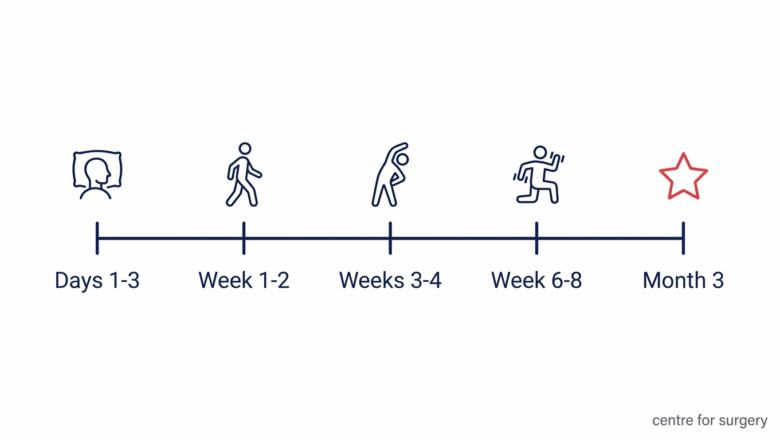
Timings vary with the technique and with how you heal, so always follow your own surgeon’s instructions.
Day of surgery
You go home the same day once you are comfortable. A responsible adult must take you home and stay with you for 24 hours; the Royal College of Anaesthetists’ advice for the person looking after you ↗ explains what that involves. You may have a light head dressing. The forehead feels tight and numb, and discomfort is usually mild and controlled with the painkillers you are prescribed. You are given your surgeon’s direct number for the first 24 hours on your discharge summary.
Days 1–3
Swelling and bruising build up and are usually at their worst around day 2 or 3. Gravity means swelling and bruising often move down from the forehead to the upper eyelids and around the eyes, which can make the eyes look puffy even though they were not operated on. Keep your head raised, use cold compresses on the forehead and around the eyes (not directly on the incisions), and avoid bending, lifting and straining. A mild headache is common.
Days 4–7
The swelling starts to go down. The forehead and scalp still feel tight, numb or tingly. Any dressing is usually removed within the first few days, and you can normally wash your hair gently once your surgeon says so. Many people who have had an endoscopic or temporal brow lift feel ready for desk work by the end of the first week.
Week 2
Stitches or clips are usually removed at seven to ten days, at your first review, and dissolvable stitches do not need removing. Most of the bruising has faded and most people are back at work. Gentle walking is encouraged.
Weeks 3–4
You feel much more like yourself. The brows often look slightly higher than intended in the first few weeks and then settle down a little as the swelling goes. Itching around the incisions can increase as the nerves recover. Light exercise can usually start again with your surgeon’s agreement.
Weeks 6–8
Most of the visible swelling has gone, and most people are back to their full exercise routine. Your surgeon may review you again to check healing and brow position.
3–12 months
The brow settles into its final position over about three months, and feeling in the forehead and scalp continues to return. Scars soften and fade for up to a year, particularly after a coronal or direct brow lift.
Swelling and Bruising After a Brow Lift
Swelling and bruising are expected parts of brow lift recovery, not complications. They usually peak around days 2 to 3, and bruising has mostly faded within two weeks. Visible swelling settles over two to three weeks, while a small amount of deeper swelling can take a few months to clear completely.
- Keep your head raised on two or three pillows, including when you sleep, for the first two weeks.
- Use cold compresses for the first two to three days, wrapped in a clean cloth and kept off the incisions, for 10–15 minutes at a time.
- Avoid bending over for the first week or two, because it sends blood to the head and worsens swelling.
- Stay hydrated and keep salty, processed food to a minimum, because salt encourages fluid retention.
- Avoid medicines that increase bleeding. Do not take aspirin or anti-inflammatory painkillers such as ibuprofen unless your surgeon advises it, and tell your surgeon about supplements such as fish oil. If you take aspirin or a blood thinner for a medical condition, only stop it on medical advice.
Numbness, Itching and Tightness After a Brow Lift
Tightness across the forehead, numbness of the forehead and scalp, tingling and itching are all common after a brow lift. They happen because small sensory nerves are stretched or disturbed during the lift, and they are usually a sign of normal healing rather than a problem.
Numbness is most noticeable after a coronal brow lift and least after a temporal lift. It usually improves over weeks to months as feeling returns from the edges inwards. In a UK series of direct brow lifts, altered sensation of the forehead was common but well tolerated, and patients were highly satisfied overall[2]. In a more recent study of 45 direct brow lifts, temporary sensory changes resolved within three to five months[3]. As feeling returns, itching and short shooting sensations are normal. Our guide to itching after cosmetic surgery explains what helps.

Brow Lift Scars: Where They Are and How They Heal
Where your eyebrow lift scars sit, and how visible they are, depends on the technique:
- Endoscopic brow lift scars: three to five short incisions behind the hairline, hidden by the hair once healed.
- Temporal brow lift scars: a short incision in the hair at each temple, usually well hidden.
- Coronal brow lift scars: a longer scar across the top of the scalp, behind the hairline, hidden once the hair grows over it.
- Direct brow lift scars: a fine line along the upper edge of each eyebrow. It is the most visible of the four early on, but usually fades well. In a 2026 review of studies on direct brow lift scars ↗, careful incision and closure techniques gave inconspicuous scars in more than 85% of cases, with high patient satisfaction[4].
Scars look pink and may feel firm for the first few months, then gradually soften and fade over up to a year. Once the incisions have fully closed, usually after about two weeks, your surgeon may suggest a scar gel. Protect any scar outside the hairline from the sun with a hat or high-factor sunscreen. Temporary thinning of the hair along an incision can occur and usually grows back.
Sleeping After a Brow Lift
Sleep on your back with your head raised for about the first two weeks, using two or three pillows or a wedge. This reduces swelling and keeps pressure and friction off the incisions. Avoid sleeping on your side or front until your surgeon is happy with healing, usually from around two weeks. A clean, smooth pillowcase helps reduce friction on the scalp.
Washing Your Hair, Glasses, Make-Up and Driving
Washing your hair
You can usually wash your hair gently once any dressing has been removed, often within the first few days, using lukewarm water and a mild shampoo and patting the incisions dry. Avoid hair dryers on a hot setting, hair dye and tight hair ties until the incisions have healed. Our guide to showering after plastic surgery has more detail.
Glasses and sunglasses
Glasses are usually fine. If the arms press on incisions at the temples, wear them loosely or for short periods until the area is comfortable.
Make-up
Make-up can be used away from the incisions once the bruising starts to fade, and on or near the incisions only once they have fully healed, usually after about two weeks.
Driving
Do not drive for at least 24 hours after sedation or TIVA. Most people drive again after about one week, once they are off painkillers that cause drowsiness, can turn their head comfortably to check mirrors, and swelling does not affect their vision. Check your insurance policy, as some insurers require a longer gap after surgery.
Flying
Short journeys are fine once you feel comfortable. Long-haul flights are best delayed for at least two weeks, because sitting still for a long time raises the risk of blood clots, as the NHS guidance on DVT ↗ explains. Confirm timing with your surgeon.
When Can I Exercise and Go Back to Work After a Brow Lift?
Most people in desk-based jobs return to work within 7–10 days, extending to around two weeks after a coronal brow lift or for physically demanding jobs.
- Week 1: rest, with short gentle walks.
- Weeks 2–3: longer walks. No lifting, bending or straining.
- Weeks 3–4: gentle exercise such as an easy static bike, if your surgeon agrees.
- Weeks 6–8: a gradual return to strenuous exercise, running and the gym. Avoid anything that could knock your forehead until your surgeon is happy.
Hot showers, saunas and steam rooms can increase swelling, so avoid them for the first few weeks. Our guide to exercising after cosmetic surgery explains how to build back up safely.
Brow Lift Aftercare: Dos and Don’ts
Do
- Prepare before surgery. Stop smoking and nicotine at least four weeks before and four weeks after surgery, stop aspirin two weeks before only if your doctor agrees, and have extra pillows, loose front-fastening clothes and easy meals ready at home.
- Eat well, with protein for tissue repair, fruit and vegetables, and plenty of water.
- Keep the incisions clean and dry and follow your surgeon’s wound care instructions.
- Attend every follow-up appointment so your surgeon can check healing and brow position.
Don’t
- Smoke or use nicotine, which restricts blood flow to the healing scalp and forehead.
- Drink alcohol for at least the first week, because it worsens swelling and should not be mixed with some painkillers. Our guide to drinking alcohol after cosmetic surgery explains why.
- Expose the scars to strong sun while they are still pink.
- Pick at scabs or scratch an itchy scalp. Tap gently instead.
- Use hair dye or chemical treatments until the incisions have fully healed, usually at least four to six weeks.
Brow Lift With Eyelid Surgery or a Facelift
A brow lift is often combined with upper blepharoplasty (eyelid surgery), because heavy upper eyelids are often caused partly by a low brow and partly by excess eyelid skin. Our guide to brow lift vs blepharoplasty explains how to tell which you need. A brow lift can also be combined with a facelift. Combined surgery means one anaesthetic and one recovery, but more swelling overall, so plan around the longer timeline; our facelift recovery guide explains that side of it.
When to Contact Your Surgeon After a Brow Lift
Serious problems after a brow lift are uncommon. In a 2013 systematic review of 82 brow lift studies ↗, altered sensation and unacceptable scarring were the most common complications across all techniques. After endoscopic brow lifts, altered sensation affected about 6% of patients, brow asymmetry about 4% and hair loss along the incisions about 3%; after coronal brow lifts, haematoma (a collection of blood) affected 0.5% and infection 0.2%[5]. Contact your surgical team straight away if you have:
- swelling that is sudden, painful or much worse on one side
- bleeding that does not stop with gentle pressure
- pain that is getting worse rather than better after the first few days
- a temperature, or increasing redness, heat or discharge from an incision
- weakness of the forehead or difficulty raising one eyebrow, or difficulty closing your eyes
- a painful, swollen calf or breathlessness (call 999 for chest pain or difficulty breathing)
For the first 24 hours, call your surgeon on the direct number on your discharge summary. After that, call the clinic on 020 7993 4849, 9am–6pm Monday to Saturday, and NHS 111 out of hours, or 999 in an emergency.
Brow Lift Recovery FAQs
How painful is a forehead lift?
Most people describe tightness, pressure and a mild headache rather than sharp pain, and this is usually well controlled with the painkillers they are prescribed for the first few days. Pain that is severe or getting worse is not normal and should be checked.
How long does it take to recover from a lateral brow lift?
A temporal (lateral) brow lift usually has the quickest recovery. Most people are back at desk work within about a week, with bruising faded by around two weeks and full exercise at six weeks.
What are the downsides of an endoscopic brow lift?
It suits people with a moderate brow drop and a normal forehead height, but gives less correction than an open lift for very heavy brows, and cannot lower a high hairline. Temporary numbness, itching and occasional hair thinning along the incisions are the commonest drawbacks[5].
Will my eyebrows look too high after a brow lift?
They often look slightly high, or surprised, for the first few weeks while the forehead is swollen and tight. The brows usually come down a little as the swelling settles, and the final position is clear at around three months.
How long does a brow lift last?
Results are long-lasting. In a 2026 meta-analysis of 22 studies covering 2,127 brows ↗, followed for an average of almost two years, the brows stayed significantly higher than before surgery, by about 3.8 mm at the outer brow[6]. Ageing continues, so many people find the effect lasts for many years rather than permanently.
Will I lose hair after a brow lift?
Hair loss is uncommon. Some thinning along an incision can happen, especially after endoscopic and hairline techniques, and it usually grows back within a few months[5].
Is it normal to feel numbness after a brow lift?
Yes. Numbness of the forehead and scalp is very common, particularly after a coronal brow lift. Feeling usually returns gradually over weeks to months, often with itching and tingling as it does.
When can I wash my hair after a brow lift?
Usually within the first few days, once any dressing has been removed and your surgeon agrees. Use lukewarm water and a mild shampoo, and be gentle around the incisions.
When can I wear make-up after a brow lift?
Away from the incisions as soon as you feel ready, and on or near them only once they have fully healed, usually after about two weeks.
Can I lift my eyebrows without surgery?
Anti-wrinkle injections can give a small lift of one to two millimetres for a few months, but they do not treat a brow that has dropped significantly. Our guide to an eyebrow lift without surgery explains who it suits.
Brow Lift in London
Brow lift surgery at Centre for Surgery is performed by GMC-registered surgeons at our CQC-regulated Baker Street hospital, rated Good overall by the CQC. We offer endoscopic, temporal, coronal and direct brow lifts, alone or combined with eyelid surgery or a facelift, and the consultant who assesses you at consultation is the consultant who performs your surgery. You have a follow-up review at about one week to check healing and remove any stitches or clips. Your initial consultation is £100, redeemable against the cost of surgery if you go ahead; our brow lift cost guide explains the price by technique, and our brow lift page explains the operation in full.
Phone: 020 7993 4849 | Address: 95–97 Baker Street, Marylebone, London W1U 6RN
Contact us to schedule a consultation
References
- Graham DW, Heller J, Kirkjian TJ, et al. Brow lift in facial rejuvenation: a systematic literature review of open versus endoscopic techniques. Plastic and Reconstructive Surgery 2011;128(4):335e–341e. doi:10.1097/PRS.0b013e3182268d41
- Booth AJ, Murray A, Tyers AG. The direct brow lift: efficacy, complications, and patient satisfaction. British Journal of Ophthalmology 2004;88(5):688–691. doi:10.1136/bjo.2003.019232
- Fakih-Gomez N, Martins L, Dagher E, et al. Deep plane direct brow lift. Aesthetic Plastic Surgery 2025;49(9):2385–2398. doi:10.1007/s00266-025-04775-2
- Khan AZ, Boberg-Ans LC, Fineide FA, et al. Contemporary concepts and techniques for scar minimization in direct brow lift: a literature review. Journal of Clinical Medicine 2026;15(12):4445. doi:10.3390/jcm15124445
- Byun S, Mukovozov I, Farrokhyar F, et al. Complications of browlift techniques: a systematic review. Aesthetic Surgery Journal 2013;33(2):189–200. doi:10.1177/1090820X12471829
- Karanfilian T, Zong AM, Delbourgo Patton C, et al. Long-term brow lift outcomes: a systematic review and meta-analysis. Ophthalmic Plastic and Reconstructive Surgery 2026;42(2):138–150. doi:10.1097/IOP.0000000000002989