


In this guide19 sections
- Key Points
- What Are Narrow Nostrils?
- Can Narrow Nostrils Affect Breathing?
- What Causes Narrow Nasal Passages?
- Narrow Nasal Passages Symptoms
- How Are Narrow Nasal Passages Diagnosed?
- How Do You Fix Narrow Nasal Passages?
- Is There Surgery to Widen Nostrils or Nasal Passages?
- Is Alarplasty the Same as Narrow Nostril Surgery?
- Septoplasty and Turbinate Reduction for a Narrow Nose
- Septorhinoplasty Before and After
- Will Nose Surgery for Breathing Change How My Nose Looks?
- Recovery After Nose Surgery for Breathing
- What Are the Risks of Surgery for Narrow Nasal Passages?
- Can I Have Narrow Nostril Surgery on the NHS?
- What Happens at a Narrow Nostril Consultation in London?
- Frequently Asked Questions
- Narrow Nostril Surgery in London
- References
Key Points
- What are narrow nostrils? Nostril openings or nasal passages that restrict airflow. Narrow nostrils on their own are rarely the whole story: a collapsing nostril rim, a narrow nasal valve, a deviated septum or swollen turbinates are usually involved.
- Can narrow nostrils affect breathing? Yes. The nasal valve is the narrowest part of the airway, so small changes in its size make a big difference to how blocked your nose feels, especially when you breathe in hard during exercise.
- Is there surgery to widen nostrils? Yes, although it is not alarplasty. Alarplasty (alar base reduction) makes nostrils narrower. Breathing is improved with cartilage grafts, septoplasty or turbinate reduction, chosen after your surgeon finds the cause.
- Try the simple things first. Nasal strips and internal dilators can open a collapsing valve, and a steroid spray helps if swelling is part of the problem. Fillers, exercises and nose clips do not permanently widen the airway.
- Surgery for breathing is well supported but not guaranteed. A 2019 randomised trial found septoplasty beat non-surgical care for a deviated septum, while the evidence for nasal valve repair is mostly from smaller studies.
- Recovery is short. Most people are back at desk work in 7 to 10 days, and breathing keeps improving for two to three months as the lining inside the nose settles.
Narrow nostrils are easy to dismiss as a cosmetic quirk, but when they restrict airflow they can affect sleep, exercise and how comfortable you feel all day. People searching for narrow nostrils, small nostrils or narrow nasal passages usually want to know why their nose feels blocked when it looks normal, and whether anything can be done.
This guide explains what narrow nostrils actually are, what causes narrow nasal passages, how the problem is diagnosed and which treatments help. It also corrects a common mix-up: the nostril reduction operation known as alarplasty makes nostrils smaller, so it is not the operation people usually need when a nose is too narrow to breathe through. The surgery that does help sits within nose surgery aimed at function, in particular septorhinoplasty and functional rhinoplasty.
What Are Narrow Nostrils?
Narrow nostrils, sometimes described as small nostrils, thin nostrils or pinched nostrils, are openings that are smaller or weaker than average. People using the phrase mean one of three things: nostrils that look slim from the front, a nose that is narrow overall (a narrow nose, often with a narrow bridge), or a nose that feels as though the airway is too small. The first two are about appearance. The third is about function, and it is the one that matters medically.
A slim nostril is not a problem in itself. Trouble starts when the opening, or the passage behind it, cannot stay open as you breathe in.
Can Narrow Nostrils Affect Breathing?
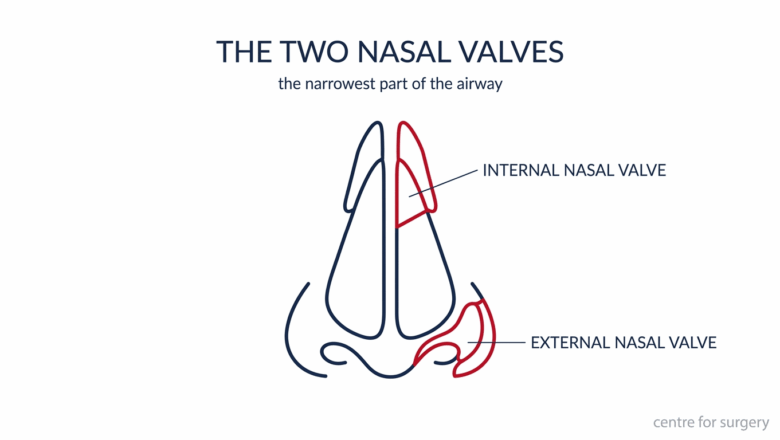
They can, although the nostril opening is only one part of the story. Air passes first through the nostril opening, then through the nasal valve, then along the nasal passages past the turbinates. The nasal valve area is the narrowest point in the nasal airway[8], so a small loss of width there has a large effect on airflow, in the same way that pinching a garden hose near the tap matters more than pinching it near the end.
This is also why narrow nasal passages often feel worse during exercise. Breathing in hard pulls the soft sidewall inwards, and if the cartilage supporting it is thin or weak, the nostril rim narrows on each breath just when you need the nose clear. Our guide to nasal valve collapse explains the mechanism in detail, and common reasons for a collapsed nostril covers how it develops.
What Causes Narrow Nasal Passages?
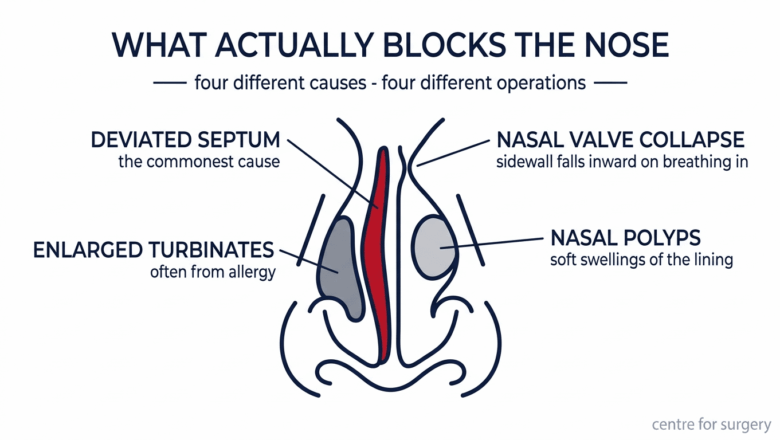
A narrow nose or narrow nasal passage usually has more than one contributor. The main ones are listed below, and they often coexist.
Nasal valve collapse and weak nostril cartilage
The internal nasal valve is the angle between the septum and the cartilage of the side of the nose, and the external valve is the nostril opening itself. Either can narrow because the cartilage is naturally thin, because it was weakened by an injury or by an earlier operation, or because it softens with age. This is the form of narrow nostrils that most closely matches the phrase “narrow nostrils making it hard to breathe”.
A deviated septum
The septum is the wall of cartilage and bone between your two nostrils. When it bends to one side, the passage on that side is narrower and the other often looks wider, and a bend near the front of the nose also pinches the valve. A deviated septum is the commonest structural cause of a blocked nose, and a bent septum can sit behind a nose that looks perfectly straight from outside.
Swollen or enlarged turbinates
The turbinates are shelf-like structures on the side walls of the nose that warm and moisten air. When allergy or irritation keeps them swollen, they fill the space and narrow the passage. This type of narrowing fluctuates with the season and allergy exposure, unlike the steady, mechanical blockage of a collapsing valve. Read more about why the nasal turbinates swell.
Previous nose surgery, injury and ageing
Removing too much cartilage during an earlier operation is a recognised cause of a collapsing nostril, as is a broken nose that healed with the sidewall pulled inwards. Scar tissue between the septum and turbinate, called nasal synechiae, can narrow the passage too. Cartilage also loses stiffness with age and the nasal tip may drop slightly, narrowing the valve over time.
Narrow Nasal Passages Symptoms
The symptoms of narrow nasal passages depend on the cause, but these are the ones that suggest a structural problem rather than a cold or allergy:
- A nose that feels blocked all or most of the time, or always blocked on the same side.
- Breathing that gets harder when you breathe in deeply or exercise.
- Little or no relief from steroid sprays or antihistamines after several weeks of proper use.
- Obvious relief when you wear a nasal strip or gently pull your cheek outwards.
- Mouth breathing, a dry mouth on waking and disturbed sleep.
- Snoring, or difficulty tolerating a CPAP mask if you have sleep apnoea.
See your GP if nasal obstruction has lasted more than a few weeks, or sooner if it affects one side only and is getting worse, you have nosebleeds or blood-stained discharge, or a nostril has changed shape without an injury.
How Are Narrow Nasal Passages Diagnosed?
Diagnosis starts with a conversation about when the blockage is worst, what you have tried and whether you have had nasal injuries or surgery. The surgeon then looks at the nose at rest and while you breathe in hard, because valve collapse often only appears on inspiration.
The Cottle manoeuvre is the simplest test. You breathe in, gently draw the skin of the cheek outwards to the side, and breathe in again; if the second breath is easier, the valve is a likely culprit. In a 2019 survey of Canadian ENT surgeons, the Cottle manoeuvre was the most widely used test for external valve collapse, and nasal valve collapse was the second most common reason given for a septoplasty failing to relieve breathing[2]. A look inside the nose with a small camera (nasal endoscopy) shows the septum, turbinates and valve directly.
Surgeons also measure how much the blockage affects you with the Nasal Obstruction Symptom Evaluation (NOSE) scale, a short questionnaire tested in adults with a deviated septum[1]. Scoring the same questionnaire before and after treatment gives an objective way to see whether an operation has helped.
How Do You Fix Narrow Nasal Passages?
Treatment follows the cause, so it is worth knowing what has been found before choosing an operation. The options run from simple aids to surgery.
What can you try before surgery?
Start with the low-risk options. A steroid nasal spray used daily for six to eight weeks treats swollen turbinates, and saline rinses help with crusting and congestion. For a collapsing valve, a nasal strip stuck across the nose or a small internal nasal dilator holds the sidewall open. They are useful during sleep and sport, and the fact that they help is itself a useful clue to the diagnosis, although they do not change the anatomy. Medication will not help a structurally weak valve, as nothing in it is swollen.
How can I widen my nasal passages naturally?
You cannot permanently widen the bony or cartilage framework of the nose without surgery. Breathing exercises, steam and nasal clips sold online may feel helpful for a short time, but none makes the nostril openings or the valve bigger.
Can fillers widen nostrils or fix breathing?
No. Dermal fillers add volume and are used for contouring the face, which Centre for Surgery offers through its dermal fillers service, but they cannot rebuild a collapsing nostril or widen an airway, and filler placed in the wrong part of the nose can narrow it further. Non-surgical nose shaping is for appearance only; see what is non-surgical rhinoplasty for what it can and cannot change.
Is There Surgery to Widen Nostrils or Nasal Passages?
Yes. Nostril widening surgery and surgery for narrow nasal passages is, in practice, functional nose surgery, which rebuilds or supports the narrow structure. The operation is chosen to match the cause:
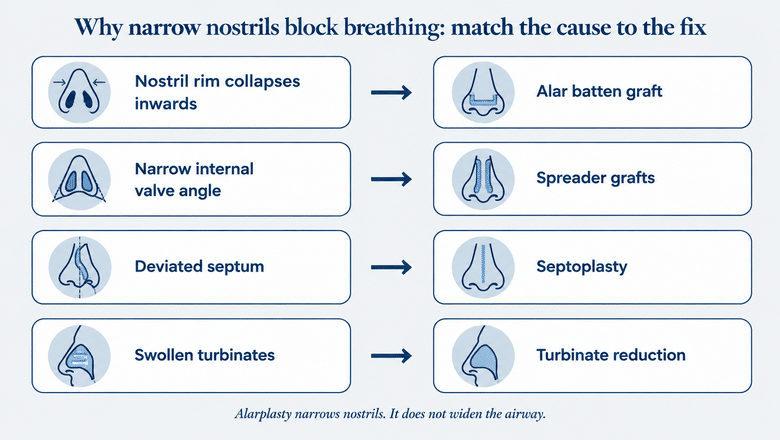
- A collapsing nostril rim or sidewall: a small piece of cartilage, called an alar batten graft, is placed along the sidewall to stiffen it. Other techniques reposition or fold the nostril cartilage to support it.
- A narrow internal valve: spreader grafts, thin strips of cartilage placed between the septum and the side cartilage, widen the angle of the valve.
- A deviated septum: septoplasty straightens the septum from inside the nose.
- Enlarged turbinates: turbinate reduction shrinks them while preserving the lining.
Grafts are taken from the septum first, then the ear, and from a rib only when neither is enough. Our guides to cartilage graft nose surgery and rhinoplasty grafts explain how they are chosen. Valve repair is rarely done alone: it is usually part of a septorhinoplasty, often with septoplasty and turbinate reduction at the same sitting.
Does nose surgery for breathing work?
The evidence is encouraging, with an honest caveat about quality. A 2008 systematic review in Otolaryngology and Head and Neck Surgery ↗ assessed 44 studies on functional rhinoplasty for nasal valve problems. Nearly all supported its effectiveness, but most were low-level evidence and only two were of higher quality[3]. More recent work points the same way: in a 2026 case series of 25 patients with lateral wall insufficiency treated with a graft-based algorithm, the average NOSE score fell from 72.5 to 22.1 over a median follow-up of 14 months, with no major complications[4]. That is a small retrospective series rather than a trial, so treat it as supportive rather than conclusive.
For a deviated septum the evidence is stronger. In a 2019 randomised trial published in The Lancet ↗, 203 adults with nasal obstruction and a deviated septum were randomly allocated to septoplasty (with or without turbinate surgery) or to non-surgical care. At 12 months the surgical group scored 72.2 on a quality-of-life measure against 63.9 in the non-surgical group, and the difference was still there at 24 months[5].
Is Alarplasty the Same as Narrow Nostril Surgery?
No, and this is the most important point for anyone searching for narrow nostril surgery. Alarplasty, also called alar base reduction or nostril reduction, removes a small wedge of skin and tissue from the base of the nostril to make wide or flared nostrils narrower. It works on skin and soft tissue and is not designed to change the airway. It does not usually improve breathing, and over-narrowing the nostrils can make breathing worse.
If your nostrils look too wide, nostril reduction surgery, our guide to flared nostrils and our article on how to make a wide nose smaller are the right place to start. If your nostrils are too narrow to breathe through, the operations above are what matters. Some people have both: nostrils that look wide but a nose that still feels blocked because the problem lies inside, and these patients benefit from having the airway treated and the shape assessed together.
Septoplasty and Turbinate Reduction for a Narrow Nose
When the narrowing is inside the nose, two operations do most of the work. Septoplasty is a day-case operation lasting about 45 to 90 minutes, done through the nostrils with no external scars. Turbinate reduction takes about an hour on its own, is also done through the nostrils and can be added to septoplasty. The two often go together, because when the septum bends one way the turbinate on the opposite side tends to enlarge to fill the space. See how septoplasty and turbinate reduction help breathing, the pros and cons of turbinate reduction with septoplasty and whether rhinoplasty and septoplasty can be done together.
The technique matters for turbinates. In a 2003 randomised trial of 382 patients ↗, six surgical techniques for enlarged inferior turbinates were compared over six years. Only submucosal resection, which preserves the lining, gave lasting normal airflow with few complications[6]. See also whether nose surgery can treat allergies.
Septorhinoplasty Before and After
The photograph below shows a Centre for Surgery patient before and after septorhinoplasty, viewed from below so the nostrils are visible.
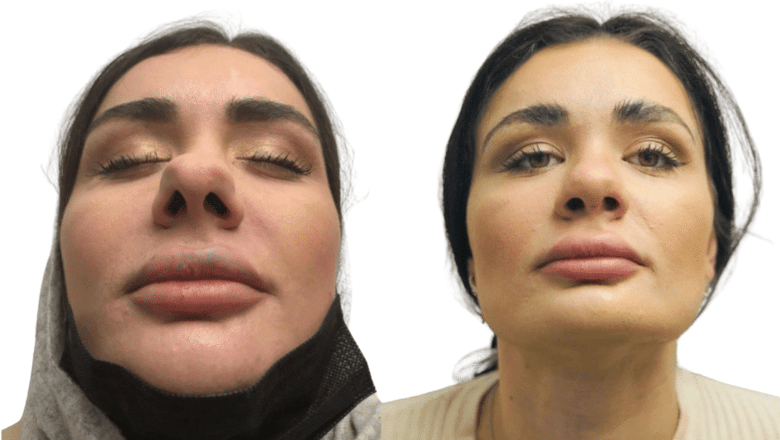
More nose surgery before and after photos are in our gallery. Functional surgery aims to improve breathing first, so the visible change is usually modest.
Will Nose Surgery for Breathing Change How My Nose Looks?
Possibly, slightly. Spreader grafts can subtly widen the middle of the nose, and batten grafts can add a little fullness at the sidewall, so a very narrow nose may look marginally broader. Septoplasty and turbinate reduction work only inside the nose and do not alter its outside shape. If you would like the appearance refined at the same time, that is discussed and agreed at consultation, and the planning covers the tip and bridge as well as the airway.
Recovery After Nose Surgery for Breathing
Recovery depends on which operations you have, but the pattern is similar:
- Day of surgery: a day case at our Baker Street hospital, with a responsible adult to take you home and stay with you for 24 hours after sedation or TIVA.
- First one to two weeks: the nose feels more blocked than before because the lining is swollen. Small internal splints, if used, come out at five to seven days. Do not blow your nose for two weeks, and sleep propped up.
- Back at desk work: usually 7 to 10 days; light exercise from about two weeks, full exercise from four weeks.
- Breathing: noticeably better by around three weeks, with the full benefit at two to three months.
If a rhinoplasty element is included, glasses stay off the bridge of the nose for six weeks. Our guides to rhinoplasty recovery and aftercare and how painful rhinoplasty is cover the first weeks in more depth.
What Are the Risks of Surgery for Narrow Nasal Passages?
Every operation carries risk. In a study of 5,639 septoplasty patients, 3.4% had any complication, and the most frequent was bleeding; infection, a blood collection in the septum (haematoma), reduced sense of smell and adhesions were more likely when turbinate surgery was added[7]. Other risks include a septal perforation (a small hole in the septum, more likely in smokers), numbness, persistent blockage if a second contributor was missed, and a second operation. In the 2019 trial above, one surgical patient developed a septal abscess and two a perforation[5]. Our rhinoplasty risks article sets out what is expected, uncommon and rare. If you smoke, stopping four weeks before and after surgery lowers the risk, and if surgery has not helped, revision rhinoplasty is the route for correcting a persistent problem.
Can I Have Narrow Nostril Surgery on the NHS?
Sometimes. NHS guidance on nose reshaping ↗ says it may be provided where it is needed to help you breathe, subject to local criteria and a GP referral. Cosmetic changes are not funded, and waiting times vary by area. Centre for Surgery is a private hospital, so surgery here is self-funded. As it treats a documented functional problem, some private insurers contribute to it, so check your policy with your insurer before your consultation. Our guides to getting a nose job on the NHS and functional rhinoplasty and who pays explain the pathway.
What Happens at a Narrow Nostril Consultation in London?
At your consultation at our CQC-regulated hospital on Baker Street, your surgeon asks about your symptoms and what you have tried, then examines your nose at rest and on breathing in. The aim is to identify everything contributing to the blockage, because treating one cause and missing another is the commonest reason surgery disappoints. You will be told plainly if a strip, a spray or your GP is the better first step. All surgery is performed by GMC-registered surgeons, and the surgeon who assesses you is the surgeon who operates.
Anaesthesia is chosen to suit the operation, ranging from local anaesthetic with sedation for a straightforward septoplasty to TIVA for combined surgery. Costs depend on which procedures are combined and are confirmed in writing after consultation, and finance options are available, subject to status. We recommend a two-week cooling-off period before surgery is booked. If snoring is part of the picture, NightLase laser snoring treatment is a non-surgical option worth discussing alongside any nasal surgery.
Frequently Asked Questions
Is it possible to widen nostrils?
Not by anything you can do at home, and not with fillers. Surgery can widen or support the nostril opening and airway by placing cartilage grafts or adjusting the cartilage, and it is chosen after your surgeon finds which part of the nose is narrow. Alarplasty does the opposite and makes nostrils smaller.
How can I widen my nasal passages naturally?
You cannot change the size of the bony and cartilage passages naturally. Saline rinses, steam and allergy treatment reduce swelling, a steroid spray helps if swollen turbinates are the cause, and nasal strips or internal dilators hold a weak valve open. These ease symptoms without altering your anatomy.
Can small nostrils affect breathing?
Yes, if the openings are small or weak enough to narrow when you breathe in. The effect is greatest during exercise, when airflow is fastest. Many people with slim nostrils breathe perfectly well, so size alone does not predict a problem. Examination of the valve, septum and turbinates shows what is happening.
How can nostril stenosis be corrected?
Nostril stenosis, a narrowed opening, is corrected by finding the cause. A collapsing rim is supported with an alar batten graft, a narrow valve is widened with spreader grafts, and a deviated septum or swollen turbinates are treated with septoplasty or turbinate reduction. Scar tissue after previous surgery may need release.
Is nasal surgery a major surgery?
Most nasal airway surgery is a day-case procedure. Septoplasty takes 45 to 90 minutes and turbinate reduction about an hour, and valve repair or septorhinoplasty takes longer, up to a few hours when operations are combined. You go home the same day, with a responsible adult to stay with you for 24 hours.
How painful is nasal septum surgery?
Most people describe pressure and a blocked, congested feeling rather than sharp pain, worst in the first few days. Paracetamol is usually enough, and a stronger painkiller can be prescribed. Your front teeth may feel bruised for a few days, and a little blood-stained discharge for the first 24 to 48 hours is normal.
Can narrow nostrils cause snoring?
Yes. Narrow nasal passages increase resistance to airflow, so you breathe through your mouth at night, which dries the throat and makes snoring louder. Opening the nasal airway often helps snoring and can make a CPAP mask easier to tolerate, but nasal surgery is rarely a complete answer to sleep apnoea.
Narrow Nostril Surgery in London
If your nose feels too narrow to breathe through, a consultation will establish whether the cause is your valve, septum or turbinates and what would help. Find out more about rhinoplasty at Centre for Surgery.
Phone: 020 7993 4849 | Address: 95–97 Baker Street, Marylebone, London W1U 6RN
Contact us to schedule a consultation
References
- Stewart MG, Witsell DL, Smith TL, Weaver EM, Yueh B, Hannley MT. Development and validation of the Nasal Obstruction Symptom Evaluation (NOSE) scale. Otolaryngology–Head and Neck Surgery 2004;130(2):157–163. doi:10.1016/j.otohns.2003.09.016 ↗
- Wang Y, Bonaparte JP. Diagnosis and management of septal deviation and nasal valve collapse: a survey of Canadian otolaryngologists. Journal of Otolaryngology – Head and Neck Surgery 2019;48(1):71. doi:10.1186/s40463-019-0394-z ↗
- Rhee JS, Arganbright JM, McMullin BT, Hannley M. Evidence supporting functional rhinoplasty or nasal valve repair: a 25-year systematic review. Otolaryngology–Head and Neck Surgery 2008;139(1):10–20. doi:10.1016/j.otohns.2008.02.007 ↗
- Nicodemi EM, Lazzeri Domar N, Schiavone G. Structured surgical algorithm for lateral wall insufficiency (LWI): a 25-patient technical case series in functional rhino-septoplasty. Aesthetic Plastic Surgery 2026;50(9):3123–3131. doi:10.1007/s00266-025-05549-6 ↗
- van Egmond MMHT, Rovers MM, Hannink G, Hendriks CTM, van Heerbeek N. Septoplasty with or without concurrent turbinate surgery versus non-surgical management for nasal obstruction in adults with a deviated septum: a pragmatic, randomised controlled trial. Lancet 2019;394(10195):314–321. doi:10.1016/S0140-6736(19)30354-X ↗
- Passàli D, Passàli FM, Damiani V, Passàli GC, Bellussi L. Treatment of inferior turbinate hypertrophy: a randomized clinical trial. Annals of Otology, Rhinology and Laryngology 2003;112(8):683–688. doi:10.1177/000348940311200806 ↗
- Dąbrowska-Bień J, Skarżyński PH, Gwizdalska I, Łazęcka K, Skarżyński H. Complications in septoplasty based on a large group of 5639 patients. European Archives of Oto-Rhino-Laryngology 2018;275(7):1789–1794. doi:10.1007/s00405-018-4990-8 ↗
- Elsayed AI, Fouad YA, El Malt A, Sweed AH. External nasal valve repair in children: alar batten graft reinforced by external temporary suspensory suture. Annals of Otology, Rhinology and Laryngology 2018;127(9):598–603. doi:10.1177/0003489418780850 ↗