


In this guide10 sections
- Key Points
- What Are “Perfect” Breasts? The Features People Rate Most Attractive
- The Perfect Breast Shape According to Research: What the Studies Found
- Perfect Breast Shape and Size: What Makes Breasts Attractive?
- What Do Normal Breasts Look Like? Skin, Shape and Nipple Variation
- Female Breast Anatomy: The Layers That Shape the Breast
- Can Surgery Change Breast Shape? What It Can and Can’t Do
- Frequently Asked Questions
- Breast Surgery at Centre for Surgery, London
- References
Key Points
- There is no single “perfect” breast. Studies of breast attractiveness disagree on the details, preferences vary with age, sex and culture, and breasts that look nothing like the research templates are entirely normal.
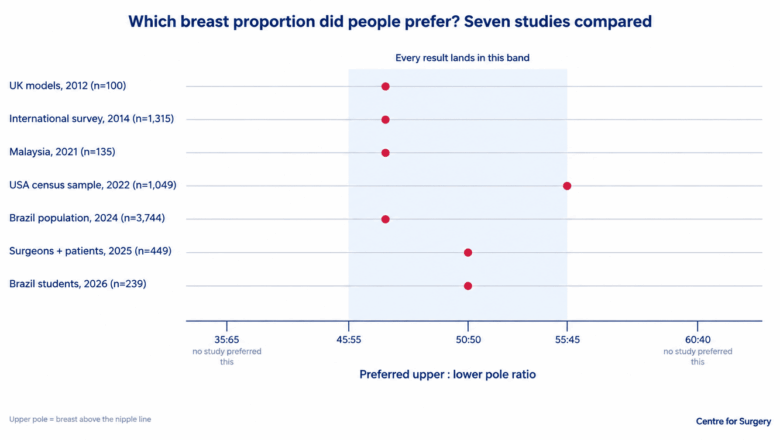
- The 45:55 ratio is a research finding, not a rule. It comes from a 2012 London analysis of topless models and a 2014 survey of 1,315 people. Later studies found 50:50 or 55:45 preferred, so the range runs from slightly fuller below the nipple to slightly fuller above it.
- Where most studies agree: a nipple centred on the breast or tilted slightly upward, a full lower curve, an areola in proportion to the breast, and moderate rather than large volume. The shape of the upper slope is where people disagree most.
- Uneven breasts are the norm. In a study of 100 women having breast augmentation, 88% had some measurable asymmetry, most often in nipple height or breast volume.
- Most women’s breasts differ from their own ideal size. In a survey of 18,541 women in 40 countries, only 29% were satisfied with their breast size.
- The ratios are planning tools, not a standard to meet. Surgery can change size, shape, nipple position and symmetry to a degree, but it cannot produce a “perfect” breast, and every operation carries risks.
Whether you searched for “perfect breasts” or “perfect boobs”, you will have found the same confident answer repeated across the internet: a 45:55 split, with slightly more of the breast below the nipple than above it. That figure is real. It comes from a published analysis by two London plastic surgeons[1], and many surgeons use it as a reference point when planning breast surgery. But it is not the whole story. Since it was published, further studies across four continents have asked thousands of people the same question, and they do not all agree.
This guide lays that evidence out plainly, including a 2026 study that found a 50:50 preference, and explains what it means for breast shape, size, symmetry and nipple position. It also covers the wide range of appearance that is completely normal, from the many different types of breast shapes to breasts that differ in size. Centre for Surgery is a CQC-regulated private hospital on Baker Street, London, where GMC-registered plastic surgeons perform breast augmentation, breast reduction, breast lift and other breast surgery, so the surgical sections describe what can realistically be changed and what cannot.
What Are “Perfect” Breasts? The Features People Rate Most Attractive
There is no single perfect breast, and the research does not claim to have found one. What it does show is that when researchers ask large groups of people to rate photographs or computer-generated images, a handful of features come up again and again. The breast rated highest in these studies tends to have:
- Balanced proportion between the upper and lower halves, from evenly balanced to slightly fuller below the nipple
- A nipple pointing forward or slightly upward, at or just above the mid-height of the breast
- A smooth upper slope from the top of the breast to the nipple, although people disagree about how full it should be
- A full, rounded lower pole below the nipple
- An areola in proportion to the breast, with smaller areolas generally preferred in surveys
- Moderate volume for the frame: in a 2023 US study, the highest-rated breasts averaged about 300 cc, a moderate size[2]
- Symmetry between the two sides, although some difference between the breasts is normal
The same features come up whether you search for perfect breasts, beautiful breasts, the most attractive breast shape or the perfect breast shape and size. If you are looking for a perfect breasts example, the 45:55 diagram further down shows the proportion most often quoted. What the research cannot tell you is what will suit your body, or whether you need to change anything at all: breasts that look nothing like a research template are usually completely healthy.
The Perfect Breast Shape According to Research: What the Studies Found
Most articles on this topic quote a single number and move on. In fact, at least seven published studies have asked people to choose between breast proportions, and several more have looked at nipple position, areola size and the shape of the upper breast. Here is what they found.
What Is the 45:55 Breast Ratio?
Unusually for an aesthetic “rule”, this one has a specific published source. In 2012, London plastic surgeons Patrick Mallucci and Olivier Branford published an analysis of 100 topless models in the Journal of Plastic, Reconstructive & Aesthetic Surgery. The women had been chosen by editors of mass-market print media for the attractiveness of their breasts and were photographed in three-quarter profile, and the authors looked for measurable features that all of them shared[1].
They identified four consistent features, not one. The 45:55 breast shape is the most quoted, but the ratio on its own is only a quarter of the picture:
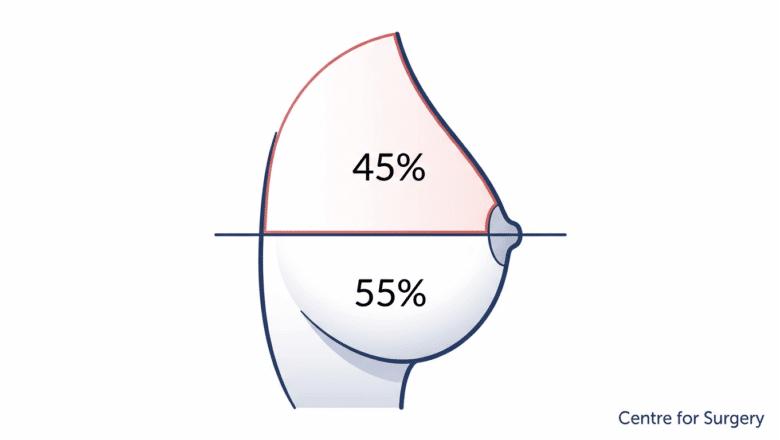
- An upper-to-lower pole ratio of 45:55. Measured as a proportion of breast height, 45% of the breast sits above the level of the nipple and 55% below it.
- A nipple angled upwards by about 20°. On average, the nipple pointed slightly upwards rather than straight ahead or downwards.
- A straight or slightly concave upper pole. The slope from the top of the breast down to the nipple was a straight line or dipped very gently inwards, not a rounded bulge. This is the feature most at odds with what patients often request.
- A convex lower pole. Below the nipple, the breast curved outwards with a full, rounded contour.
The authors also examined breasts judged less attractive and found that the further a breast departed from this pattern, the less attractive it was rated[1]. They proposed the four features as a guide for planning aesthetic breast surgery and judging its results. That is all a ratio like this can be: a planning tool, not a measure of whether a natural breast is normal.
Is 45:55 the Most Attractive Breast Shape? The 2014 Study of 1,315 People
The 2012 sample had an obvious weakness (more on that below), so in 2014 the same authors put the question to the public. They took photographs of four women with different breast sizes, digitally morphed each into four proportions (35:65, 45:55, 50:50 and 55:45) and asked 1,315 people to rank them. In their 2014 population study in Plastic and Reconstructive Surgery, the 45:55 version came out highest across the groups analysed: it was rated highest by 90% of men, 87% of women in their thirties, 94% of the 53 plastic surgeons, 86% of Europeans and 87% of both Caucasian and Asian respondents[3]. A Brazilian study of 3,744 people, published online in 2024 and using the same four proportions, reached the same answer: 45:55 was preferred by 73% of the general population and 78% of plastic surgeons, with 50:50 the next most popular choice[4].
Is 50:50 the Perfect Breast Ratio? Newer Studies From 2022 to 2026
This is the part most “perfect breasts” articles leave out.
- USA, 2022: 55:45. A survey of 1,049 people, designed to represent the US population, used lifelike computer-generated 3D models rather than morphed photographs. Both women and men preferred a 55:45 ratio, slightly fuller above the nipple. Women chose a cup size around a B, men preferred larger, and every group favoured the smallest areola shown, 30 mm across[5].
- New York, 2023: projected, moderate size. Rather than morphed images, researchers at NYU had 1,021 people rate photographs of 25 real patients. The five highest-scoring women all had minimal droop and a projected contour, with an average breast volume of about 300 cc, and moderately sized, projected breasts with some upper-pole fullness were linked with higher scores[2].
- International survey, published online in 2025: 50:50. At an aesthetic surgery meeting, 80 plastic surgeons from Europe and South America and, separately, 369 female patients assessed computer-generated images. Both groups favoured moderate volume, pronounced projection, a close cleavage and a balanced 50:50 ratio[6]. Patrick Mallucci was one of the co-authors.
- Brazil, 2026: 50:50. 239 medical students at a single Brazilian university chose between 40:60, 50:50 and 60:40 images. 61% picked 50:50, about 30% picked 40:60 and 9% picked the top-heavy 60:40. Nearly 60% preferred a centrally placed nipple, 26% one angled 20° upward and 84% the smaller areola, and men and women did not differ significantly[7].
Smaller studies add nuance. A Malaysian survey of 135 people found 45:55 the most preferred ratio but, unlike the London findings, a preference for a more convex (fuller) upper pole[8]. A Colombian survey of nearly 1,300 people found that preferred proportions differed with age, sex, education and whether the respondent had already had breast surgery[9]. And a US survey of 298 transgender and gender-diverse patients also preferred 45:55 overall, while respondents in their thirties and younger rated 50:50 about as highly[10].
45:55 vs 50:50: Which Is the Ideal Breast Shape?
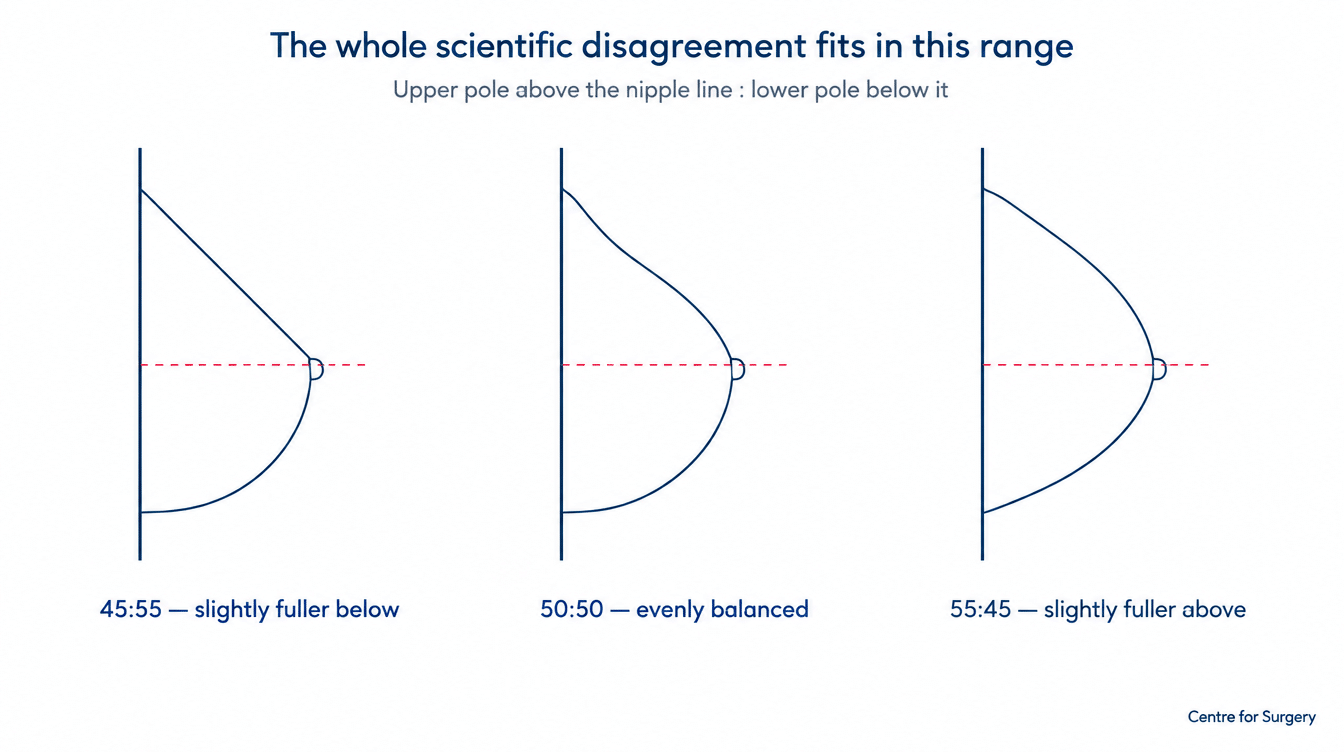
Look at the results together and the apparent contradiction largely dissolves. The preferred proportion in these studies falls between 45:55 and 55:45, and where a clearly top-heavy 60:40 option was offered, in the 2026 Brazilian study, fewer than one in ten people chose it[7]. The differences that remain are largely explained by how each study was run:
- Who was asked. Topless models chosen by picture editors (2012), the general public (2014, 2022, 2024), surgeons and patients (2025) and medical students at one Brazilian university (2026) are different groups with different reference points.
- What they were shown. Morphed photographs of real women, computer-generated 3D models and generated images each render “the same” ratio slightly differently, and the studies did not all offer the same options: the 2026 study did not include 45:55 at all, so 50:50 and 40:60 were the closest choices to it.
- Where the line is drawn. All of these ratios use the nipple as the dividing line, so a nipple that sits slightly high or low changes the measured ratio without changing the overall shape of the breast.
The practical reading is this: across the groups studied, the breast people rate highest is balanced or slightly fuller below the nipple, with the nipple centred or tilted a little upward and a full lower curve. Whether you call that 45:55 or 50:50 matters far less than two other facts: preferences vary from person to person, and these numbers describe preferences for images, not how breasts typically look.
Upper Pole Fullness: Where Surgeons and Patients Disagree
The third Mallucci feature is worth dwelling on, because it is where the research is least settled and where surgeons and patients most often picture different things.
Some patients ask for “fullness on top”: a rounded, convex upper pole. The original London analysis found a straight or slightly hollow upper slope in all 100 models[1]. A small 2003 Yale study asked 66 people to rate 12 breast profiles with different upper-pole contours: plastic surgeons scored concave upper poles significantly higher for attractiveness and naturalness than women seeking breast augmentation did, and scored convex ones lower, while lay people sat in between[11]. Other studies point the other way. The 2023 New York study linked some upper-pole fullness with higher attractiveness scores[2], and the Malaysian survey found a preference for a more convex upper pole[8]. Surgeon and patient can use the same words while picturing different breasts, which is why time is spent on this in consultation.
In practical terms this influences implant choice and placement: a lower-profile implant positioned to fill the lower pole tends to give a gentler upper slope than a high-profile implant, which adds more projection and upper fullness. It is also why smaller implants often look more natural than patients expect, and why our guide to natural vs fake-looking breasts comes down largely to the upper pole.
How Reliable Is the “Perfect Breast” Research?
The studies are useful, but their limitations should be stated plainly, because most articles quoting the 45:55 figure leave them out.
The 100 women in the original 2012 study were topless models selected by editors of mass-print media for the attractiveness of their breasts[1]. That is a narrow, commercially defined and culturally specific sample, not a cross-section of women or of what people of different cultures and ages find attractive. The later surveys are broader, but every one asked people to rate images, so they measure what looks appealing in a picture, not what feels comfortable, breastfeeds well or ages well. Preferences also shift with age, sex, education and previous surgery[9], and the newest study was a single-university sample of 239 medical students[7].
Real women’s feelings about their own breasts rarely match any template. In a survey of 18,541 women in 40 countries, only 29% were satisfied with their breast size: 47.5% wanted larger breasts and 23% wanted smaller ones, and greater dissatisfaction was linked with poorer psychological wellbeing[12]. The ratios are templates for appearance, not for health, function or comfort. Plenty of breasts fall well outside 45:55 and are entirely normal, and the ratio is not a standard anyone should measure themselves against. If worries about how your breasts look are taking up a lot of your time or affecting your daily life, our guide to body dysmorphia and cosmetic surgery may help.
Perfect Breast Shape and Size: What Makes Breasts Attractive?
There is no single ideal breast shape, and attractiveness is only one way of thinking about breasts. Several features work together in how a breast looks on a particular frame: proportion, symmetry, volume, firmness, perkiness, cleavage and position on the chest. Here is how each one holds up against the evidence.
What Is the Perfect Breast Size?

“Bigger is better” is not what the research shows. In the US census study, women chose a size around a B cup for themselves while men preferred larger[5]. In the New York study, the highest-rated breasts averaged about 300 cc, a moderate volume[2], and the international surgeon-and-patient survey also favoured moderate volume[6]. Cup size on its own is a poor guide, because it depends on band size and the brand of bra: a C cup on a petite frame and a C cup on a broad frame are very different breasts. What matters more is how breast size relates to chest width, height and build, which we cover in our guide to ideal breast size for your height and weight.
Are Uneven Breasts Normal? Breast Symmetry
Symmetry is often associated with attractiveness, and many women worry when their breasts do not match. Yet perfectly matching breasts are uncommon. In a 2003 study of 100 women having breast augmentation, 88% had some measurable asymmetry and 65% had more than one type: the nipples sat at different heights in 53%, breast volume differed in 44%, the breast fold sat at a different level in 30% and the nipples or areolas differed in size in 24%[13]. Minor differences between the two sides are the norm, not a flaw, as our guide to why one breast is bigger than the other explains. When the difference is a cup size or more, or the shapes differ markedly, breast asymmetry correction can bring the two sides closer together, although it cannot make them identical.
Teardrop vs Round: Which Breast Shape Is Most Attractive?
A teardrop shape, with thinner tissue at the top and gradually increasing fullness below the nipple, is close to what the 45:55 and 50:50 templates describe, which is why it is often called the most attractive breast shape. But round, athletic, bell-shaped, relaxed and fuller shapes are just as normal, and shape is partly set by skin, breast width and chest anatomy that surgery can refine but not reinvent.
What Makes Breasts Firm?
Breasts range from firm to soft, and both are normal. Firmness depends largely on how much glandular tissue the breast contains compared with fat, and on the elasticity of the skin, all of which change with age, pregnancy, breastfeeding and weight.
For practical steps, read our guide on how to get firmer, perkier breasts.
What Do Perky Breasts Look Like? Sagging and Breast Ptosis
Perkiness is mostly a matter of where the nipple sits relative to the fold beneath the breast. In the New York study, all of the highest-rated breasts had minimal ptosis (droop)[2]. Some sagging is a normal part of ageing and of the changes that follow pregnancy and weight loss: even among the women in the 2003 asymmetry study, all of whom were having breast augmentation, 29% already had some degree of ptosis[13].
Surgeons commonly describe sagging using a classification first set out by Regnault in 1976, which grades true ptosis into three degrees according to where the nipple sits relative to the breast fold, and separates it from partial ptosis and pseudoptosis[14]. In pseudoptosis, the lower part of the breast hangs below the fold while the nipple stays at or above it. Our guide to breast ptosis grades and treatment explains each grade. Once the nipple has dropped below the fold, an implant alone usually cannot restore its position, and a breast lift is normally needed.
Cleavage: Why Breast Spacing Matters
A visible cleavage is often seen as attractive, and the international surgeon-and-patient survey favoured a close (“tight”) cleavage[6]. Cleavage depends more on the width of the breastbone and the natural gap between the breasts than on breast size: breasts that sit wide apart will not be pushed together by larger implants. Our guides to side-set (wide-set) breasts and to whether breast augmentation enhances cleavage explain what does and does not work.
Where Should Breasts Sit on the Chest?
Breast position varies with height, chest shape and breast size, and there is no single correct position. When planning surgery, surgeons often use landmarks such as the midpoint of the upper arm as a rough guide to nipple height, alongside the level of the breast fold on the ribcage.
What Does a Normal Nipple Look Like? Position, Size and the Areola
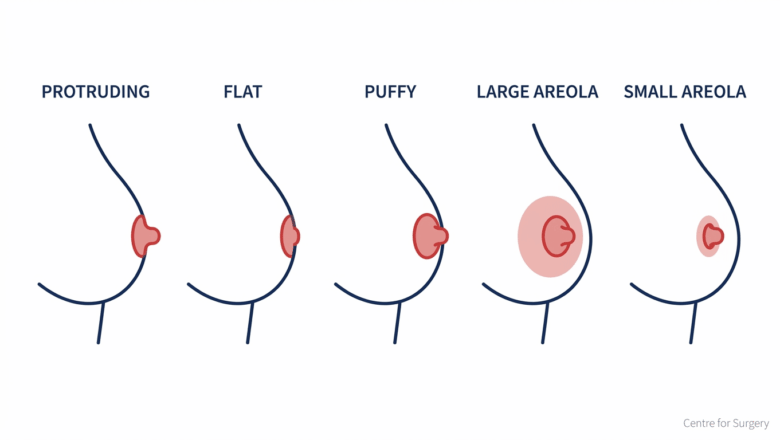
There is no single “correct” nipple appearance. The normal range is wide, and most of what people privately worry about is completely unremarkable. Normal variation includes:
- Protruding nipples that project outwards, an appearance often pictured but no more “correct” than the alternatives
- Flat nipples that sit level with the areola without prominent projection
- Puffy nipples, where the areola itself is slightly raised and fuller
- Areola size, which varies considerably: anywhere from small to noticeably larger is within the normal range
- Nipple colour, which ranges from pale pink to dark brown depending on skin tone, and often darkens during pregnancy
Where the research does express a preference, it is about position and proportion rather than nipple type. A Swedish survey of 813 people found the preferred position for the nipple and areola was the vertical midpoint of the breast, slightly to the outer side of centre[15], while 60% of the 2026 Brazilian students preferred a centred nipple and 14% one placed further out[7]. On areola size, every group in the 2022 US study preferred the smallest areola shown[5], and in an online survey of 2,259 people the two most popular choices were an areola a sixth or a quarter of the breast’s diameter, with preferences differing between men and women and between countries[16]. A preference is not a norm: larger areolas are common and normal, as we explain in our guide to large areolas. Nipple ptosis, where the nipple sits low on the breast or points downward, is a matter of position rather than nipple type, and it changes the breast’s outline in a way that nipple type does not. If areola size bothers you, it can be reduced with areola reduction, either on its own or during a breast lift or reduction.
Why Comfort Matters as Much as Appearance
For many women, how their breasts feel matters more than how they look: whether they are heavy, whether clothes and bras fit, and whether they get in the way of exercise. No ratio in any study measures this, and comfort is often the main reason women choose a breast reduction. A 2023 systematic review and meta-analysis of studies using the BREAST-Q questionnaire found that satisfaction with the breasts rose from an average score of about 23 to 73 out of 100 after reduction, and quality-of-life scores rose to levels similar to those of the general population[17].
What Do Normal Breasts Look Like? Skin, Shape and Nipple Variation
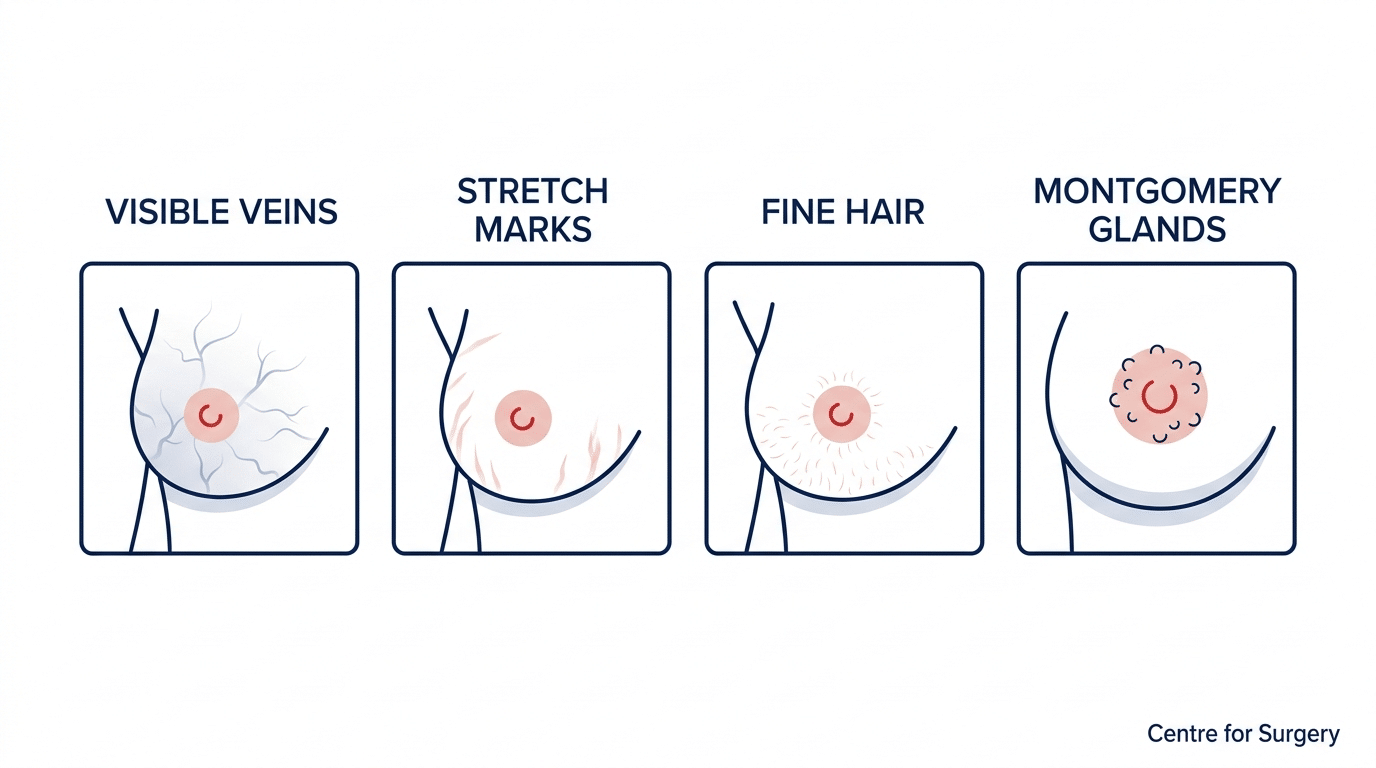
If you are asking what normal breasts look like, or what healthy breasts look like when nothing is wrong, the honest answer is: almost anything. Many people who search “what do breasts look like” are really asking whether theirs are normal, and they almost always are. An enormous range of breast skin, shape and nipple appearance is normal, and none of it needs correcting or is a sign that something is wrong. It is also worth remembering that many images labelled “perfect” online have been lit, posed, edited or surgically enhanced.
- Asymmetry: as above, nearly nine in ten women in one study of breast augmentation patients had a measurable difference between their breasts in size, nipple height or fold position[13].
- Visible veins, particularly noticeable in fair or thin skin, or during pregnancy and breastfeeding when blood flow to the breast increases. Entirely normal.
- Stretch marks, which form when skin stretches faster than it can adapt, commonly during puberty, pregnancy or weight change. Extremely common and not a sign of poor skin quality.
- Fine hair: many women have a few hairs around the areola. This is normal and usually not related to any hormonal problem.
- Montgomery glands: the small, slightly raised bumps on the areola are glands that lubricate the nipple, particularly during breastfeeding. They are not spots or a skin condition.
- Mild texture and colour variation: skin tone across the breast and areola is rarely uniform, and this is normal anatomical variation rather than a flaw.
- Shape variation: breast shapes and sizes vary enormously. Round, teardrop, bell-shaped, relaxed, slender, wide-set (“east-west”) and side-set breasts are all normal types of breasts, and they change through puberty, pregnancy, weight change and ageing.
If you notice a new change (a new lump, dimpling, skin puckering, a nipple that has newly turned inwards, discharge, or persistent redness), that is different from the normal variation described above and is worth having checked by your GP. The everyday texture, colour and hair variation that many people worry about is simply part of normal anatomy.
Female Breast Anatomy: The Layers That Shape the Breast
The female breast serves both functional and aesthetic purposes, and its layers explain why its shape changes over time. It is made up of skin, fatty tissue, glandular tissue, connective tissue, blood vessels, nerves and lymphatic vessels; our guide to breast anatomy basics before surgery goes into more depth.
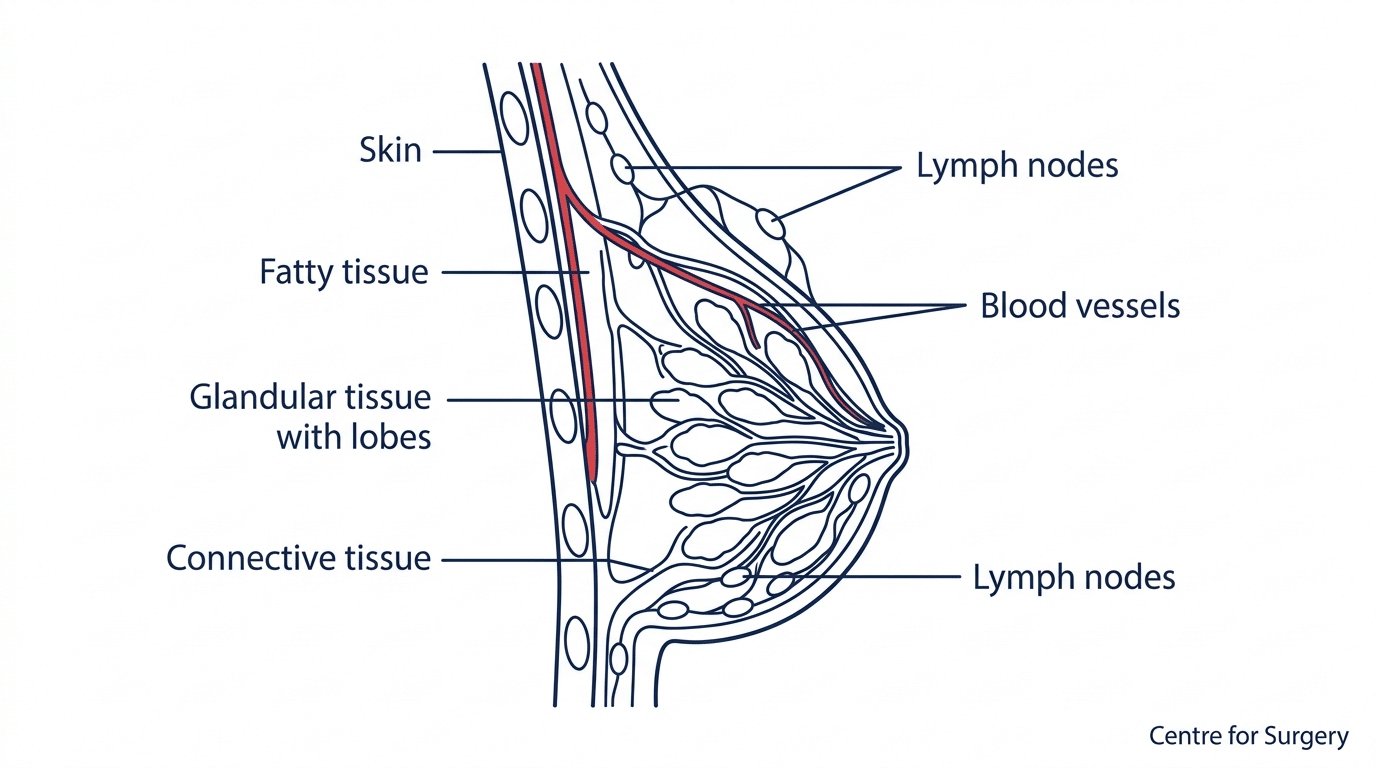
- Skin: the outermost layer, which provides a protective barrier and includes the nipple and areola.
- Fatty tissue: beneath the skin, making up much of the breast’s volume. Its share tends to rise with age, which is one reason breasts become softer.
- Glandular tissue: the milk-producing glands, arranged in lobes (classically described as 15 to 20).
- Connective tissue: collagen and elastin fibres, including Cooper’s ligaments, which provide structural support and stretch over time.
- Blood vessels: the breast is supplied mainly by branches of the internal mammary (internal thoracic) and lateral thoracic arteries.
- Nerves: providing sensation, including touch and temperature, and playing a role in the let-down reflex during breastfeeding. Their position is one reason incision choice matters in surgery.
- Lymphatic system: lymphatic vessels within the breast drain lymph fluid to nearby lymph nodes, mainly in the armpit.
Can Surgery Change Breast Shape? What It Can and Can’t Do
If your breasts do not look or feel the way you would like, the first step is a consultation at our Baker Street hospital, where your surgeon assesses your height, weight, chest width, breast width, skin quality and nipple position, and discusses what you would like to change and why. Many of the features discussed above can be changed to some degree: volume, upper-pole fullness, nipple height, the position of the breast fold, symmetry and areola size. What surgery cannot do is change your chest width, move breasts that naturally sit wide apart closer together, or produce identical or “perfect” breasts, because the ribcage and the tissue on each side are never the same. Results vary from person to person and cannot be guaranteed.
Breast Augmentation

Breast augmentation surgery, also known as augmentation mammaplasty and often called a “boob job”, increases breast volume using implants or fat transfer. The implant’s shape (round or teardrop) and profile affect where the added volume sits: in general, a teardrop implant or a lower-profile round implant gives a gentler upper slope, while a high-profile implant adds more projection and upper fullness. We use Silimed silicone implants.
Where the implant sits also changes the result; compare implant placement over the muscle, under the muscle or dual plane.
Breast Lift
A breast lift, or mastopexy, reshapes and raises the breast without necessarily adding volume, moving the nipple higher on the breast and restoring a fuller lower curve. It is the operation that most directly changes the shape and proportions of a breast that has dropped after pregnancy, breastfeeding or weight loss. Techniques include the anchor, lollipop (vertical), doughnut (periareolar) and crescent lifts, and every technique leaves scars; see our guide to types of breast lifts for a comparison.
Breast Reduction

Breast reduction surgery, or reduction mammaplasty, removes excess fat, glandular tissue and skin to make the breasts smaller, lighter and more in proportion with the body, and raises and resizes the nipple and areola at the same time. It is the breast operation most closely tied to comfort rather than appearance, and on average patients report marked improvements in satisfaction and quality of life afterwards[17].
Fat Transfer to Breasts
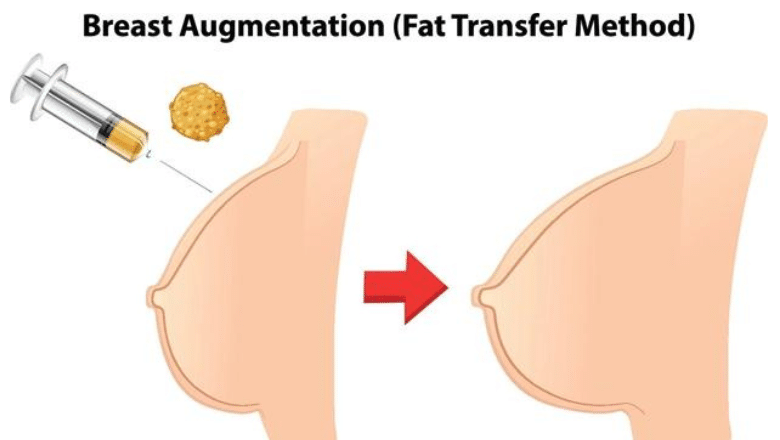
Fat transfer to the breasts uses your own fat, removed by liposuction from another area, to add a modest amount of volume, typically up to about one cup size, without an implant. Not all of the transferred fat survives, so the final size is less predictable than with an implant and a second session is sometimes needed. Fat transfer is also used alongside implants to soften the upper slope or even out asymmetry.
Tuberous Breast and Asymmetry Correction
Some women are born with breasts that differ noticeably in shape or size. Our surgeons correct tuberous breast deformity, where the lower part of the breast is constricted and the areola is often puffy, and breast asymmetry, with the approach planned separately for each breast. Breast reconstruction after mastectomy for breast cancer is a separate specialty that we do not offer; your breast care team can advise you on it.
What Are the Risks of Breast Surgery?
Every breast operation carries risks, and your surgeon will go through them with you before you decide. They include bleeding, infection, problems with wound healing, visible scars, changes in nipple or breast sensation, asymmetry and a result that differs from what you hoped for. Implants carry additional risks, including capsular contracture (hardening of the scar tissue around the implant), rupture, rippling and a rare lymphoma linked mainly to textured implants (BIA-ALCL). Implants are not lifetime devices, so further surgery is likely at some point. Breast lift and reduction leave permanent scars and can affect breastfeeding. Our guide to cosmetic surgery risks covers these in more detail.
Are You a Good Candidate for Breast Surgery?
Deciding to have breast surgery is a significant step, and a consultation with a plastic surgeon at Centre for Surgery is a sensible place to start. You are more likely to be a suitable candidate if you are in good general health, have realistic expectations (an improvement rather than “perfection”), are at least 18 years old, do not smoke or can stop for at least four weeks before and after surgery, have a stable weight, and are not pregnant or breastfeeding. We advise waiting at least three months, and ideally around six, after breastfeeding has completely stopped, or six months after the birth if you did not breastfeed. We recommend a two-week cooling-off period between your consultation and surgery, so you have time to think it over.
Can You Change Breast Shape Without Surgery?
Good posture, chest exercises such as push-ups and presses, a stable healthy weight and a well-fitted supportive bra can all improve how your breasts look in clothes, and are worth doing regardless. But chest exercises strengthen the muscle beneath the breast, not the breast itself, and none of these measures can meaningfully change breast size, shape, nipple position or the upper-to-lower proportion.
Which breast procedure is right for you?
A few short questions, including a simple mirror test. You will get a suggested procedure, realistic recovery times, and an honest view of when an examination is needed first.
Frequently Asked Questions
What is the most attractive breast shape?
In the studies published so far, the breast rated most attractive is balanced or slightly fuller below the nipple (between 45:55 and 55:45), with the nipple centred or angled slightly upward and a full, rounded lower curve. A moderately sized teardrop shape with an areola in proportion to the breast is the closest single description. Preferences vary between people, though, and no study has found a shape that everyone prefers.
What do people mean by “perfect boobs”?
“Perfect boobs” is the everyday way many people search for perfect breasts, and the answer is the same. In the research, proportion, a centred or slightly upturned nipple and moderate volume matter more than size. There is no single perfect breast, and a huge range of appearance, including visible veins, stretch marks, hair around the areola and some asymmetry, is entirely normal.
What is the golden ratio for breasts?
In breast aesthetics, “golden ratio” is shorthand for the 45:55 rule: 45% of the breast above the level of the nipple and 55% below, with the nipple angled slightly upward. It is unrelated to the mathematical golden ratio of 1.618. It describes how volume is distributed rather than how much there is, so it applies to small and large breasts alike.
Is 45:55 or 50:50 the perfect breast ratio?
Both have been found, by different studies using different images and groups of people. 45:55 came from London studies in 2012 and 2014 and was supported in Brazil and Malaysia; 50:50 came from an international survey of surgeons and patients published online in 2025 and a 2026 survey of Brazilian medical students; and a 2022 US study found 55:45. All of them sit within a narrow band, and none is a standard that a natural breast needs to meet.
What is the perfect breast size?
There is no perfect breast size. Where studies have asked, people tend to prefer moderate rather than large volumes: women in the 2022 US study chose around a B cup for themselves, and the highest-rated breasts in the 2023 New York study averaged about 300 cc. A size that suits one frame can look quite different on another, which is why implant sizing is based on your chest width, height and build.
What breast size do men prefer?
In the 2022 US study, men preferred somewhat larger breasts than women chose for themselves. On shape and proportion, men and women largely agree: in the 2014 study, 90% of men and 87% of women in their thirties ranked the 45:55 image highest, and the 2026 study found no significant difference between male and female respondents.
What is the most attractive cup size?
There is no single most attractive cup size in the research, because cup size depends on band size and bra brand, and ratings follow proportion to the body rather than the cup letter. The studies that looked at size point to moderate volumes, and our guide to C cup breasts explains why that size is so often requested.
What do beautiful breasts look like?
Beautiful breasts come in many shapes and sizes. In attractiveness studies, the features rated highest are balance between the upper and lower halves, a full lower curve, a nipple that points forward or slightly up, and volume in proportion to the frame. Beauty here is about proportion rather than size, and personal and cultural preferences vary widely.
Are perfectly symmetrical breasts normal?
They are unusual. In a study of 100 women having breast augmentation, 88% had measurable asymmetry between their breasts and 65% had more than one type, most often a difference in nipple height (53%) or volume (44%). Minor asymmetry is the norm, and noticeable asymmetry of a cup size or more can be improved surgically.
What is the ideal areola size?
Survey respondents tend to prefer an areola in proportion to the breast, and usually smaller rather than larger: 84% of the 2026 Brazilian students chose the smaller option, and the most popular choices in a large online survey were an areola a sixth or a quarter of the breast’s diameter. That is a preference, not a norm, and larger areolas are common and normal. Areola size can be reduced on its own or during a breast lift or reduction if it bothers you.
How can I improve the appearance of my breasts?
Non-surgical measures include a well-fitted supportive bra, good posture, chest exercises for the muscle beneath the breast and a stable, healthy weight. Surgical options include breast augmentation for volume, a breast lift for position and shape, breast reduction for size and comfort, and fat transfer for a modest increase. Each operation has risks and limits, which a consultation will go through.
What can be done about sagging breasts?
A supportive bra and a stable weight help how breasts look day to day, but they cannot lift the breast. Once the nipple has dropped below the breast fold, a breast lift (mastopexy) is usually needed to raise it and reshape the breast, by removing excess skin and repositioning the remaining tissue. Our guide to breast ptosis explains how the grade of sagging affects the options.
What if one breast is larger than the other?
Breast asymmetry is common and usually normal. Options include doing nothing, using a removable bra insert, or surgery: a small implant or fat transfer on the smaller side, a reduction or lift on the larger side, or a combination. Our guide to uneven breasts explains the causes and options in more detail.
Is there an ideal breast shape everyone should aim for?
No. Proportions like 45:55 are often quoted, and the research shows broad agreement on balance and a full lower curve, but there is no single breast shape that suits everyone or that anyone needs to aim for. Natural variation is normal and healthy, and a good consultation focuses on what suits your frame and what you want, including whether surgery is right for you at all.
Breast Surgery at Centre for Surgery, London
At Centre for Surgery, breast augmentation, breast lift, breast reduction, fat transfer to the breasts and tuberous breast and asymmetry correction are performed by GMC-registered plastic surgeons at our CQC-regulated Baker Street hospital, rated Good overall by the Care Quality Commission. Breast operations are carried out under TIVA (total intravenous anaesthesia) or, for some procedures, local anaesthetic with sedation, usually as a day case.
At your consultation, your surgeon will talk through what you would like to change, take measurements, and explain the options that suit your frame along with their risks and limits, including when surgery is unlikely to help. You can see patients’ results in our breast augmentation before and after photos, breast lift before and after photos and breast reduction before and after photos, and read patient reviews on Google or on our patient reviews page.
Phone: 020 7993 4849 | Address: 95–97 Baker Street, Marylebone, London W1U 6RN
Contact us to book a consultation
References
- Mallucci P, Branford OA. Concepts in aesthetic breast dimensions: analysis of the ideal breast. Journal of Plastic, Reconstructive & Aesthetic Surgery 2012;65(1):8–16. doi:10.1016/j.bjps.2011.08.006
- Bekisz JM, Boyd CJ, Salibian AA, et al. Aesthetic characteristics of the ideal female breast. Plastic and Reconstructive Surgery Global Open 2023;11(1):e4770. doi:10.1097/GOX.0000000000004770
- Mallucci P, Branford OA. Population analysis of the perfect breast: a morphometric analysis. Plastic and Reconstructive Surgery 2014;134(3):436–447. doi:10.1097/PRS.0000000000000485
- Ferraz CCV, Guimarães PAMP, Felix GAA, et al. Exploring the ideal of breast beauty: a morphometric analysis based on the opinions of the Brazilian population. Aesthetic Plastic Surgery 2025;49(1):147–155. doi:10.1007/s00266-024-04184-x
- Wallner C, Dahlmann V, Montemurro P, et al. The search for the ideal female breast: a nationally representative United-States-census study. Aesthetic Plastic Surgery 2022;46(4):1567–1574. doi:10.1007/s00266-021-02753-y
- Buccheri EM, Lanzano G, Montemurro P, et al. The ideal breast: insights from a patient’s survey and a global aesthetic surgery consensus at the A.M.B.E.R. Aesthetic Plastic Surgery 2026;50(7):2567–2577. doi:10.1007/s00266-025-05471-x
- Pereira LGRR, Rodrigues LLR, Caldato ME, et al. Breast esthetic preferences from the perspective of medical students: a cross-sectional study. Revista Brasileira de Cirurgia Plástica 2026;41(1):1–7. doi:10.1055/s-0046-1816565
- Hamzan MI, Wan Sulaiman WA, Ismail NN. Perception of the most perfect female breast shape among Malays, Chinese, and Indians community. Journal of Plastic Surgery and Hand Surgery 2022;56(1):30–37. doi:10.1080/2000656X.2021.1908313
- Mejia Jimenez N, Patrón Gómez AS. Breast aesthetic preferences: analysis of 1294 surveys. Aesthetic Plastic Surgery 2021;45(5):2088–2093. doi:10.1007/s00266-021-02253-z
- Song S, Parmeshwar N, Steiner G, et al. Morphometric analysis of gender-affirming breast augmentation. Plastic and Reconstructive Surgery Global Open 2022;10(11):e4691. doi:10.1097/GOX.0000000000004691
- Hsia HC, Thomson JG. Differences in breast shape preferences between plastic surgeons and patients seeking breast augmentation. Plastic and Reconstructive Surgery 2003;112(1):312–320. doi:10.1097/01.PRS.0000066365.12348.A7
- Swami V, Tran US, Barron D, et al. The Breast Size Satisfaction Survey (BSSS): breast size dissatisfaction and its antecedents and outcomes in women from 40 nations. Body Image 2020;32:199–217. doi:10.1016/j.bodyim.2020.01.006
- Rohrich RJ, Hartley W, Brown S. Incidence of breast and chest wall asymmetry in breast augmentation: a retrospective analysis of 100 patients. Plastic and Reconstructive Surgery 2003;111(4):1513–1519. doi:10.1097/01.PRS.0000049636.17522.1B
- Regnault P. Breast ptosis. Definition and treatment. Clinics in Plastic Surgery 1976;3(2):193–203. PMID: 1261176
- Lewin R, Amoroso M, Plate N, et al. The aesthetically ideal position of the nipple-areola complex on the breast. Aesthetic Plastic Surgery 2016;40(5):724–732. doi:10.1007/s00266-016-0684-z
- Kuruvilla AS, Kumar A, Ibelli TJ, et al. Public perception of ideal areola proportions. Annals of Plastic Surgery 2023;90(6S Suppl 5):S654–S658. doi:10.1097/SAP.0000000000003407
- Wang AT, Panayi AC, Fischer S, et al. Patient-reported outcomes after reduction mammoplasty using BREAST-Q: a systematic review and meta-analysis. Aesthetic Surgery Journal 2023;43(4):NP231–NP241. doi:10.1093/asj/sjac293



