


In this guide16 sections
- Key Points
- What Is 360 Lipo and BBL?
- Lipo 360 vs BBL: What’s the Difference?
- Why Is 360 Lipo the Most Common Combination With a BBL?
- How Does 360 Lipo With BBL Change the Waist-to-Hip Ratio?
- Who Is a Good Candidate for 360 Lipo and BBL?
- VASER or Power-Assisted Liposuction: Which Is Used for the Harvest?
- What Happens During 360 Lipo and BBL Surgery?
- How Long Is Recovery From Lipo 360 and BBL?
- What Are the Risks of 360 Lipo and BBL Combined?
- 360 Lipo and BBL vs Mini BBL: Which Do You Need?
- What Results Can You Expect From 360 Lipo and BBL?
- How Much Does 360 Lipo and BBL Cost?
- Frequently Asked Questions
- 360 Lipo and BBL in London
- References
Key Points
- 360 lipo and BBL is one operation with two jobs. 360 liposuction slims the abdomen, flanks, waist and back, and the fat it removes is purified and transferred to the buttocks.
- It is the most common BBL combination. Both parts are done in a single session of 3 to 4 hours as a day case under TIVA, at the longer end of that range when 360 lipo is included.
- The waist-to-hip ratio is the real target. Narrowing the waist while adding volume to the buttocks changes the ratio from both ends.
- Recovery is felt mostly in the donor areas. Expect soreness around the whole midsection, a compression garment for 6 weeks and no sitting directly on the buttocks for 2 weeks.
- Combined and larger-volume surgery carries more risk. Careful selection, a 5-litre liposuction limit and fat placed only above the muscle under ultrasound keep that risk low.
- Lipo 360 is not the same as a BBL. Lipo 360 removes fat; a BBL moves it. A mini BBL uses two donor areas instead of a full 360 harvest.
360 lipo and BBL means having 360 liposuction of the abdomen, flanks, waist and back and a Brazilian butt lift in the same operation, using the fat removed from your midsection to add shape and volume to your buttocks. It is the most common way a BBL is performed, takes around 3 to 4 hours as a day case, and is planned around your waist-to-hip ratio rather than buttock size alone.
This guide explains what 360 liposuction involves, how it differs from a Brazilian butt lift, who suits the combination, how VASER and power-assisted harvesting compare, and what the evidence says about the risks of combined and larger-volume liposuction. For the week-by-week timeline after surgery, see our BBL recovery guide.
What Is 360 Lipo and BBL?
360 lipo, also called lipo 360, 360 liposuction or circumferential liposuction, treats the entire midsection as one continuous unit rather than as separate areas:
- Upper and lower abdomen: the most commonly treated area, including the lower tummy that often persists after weight loss or pregnancy.
- Flanks (love handles): the fat at the sides of the waist, which has the biggest influence on the waist-to-hip ratio.
- Mid and lower back: including the bra-line and lower-back rolls visible above a waistband.
- Waist: the circumference between the ribs and hips, treated so the front, sides and back blend into each other.
A BBL is a fat transfer to the buttocks. Fat is harvested by liposuction, processed to remove fluid and oil, and injected to add projection, roundness and upper-buttock fullness, and to soften hip dips. When the two are combined, the 360 liposuction is both the contouring procedure and the fat harvest: the fat that was widening your waist becomes the volume that shapes your hips and buttocks. Treating the whole circumference matters, as a BBL is judged mostly from the side and back.
Lipo 360 vs BBL: What’s the Difference?
People often search “lipo 360 vs BBL” or ask whether lipo 360 includes a BBL. They are different operations that are often booked together:
- Lipo 360 removes fat. It slims and smooths the midsection, and the fat is discarded. Most people take 3 to 7 days off work, with no sitting restrictions.
- A BBL moves fat. It always includes liposuction, but the aim is buttock volume. The harvest can come from two areas (a mini BBL) or from a full 360 liposuction.
- 360 lipo with BBL does both. The midsection is fully contoured and the fat is grafted into the buttocks, with the BBL recovery rules.
If your main concern is a thick midsection and you are happy with your buttocks, lipo 360 alone may be enough. If you want more curve, the BBL is what adds it.
Why Is 360 Lipo the Most Common Combination With a BBL?
At Centre for Surgery, 360 liposuction with BBL is the combination most patients choose, and it is done in one session:
- Enough fat for a full BBL. A full BBL typically transfers around 1,600 to 2,000 ml of fat in total. Harvesting all four midsection zones usually provides that, plus the extra needed to allow for fat that does not survive.
- The contrast is the result. A smaller waist makes the buttocks look rounder and higher even before fat is added.
- One anaesthetic and one recovery. The operation takes 3 to 4 hours under TIVA, at the longer end with 360 lipo, rather than two separate procedures.
- Smooth transitions. The flanks and lower back sit directly above the buttocks, so contouring them in the same operation lets your surgeon blend waist into hip without a visible step.
A tummy tuck is never performed in the same operation as a BBL at Centre for Surgery, as the two need opposite positions during surgery and recovery. Where loose abdominal skin needs removing, the operations are staged 3 to 6 months apart; our guide to combining a tummy tuck and BBL explains the timing.

How Does 360 Lipo With BBL Change the Waist-to-Hip Ratio?
The waist-to-hip ratio is your waist measurement divided by your hip measurement; the lower it is, the curvier the outline. In a 2016 population survey of 1,146 people published in Plastic and Reconstructive Surgery ↗, the buttock shape rated most attractive from behind had a ratio of 0.65, and from the side 0.70, with no significant differences in preference by age, gender or ethnicity[1].
360 lipo with BBL changes the ratio from both ends: liposuction narrows the waist and flanks, and fat grafting builds the hips and buttocks. In a 2025 study of 293 patients having subcutaneous buttock fat grafting, with fat harvested by power-assisted and ultrasound-assisted liposuction, the average waist-to-hip ratio in women improved from 0.81 to 0.72, with no deaths reported[2].
A good plan is about proportion, not chasing a number. The width of your lower ribcage sets a floor on how narrow the waist can become, as liposuction removes fat, not bone. Filling hip dips and the upper outer buttock often does more for the outline than adding volume to the centre, and the amount of donor fat you have limits what can safely be transferred.

Real Centre for Surgery patient after 360 liposuction with fat transfer to the buttocks. Individual results vary.
Who Is a Good Candidate for 360 Lipo and BBL?
You are likely to be suitable if:
- You have enough donor fat around the midsection. A BMI of about 23 to 28 usually provides enough for a full BBL with 360 harvest.
- Your weight has been stable for at least 3 months, or 6 to 12 months after major weight loss.
- Your skin is reasonably firm, so it can shrink back over the slimmer midsection. Loose abdominal skin may need a staged tummy tuck, and loose buttock skin a buttock lift.
- You do not smoke or vape, or can stop all nicotine for 4 weeks before and 4 weeks after surgery, as nicotine reduces fat survival.
- You are 18 or over, not pregnant or breastfeeding, in good general health, and realistic about the fact that some transferred fat is always reabsorbed.
If your BMI is below about 23, there may not be enough fat for a full BBL, and a skinny BBL harvests modest amounts from more areas instead. If your BMI is higher, the issue is safety rather than fat supply: liposuction is generally not advised above a BMI of about 30. In a study of 4,534 liposuction patients, removing more than 100 ml of fat per unit of BMI was an independent predictor of complications[3]; for a BMI of 25, that is around 2.5 litres. Your surgeon plans the harvest around your BMI, and Centre for Surgery limits liposuction to 5 litres per session.
VASER or Power-Assisted Liposuction: Which Is Used for the Harvest?
Both are equally available for 360 lipo with BBL at Centre for Surgery, and your surgeon recommends one, or a combination, based on your tissue:
- Power-assisted liposuction (PAL) uses a vibrating cannula to loosen fat mechanically. It is not heat-based, and it is followed by fat equalisation, which spreads a thin, even layer of fat under the skin to reduce irregularities.
- VASER liposuction uses ultrasound energy to loosen fat first. It suits dense or fibrous fat, common in the back and flanks and after previous liposuction.
Neither removes more fat than the other, and the 5-litre limit applies to both. In a 2022 laboratory study of 47 fat samples, fat harvested with a super-wet technique plus ultrasound showed the least cell damage under electron microscopy[4]. That measured cell structure, not fat survival in the buttocks, and no clinical trial shows either method gives a better BBL.
What Happens During 360 Lipo and BBL Surgery?
The operation follows the same safety protocol as every BBL at Centre for Surgery, with the liposuction extended around the midsection:
- Before surgery: stop all nicotine 4 weeks before and aspirin 2 weeks before; stop anti-inflammatory painkillers and supplements such as fish oil, vitamin E, ginkgo, garlic and St John’s wort; keep alcohol to little or none for a week either side. Paracetamol is fine. An oestrogen-containing pill or HRT may need pausing 4 weeks before. Have a BBL cushion ready at home.
- Anaesthesia: you are asleep under TIVA (total intravenous anaesthesia), given and monitored by a consultant anaesthetist. You fast for 6 hours from food and 2 hours from clear fluids.
- Liposuction: you lie face down while the back and flanks are treated, then are turned for the abdomen and waist. Tumescent fluid with local anaesthetic and adrenaline reduces bleeding and helps comfort. Incisions are 3 to 4 mm, placed in natural creases.
- Fat transfer: the processed fat is injected only into the subcutaneous layer above the gluteal muscle, never into or beneath it, using a blunt cannula and expansion vibration lipofilling (EVL), under real-time ultrasound guidance on every BBL.
- After surgery: you are monitored for 1 to 3 hours, fitted with your compression garment and go home the same day with a responsible adult, who stays with you for 24 hours.
Our article on ultrasound-guided BBL explains why seeing the fat go into the correct layer is the most important safety step.
How Long Is Recovery From Lipo 360 and BBL?
Recovery follows the BBL rules, but how it feels is shaped by the 360 liposuction. Most people find the donor areas sorer than the buttocks. Compared with a BBL using a smaller harvest:
- Soreness is all the way round. The abdomen, flanks and back are all treated, so there is no comfortable side to lean on at first. It feels like deep bruising and tightness, peaking around days 2 to 5. Centre for Surgery runs regular post-operative pain audits, and combining TIVA with local anaesthetic has minimised, or even avoided, strong opioid painkillers for many patients.
- The compression garment covers more. You wear it for 6 weeks, day and night, removing it only briefly to shower. It covers the whole midsection and back and leaves the buttocks free, so the new fat is not squashed.
- There is more fluid and swelling. Reddish tumescent fluid may leak from the incisions for 24 to 48 hours, and swelling peaks around days 3 to 5, with some residual swelling at the waist for a few months.
The BBL rules then apply in full:
- Sitting: no sitting directly on your buttocks for 2 weeks; use a BBL cushion if it is unavoidable, and expect short spells of normal sitting from week 3. Our guide on when you can sit after a BBL explains why.
- Sleeping: on your front or side for 2 weeks, not your back. With a tender tummy, many people find side-lying with pillows easiest at first.
- Activity: walking from day 1; light cardio such as walking (not cycling) from week 3; full exercise, including weights, from 6 weeks.
- Work and driving: 1 to 2 weeks off work, with desk work from about day 7 if you can avoid sitting on your buttocks; driving after 4 weeks.
A nurse-led wound check takes place at 7 to 14 days and a surgeon review at 6 weeks. Lymphatic drainage massage is sometimes recommended after 360 liposuction; Centre for Surgery does not provide it in-house, so if your surgeon advises it you will be referred to a qualified therapist and pay them directly. Call 999 for breathlessness, chest pain or coughing blood, and call us, or NHS 111 out of hours, for calf pain or swelling, a fever, or a red, hot incision.
What Are the Risks of 360 Lipo and BBL Combined?
360 lipo and BBL carries the risks of both liposuction and gluteal fat grafting, and the evidence shows that combining procedures and removing larger volumes both add risk. That is why patient selection and strict technique matter.
Fat embolism and BBL safety
The most serious BBL risk is fat entering the large veins beneath the gluteal muscle and travelling to the lungs. In a 2017 ASERF task force survey in Aesthetic Surgery Journal ↗, surgeons reporting on 198,857 gluteal fat grafting cases described 32 deaths and 103 non-fatal fat emboli, with a significantly higher risk among those who injected into the deep muscle[5]. Practice has since moved to subcutaneous-only grafting. The British Association of Aesthetic Plastic Surgeons’ 2023 safety review noted the estimated mortality risk had fallen from about 1 in 2,500 to nearer 1 in 15,000, similar to a tummy tuck, and highlighted intraoperative ultrasound as effective in avoiding deep injection[6]. In a 2024 study of 1,815 ultrasound-guided BBLs, 4% of patients had a complication, most often seroma (1.2%), small areas of skin damage (1.2%) or wound infection (0.8%), with no fat embolisms and no deaths[7].
Risks of combined surgery
Adding procedures lengthens the operation and increases tissue trauma. In a 2017 prospective cohort study of 31,010 liposuction procedures in Aesthetic Surgery Journal ↗, liposuction alone had a major complication rate of 0.7%, while combining it with other cosmetic procedures was the strongest independent predictor of major complications (relative risk 4.81)[8]. In a study of 129,007 cosmetic surgery patients, combined procedures had a blood clot rate of 0.20% compared with 0.04% for single procedures, and body procedures carried the highest risk[9]. These studies mostly looked at liposuction added to separate operations such as a tummy tuck.
Risks of larger-volume liposuction
A full 360 harvest removes more fat than single-area liposuction, and volume relative to body size matters[3]. Centre for Surgery limits liposuction to 5 litres per session and stages larger treatments.
Other risks
- Seroma: a fluid collection, more common after multi-area liposuction; it may need draining.
- Contour irregularities: dents or ridges in the donor areas, reduced by fat equalisation and wearing the garment.
- Fat necrosis, asymmetry and fat loss: firm lumps or uneven reabsorption, sometimes correctable later.
- Loose skin, infection, bleeding and numbness: uncommon; numbness usually settles over weeks to months.
- Blood clots (DVT or PE): reduced by early walking, compression and an individual risk assessment.
Surgery abroad adds risk: the injection plane is hard to verify and flying soon after raises clot risk. Our guide to BBL risks covers safety in more depth.
360 Lipo and BBL vs Mini BBL: Which Do You Need?
The difference between a full BBL with 360 lipo and a mini BBL is scope, not technique; both use ultrasound-guided, subcutaneous-only fat transfer.
- Donor areas: two for a mini BBL, usually the lower flanks and upper thighs, against the abdomen, flanks, waist and back for 360 lipo with BBL.
- Volume: around 800 to 1,000 ml in total (400 to 500 ml per side), against around 1,600 to 2,000 ml for a full BBL.
- Operation time: around 2 hours, against 3 to 4 hours.
- Recovery: about a week off and exercise from 4 weeks after a mini BBL, against 1 to 2 weeks off and exercise from 6 weeks. The 2-week sitting rule and 4-week driving rule apply to both.
A mini BBL suits subtle shaping when the midsection is already slim; 360 lipo with BBL suits people who want a narrower waist and a noticeable increase in buttock volume.
What Results Can You Expect From 360 Lipo and BBL?
Your waist looks slimmer straight away, although swelling hides much of the change at first, and the buttocks look fuller than the final result, as your surgeon over-fills slightly to allow for reabsorption. Swelling peaks in the first week, the skin softens (“fluffing”) around 6 to 8 weeks, most of the result is visible at 3 months and the final shape at 3 to 6 months. Around 50 to 70% of the transferred fat survives. Surviving fat is permanent from about 6 months but changes with your weight, so keeping your weight stable protects both the waist and the buttock result.
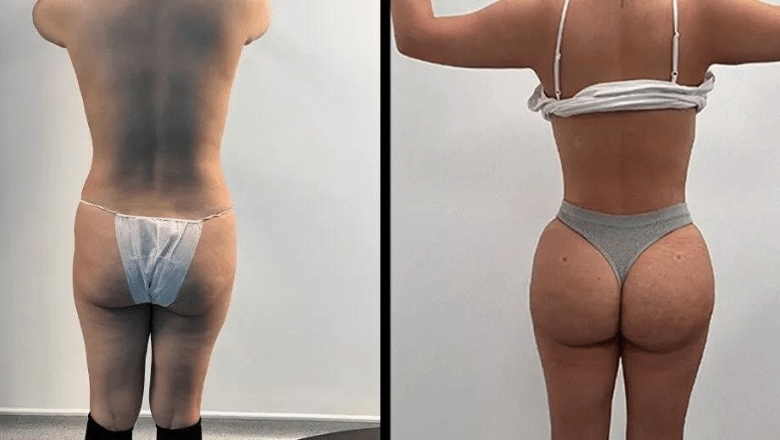
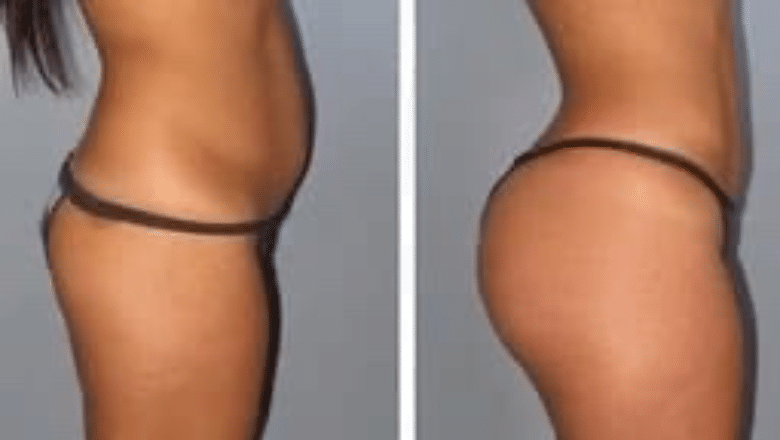
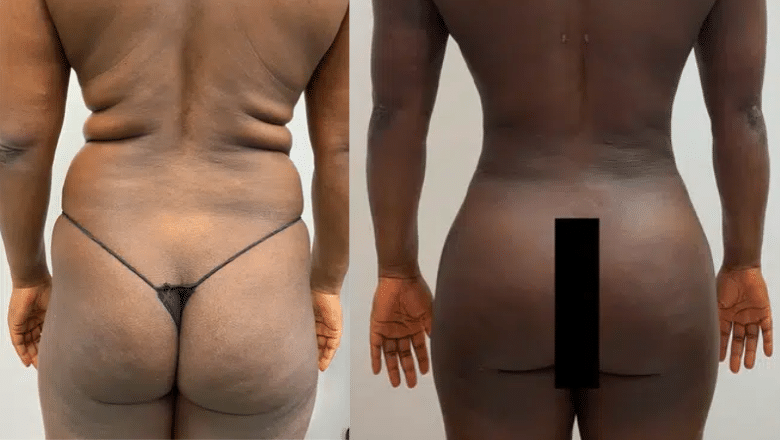
Real Centre for Surgery patients. Individual results vary.
More results are in our BBL before and after photos.
How Much Does 360 Lipo and BBL Cost?
The cost depends on the number of liposuction areas, the volume of fat transferred, your BMI and whether it is a first BBL or a revision. Current prices are set out in our BBL cost guide, and your figure is confirmed in writing after consultation. Compression garments and prescribed medication are bought separately. Finance isn’t available for BBL at Centre for Surgery, including with 360 liposuction, so the procedure is self-funded.
Frequently Asked Questions
How long does it take to recover from a BBL and lipo 360?
Most people take 1 to 2 weeks off work, avoid sitting directly on the buttocks for 2 weeks and wear a compression garment for 6 weeks. Light cardio starts from week 3, full exercise from 6 weeks and driving after 4 weeks. The final result takes 3 to 6 months.
Is lipo 360 very painful?
It is usually described as deep bruising and tightness rather than sharp pain, felt across the abdomen, flanks and back for the first few days. With a BBL, the donor areas are often sorer than the buttocks. Local anaesthetic in the tumescent fluid, TIVA and regular paracetamol keep most patients comfortable.
Does lipo 360 include a BBL?
No. Lipo 360 removes fat from the abdomen, flanks, waist and back, and the fat is discarded. A BBL is a separate step in which that fat is purified and transferred to the buttocks. Many people have both in one operation.
Can you transfer fat from your stomach to your buttocks?
Yes. The abdomen is one of the most common BBL donor areas. Fat removed from the stomach, flanks and back is processed and injected into the fat layer above the gluteal muscle, and around 50 to 70% of it survives long term.
Do you lose weight after lipo 360?
Not much on the scales. Fat is light for its volume, and swelling can even push the scales up at first. The change shows in your measurements and how clothes fit. Lipo 360 is a contouring procedure, not a weight-loss treatment.
How many inches does lipo 360 take off?
There is no reliable standard figure. The change depends on how much fat sits over the muscles, the width of your ribcage and how well your skin shrinks back. Your surgeon can estimate what is realistic for you, and the final measurement is clearer once swelling settles at 3 to 6 months.
How do you sleep after lipo 360 and BBL?
Sleep on your front or side for 2 weeks and avoid lying on your back, so there is no pressure on the transferred fat. With a tender tummy after 360 lipo, many people find side-lying with a pillow between the knees and another behind the back most comfortable.
Can I sit on the toilet after a BBL with lipo 360?
Yes. Keep toilet visits brief and lean forward so most of your weight rests on your thighs. Do not use a cushion on the toilet. Drinking plenty of water and eating fibre helps avoid constipation from painkillers.
Can you have lipo 360, a tummy tuck and a BBL together?
Not in one operation at Centre for Surgery, as a tummy tuck and a BBL need opposite positions during surgery and recovery. Lipo 360 with BBL is done together, and a tummy tuck is staged 3 to 6 months apart if loose skin needs removing.
360 Lipo and BBL in London
360 lipo and BBL at Centre for Surgery is performed by GMC-registered surgeons at our CQC-regulated Baker Street hospital, rated Good overall by the CQC. Every BBL uses real-time ultrasound guidance with fat placed only above the gluteal muscle, and the harvest is by VASER or power-assisted liposuction, as your surgeon recommends. Surgery is a day case under TIVA, and the consultant who assesses you performs your surgery. Follow-up appointments are included, further consultations before surgery are free, and we recommend a two-week cooling-off period. Your initial consultation is £100, redeemable against the cost of surgery if you go ahead.
Phone: 020 7993 4849 | Address: 95–97 Baker Street, Marylebone, London W1U 6RN
Contact us to schedule a consultation
References
- Wong WW, Motakef S, Lin Y, Gupta SC. Redefining the ideal buttocks: a population analysis. Plastic and Reconstructive Surgery 2016;137(6):1739–1747. doi:10.1097/PRS.0000000000002192 ↗
- Gupta R, Bansal P, Chaudhury G, Tanwar NS. Safety and efficacy of subcutaneous buttock augmentation in Indian population: a retrospective analysis. Indian Journal of Plastic Surgery 2025;58(6):447–453. doi:10.1055/s-0045-1809330 ↗
- Chow I, Alghoul MS, Khavanin N, et al. Is there a safe lipoaspirate volume? A risk assessment model of liposuction volume as a function of body mass index. Plastic and Reconstructive Surgery 2015;136(3):474–483. doi:10.1097/PRS.0000000000001498 ↗
- Luze H, Einsiedler J, Nischwitz SP, et al. Quality and vitality of autologous fat grafts harvested by different techniques: a clinical comparison study. Aesthetic Surgery Journal 2022;42(12):1416–1424. doi:10.1093/asj/sjac192 ↗
- Mofid MM, Teitelbaum S, Suissa D, et al. Report on mortality from gluteal fat grafting: recommendations from the ASERF Task Force. Aesthetic Surgery Journal 2017;37(7):796–806. doi:10.1093/asj/sjx004 ↗
- Tillo O, Nassab R, Pacifico MD. The British Association of Aesthetic Plastic Surgeons (BAAPS) gluteal fat grafting safety review and recommendations. Aesthetic Surgery Journal 2023;43(6):675–682. doi:10.1093/asj/sjac316 ↗
- Vidal-Laureano N, Huerta CT, Perez EA, Earle SA. Augmented safety profile of ultrasound-guided gluteal fat transfer: retrospective study with 1815 patients. Aesthetic Surgery Journal 2024;44(4):NP263–NP270. doi:10.1093/asj/sjad377 ↗
- Kaoutzanis C, Gupta V, Winocour J, et al. Cosmetic liposuction: preoperative risk factors, major complication rates, and safety of combined procedures. Aesthetic Surgery Journal 2017;37(6):680–694. doi:10.1093/asj/sjw243 ↗
- Winocour J, Gupta V, Kaoutzanis C, et al. Venous thromboembolism in the cosmetic patient: analysis of 129,007 patients. Aesthetic Surgery Journal 2017;37(3):337–349. doi:10.1093/asj/sjw173 ↗

Related Articles
- BBL Recovery and Aftercare: A Week-by-Week Guide
- Safe BBL: What Is an Ultrasound-Guided BBL and Is It Safer?
- Can You Combine a Tummy Tuck and BBL?
- How Much Fat is Transferred to the Buttocks in a BBL?






