


In this guide17 sections
- Key Points
- Can You Have Liposuction on Your Face?
- What Is Facial Liposuction and How Does It Work?
- Who Is a Good Candidate for Face Liposuction?
- Face Lipo vs Neck Lift vs Facelift: Which Is Better for Jowls and a Double Chin?
- Can You Reduce Facial Fat Without Surgery?
- Face Liposuction Before and After
- How Is Face Liposuction Done?
- Does Face Liposuction Hurt?
- Face Liposuction Recovery: How Long Does It Take?
- Face Liposuction Risks and Side Effects
- Is Face Liposuction Permanent?
- How Much Does Face Liposuction Cost in the UK?
- What Happens at a Face Liposuction Consultation?
- Frequently Asked Questions
- Face Liposuction in London
- References
Key Points
- Can liposuction be done on the face? Yes, but mainly on the lower face. Face liposuction is well established under the chin and along the jawline and upper neck, where it removes fat permanently. It is much less suited to the cheeks, jowls and smile lines.
- Face lipo removes fat, not loose skin. If the heaviness is caused by sagging skin or neck bands rather than fat, a neck lift or mini facelift is the better operation.
- Jowls are often a mix of fat and ptosis. Lipo for jowls works only when the skin is elastic enough to shrink back. Otherwise liposuction is combined with a lift.
- Cheek fullness has its own operation. Buccal fat removal, not liposuction, is the usual surgical option for rounder lower cheeks.
- Recovery is short. Chin and neck liposuction is done as a day case under local anaesthetic with sedation or TIVA, with most people back at desk work in 7 to 10 days and the final contour visible by 2 to 3 months.
- The main risks are swelling, bruising, temporary numbness and an uneven contour or loose skin if the case is chosen badly. Costs are confirmed in writing after consultation.
Face liposuction is one of the most searched-for facial contouring procedures, and the question behind most of those searches is simple: can liposuction be done on the face at all? It can. Fat under the chin and along the jawline responds very well to chin and neck liposuction, which sharpens the angle between the jaw and the neck through incisions only a few millimetres long. Other areas people ask about, such as the jowls, the cheeks and the lines beside the nose, are more complicated, and surgeons are right to be cautious about them.
This guide explains where face lipo works, where it does not, and what to consider instead. If your concern is a heavy lower face, our guides to treatments for sagging jowls and how to get rid of a double chin compare every option, and general liposuction is covered on its own service page. Where skin has loosened as well, a neck lift, mini facelift or facelift may suit better, and rounder cheeks are treated with buccal fat removal.
Can You Have Liposuction on Your Face?
Yes, you can have liposuction on your face, but the answer depends on which part of the face. Liposuction works by passing a fine tube (a cannula) through the fat layer to break up and remove fat cells. It needs a reasonably thick, even layer of fat to work on and skin that can contract afterwards. The area beneath the chin has both, which is why chin and neck liposuction is the standard facial liposuction operation. Elsewhere in the face the fat is thinner, more fibrous or sits in compartments that are close to nerves and muscles, so the margin for error is smaller.
Can liposuction be done on the jowls?
Liposuction for jowls is possible in the right patient, but it is rarely the whole answer. A 2008 review of jowl ageing in Aesthetic Surgery Journal ↗ described three patterns: thin skin with fat loss, jowl ptosis where the fat compartments have slipped downwards, and confluent fat spilling over the jaw because the supporting ligaments have loosened. Only the third pattern involves a genuine excess of fat, and even then the authors treated it by releasing the ligaments, lifting the deeper tissue and removing fat directly, rather than by liposuction alone[1].
Jowls also change with age and weight. An ultrasound study of 51 patients found that the soft tissue was thickest at the jowl, and that thickness rose with both age and BMI[2]. In practice, that means younger or slimmer patients with fullness along the jawline and good skin may do well with jawline lipo as part of chin and neck liposuction, whereas established sagging jowls usually need a lift. Our guide to the ideal female jawline and our article on a weak jawline explain how fat, skin and bone each shape the lower face.
Can you have liposuction on nasolabial folds and smile lines?
Liposuction is not a treatment for nasolabial folds, the creases running from the nose to the corners of the mouth. These folds form where thicker and thinner fat compartments meet, and with age the deeper fat can shrink or slip, which deepens them[3]. Removing more fat can make a fold look worse, not better. The usual treatments restore volume instead, with dermal fillers, or lift the tissue with a mini facelift or facelift.
Can you get liposuction on your cheeks?
Cheek liposuction is occasionally discussed for very full cheeks, but it is not a routine operation, and the more established way to slim the lower cheeks is buccal fat removal. This removes the buccal fat pad through a small cut inside the mouth, so there is no external scar. A 2025 meta-analysis of 12 studies in the Journal of Cranio-Maxillofacial Surgery found complications in about one in four of the 308 patients, mostly swelling, trismus (difficulty opening the mouth) and pain, and concluded that the operation should be recommended with caution[4]. A separate systematic review found early results were favourable but that the evidence was of low quality and lacked long-term follow-up[5].
It also matters who the operation suits. Removing fat from an already slim or ageing face can leave it looking gaunt. Our guides to losing face fat and chubby cheeks, non-surgical alternatives to buccal fat removal and buccal fat removal cost go into this in more detail.
What Is Facial Liposuction and How Does It Work?
Facial liposuction, also called face lipo, lipo for the face or facial liposculpture, is a surgical procedure that removes localised fat from the lower face and neck. In practice it means chin and neck liposuction, sometimes extended along the jawline. The surgeon makes incisions of around 3 to 5 mm in the crease under the chin, and sometimes behind each earlobe, injects a dilute local anaesthetic solution, and passes a fine cannula through the fat in a fan pattern. The thickness of the remaining fat is checked by hand throughout, so the contour comes out smooth and even.
Several techniques exist, including suction-assisted, power-assisted, ultrasound and laser-assisted liposuction. A review of 25 comparative studies found no clear advantage of one over another in most areas, with the exception that laser-assisted liposuction may tighten skin better under the chin[6]. The surgeon’s judgement and technique usually matter more than the device. Our service page on chin and neck liposuction sets out the technique used at Centre for Surgery.

Who Is a Good Candidate for Face Liposuction?
Good candidates for face liposuction have a localised pad of fat under the chin or along the jawline, skin that is still elastic, and a stable weight. Most people who have chin lipo are aged between 25 and 55. Younger patients with an inherited double chin often have excellent skin recoil and do well with liposuction alone.
Face lipo is usually not the right choice when:
- The skin under the chin is already loose or hanging, because it cannot shrink onto the smaller contour.
- Vertical neck bands (platysma bands) are the main problem.
- The fat lies beneath the platysma muscle, where liposuction cannot reach it.
- A recessed chin, rather than fat, is causing the double-chin look.
- Your weight is still changing or you are planning to lose a significant amount.
Your surgeon will pinch, measure and assess skin elasticity at consultation, which is the most reliable way to tell fat from skin from bone.
Face Lipo vs Neck Lift vs Facelift: Which Is Better for Jowls and a Double Chin?
The right operation depends on what is making the lower face look heavy, so the better question is whether the problem is fat, skin or muscle. Liposuction removes fat. A neck lift tightens the platysma muscle and removes excess skin, and a review of neck rejuvenation techniques describes platysma tightening as central to correcting banding and a blunted jaw-to-neck angle[7]. A mini facelift or facelift repositions the tissue that has slipped downwards, which is what jowls usually are.

Is chin liposuction better than a neck lift?
Neither is better in general. Chin and neck liposuction is a smaller operation with a shorter recovery and suits good skin with excess fat. A neck lift is a bigger operation that suits loose skin and bands. Many people over 50 benefit from combining the two, and in people with mild skin laxity FaceTite radiofrequency tightening can be added to liposuction in the same sitting. Where jowls and a double chin occur together, a mini facelift with chin liposuction is a common combination.
Is face lipo better than buccal fat removal?
They treat different places. Face lipo treats fat under the chin and along the jawline, while buccal fat removal treats the deep fat pad in the cheek. Some people have both, but it is important not to remove cheek fat from a face that is already lean, as this can accentuate ageing.
Can You Reduce Facial Fat Without Surgery?
Non-surgical options exist, but they suit different problems and carry different trade-offs. The honest summary is that they suit mild fullness, mild skin laxity or a loss of definition rather than a pronounced fat pad.
- Fat-dissolving injections (deoxycholic acid): these shrink fat under the chin gradually over several sessions. A 2018 pooled analysis of four phase 3 trials in JAMA Facial Plastic Surgery ↗ covering 1,738 patients confirmed they work, but many patients had pain, swelling and numbness, and the large volume of drug needed made them poor value except for mild to moderate fat[8]. At Centre for Surgery, liposuction is the preferred option for a noticeable pad.
- Radiofrequency and microneedling: treatments such as Morpheus8 RF microneedling can improve mild skin laxity along the jawline. A systematic review of subsurface radiofrequency treatments noted that most studies relied on patient satisfaction, that swelling and numbness were common, and that evidence for added benefit over surgery was limited[9].
- Jawline filler: jawline filler adds definition along the jaw without removing fat, and suits a soft jawline more than a heavy one.
- Anti-wrinkle injections: anti-wrinkle injections can soften neck bands and relax the muscles pulling the jawline down, but they do not remove fat.
- Thread lifts: these are sometimes marketed for jowls. We do not offer thread lifts, and when skin has genuinely sagged, a surgical lift gives a more predictable and longer-lasting result.
Our guides to non-surgical body contouring and alternatives to liposuction compare the evidence for each.
Face Liposuction Before and After
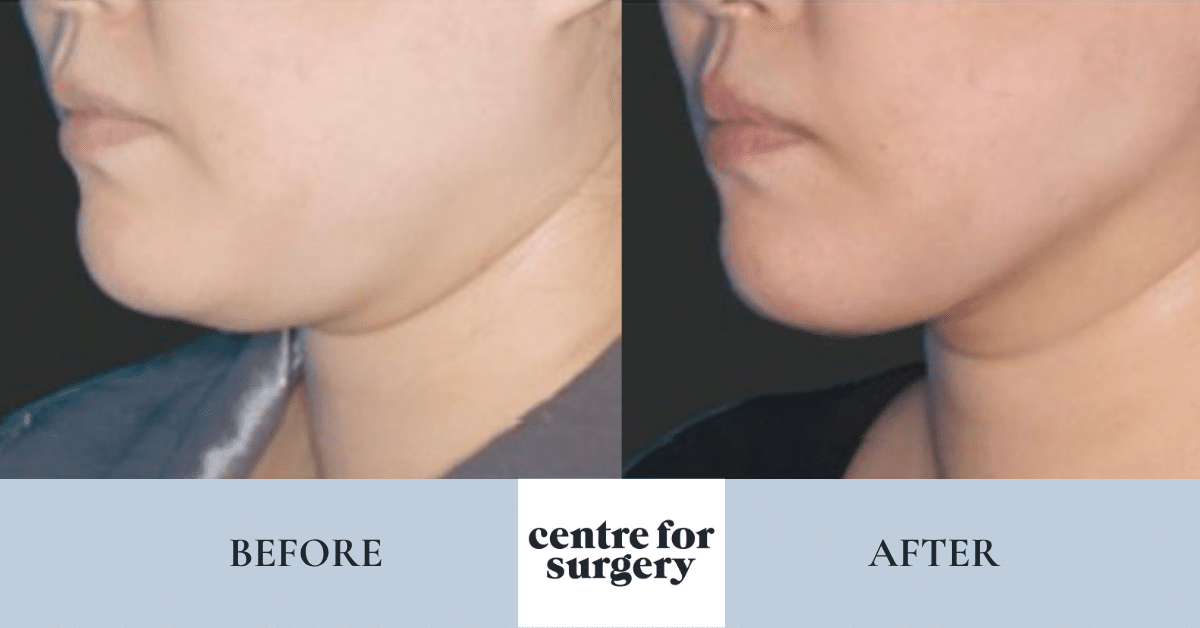
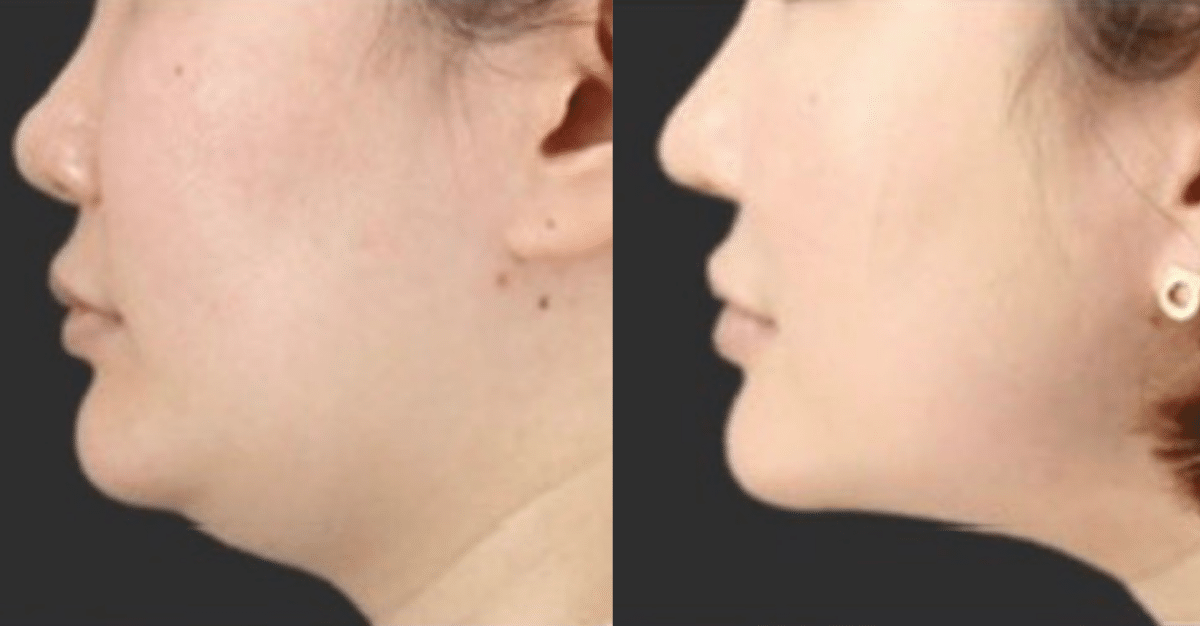
Face liposuction before and after photos show the change that is realistic when fat under the chin is the problem: a sharper, more defined angle between the jaw and the neck, and less fullness in profile. The photographs below are genuine Centre for Surgery patients who had chin and neck liposuction. Results vary between people, and photographs cannot show how skin quality and anatomy differ from case to case. You can see more in our liposuction before and after photos gallery.
How Is Face Liposuction Done?
Standalone chin and neck liposuction takes around an hour and is done as a day case. At Centre for Surgery it is performed under local anaesthetic with sedation, so you are comfortable but not fully asleep, or under TIVA (total intravenous anaesthesia) when it is combined with other procedures. Our guides to TIVA anaesthesia and anaesthesia for cosmetic surgery explain the options. The steps are:
- Marking: your surgeon marks the area to be treated while you sit upright.
- Anaesthetic: local anaesthetic solution is injected, with sedation or TIVA if chosen.
- Liposuction: a fine cannula is passed through the fat layer through small incisions to remove it evenly.
- Closure and garment: each incision is closed with one or two fine stitches and a compression garment is fitted.
You go home the same day, and a responsible adult must collect you and stay with you for the first 24 hours.
Does Face Liposuction Hurt?
Most people describe chin and neck liposuction as sore and tight rather than painful. You feel nothing during the procedure, and afterwards discomfort is usually controlled with paracetamol. The soreness is generally at its worst over the first couple of days, and the area can feel tight and numb as swelling settles. Stronger pain relief is rarely needed.
Face Liposuction Recovery: How Long Does It Take?
Recovery from chin and neck liposuction is short compared with a facelift, but it is not instant. The following timeline reflects our chin liposuction service page, and each person heals at a slightly different pace:
- First days: swelling and bruising build, peaking around days 3 to 4, and you wear a compression garment as instructed.
- Days 5 to 7: stitches come out.
- Days 7 to 10: most people are back at desk work, once bruising can be covered with concealer.
- Week 2: gentle cardio can resume.
- Week 4: weights and full exercise can resume.
- Months 2 to 3: most of the final contour is visible, although numbness under the chin can take this long to fade.
Our chin liposuction recovery guide and liposuction recovery and aftercare article cover each stage, including sleeping position and exercise.
Face Liposuction Risks and Side Effects
All surgery carries risk, and facial surgery sits close to important nerves. The common effects are swelling, bruising, tightness and temporary numbness under the chin. Less common risks are:
- An uneven contour or dimpling, particularly if too much fat is removed or the skin is poor.
- Loose skin, if the skin does not shrink onto the new contour.
- Haematoma or infection, which are uncommon.
- Nerve injury: a systematic review of submental liposuction combined with jaw surgery reported lower lip sensory change in around 6% and facial nerve injury in around 3% of 67 patients, which is a reminder that the risk is real though small[10].
Most dissatisfaction comes from choosing liposuction when skin or muscle was the underlying problem, which is why assessment matters more than technique. If a result disappoints, see our guide on correcting botched chin liposuction, and read about liposuction side effects and liposuction scars. The small incisions under the chin and behind the ears usually fade to barely visible lines within a few months.
Is Face Liposuction Permanent?
Face liposuction is long lasting because fat cells that are removed do not grow back. The remaining fat cells can still enlarge if you gain a lot of weight, though usually not to the same extent as before. The neck and jawline will also keep ageing, so looser skin or neck bands may appear years later. That is new ageing, not fat returning. Our guide to whether liposuction is permanent explains this further.
How Much Does Face Liposuction Cost in the UK?
The cost of face liposuction depends on how much fat is treated, whether the neck is included, the type of anaesthetic, and whether you combine it with skin tightening, a neck lift or other procedures. Your exact cost is confirmed in writing after your consultation, so there are no surprises. Read our chin liposuction cost guide and overview of cosmetic surgery costs for what is included, and see our finance options if you want to spread the cost.
What Happens at a Face Liposuction Consultation?
A consultation at Centre for Surgery is with a GMC-registered surgeon, and the surgeon who assesses you is the surgeon who operates. They will examine the fat, skin and muscle under the chin and along the jawline, discuss what you want to change, and tell you honestly whether liposuction, a lift or a non-surgical option suits you, which can include advising against surgery. The hospital on Baker Street is CQC-regulated. You then have a cooling-off period before deciding. Read our guide to preparing for your cosmetic surgery consultation to make the most of it.
Frequently Asked Questions
Can I get liposuction on my face?
Yes, in the right area. Liposuction on the face is well established under the chin and along the jawline and upper neck. It is not usually used on the cheeks, smile lines or sagging jowls, where a different procedure often gives a better result.
Does face lipo work for jowls?
Sometimes. Lipo for jowls helps when fullness along the jaw is mostly fat and the skin is elastic. If the jowls are sagging because the tissue has slipped down, liposuction alone can leave the area looking looser, and a mini facelift or facelift is usually more effective.
How much fat can you remove from your face?
Only a small volume. Fat under the chin is a limited pad, and surgeons deliberately leave an even layer so the contour looks natural. Removing too much risks dents, irregularities and a hollow look.
How long does face liposuction take?
Standalone chin and neck liposuction takes around an hour. It is longer when combined with a neck lift, FaceTite or other procedures, and you go home the same day.
What is the recovery time for face liposuction?
Most people return to desk work after 7 to 10 days, once the bruising can be covered. Stitches come out at days 5 to 7, gentle exercise resumes at week 2 and full exercise at week 4. The final contour settles over 2 to 3 months.
Is face liposuction better than fat-dissolving injections?
For a noticeable pad of fat, usually yes. Liposuction removes the fat in one procedure, whereas injections shrink it gradually over several sessions with more swelling and less predictable results[8].
Will my skin sag after face liposuction?
It can if the skin is not elastic enough to shrink back. This is the most important thing your surgeon checks. With mild laxity, radiofrequency skin tightening can be added, and with loose skin a neck lift is more appropriate.
Can face liposuction be done on the NHS?
Not normally. Liposuction for cosmetic reasons is not funded by the NHS, which uses it only for certain medical conditions such as lymphoedema and lipoedema.
Face Liposuction in London
If you are considering face liposuction for a double chin, jawline fullness or jowls, a consultation with one of our surgeons will establish whether fat, skin or muscle is responsible and which operation, if any, would help. Find out more about chin and neck liposuction at Centre for Surgery.
Phone: 020 7993 4849 | Address: 95–97 Baker Street, Marylebone, London W1U 6RN
Contact us to schedule a consultation
References
- Reece EM, Rohrich RJ. The aesthetic jaw line: management of the aging jowl. Aesthetic Surgery Journal 2008;28(6):668–674. doi:10.1016/j.asj.2008.09.007 ↗
- Zhang M, Yang Y, Shi Y, et al. A comprehensive ultrasound investigation of lower facial and neck structure. Aesthetic Plastic Surgery 2025;49(1):1–12. doi:10.1007/s00266-024-04313-6 ↗
- Rohrich RJ, Arbique GM, Wong C, Brown S, Pessa JE. The anatomy of suborbicularis fat: implications for periorbital rejuvenation. Plastic and Reconstructive Surgery 2009;124(3):946–951. doi:10.1097/PRS.0b013e3181b17b76 ↗
- Albuquerque MC, Arruda KAR, Xavier Junior GF, et al. Prevalence of complications of buccal fat removal: a systematic review and meta-analysis. Journal of Cranio-Maxillofacial Surgery 2025;53(4):363–369. doi:10.1016/j.jcms.2024.12.014 ↗
- Traboulsi-Garet B, Camps-Font O, Traboulsi-Garet M, Gay-Escoda C. Buccal fat pad excision for cheek refinement: a systematic review. Medicina Oral, Patologia Oral y Cirugia Bucal 2021;26(4):e474–e481. doi:10.4317/medoral.24335 ↗
- Collins PS, Moyer KE. Evidence-based practice in liposuction. Annals of Plastic Surgery 2018;80(6 Suppl 6):S403–S405. doi:10.1097/SAP.0000000000001325 ↗
- Farrior E, Eisler L, Wright HV. Techniques for rejuvenation of the neck platysma. Facial Plastic Surgery Clinics of North America 2014;22(2):243–252. doi:10.1016/j.fsc.2014.01.012 ↗
- Patel S, Kridel R. Current trends in management of submental liposis: a pooled analysis and survey. JAMA Facial Plastic Surgery 2018;20(3):202–206. doi:10.1001/jamafacial.2017.1567 ↗
- Swanson E. A systematic review of subsurface radiofrequency treatments in plastic surgery. Annals of Plastic Surgery 2022;89(3):274–285. doi:10.1097/SAP.0000000000003093 ↗
- Bachesk AB, Peixoto AO, Leal MOCD, Teixeira RG, Machado RA, Jodas CRP. Assessing the efficacy of submental liposuction association in orthognathic surgery: a systematic review. Annals of Plastic Surgery 2024;93(3):e1–e8. doi:10.1097/SAP.0000000000004071 ↗







