


In this guide17 sections
- Key Points
- What Is “Non-Surgical Liposuction”?
- What Is Body Contouring, and What Does It Actually Do to Fat?
- Does Fat Freezing (CoolSculpting) Work?
- Does Emsculpt Work?
- Do Fat-Dissolving Injections Work? (Aqualyx, Kybella)
- Does Laser Lipo Work? Laser, Radiofrequency, HIFU and Cavitation
- TightSculpting at Centre for Surgery: What It Is and What the Evidence Supports
- Non-Surgical Fat Reduction vs Liposuction: The Numbers Side by Side
- Does Liposuction Work Better? The Honest Answer
- If Your Goal Is Weight, Not Shape
- Which Is Right for You?
- Liposuction Before and After Photos
- How Much Does Non-Surgical Liposuction Cost Compared With Liposuction?
- Frequently Asked Questions About Non-Surgical Body Contouring
- Liposuction and Body Contouring at Centre for Surgery
- References
Key Points
- “Non-surgical liposuction” does not exist. Nothing non-surgical suctions anything. The phrase is an umbrella for fat freezing, laser, radiofrequency, ultrasound, injections and electromagnetic devices, all of which damage fat cells through the skin and leave the body to clear them.
- They work on one layer only — the subcutaneous fat you can pinch — and published results are measured in millimetres: a 10–25% reduction of a 2.5 cm layer is about 5 mm.
- Fat freezing has the best evidence of the group, but the rare complication of paradoxical adipose hyperplasia is more common than the 1-in-4,000 figure quoted, and the treatment for it is liposuction.
- Emsculpt’s evidence is the weakest: a systematic review found about 5 mm of fat change, mostly in studies authored by the manufacturer’s advisers, and called the efficacy evidence “tenuous”.
- Fat-dissolving injections have proper trial evidence under the chin only; body use is off the evidence.
- Liposuction removes litres in one session and reshapes the whole area — but a randomised trial shows the body defends its fat stores, so weight still has to be kept.
Search “non-surgical liposuction” and you will find clinics offering it by the course. Search “does body contouring work” and you will find the same clinics answering yes. What neither search returns is a plain grading of the evidence: how much fat each treatment removes, measured how, in whose study, and how that compares with the operation the name borrows from. This guide does that. It covers fat freezing (CoolSculpting), Emsculpt, fat-dissolving injections (Aqualyx), laser, radiofrequency and ultrasound devices, and the non-surgical treatment we offer ourselves — TightSculpting — graded on the same scale as liposuction, with the studies referenced at the end.
Centre for Surgery is a surgical hospital, so read the conclusions with that in mind. But we have chosen not to offer fat freezing or injections at all, and where our own laser treatment’s evidence is thinner than we would like, we say so.
What Is “Non-Surgical Liposuction”?
It is a marketing term, not a procedure. Liposuction is surgery: a cannula is passed through small incisions into the fat layer under anaesthesia and the fat is physically removed, typically hundreds of millilitres to several litres in a session. “Non-surgical liposuction” describes treatments that involve no incision, no cannula and no removal of anything — an applicator on the skin injures fat cells with cold, heat, sound, current or a chemical, and the body’s immune system clears the debris over the following weeks. The name survives because it sells, and because patients search for it: it is one of the most-searched body contouring terms in the UK, ahead of any of the actual technologies.
One confusion runs the other way. VASER liposuction and BodyTite are sometimes assumed to be non-surgical because of the technology in the name. Both are surgical: VASER uses ultrasound to loosen fat before it is suctioned out, and BodyTite passes a radiofrequency probe under the skin through a small incision. If you are ever unsure which side of the line a treatment sits on, ask one question — does anything go through the skin?
What Is Body Contouring, and What Does It Actually Do to Fat?

Body contouring — body sculpting is the same thing under another name — means changing the shape of an area rather than the number on the scales. The fat it deals with is the subcutaneous layer between skin and muscle, the fat you can pinch. Below the muscle wall sits visceral fat, packed around the organs; no device and no operation reaches it, and it is the fat that responds to weight loss and drives health risk. Our guide to visceral vs subcutaneous fat explains how to tell which you are carrying, and the pinch test that tells fat from loose skin — a distinction that matters, because no fat treatment tightens skin that has already lost its elasticity.
Two things follow. First, if the fat you want gone is behind the muscle wall, nothing on this page will help and the honest advice is weight loss. Second, non-surgical results are quoted as percentages of a pinchable layer, and the layer is thin: a flank fold of 2.5 cm reduced by 20% is 2 cm. That is a real change, and it is a small one.
Does Fat Freezing (CoolSculpting) Work?
Yes, within limits, and it has the best evidence of any non-surgical option. Cryolipolysis cools a suctioned fold of tissue to a temperature that injures fat cells while sparing skin and nerves; the damaged cells are cleared over two to three months. A systematic review of 19 clinical studies found an average reduction in the treated fat layer of 14.7% to 28.5% by caliper and 10.3% to 25.5% by ultrasound after treatment, with only mild, short-lived side effects such as redness, swelling and numbness (Ingargiola et al., 2015). An earlier review put the figure at up to 25% after one treatment, with visible improvement in 86% of patients and a satisfaction rate of 73% (Krueger et al., 2014). The treated cells do not come back; the untreated ones around them still grow and shrink with your weight.
The caveat is the rare complication. Paradoxical adipose hyperplasia (PAH) is a firm, painless enlargement of the treated area that appears months after treatment: the fat grows rather than shrinks. The manufacturer quotes one case per 4,000 treatment cycles. A review of 8,658 cycles in 2,114 patients across eight Canadian clinics found rates of 0.05% to 0.39% — up to one in 250 — with three-quarters of cases linked to older machines and 55% occurring in men (Nikolis and Enright, 2021). PAH does not resolve on its own, and the treatment for it is liposuction; it is why the condition reaches a surgical clinic. It has since been reported after non-contact radiofrequency treatment too (Agochukwu-Nwubah and Mentz, 2019).
We do not offer fat freezing. A small, defined pocket of fat in a person at a stable weight is the ideal case for it, and it is also the case where a single session of liposuction removes the pocket completely rather than a quarter of it — which, for most people paying for two or three cycles per area, is the comparison that matters. Our full guide to whether fat freezing works covers the results, sessions, side effects and cost in detail.
Does Emsculpt Work?
Emsculpt and its successors use high-intensity electromagnetic fields to contract the underlying muscle thousands of times in a half-hour session, and are marketed as building muscle and reducing fat at once. The claims come almost entirely from the device’s own studies. A 2023 systematic review of 14 clinical studies — 11 of them using Emsculpt — found a mean reduction in fat thickness of 5.5 mm and a mean gain in muscle thickness of 2.2 mm on imaging, with high variance between measurements. The reviewer noted that the fat change appeared almost immediately after treatment, which no other energy-based method achieves without swelling; that muscle does not thicken acutely after exercise, so early “growth” was more consistent with swelling; that any improvement in muscle separation was “likely fictitious”; and that almost all of the studies were authored by medical advisers to the manufacturer. His conclusion was that the treatments are safe but the evidence for efficacy is “tenuous” (Swanson, 2023).
A 5 mm change would not be visible on most abdomens. If the aim is a flatter, firmer midsection, progressive strength training builds more muscle than any device, and our guides to the smaller waist and the hourglass figure set out what training can and cannot change.
Do Fat-Dissolving Injections Work? (Aqualyx, Kybella)
Injection lipolysis uses deoxycholic acid, a bile salt, to break down fat-cell membranes where it is injected. The evidence is real but narrow. In the REFINE-1 trial, 506 people with fat under the chin were randomised to the licensed drug (ATX-101, sold as Kybella or Belkyra) or placebo: 70% of treated patients improved by at least one grade against 18.6% on placebo, and 46% showed a measurable reduction on MRI against 5%. Side effects were mostly injection-site swelling, bruising and numbness, but 4.3% developed a temporary weakness of the nerve to the lower lip (Jones et al., 2016). That trial is the reason the drug is licensed — for the chin only.
Aqualyx, the product most UK clinics inject into the stomach, thighs and arms, is a different formulation sold as a device rather than a medicine and has never been through a trial of that kind on the body. Larger areas need larger volumes and more sessions, the spread of the injected solution is hard to control, and irregular contours are the recognised result when it goes wrong. We do not offer fat-dissolving injections. For a double chin, chin liposuction removes the fat pad in one session under local anaesthetic; for the body, see below.
Does Laser Lipo Work? Laser, Radiofrequency, HIFU and Cavitation
These are four different technologies that share one heating principle and very different evidence bases.
- High-intensity focused ultrasound (HIFU): the only one with a randomised, sham-controlled trial. Across the abdomen and flanks, a single treatment reduced waist circumference by about 2.4 cm at 12 weeks against sham, with bruising and discomfort as the main side effects (Jewell et al., 2011). A 2 cm change on a waist measurement is roughly a 1 cm change on each side.
- Non-invasive laser (1060 nm devices): heats the fat layer through the skin over 25 minutes; small industry-run studies report fat-layer reductions in the same 20% range as cryolipolysis. Not to be confused with laser-assisted liposuction, which is surgery — our guide to laser lipo covers that version, and the salon pads sold under the same name.
- Non-contact radiofrequency: heats fat from above the skin over several sessions; evidence is limited to small series, and it has produced at least one reported case of paradoxical adipose hyperplasia (Agochukwu-Nwubah and Mentz, 2019).
- Ultrasound cavitation and “laser lipo pads”: the low-power devices used in salons and sold for home use have no evidence of fat reduction worth the name, and the water loss that produces a smaller tape measurement afterwards returns within a day.
One reason the numbers vary so much between studies is that measuring fat non-invasively is hard. A systematic review of 36 studies found every method used — tape measurement, calipers, ultrasound, MRI and photographs — had significant limitations, and that circumference and caliper readings in particular are easily confounded by posture, hydration and who is holding the instrument (Auh et al., 2018). A clinic’s own before-and-after tape measurements are the weakest form of evidence there is.
TightSculpting at Centre for Surgery: What It Is and What the Evidence Supports
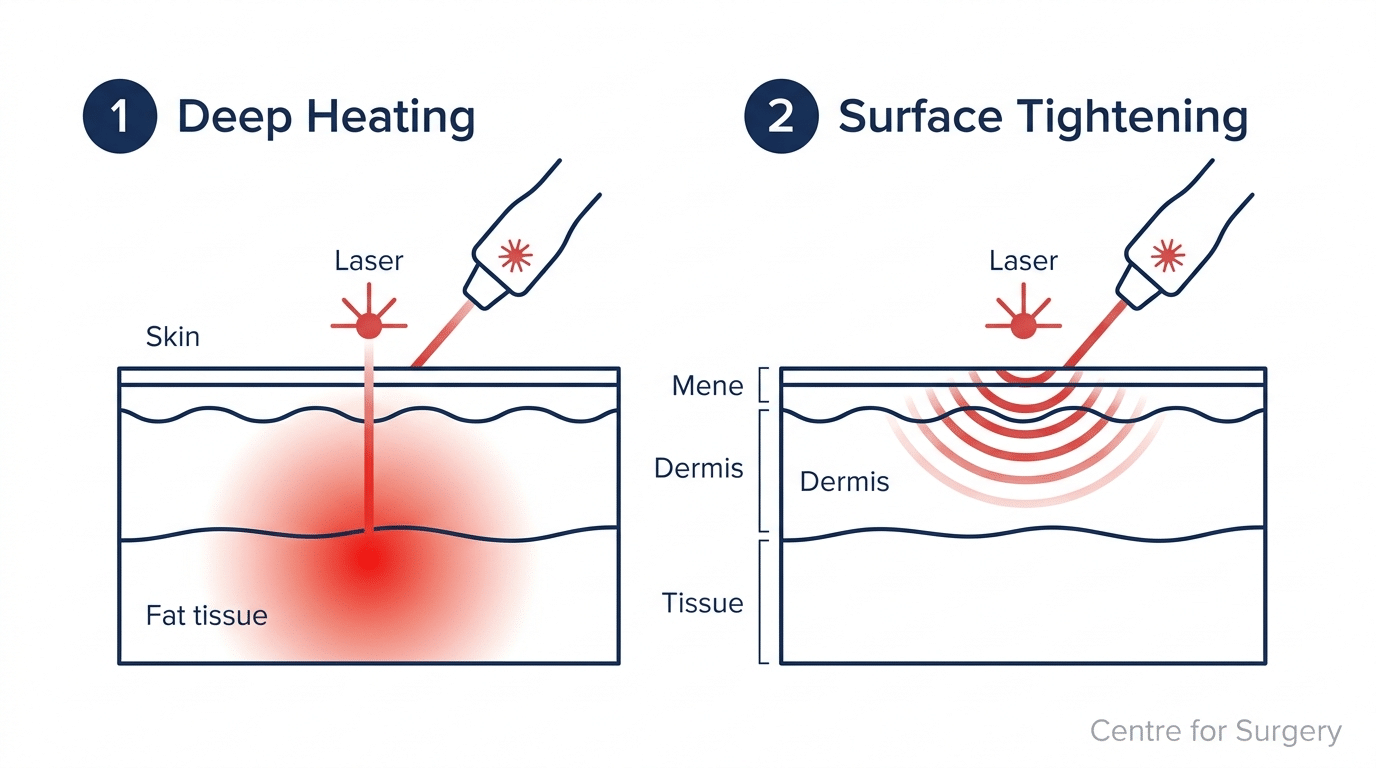
TightSculpting is the one non-surgical fat treatment we do offer, delivered on Fotona’s dual-wavelength laser. In a single session, a long-pulse Nd:YAG mode heats the subcutaneous fat layer to disrupt fat cells, and an Er:YAG mode then heats the surface of the skin to stimulate collagen. Sessions take 30–60 minutes with no anaesthetic and no downtime; a course is four to six sessions two to four weeks apart, with the fullest result at three to six months.
Prices for these treatments are on our Skin & Aesthetics price list.
The honest grading is this. The published evidence for TightSculpting is smaller than for fat freezing — manufacturer-supported studies of modest size rather than an independent systematic review — and the fat change it produces is in the same millimetre range as every other device on this page. Where it earns its place is the second step: it is one of the few non-surgical treatments that addresses skin laxity in the same session, which is why we use it after pregnancy, after moderate weight loss and for cellulite, and as a finishing treatment after liposuction. It is not a weight-loss treatment, we do not offer it above a BMI of about 35, and it will not tighten a true skin apron — that needs excision. For tightening alone, Morpheus8 has a stronger evidence base for the skin than any laser has for fat.
Non-Surgical Fat Reduction vs Liposuction: The Numbers Side by Side

| Factor | Non-surgical (fat freezing, laser, RF, TightSculpting) | Liposuction (PAL or VASER) |
|---|---|---|
| What it removes | 10–25% of a pinchable layer per course; millimetres | The pocket, or the whole area; hundreds of millilitres to litres |
| Sessions | 1–6 per area, weeks apart | 1 |
| Anaesthetic | None | TIVA (or local for small areas) |
| Downtime | Same day | Desk work at about a week; compression garment for 4–6 weeks |
| Who sees the fat go | Nobody — you wait 8–12 weeks | The surgeon, in real time, and can shape as they go |
| Skin | Modest tightening (TightSculpting); none from freezing or injections | None built in; combine with BodyTite for laxity |
| Dense or fibrous fat | Poorly suited | VASER is designed for it |
| Permanence | Treated cells gone; remaining cells grow with weight | Treated cells gone; remaining cells grow with weight |
| Quality of evidence | Small trials, mostly device-funded | Decades of surgical data and long-term follow-up |

Does Liposuction Work Better? The Honest Answer
For removing fat, yes, and it is not close: one session of liposuction removes the fat that a course of non-surgical treatment reduces by a fifth, and a surgeon shapes the area as it goes rather than treating a fixed applicator footprint. 360 liposuction treats the whole circumference of the waist in one operation; high-definition liposuction goes further to reveal muscle outline; VASER handles the dense, fibrous fat of the male chest, back and flanks that heat-based devices struggle with. Recovery is real — about a week away from a desk, a compression garment for several weeks, swelling settling over three to six months — and it is surgery, with surgery’s small but real risks.
What liposuction does not do is change how your body handles fat afterwards. In a randomised trial, 32 women of normal weight had either small-volume liposuction of the thighs and lower abdomen or no treatment, and agreed not to change their lifestyle. At six weeks the treated group’s body fat was clearly lower; by one year the difference was no longer significant, because fat had been laid down again — the thighs stayed slimmer, but the abdomen had refilled (Hernandez et al., 2011). The treated area keeps its new shape because the cells are gone; the rest of the body compensates if the intake that built the fat continues. Our guide to whether liposuction is worth it goes through this frankly, and the same rule applies to every treatment on this page.
If Your Goal Is Weight, Not Shape
None of this is weight loss. Liposuction removes a few kilograms at most and does not improve the metabolic markers that visceral fat drives; non-surgical treatments remove grams. If the concern is overall fat rather than a specific pocket, the answer is diet, exercise and, where appropriate, medically supervised weight-loss treatment — and the body contouring question comes afterwards, when the weight is stable, because rapid loss leaves loose skin that no fat treatment addresses. Our guides to loose skin after weight loss and how to get rid of fat cover that sequence.
Which Is Right for You?
- A small, pinchable pocket, stable weight, good skin, and a strong wish to avoid surgery: a non-surgical treatment can produce a modest, visible change. Budget for a full course and accept a fraction of the pocket rather than all of it.
- The same pocket and a preference for one appointment and a complete result: liposuction of a single area, often under local anaesthetic.
- Fat plus loose skin: TightSculpting for mild laxity; BodyTite or a tummy tuck for more.
- More than one area, dense fat, or a waist you want reshaped rather than reduced: surgical body contouring — see our body contouring page.
- Fat you cannot pinch: visceral fat; weight loss, not contouring.
- Already had non-surgical treatment elsewhere with little change: the commonest story at our consultations, and the pinch test usually shows why. Liposuction is the next step, not another course.
Liposuction Before and After Photos


All patients consented to their images being used for educational purposes; results vary with anatomy, skin quality and weight afterwards. More cases are in our liposuction before and after gallery.
How Much Does Non-Surgical Liposuction Cost Compared With Liposuction?
Non-surgical treatments are priced per session and almost always need a course: fat freezing is sold per cycle with two or three cycles per area, injections by the session over several months, and TightSculpting in courses of four to six. Each course removes a fraction of the pocket, so the total for a visible result is often close to the price of removing the pocket outright. Liposuction is priced per area for a single session, with the surgeon’s and anaesthetist’s fees, theatre time at our CQC-regulated Baker Street hospital and follow-up care included; indicative figures are on our liposuction cost guide and the full list on our cosmetic surgery costs page. Your consultation is £100, redeemable against the cost of your procedure. Finance is available through Chrysalis Finance, subject to status; see our finance options page. Subject to status.
Frequently Asked Questions About Non-Surgical Body Contouring
Does non-surgical liposuction actually work?
The technologies reduce fat cells in a treated area, and the better ones have trial evidence showing it. What they do not do is remove a pocket of fat: expect a 10–25% reduction of a pinchable layer per course, visible on a thick fold and hard to see on a thin one.
Does body contouring work on belly fat?
Only on the belly fat you can pinch. Fat behind the muscle wall, around the organs, is untouched by every device and by liposuction; a firm, rounded abdomen that does not pinch is visceral fat and needs weight loss. A soft, pinchable lower-belly pouch responds to both non-surgical treatment and liposuction, in proportion.
What are the disadvantages of non-surgical fat removal?
Modest results, several sessions over months, no control over shape, results that depend on the operator’s tape measure, and — for fat freezing — a small risk of the fat growing rather than shrinking. The cost of a full course often approaches the cost of surgery for a fraction of the result.
How many sessions does non-surgical body contouring take?
Fat freezing typically two or three cycles per area, spaced two to three months apart; Emsculpt four sessions in two weeks; injections two to six sessions; TightSculpting four to six sessions two to four weeks apart. Liposuction is one session.
Is non-surgical fat reduction permanent?
The cells that are destroyed do not return, from any method. The cells that remain — most of them, after a non-surgical course — grow with weight gain exactly as before, which is why results depend on keeping your weight.
What is the cheapest form of “liposuction”?
Per session, a non-surgical treatment. Per unit of fat removed, liposuction, by a wide margin. Compare the price of a full course against the price of one area of liposuction before deciding.
Is fat freezing better than liposuction?
For avoiding an anaesthetic and any downtime, yes. For the amount of fat removed, the shape of the result and the number of appointments, no. Fat freezing suits a small pocket in someone who will not consider surgery; it cannot compete on volume. Our guide to does fat freezing work sets out the numbers.
Can you combine non-surgical treatment with liposuction?
Yes. TightSculpting is a useful finishing treatment for mild residual laxity after liposuction, and Morpheus8 or BodyTite address skin that liposuction alone would leave loose. Your surgeon will say whether the combination adds anything in your case.
Liposuction and Body Contouring at Centre for Surgery
Centre for Surgery offers liposuction, VASER, 360 liposuction, BodyTite and TightSculpting at our CQC-regulated private hospital at 95–97 Baker Street, rated Good overall. Consultations are with a GMC-registered plastic surgeon, who examines the fat, the skin and the muscle wall before recommending anything — and who will say when the honest recommendation is no treatment at all. Surgery is performed under TIVA anaesthesia, the surgeon who assesses you operates, and we recommend a two-week cooling-off period after consultation. If you smoke, you will be asked to stop for four weeks before and four weeks after surgery.
Phone: 020 7993 4849 | Email: contact@centreforsurgery.com | Address: 95–97 Baker Street, London W1U 6RN

References
- Ingargiola MJ, Motakef S, Chung MT, Vasconez HC, Sasaki GH. Cryolipolysis for fat reduction and body contouring: safety and efficacy of current treatment paradigms. Plast Reconstr Surg. 2015;135(6):1581–1590. doi:10.1097/PRS.0000000000001236. PMID 26017594.
- Krueger N, Mai SV, Luebberding S, Sadick NS. Cryolipolysis for noninvasive body contouring: clinical efficacy and patient satisfaction. Clin Cosmet Investig Dermatol. 2014;7:201–205. doi:10.2147/CCID.S44371. PMID 25061326.
- Nikolis A, Enright KM. A multicenter evaluation of paradoxical adipose hyperplasia following cryolipolysis for fat reduction and body contouring: a review of 8658 cycles in 2114 patients. Aesthet Surg J. 2021;41(8):932–941. doi:10.1093/asj/sjaa310. PMID 33216910.
- Swanson E. A systematic review of electromagnetic treatments for body contouring. Ann Plast Surg. 2023;90(2):180–188. doi:10.1097/SAP.0000000000003387. PMID 36688862.
- Jones DH, Carruthers J, Joseph JH, et al. REFINE-1, a multicenter, randomized, double-blind, placebo-controlled, phase 3 trial with ATX-101, an injectable drug for submental fat reduction. Dermatol Surg. 2016;42(1):38–49. doi:10.1097/DSS.0000000000000578. PMID 26673433.
- Jewell ML, Baxter RA, Cox SE, et al. Randomized sham-controlled trial to evaluate the safety and effectiveness of a high-intensity focused ultrasound device for noninvasive body sculpting. Plast Reconstr Surg. 2011;128(1):253–262. doi:10.1097/PRS.0b013e3182174278. PMID 21701341.
- Auh SL, Iyengar S, Weil A, et al. Quantification of noninvasive fat reduction: a systematic review. Lasers Surg Med. 2018;50(2):96–110. doi:10.1002/lsm.22761. PMID 29210446.
- Agochukwu-Nwubah N, Mentz H. Paradoxical adipose hyperplasia after noninvasive radiofrequency treatment: a novel report and review. J Cosmet Dermatol. 2019;19(4):866–868. doi:10.1111/jocd.13090. PMID 31376204.
- Hernandez TL, Kittelson JM, Law CK, et al. Fat redistribution following suction lipectomy: defense of body fat and patterns of restoration. Obesity (Silver Spring). 2011;19(7):1388–1395. doi:10.1038/oby.2011.64. PMID 21475140.






