


In this guide16 sections
- Key Points
- What Is an Hourglass Figure?
- Hourglass Figure Measurements: Do I Have an Hourglass Body?
- How Rare Is an Hourglass Figure?
- What Actually Makes an Hourglass Figure: Bone, Muscle and Fat
- Can You Naturally Get an Hourglass Figure?
- Hourglass Figure Workout: What Is Worth Doing
- Can an Hourglass Figure Have a Tummy? Is It Attractive?
- Why Pregnancy Changes the Shape
- Hourglass Figure Surgery: What Each Procedure Changes
- Hourglass Figure Before and After Photos
- Am I Suitable for Hourglass Body Surgery?
- How Much Does Hourglass Figure Surgery Cost in the UK?
- Frequently Asked Questions About the Hourglass Figure
- Body Contouring for an Hourglass Figure at Centre for Surgery
- References
Key Points
- An hourglass figure means bust and hips of roughly equal circumference with a waist markedly smaller than both — the classic yardstick is a waist at least 25% smaller, giving a waist-to-hip ratio of around 0.7.
- It is rare. In the largest body-scan survey of its kind, only 8% of more than 6,000 women had an hourglass shape; 46% were rectangles.
- Three layers make the shape: bone, muscle and fat. The width of the rib cage and pelvis is fixed. Muscle at the shoulders, upper back and glutes is trainable. Where fat is stored is largely genetic, and it cannot be spot-reduced — six weeks of daily abdominal exercise changed abdominal fat by nothing measurable in a controlled trial.
- Exercise can move you towards the shape by building the glutes and upper back and lowering overall body fat, but it cannot narrow the skeleton or choose where fat leaves. “Hourglass in a week” content is fiction.
- Surgery works layer by layer: 360 liposuction on the fat, an hourglass tummy tuck on skin, muscle and fat, a BBL or skinny BBL to move fat to the hips, and rib remodelling — the only procedure that changes the bony waist, and one that suits a small minority.
Type “how to get an hourglass figure” into Google and the results are almost entirely stylists and personal trainers. Both are useful, and both leave out the part that decides whether the shape is achievable for you at all: an hourglass body is produced by three separate layers — your skeleton, your muscle and where your body stores fat — and training only reaches one of them. This guide explains what the hourglass figure actually is, how to measure whether you have one, how rare it is, what exercise and diet can and cannot change, and what each surgical option — from 360 liposuction and the hourglass tummy tuck to the Brazilian butt lift and rib remodelling — does to which layer.
It is written for the woman who has done the workouts and still does not have the waist she was promised. That is usually not a failure of effort; it is a question of which layer is limiting her.
What Is an Hourglass Figure?
The hourglass figure — hourglass body, hourglass shape, hourglass body shape — is one of the five body shapes used by the clothing industry, alongside the rectangle, pear (spoon), inverted triangle and apple. It is defined entirely by proportion: the bust and hips measure roughly the same, and the waist is noticeably narrower than both, so that the outline curves in at the middle like the glass of an egg timer. Two women can both be hourglasses at very different sizes, and a slim woman with a straight waist is not one.
Two features make it distinct from the shapes it gets confused with. A pear has hips clearly wider than the bust; an inverted triangle has a bust or shoulders clearly wider than the hips. An hourglass balances the two. And unlike the rectangle — the most common shape — it has a defined waist, which is the feature most women searching this term are really asking about. Our guide to waist-to-hip ratio and body shape covers the other four shapes and how they are told apart.
Hourglass Figure Measurements: Do I Have an Hourglass Body?

You need three measurements, taken with a soft tape against the skin: the bust at its fullest point, the waist at its narrowest (usually just above the navel), and the hips at the widest point of the buttocks. Then apply two tests:
- Bust and hips within about 5% of each other. On a 94 cm hip, that means a bust between roughly 89 and 99 cm.
- Waist at least 25% smaller than both. The body-shape classification developed at North Carolina State University from the SizeUSA scans used a difference of at least 9 inches (23 cm) between bust and waist, or 10 inches (25 cm) between hips and waist, to separate an hourglass from a rectangle (Lee et al., 2007).
Expressed as a ratio, that is a waist-to-hip ratio (WHR) of about 0.70 — waist divided by hips. The “36-24-36” of old magazine copy is a 0.67. Our waist-to-hip ratio calculator works it out from your own numbers and tells you which shape category they fall into. Two cautions: measure the hips at the buttocks rather than the hip bones, which understates the number; and treat the ratio as a description, not a target — it says where you are, not where you should be.
How Rare Is an Hourglass Figure?
Much rarer than clothing sizes and social media suggest. When researchers at North Carolina State University applied their classification to 3D body scans of more than 6,000 American women from the SizeUSA survey, 46% were rectangles, just over 20% were pears, about 14% were inverted triangles, and 8% were hourglasses (Lee et al., 2007). The shape that the fashion industry still cuts most of its patterns for is one that fewer than one woman in ten actually has.
Why so rare? It needs all three layers to line up: a rib cage and pelvis of similar width, enough muscle or fat at the shoulders and hips to fill them out, and a fat-storage pattern that leaves the waist alone. Most women have two of the three.
What Actually Makes an Hourglass Figure: Bone, Muscle and Fat

Bone: the frame you were born with
The width of your lower rib cage sets the narrowest possible waist, and the width of your pelvis sets the hips. Both are fixed by adulthood. A woman with a broad, flared lower rib cage and a narrow pelvis will have a straight outline however lean she gets, because the bone above the waist is as wide as the bone below it; a woman with a narrow rib cage and a wide pelvis has an hourglass frame before muscle or fat are added. Pregnancy widens the lower ribs, which is one reason the waist often looks different after children even at the same weight — our guide to the mum tum covers what settles and what does not. So-called hip dips, the inward curve between the hip bone and the top of the thigh, are also mostly skeletal.
Muscle: the layer you can train
Muscle adds width where you build it. The gluteus maximus and medius fill out the hips and buttocks; the latissimus dorsi and deltoids widen the upper back and shoulders. Build both and the waist between them looks smaller by contrast even if its circumference has not changed a millimetre. This is the whole basis of the “hourglass workout”, and it works — within the limits of your frame.
Fat: the layer that decides whether the waist shows
Where your body stores fat is largely inherited. A genome-wide study of more than 224,000 people identified 49 genetic regions linked to waist-to-hip ratio independently of overall weight, and 19 of them had a stronger effect in women than in men (Shungin et al., 2015). Some women gain weight at the hips and thighs and keep a waist at a size 16; others store it around the middle and lose the waist at a size 10. Diet changes how much fat you carry; it does not choose where it comes off. And it cannot be targeted: in a randomised trial, six weeks of seven abdominal exercises five days a week produced no measurable change in abdominal fat, waist circumference or skinfolds compared with controls — only better abdominal endurance (Vispute et al., 2011). Whether the fat sits under the skin or deeper around the organs matters too, and our guide to visceral vs subcutaneous fat explains how to tell.
Can You Naturally Get an Hourglass Figure?
Partly, and it depends which layer is holding you back. If your frame is already hourglass-shaped and body fat is hiding it, losing fat will reveal it. If your frame is a rectangle, building the glutes and upper back will create hourglass proportions — a real, visible change, but a muscular one, and it stops where the skeleton stops. If your frame is a rectangle and you store fat around the middle, training and diet will improve the shape but will not produce a 0.7 ratio, and no amount of core work will change that, because the ribs and the fat pattern are not things exercise reaches.
The related searches — “hourglass figure in 1 week”, “overnight”, “in 1 month” — describe things that do not happen. Building the amount of glute and back muscle that visibly changes a silhouette takes most women six to twelve months of progressive strength training; losing fat at a sustainable rate takes as long again. Anyone selling a shorter timeline is selling a photo angle.
Hourglass Figure Workout: What Is Worth Doing
The evidence supports a simple split — build below the waist, build above it, and let the waist take care of itself.
- Glutes: hip thrusts, squats, Romanian deadlifts and hip abductions. A nine-week randomised trial found that hip thrusts and back squats grew the glutes to a similar degree, so the choice between them is preference rather than physiology (Plotkin et al., 2023); two to three sessions a week, adding load over time, is what produces growth.
- Upper back and shoulders: lat pulldowns, rows and lateral raises. Width here is what makes the waist read as narrow from the front and behind.
- Waist: deep-core work — dead bugs, planks, Pallof presses — for a flat, supported midsection. Heavily loaded side bends and weighted oblique work build the muscles at the side of the waist, which can make it look wider; most coaches keep oblique loading light for exactly that reason.
- Body fat: a modest calorie deficit and daily movement, if you have fat to lose. This is what reveals the waist; the exercises above are what frame it.
The “3-2-1 method” doing the rounds — three strength sessions, two Pilates, one cardio a week — is a sensible weekly structure, not a shape-specific secret. What matters is progressive load on the glutes and back, consistency, and patience. Our guide to how to get a smaller waist goes further on the waist specifically, including posture, and our guide to whether waist trainers work explains why compression never changes waist shape for good.
Can an Hourglass Figure Have a Tummy? Is It Attractive?
Yes, an hourglass can have a tummy. The shape is about the relationship between three circumferences, not about flatness, and plenty of women with a 0.7 ratio carry a soft lower stomach. Fat that sits in front rather than at the sides — the pattern behind a B belly or a lower pouch — changes the profile view without changing the ratio at all.
As for attractiveness, the research is consistent but narrower than it is usually quoted. Devendra Singh’s studies in the early 1990s found that men and women across age groups rated female figures with a waist-to-hip ratio of about 0.7 as more attractive, healthier and younger-looking than the same figures with higher ratios, and argued the preference tracks a signal of health and fertility (Singh, 1993). Later work has shown the preference varies between cultures and with overall body size. What the studies do not say is that anyone needs a 0.7; they say proportion is noticed. For health, the ratio matters in the other direction — a rising WHR is a marker of fat around the organs, which is why the NHS and WHO use it — and that has nothing to do with looking like an hourglass.
Why Pregnancy Changes the Shape
Pregnancy acts on all three layers at once, which is why so many women who had an hourglass figure notice it has gone after children. The growing uterus pushes the lower ribs outward, and the flare does not always settle; the abdominal muscles separate at the midline and may stay apart; retained weight tends to settle at the waist; and the skin of the lower abdomen can stay loose. Exercise helps with the muscle and the fat, and nothing else. Our guides to the mum tum and loose skin after pregnancy explain how to tell which of those you are dealing with, and why the mummy makeover is often the operation that restores the proportion rather than any single procedure.
Hourglass Figure Surgery: What Each Procedure Changes

Surgery is the only route that reaches the layers exercise cannot, and the right operation follows from the same three-layer assessment. In practice most hourglass results at Centre for Surgery come from combining two of these, planned by a plastic surgeon after examining your frame, your fat distribution and your skin. A BBL and a tummy tuck are never combined in the same operation; where both are wanted, they are staged.
360 liposuction: the fat layer
360 liposuction removes fat from the whole circumference of the midsection — abdomen, flanks, waist and lower back — in one session, which is what creates a continuous narrowing rather than a flat front with the same sides. It is the procedure for a woman whose frame and skin are good and whose waist is hidden by fat that diet has not shifted, and it is the foundation of almost every other hourglass operation. VASER liposuction uses ultrasound to loosen the fat first, and high-definition liposuction takes it further to reveal muscle outline. Liposuction narrows the waist by a few centimetres; it cannot narrow bone, and it will not tighten skin that has already lost its elasticity — our guide to loose skin vs fat explains the pinch test that tells the two apart.
Hourglass tummy tuck: skin, muscle and fat together
Where there is loose skin and separated abdominal muscles as well as fat — usually after pregnancy or weight loss — an hourglass tummy tuck combines three steps in one operation: 360 liposuction of the waist and back, a full tummy tuck with muscle repair and skin removal, and transfer of the harvested fat to the hips to fill hip dips and widen the curve below the waist. In a series of 160 postpartum women of normal weight who had abdominoplasty with circumferential liposuction, average waist circumference fell from 90.9 cm to 80.4 cm (Yang et al., 2026). It is the most complete of the hourglass operations and the biggest recovery, and it is the one to read about if the finger test in our mum tum guide finds a gap.
BBL and skinny BBL: moving fat to the hips
A Brazilian butt lift takes fat from the waist, flanks and back by liposuction and grafts it into the hips and buttocks, so it narrows the middle and widens the bottom in a single procedure — the two halves of the ratio moved at once. In a prospective series of 35 women, average waist-to-hip ratio improved from 0.78 to 0.74, with 65% of the grafted fat surviving at six months (Wang et al., 2024). A skinny BBL applies the same principle to slim women who have less fat to harvest, aiming for hip and upper-buttock shape rather than volume. Fat that survives the first few months is permanent, but it behaves like the rest of your fat afterwards — it shrinks and grows with your weight. Our BBL before and after gallery shows the range of results.
Rib remodelling: the only operation that changes the bone
For the woman whose waist is limited by the width of her lower rib cage rather than by fat, liposuction reaches a floor and stops. Rib remodelling — also searched for as waist narrowing surgery or, inaccurately, rib removal — is the only procedure that changes that floor, and it is worth being clear about what it is. Nothing is removed. Through a 2–3 cm incision on each side, an ultrasonic bone-cutting instrument (a piezotome) divides only the outer 3–4 mm of the lowest ribs; a controlled greenstick fracture then angles each rib inward, and the rib heals in its new position. Cutting partially rather than through the rib is what keeps the nerves, vessels and the lining of the lung behind it intact.
The ribs are held in their new position one of two ways. In the original technique, a firmly fitted chest corset is worn for around three months while the bone consolidates — nothing is implanted, and this version has the larger published experience, with two series of 93 and 131 patients averaging around 8 cm of waist reduction, though every case of asymmetry in the larger series was traced to patients not wearing the corset. In the newer technique, a small titanium plate is fixed across each fracture so the result does not depend on corset wear; in the published series of 27 patients, waist circumference fell by an average of 13 cm at three months with hip circumference also reduced, pain averaged 2.4 out of 10 in the first week and 0.26 by one month, and the only complications were one wound problem and one case of pain (Aguilar Villa et al., 2024). Almost all of those patients had liposuction at the same time, which is the usual approach, because narrowing the bone under an untouched layer of fat looks incomplete.
It is a significant operation and it suits a small minority. At Centre for Surgery it is performed by Mr Metin Nizamoglu, consultant plastic surgeon, under TIVA anaesthesia with local anaesthetic infiltration, planned from a CT scan of your ribs — which is arranged before any surgical date and will sometimes show that reshaping would not measurably change your waist. It is not offered to anyone with a BMI over 30, reduced bone density, chronic lung disease, previous chest surgery, a bleeding disorder, or, for the plate technique, a titanium allergy. Recovery means desk work within one to two weeks, light exercise from about four weeks, and no loading or twisting of the torso until follow-up imaging confirms the bone has healed; the corset technique adds three months of continuous corset wear. The risks — pneumothorax, intercostal nerve injury, non-union, plate prominence or infection, asymmetry — are the risks of chest wall surgery and are set out in full at consultation, along with the honest position that the longest published follow-up is measured in months rather than decades. The result, once healed, is structural: reshaped bone does not change with your weight, although the fat over it still will. Pricing is confirmed at consultation, with CT scans charged separately; the rib remodelling page sets out both techniques, the evidence behind each and the full exclusion list.
Hourglass Figure Before and After Photos
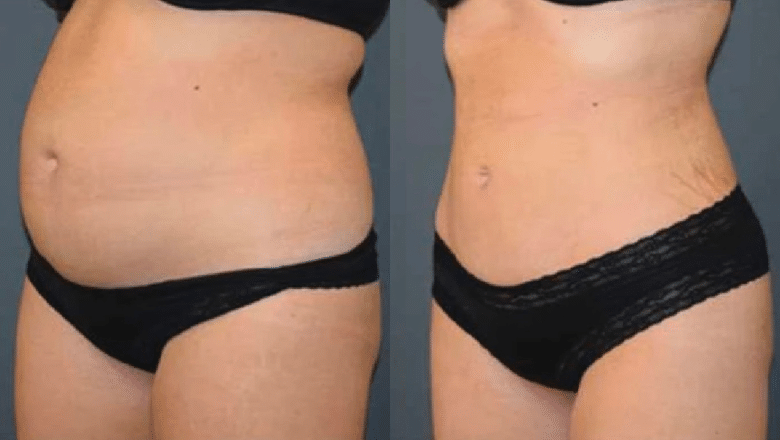
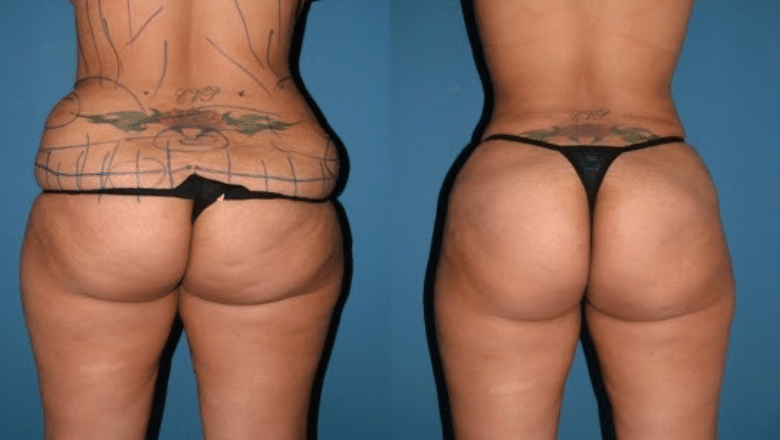

These are examples of the procedures rather than cases selected for a particular starting shape; results depend on your frame, your fat distribution and your weight afterwards. All patients consented to their images being used for educational purposes. More results are in our tummy tuck before and after gallery.
Am I Suitable for Hourglass Body Surgery?
- A stable weight for at least three months, with a BMI under 30 — the shape is planned around the body you will keep.
- A clear idea of which layer is limiting you — fat, skin, muscle or bone — which the consultation establishes by examination rather than assumption.
- Realistic expectations: a narrower waist and fuller hips in proportion to your frame, not a ratio borrowed from someone else’s photograph.
- A non-smoker, or willing to stop for four weeks before and four weeks after surgery, since nicotine impairs both wound healing and fat graft survival.
- Finished having children, if a tummy tuck is part of the plan, because pregnancy can undo a muscle repair.
A face-to-face consultation with one of our plastic surgeons at 95–97 Baker Street includes an examination of your frame, a pinch test of the fat and skin, and a check for muscle separation; the surgeon who assesses you is the surgeon who operates. We recommend a two-week cooling-off period after consultation.
How Much Does Hourglass Figure Surgery Cost in the UK?
The hourglass figure is built from standard procedures combined for your anatomy, so there is no single price. Indicative pricing for each component is on our liposuction cost, BBL cost and tummy tuck cost guides, with the full list on our cosmetic surgery costs page, and rib remodelling pricing is set out above and on its service page. Procedures that can be safely combined are quoted as a package after consultation, which is better value than staging them and means one anaesthetic and one recovery. Surgical prices include your surgeon’s and anaesthetist’s fees, theatre time at our CQC-regulated Baker Street hospital, TIVA anaesthesia and aftercare with follow-up reviews; compression garments are confirmed separately. Your initial consultation is £100, redeemable against the cost of your procedure.
Finance is available through Chrysalis Finance, subject to status. Body contouring for shape is cosmetic and is not available on the NHS.
Frequently Asked Questions About the Hourglass Figure
What qualifies as an hourglass figure?
Bust and hips within about 5% of each other and a waist at least 25% smaller than both — roughly a 23–25 cm difference, or a waist-to-hip ratio of about 0.7. The proportions define it, not the size.
How long does it take to get an hourglass body shape?
If muscle is what you are adding, six to twelve months of progressive glute and upper-back training produces a visible change; if fat is what you are losing, a sustainable deficit takes a similar time. Claims of a week or a month describe posing, not physiology. Surgical results are visible within weeks and settle over three to six months.
Can you get an hourglass figure with a straight frame?
You can create hourglass proportions on a rectangular frame by building the glutes and upper back and keeping the waist lean; you cannot narrow the rib cage or widen the pelvis with exercise. Where the bone is the limit, liposuction reaches a floor, fat transfer to the hips changes the lower half of the ratio, and rib remodelling is the only way to change the upper half.
Does a waist trainer give you an hourglass figure?
No. A waist trainer compresses soft tissue while it is worn and changes nothing when it comes off; it does not move fat, reshape ribs or build muscle. Worn tightly for long periods it weakens the core muscles it squeezes.
Is the hourglass figure only about the waist?
No — it is the balance of bust, waist and hips. A woman with a small waist and narrow hips is a rectangle or an inverted triangle, not an hourglass. Widening the hips, whether by glute training or fat transfer, does as much for the ratio as narrowing the waist.
Can men get an hourglass figure?
Men who search the term are usually describing a narrow waist under broad shoulders, which is the V-taper rather than an hourglass. Our guide to the V-taper body covers what sets it and how it is built.
Does an hourglass figure mean you are healthy?
Not in itself. A low waist-to-hip ratio is associated with less fat around the organs, which is why the ratio is used as a health measure, but the shape can be present at any weight and absent in very fit women with straight frames. Health is measured by fitness, blood markers and fat around the organs, not by silhouette.
Body Contouring for an Hourglass Figure at Centre for Surgery
Centre for Surgery offers every layer of the hourglass — 360 liposuction and liposuction for the fat, the hourglass tummy tuck for skin and muscle, the Brazilian butt lift for the hips, and rib remodelling for the bone — at our CQC-regulated private hospital on Baker Street, rated Good overall. All of them are available under one roof, so the recommendation follows the examination rather than the equipment. Surgery is performed by GMC-registered plastic surgeons under TIVA anaesthesia, with further pre-operative consultations as needed, a two-week cooling-off period after your consultation, and follow-up reviews through your recovery.
Phone: 020 7993 4849 | Email: contact@centreforsurgery.com | Address: 95–97 Baker Street, London W1U 6RN
References
- Lee JY, Istook CL, Nam YJ, Park SM. Comparison of body shape between USA and Korean women. Int J Clothing Sci Technol. 2007;19(5):374–391. doi:10.1108/09556220710819555.
- Singh D. Adaptive significance of female physical attractiveness: role of waist-to-hip ratio. J Pers Soc Psychol. 1993;65(2):293–307. doi:10.1037//0022-3514.65.2.293. PMID 8366421.
- Shungin D, Winkler TW, Croteau-Chonka DC, et al. New genetic loci link adipose and insulin biology to body fat distribution. Nature. 2015;518(7538):187–196. doi:10.1038/nature14132. PMID 25673412.
- Vispute SS, Smith JD, LeCheminant JD, Hurley KS. The effect of abdominal exercise on abdominal fat. J Strength Cond Res. 2011;25(9):2559–2564. doi:10.1519/JSC.0b013e3181fb4a46. PMID 21804427.
- Plotkin DL, Rodas MA, Vigotsky AD, et al. Hip thrust and back squat training elicit similar gluteus muscle hypertrophy and transfer similarly to the deadlift. Front Physiol. 2023;14:1279170. doi:10.3389/fphys.2023.1279170. PMID 37877099.
- Yang R, Song Z, Wang J, Xia L, Liang H. Aesthetic abdominal contouring enhancement with combined abdominoplasty and circumferential liposuction in normal-BMI postpartum Asian women. Front Surg. 2026;13:1793884. doi:10.3389/fsurg.2026.1793884. PMID 41993785.
- Wang B, He P, Zhao R. B-ultrasound-assisted gluteal fat grafting in Asians: a prospective study of quantitative results from three-dimensional imaging and B-ultrasound analysis. J Plast Reconstr Aesthet Surg. 2024;94:12–19. doi:10.1016/j.bjps.2024.04.035. PMID 38729047.
- Aguilar Villa H, Villabona-Florez SJ, Hoyos AE, et al. Aesthetic rib cage remodeling with osteosynthesis: body structural high-definition reshaping (rib osteotomy with osteosynthesis stabilization). Plast Reconstr Surg. 2025;155(2):279–288. doi:10.1097/PRS.0000000000011512. PMID 38710099.