



In this guide10 sections
- What Is Waist-to-Hip Ratio?
- Why Does Waist-to-Hip Ratio Matter?
- How to Calculate Your Waist-to-Hip Ratio
- Understanding Your Waist-to-Hip Ratio Result
- What Body Shape Am I?
- What Determines Your Waist-to-Hip Ratio?
- How to Improve Your Waist-to-Hip Ratio
- Which Approach Is Right for You?
- Frequently Asked Questions
- Body Contouring at Centre for Surgery
What Is Waist-to-Hip Ratio?
Waist-to-hip ratio (WHR) is a simple measurement that describes how your body stores fat around the middle relative to your hips. You get it by dividing your waist circumference by your hip circumference. Unlike a single measurement like waist size alone, WHR is a ratio — which means it captures something BMI and waist circumference alone can’t: the relationship between two areas of the body, and therefore your overall body shape.
WHR is used for two genuinely distinct purposes, and it’s worth being clear about both from the outset. First, it’s a recognised health indicator — a lower ratio is generally associated with lower cardiovascular and metabolic risk, because it reflects less fat stored viscerally around the abdomen. Second, it’s a widely used descriptor of body shape and proportion — the measurement behind classifications like “hourglass,” “pear,” “apple” and “rectangle” that shape how people think about their own figure.
Both are legitimate reasons to care about your WHR, but they call for different responses. If your primary concern is health, the conversation is largely about reducing visceral fat. If your primary concern is body shape and proportion, the conversation is much broader — because your ratio can be changed by narrowing the waist with liposuction or a tummy tuck, building the hips with a Brazilian Butt Lift, or both — and only some of those changes involve losing fat at all.
Why Does Waist-to-Hip Ratio Matter?
As a Health Indicator
Where your body stores fat matters more than how much you weigh. Subcutaneous fat — the layer just under the skin, the kind you can pinch — is relatively metabolically inactive. Visceral fat, stored deeper around the abdominal organs, behaves very differently: it’s hormonally active tissue that releases inflammatory markers and fatty acids directly into the bloodstream, and it’s specifically linked to cardiovascular disease, insulin resistance, type 2 diabetes, and metabolic syndrome. Our guide to visceral vs subcutaneous fat explains how to tell which type you’re carrying, including a pinch test and a separate waist-to-height calculator.
A higher waist-to-hip ratio is a proxy for higher visceral fat, which is exactly why it’s used as a health indicator independent of weight or BMI. Two people with an identical BMI can carry very different levels of health risk depending on where that weight sits — a higher-WHR “apple” pattern with central fat storage is consistently associated with greater metabolic risk than a lower-WHR “pear” pattern, even at the same total body weight. This is precisely BMI’s blind spot: it can’t distinguish between fat and muscle, and it can’t see where fat is distributed at all. People with a normal BMI but too much body fat and too little muscle are sometimes described as skinny fat, and a high waist-to-hip ratio is one of the clearest signs. WHR fills that gap.
As a Measure of Body Shape and Proportion
Separately from the health angle, WHR is also the measurement most closely tied to body shape and the proportions many people find aesthetically desirable — most obviously the hourglass silhouette, with a narrow waist relative to balanced bust and hip measurements. Evolutionary psychologists have written extensively about why a lower WHR reads as conventionally attractive across cultures, though the honest answer is simpler for most people: it’s about how clothes fit, how your silhouette looks in photos, and how proportionate you feel in your own body — reasons that are entirely valid on their own terms, independent of any health framing.
It’s worth saying plainly: not every body is built toward an hourglass shape, and that’s not a problem to solve. Skeletal structure, rib cage width, and pelvis shape all set real limits on what any given body can achieve through fat loss or muscle gain alone. Of those, the ribcage is the one that can now be altered surgically — rib remodelling surgery reshapes the lower ribs to narrow the waist — though that is a bone operation appropriate for a small minority of people, not a general answer to body shape. Understanding your WHR and body shape is about making informed decisions for your own goals, not chasing a single “ideal.”
How to Calculate Your Waist-to-Hip Ratio
Calculating your WHR accurately takes about two minutes with a flexible tape measure. Getting the measurement points right matters more than most people expect — a few centimetres in the wrong place noticeably changes the result.
Step 1: Measure Your Waist
Find the narrowest point of your natural waist — for most people this is roughly level with your navel, but it varies by body shape. Wrap the tape measure around this point, keeping it level and snug but not compressing the skin. Breathe out naturally and measure without pulling your stomach in.
Step 2: Measure Your Hips
Find the widest point of your hips and buttocks — usually a few centimetres below your hip bones, at the fullest part of your seat. Keep the tape level all the way around.
Step 3: Divide
Divide your waist measurement by your hip measurement. Both measurements need to be in the same unit (both centimetres or both inches) — the ratio itself comes out the same either way, since it’s simply a proportion.
Waist-to-hip ratio = waist circumference ÷ hip circumference
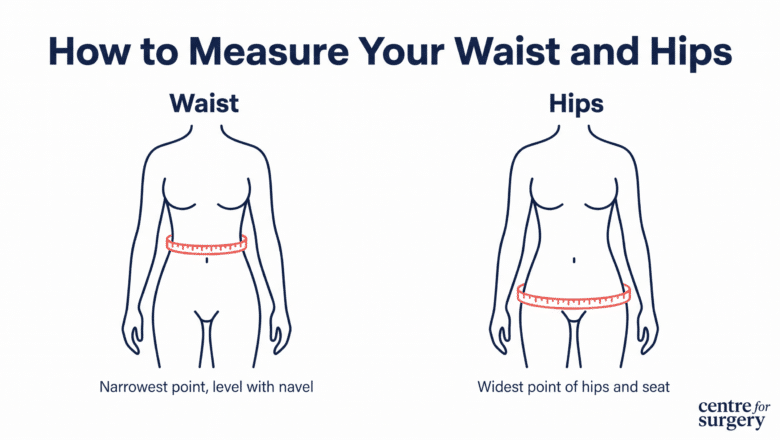
How to measure your waist and hips correctly, Centre for Surgery, London.
Waist-to-hip or waist-to-height?
These are two different ratios and they answer different questions. Waist-to-hip ratio compares two body measurements against each other, which makes it the better guide to body shape and proportion — it’s what tells you whether you read as hourglass, pear, apple or rectangle. Waist-to-height ratio compares your waist against your height, which makes it the better guide to central adiposity and health risk; NICE now recommends it specifically for that purpose, using the simple rule that your waist should be under half your height. If your question is about health rather than shape, use our visceral fat calculator alongside this one.
Understanding Your Waist-to-Hip Ratio Result
If you’re wondering what the ideal waist-to-hip ratio actually is, there isn’t one single universal answer — it depends on whether you’re assessing health risk or working toward a personal aesthetic goal. For health purposes, the thresholds below are the standard reference points, and they differ between men and women, reflecting genuine physiological differences in typical fat distribution:
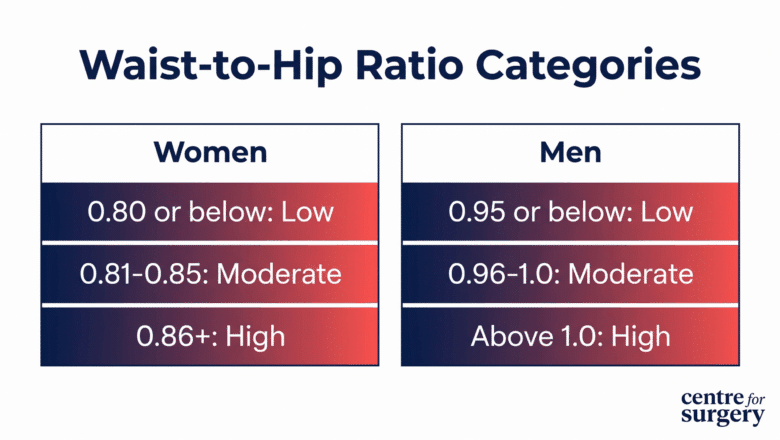
Waist-to-hip ratio categories for women and men, Centre for Surgery, London.
For women:
- Low (lower health risk): 0.80 or below
- Moderate: 0.81–0.85
- High (higher health risk): 0.86 and above
For men:
- Low (lower health risk): 0.95 or below
- Moderate: 0.96–1.0
- High (higher health risk): above 1.0
A lower ratio generally corresponds to a pear or hourglass-leaning body shape, where more fat is carried on the hips and thighs relative to the waist. A higher ratio corresponds more closely to an apple-leaning shape, with fat concentrated centrally around the abdomen. These thresholds are a useful general guide rather than a diagnostic tool — if you have specific health concerns about your body fat distribution, that’s a conversation for your GP, who can look at your WHR alongside other markers like blood pressure, cholesterol, and blood glucose for a fuller picture.
What Body Shape Am I?
Waist-to-hip ratio describes the relationship between your waist and hips specifically, but body shape as a broader concept usually also factors in your bust or shoulder width. Most classifications use four broad categories, and it’s genuinely common to sit somewhere between two of them rather than fit one perfectly.
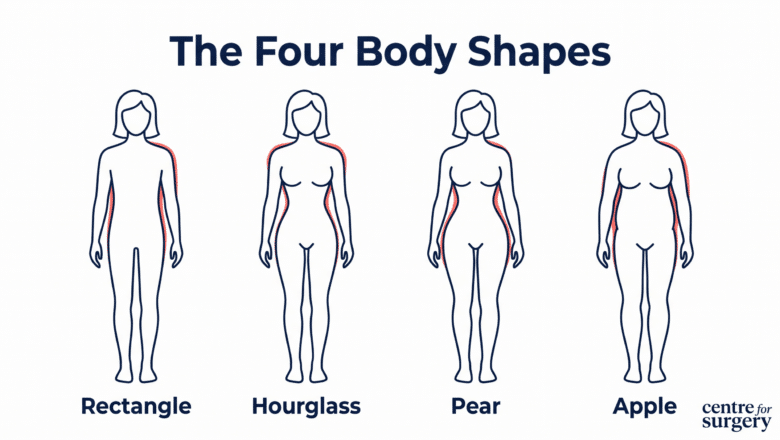
The four body shapes — rectangle, hourglass, pear and apple, Centre for Surgery, London.
Hourglass
Bust and hips are roughly balanced in width, with a clearly narrower waist in between — typically at least 25% smaller than both bust and hip measurement. This hourglass body shape is associated with the lowest WHR values and is often what people mean when they describe wanting a more “defined” waist.
Pear (Triangle)
Hips noticeably wider than the bust, with a defined waist that’s narrower than the hips but the overall silhouette is bottom-heavy. Fat is predominantly carried on the hips, thighs and buttocks. This shape typically produces a lower WHR even though the bust-to-hip proportions aren’t balanced the way they are in an hourglass shape.
Apple (Round)
Fat is carried predominantly around the abdomen and mid-section, with comparatively slimmer hips and less waist definition. This is the shape most closely associated with a higher WHR and the pattern most relevant to the cardiovascular and metabolic risk factors discussed above. It’s also the shape where it matters most to establish whether the fat is visceral or subcutaneous, because only one of the two can be treated surgically. If this is your natural shape and stubborn abdominal fat remains a concern once your weight is stable, liposuction or a tummy tuck are the most direct ways to add waist definition — we cover both in detail in our guide to how to get a smaller waist.
Rectangle (Straight)
Bust, waist and hip measurements are all relatively similar, with minimal waist definition either way. This is a genuinely common and entirely normal body shape — it simply reflects a more even distribution of fat and muscle along the torso rather than pronounced curves at any point. If you’re specifically looking to add more curve to this shape, that typically means building volume at the hips rather than losing weight — see our guides to Brazilian Butt Lift and hip dip surgery.
What Determines Your Waist-to-Hip Ratio?
Your natural WHR and body shape are shaped by a combination of factors, most of which are largely outside your direct control:
- Skeletal structure: the width of your pelvis and ribcage sets real physical limits (the ribcage being the one part of this that rib remodelling surgery can alter) on your proportions, regardless of body fat percentage.
- Sex hormones: oestrogen promotes fat storage in the hips and thighs (a gynoid pattern), while testosterone promotes more central, abdominal storage (an android pattern) — which is the core reason WHR thresholds differ between men and women.
- Genetics: your family’s typical fat distribution pattern is a meaningful predictor of your own, independent of diet or activity level.
- Age and menopause: declining oestrogen during and after menopause typically shifts fat storage from the hips toward the abdomen, which is why WHR tends to rise with age in women even without any change in overall weight.
- Overall body fat percentage: significant weight gain or loss affects both waist and hip measurements, though rarely in perfectly equal proportion, which is why WHR itself can shift with weight change even when the underlying body shape tendency stays the same.
How to Improve Your Waist-to-Hip Ratio
WHR is a ratio between two measurements, so there are two fundamentally different ways to change it: reducing the waist, or increasing the hips. Which one is right for you depends entirely on what’s actually driving your current ratio and what you’re trying to achieve.
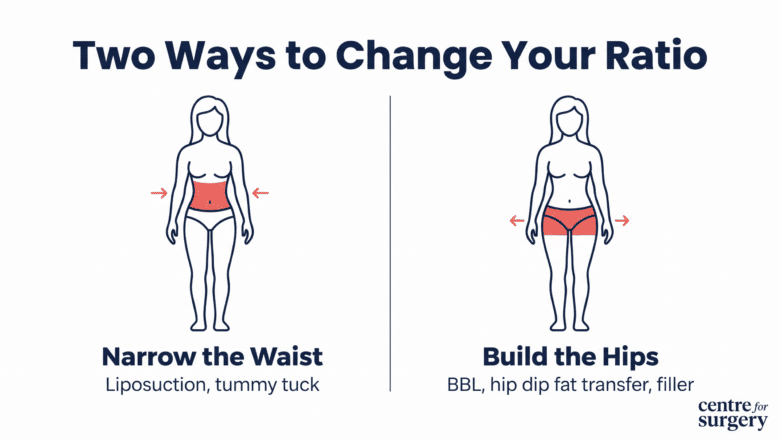
Two ways to change your waist-to-hip ratio — narrow the waist or build the hips, Centre for Surgery, London.
If Your Priority Is Health
Where a higher WHR reflects excess visceral fat and genuine health risk, the priority is reducing overall body fat through sustainable diet and exercise changes — there’s no shortcut around this for the health benefit specifically, since liposuction cannot remove visceral fat stored around the organs, for straightforward anatomical reasons. For patients who have tried sustained lifestyle changes without success, GLP-1 and dual GIP/GLP-1 receptor agonist medications have become a significant option over the past few years, prescribed and monitored by a GP or specialist weight management service based on BMI, medical history and prior weight loss attempts. We don’t prescribe weight loss medication directly, but we see a growing number of patients who’ve used it as a starting point before considering body contouring for the loose skin or residual fat pockets that significant weight loss can leave behind.
If Your Priority Is Waist Definition
For patients whose ratio is driven by stubborn fat around the waist and midsection that hasn’t responded to diet and exercise, or by loose skin following pregnancy or weight loss, several routes are available depending on what’s actually causing the appearance:
- Liposuction directly removes stubborn fat deposits from the waist and flanks — most effective for patients near their target weight with localised fat rather than significant excess skin.
- Tummy tuck (abdominoplasty) removes excess skin and tightens the underlying abdominal muscles, which liposuction alone cannot do — particularly relevant where pregnancy has caused diastasis recti (muscle separation).
- Combining the two — sometimes called a Brazilian tummy tuck — addresses fat, skin and muscle laxity together for a more comprehensive result.
We’ve covered waist-specific options in far more detail, including full pricing, in our guide: How to Get a Smaller Waist.
If Your Priority Is Hip and Buttock Volume
For patients whose ratio (and overall silhouette) would benefit more from added volume at the hips and buttocks rather than a smaller waist — often the case for naturally straighter, rectangle-leaning body shapes wanting a more hourglass-proportioned look — the options work in the opposite direction. This is genuinely the answer to how to get an hourglass figure when your natural skeletal proportions don’t lean that way on their own:
- Brazilian Butt Lift (BBL) transfers your own fat, harvested by liposuction elsewhere on the body, into the buttocks and hip area — often combined with 360 liposuction to the waist itself, which narrows the waist and adds hip volume in the same procedure for a genuinely significant change to your ratio.
- Fat transfer specifically targeted to hip dips — the natural indentation where the hip bone meets the thigh — can smooth this specific area without a full BBL, for patients whose concern is localised rather than an overall lack of hip volume.
- Non-surgical options using dermal filler can add modest, targeted volume to the hips without surgery, for patients seeking a subtler change or who aren’t candidates for fat transfer.
This is genuinely the area where waist-to-hip ratio connects most directly to buttock and hip procedures — combining 360 liposuction with BBL is specifically popular with patients aiming for a more pronounced hourglass silhouette, because it works on both sides of the ratio at once.
Which Approach Is Right for You?
A few honest questions can help narrow down where to start:
- Is your main concern health-related? Focus on sustainable fat loss first — surgery doesn’t address visceral fat or the metabolic risk associated with it.
- Do you already have a proportionate hip and bust, but carry stubborn fat or loose skin at the waist? Liposuction, a tummy tuck, or both, are likely to be more relevant to you than any hip-focused procedure.
- Is your waist already fairly narrow, but your overall silhouette feels flat or straight? BBL, hip dip fat transfer, or non-surgical filler are more likely to give you the change you’re actually looking for.
- Do you want a more dramatic change to your overall proportions? Combined procedures — 360 liposuction with BBL, or lipoabdominoplasty — address both sides of the ratio in a single surgical journey.
A face-to-face consultation is genuinely the only reliable way to know which combination fits your anatomy, since the same measurement can be driven by very different underlying causes in different people.
Frequently Asked Questions
What is a good or ideal waist-to-hip ratio?
For women, a WHR of 0.80 or below is generally considered lower-risk from a health perspective. For men, the equivalent threshold is 0.95 or below. Beyond the health framing, there’s no single ideal waist-to-hip ratio for aesthetics — it depends entirely on your personal goals and natural body shape.
How do you get an hourglass figure?
If your natural skeletal proportions already lean that way, a lower body fat percentage tends to reveal more waist definition. If they don’t, the change usually needs to come from body contouring on one or both sides of the ratio — narrowing the waist with liposuction or a tummy tuck, adding volume to the hips with a BBL or hip dip fat transfer, or both (a BBL and a tummy tuck are always done as separate operations). Exercise can tone the muscles involved but can’t change the underlying bone structure that ultimately sets the limits of your shape.
Can surgery change my waist-to-hip ratio?
Yes, in both directions. Liposuction and a tummy tuck can narrow the waist measurement, while a Brazilian Butt Lift, hip dip fat transfer, or hip filler can increase the hip measurement — either changes the ratio, and many patients have both for a more significant overall change to their proportions, though a BBL and a tummy tuck are always separate operations. One caveat: if a high ratio is driven by visceral fat rather than subcutaneous fat, surgery can’t change it, because liposuction only reaches the subcutaneous layer.
Is waist-to-hip ratio more accurate than BMI?
They measure different things, so it’s not quite a fair comparison — BMI reflects overall weight relative to height, while WHR reflects fat distribution. For cardiovascular and metabolic risk specifically, several studies suggest WHR (or waist circumference alone) can be a more informative indicator than BMI, precisely because BMI can’t distinguish between fat and muscle or account for where fat sits. The two measurements are best used alongside each other rather than as substitutes.
What is an hourglass figure and how is it related to WHR?
An hourglass figure describes a body shape where the bust and hips are proportionate to each other and the waist is significantly narrower than both — typically producing a WHR at the lower end of the healthy range. It’s one of four commonly used body shape classifications, alongside pear, apple, and rectangle.
Can I improve my waist-to-hip ratio without surgery?
If your ratio is driven primarily by excess body fat, sustainable diet and exercise changes — and, where appropriate and medically supervised, weight loss medication — can improve it over time by reducing overall and visceral fat. If your ratio is driven by your underlying skeletal proportions or fat distribution pattern rather than excess weight, non-surgical treatments have more limited scope, and surgical options (on either the waist or hip side of the ratio) tend to produce a more significant, lasting change. Where the limiting factor is the width of the bony ribcage rather than the fat over it, rib remodelling surgery is the only procedure that addresses it directly — though it applies to a much smaller group than the number of people who ask about it. Fat-based approaches like liposuction remain the right answer for most people. Change.
Body Contouring at Centre for Surgery
Whether your waist-to-hip ratio goals are about narrowing your waist, building your hips, or both, we’d encourage an honest consultation about which combination of procedures genuinely fits your anatomy — rather than assuming any single “hourglass” procedure is automatically right for you.
Verified Patient Reviews
We invite you to read what our patients say on independent, verified review platforms — Google Reviews, or on our own patient reviews page, which brings together verified reviews from Google and Trustpilot.
Book a Consultation
Phone: 020 7993 4849
Email: contact@centreforsurgery.com
📍 Address: 95-97 Baker Street, London W1U 6RN
Consultation fee: £100, redeemable against the cost of your treatment.
Learn More
- Visceral vs Subcutaneous Fat
- How to Get a Smaller Waist
- Brazilian Butt Lift
- Hip Dip Surgery
- 360 Lipo and BBL
- Tummy Tuck







