



Argo Plasma London and argon plasma skin tightening
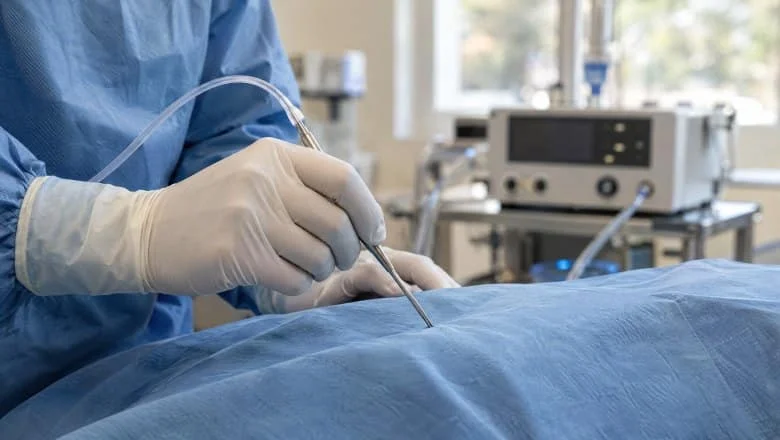
Argo Plasma (sometimes written argoplasma) is argon plasma skin tightening: a minimally invasive procedure in which a fine probe is passed under the skin through 3–5 mm incisions to firm mild to moderate loose skin from beneath. It is most often carried out straight after liposuction or VASER liposuction, through the same small incisions, so that fat removal and subdermal skin tightening happen in one operation.
It is designed for skin that has lost some firmness but still has elasticity: a tummy that has not snapped back after pregnancy or weight loss, slightly crepey upper arms, looseness on the inner thighs and knees, or softening skin under the chin and along the neck. It does not remove skin, so where there is a fold or apron of hanging skin, a tummy tuck or another lift is the more reliable answer.
Argo Plasma belongs to the same family of subdermal plasma devices as Renuvion (J-Plasma), but it uses argon gas rather than helium: it is the argon-based alternative to Renuvion that we offer. It is not a plasma pen, which works on the surface of the skin, and unlike BodyTite it does not remove fat itself. It sits between non-surgical devices and a surgical lift among our skin tightening treatments.
At Centre for Surgery, Argo Plasma is performed by our GMC-registered surgeons at our Baker Street hospital, usually as part of a liposuction plan and occasionally on its own for looseness that remains after earlier liposuction. The research on argon plasma is still limited, so this page sets out what the studies show as well as what the procedure involves.
Argo Plasma at a Glance
Argo Plasma is not a substitute for a lift where skin hangs, and it is not a weight-loss treatment; your surgeon confirms whether it suits you at consultation.
Considering Argo Plasma?Speak to a surgeon about whether it suits your skin and your goals. No obligation, and no pressure to book.
Argo Plasma before and after photos
These Argo Plasma before and after photos show real Centre for Surgery patients who had argon plasma skin tightening, in most cases combined with liposuction of the same area. Every patient gave written consent for their photographs to be used, and a wider selection is available to view at your consultation.
How much your skin tightens depends on its elasticity, the amount of loose skin and how much fat is removed, so individual results vary and these photos are not a prediction of yours.
What is argon plasma skin tightening and how does Argo Plasma work?

Argo Plasma is a form of argon plasma coagulation, an electrosurgical technique used in hospitals for many years, adapted to work under the skin. A fine probe connected to the Argo Plasma generator, made by EMED in Poland, carries a stream of argon gas. High-frequency electrical (radiofrequency) energy passes through the gas and turns it into plasma, an energised state of gas that delivers heat to the tissue at the tip of the probe.[1]
Your surgeon passes the probe through 3–5 mm incisions into the layer just beneath the skin and moves it in steady, even passes. The heat contracts the fibrous bands (septa) that connect the skin to the deeper tissues, as well as the underside of the skin itself, which is why some tightening can often be seen and felt during the procedure. Over the following weeks the treated tissue heals and firms as new collagen forms.
The probe does not have built-in temperature monitoring, so the amount of energy delivered depends on the power setting, the number of passes and how steadily the probe is moved. That is why Argo Plasma is a surgeon’s procedure: technique, rather than the device alone, decides both the result and the risk of a burn. Argo Plasma does not remove fat; when fat needs removing, liposuction is done first.
Argo Plasma is not a plasma pen or “cold plasma”
If you have searched for plasma skin tightening, many of the results describe a plasma pen (plasma fibroblast): a handheld device that makes tiny arcs of energy on the surface of the skin, usually as a non-surgical beauty treatment. Argo Plasma works in a different layer altogether, beneath the skin, and is carried out by a surgeon in theatre. It is not a “cold plasma” treatment either, because it tightens tissue with heat.
If you would rather avoid surgery and your laxity is mild, RF microneedling such as Morpheus8 heats the deeper layers of the skin through fine needles, with no incisions. Our guide to radiofrequency skin tightening explains how the different types compare. The diagram below shows where each treatment works.

What areas can Argo Plasma treat?

Argo Plasma can be used wherever mild to moderate loose skin sits over an area being contoured, and it is most often added to liposuction to treat the looseness that fat removal alone does not fix. The areas most affected by loose skin after weight loss are much the same as the areas we treat most often.
Tummy and flanks
The abdomen is the most common area. Argo Plasma suits mild looseness after liposuction, weight loss or pregnancy in people who do not need, or do not want, the scar of a tummy tuck. It is often combined with 360 liposuction of the tummy, waist and back.
Upper arms (bingo wings)
Mild to moderate looseness of the upper arms, often called bingo wings, can be treated with liposuction plus Argo Plasma, avoiding the long scar of an arm lift (brachioplasty). The arms are also where the argon evidence is most direct: a 2025 study measured less arm sagging six months after liposuction with argon plasma.[1] A randomised study of VASER arm liposuction with or without BodyTite or a helium plasma device (not Argo Plasma) found most treated patients satisfied.[2] Where a lot of skin hangs, an arm lift is still the right operation.
Thighs
Inner and outer thigh looseness after weight loss or liposuction can be tightened with Argo Plasma. Where the laxity is significant, a thigh lift removes skin that no energy device can shrink.
Neck and under the chin
Mild looseness under the chin and along the neck can be tightened with Argo Plasma, usually alongside chin and neck liposuction through the same small incisions. The neck has been studied less than the tummy and arms, so your surgeon will be cautious about how much change to expect. Where the neck skin hangs in folds or bands, a neck lift removes skin that no energy device can shrink, and for the jawline and lower face, FaceTite is the radiofrequency alternative.
Male chest after gynaecomastia surgery
After gynaecomastia surgery removes fat and gland tissue, the skin over the chest can stay slightly loose. Argo Plasma can be used at the same operation to help the skin settle onto the new, flatter contour.
Knees and ankles
Mild looseness around the inner knees and ankles can be treated alongside knee liposuction or calf and ankle liposuction. These areas are less well studied than the tummy and arms, so your surgeon will be cautious about how much change to expect.
Hips and buttocks
Loose skin over the hips and buttocks after weight loss or liposuction can be treated in the same way, to refine the contour achieved by the main procedure.
Cellulite
Argon plasma is also part of CelluTite, our cellulite treatment, which combines subcision (releasing the fibrous bands that pull the skin down into dimples) with argon plasma.
Does Argo Plasma work? What the research shows
Argo Plasma is a relatively new use of argon plasma, and we know of only two published clinical studies of it for skin tightening. Both are encouraging, but neither compared argon plasma with liposuction alone, so they cannot tell you exactly how much extra tightening it adds.
The larger is a 2026 multicentre retrospective study in Plastic and Reconstructive Surgery (Nahas et al.) of 594 patients treated with argon plasma after liposuction by 41 surgeons in Brazil. Patients rated their satisfaction with skin retraction at 8.9 out of 10 on average, and the overall complication rate was 9.4%, mostly seroma and thermal injury.[3] The data came from surgeon questionnaires with no comparison group, so it says more about safety than about how much tightening argon plasma adds.
A 2025 prospective study in Aesthetic Surgery Journal Open Forum (Benito-Ruiz) followed 15 women who had power-assisted liposuction of the upper arms with Argo Plasma, measuring the result with 3D imaging, ultrasound and a skin elasticity device. At six months, arm sagging had fallen by 29% and arm diameter by 15%, with results stable from about one month. There were no major complications; small fluid collections in five of the 30 arms were drained with a needle.[1] It is a small study without a control group, so the share of the change due to liposuction is unknown.
Most of the wider research is on the helium device, Renuvion, which works in a similar way. A 2025 systematic review in Annals of Plastic Surgery (Swanson) of 25 Renuvion publications found that most were funded by the manufacturer and relied on surgeons’ own ratings, and concluded that there was no evidence of tightening beyond what liposuction alone achieves.[4] On the other side, a small randomised trial in 76 patients having tummy tuck surgery after major weight loss found that those who also had helium plasma rated their abdomen and excess skin more favourably at six months, one year and two years, and independent surgeons scored their photographs higher.[5] Neither result transfers directly to argon, but together they point to a modest benefit as an addition to surgery rather than a dramatic one.
How much skin tightening can I expect?
How much your skin retracts depends mainly on its elasticity, your age, how much loose skin there is, whether you have stretch marks and how much fat is removed. Skin that springs back quickly when pinched usually responds better than skin that has been stretched for years. In the arm study, patients with more laxity sometimes developed fine wrinkling as the swelling went down, a reminder that plasma tightening has limits.[1]
Our honest summary: Argo Plasma can add a modest extra degree of firmness to liposuction in people with mild to moderate laxity. It does not remove skin, and it is not a substitute for a lift. Your surgeon will tell you at consultation whether it is likely to make a worthwhile difference for you.
Who is suitable for Argo Plasma skin tightening?

Argo Plasma suits people with mild to moderate loose skin that still has some elasticity, usually alongside liposuction. The first question is whether what bothers you is loose skin or fat: liposuction treats fat, Argo Plasma firms skin, and many people need a little of both.
You are likely to be a good candidate if:
- you have mild to moderate laxity in one or more areas, and the skin still has some elasticity
- your weight has been stable for at least three months
- your BMI is 30 or below, because Argo Plasma tightens skin and is not a fat-loss treatment
- you do not smoke, or will stop at least four weeks before and four weeks after surgery
- you have no medical conditions that significantly increase the risk of surgery or anaesthesia
- you are looking for firmer skin, not the removal of excess skin
Is Argo Plasma a tummy tuck alternative?
Only for some people. If your tummy skin hangs in a fold, or your stomach muscles have separated after pregnancy, a tummy tuck removes the skin and repairs the muscle, which Argo Plasma cannot do. If the looseness sits mainly below the belly button, a mini tummy tuck may be enough. Argo Plasma is a realistic tummy tuck alternative when the laxity is mild to moderate and you would rather avoid a long scar.
Loose skin after major weight loss
After major weight loss, skin often has too little elasticity left to shrink back, and energy devices on their own make little difference. Excess skin removal surgery is usually needed, and our guide to loose skin after weight loss explains the options. Your surgeon will tell you plainly if Argo Plasma is not the right tool for you.
Argo Plasma vs Renuvion (J-Plasma) and BodyTite

Argo Plasma, Renuvion and J-Plasma (J Plasma) are the same class of procedure: a probe under the skin that uses plasma energy to heat and contract the tissue. BodyTite is a different technology that also removes fat. Here is how they compare.
Helium plasma vs argon plasma: Argo Plasma vs Renuvion
Renuvion is the cosmetic name for Apyx Medical’s helium plasma technology, originally sold as J-Plasma. Argo Plasma is made by EMED and uses argon. We do not offer Renuvion or J-Plasma, and we will not tell you Argo Plasma is the same machine; it is the argon-based alternative to Renuvion that we offer.
No study has compared the two devices head to head, so claims that one tightens more than the other are not supported. Argon is a heavier gas than helium, and one author has suggested it may spread less through the tissues, but that is a theoretical point rather than a proven advantage.[1] If you have been researching Renuvion in the UK, you will find it offered by other clinics, including in London. Wherever you are treated, ask which device will be used, who will use it and how many of these procedures they have done.
| Plasma gas | Renuvion and J-Plasma use helium; Argo Plasma uses argon |
| Energy | All three pass high-frequency (radiofrequency) energy through the gas to create plasma |
| Delivery | A probe under the skin through small incisions, in all three |
| How it tightens | Heat contracts the connective tissue under the skin, which then heals and firms over the following months |
| Manufacturer | Renuvion and J-Plasma: Apyx Medical (USA). Argo Plasma: EMED (Poland) |
| Head-to-head studies | None published comparing the argon and helium devices |
| Available at Centre for Surgery | Argo Plasma only |
Argo Plasma vs BodyTite
BodyTite passes radiofrequency energy between a probe under the skin and an electrode on the surface, and it is used to remove fat as well as tighten skin. It also has built-in temperature sensors that cut the energy at a set level. Argo Plasma does not remove fat and has no built-in temperature monitoring, so it relies on the surgeon’s control of power and movement, and it is used after a separate liposuction.[1]
Neither is right for everyone. The choice depends on how much fat there is, how loose the skin is and the area being treated. A randomised study of arm contouring that used BodyTite in one group and a helium plasma device in another found most treated patients satisfied, without setting out a clear winner between the devices.[2] Our Argo Plasma vs BodyTite comparison goes through the differences in more detail.
Liposuction with skin tightening: using Argo Plasma after lipo
Liposuction removes fat, but the skin over it has to shrink to fit the new shape. Skin with good elasticity usually does; skin that has been stretched by weight changes, pregnancy or age may not, leaving the kind of loose skin after liposuction many people worry about. Adding Argo Plasma at the end of the operation aims to help the skin contract onto the new contour, an approach described in the medical literature as argon plasma-assisted liposuction.

The probe usually goes in through the same small incisions used for the liposuction, so lipo with skin tightening adds few or no extra scars and no second anaesthetic or recovery. Argo Plasma can be combined with power-assisted or VASER liposuction, and it is used in HD lipo and abdominal etching where your surgeon decides it is appropriate.
Skin tightening after liposuction can also be carried out as a separate, later procedure if looseness remains once you have healed, including after liposuction done elsewhere. Your surgeon will check first that the remaining concern is skin rather than fat.
What happens during an Argo Plasma procedure?

Argo Plasma is a day-case procedure at our Baker Street hospital: you arrive and go home on the same day. It usually takes one to four hours, depending on the number of areas and whether liposuction is done at the same time; extensive combined procedures, such as 360 liposuction with Argo Plasma to several areas, can take longer.
Preparing for Argo Plasma
- Stop smoking at least four weeks before surgery and for four weeks after, because smoking slows healing.
- Stop aspirin and aspirin-containing medicines two weeks before surgery, and anti-inflammatories such as ibuprofen unless we advise otherwise.
- Tell us about every medicine, supplement and herbal product you take.
- If you are having sedation or TIVA, do not eat for six hours beforehand; your written instructions confirm when to stop clear fluids.
- Arrange a responsible adult to take you home and stay with you for 24 hours, and have paracetamol ready at home.
Anaesthesia
A small area treated on its own can be done under local anaesthetic, with sedation where appropriate. When Argo Plasma is combined with liposuction, the usual setting, it is normally carried out under TIVA (total intravenous anaesthesia), given into a vein and monitored throughout by a consultant anaesthetist.
The procedure step by step
- Your surgeon marks the areas to be treated with you standing.
- Small 3–5 mm incisions are made, placed in skin folds or near existing scars where possible.
- If you are having liposuction, the fat is removed first.
- The Argo Plasma probe goes in through the same incisions and is moved in even passes just under the skin; some tightening can often be seen and felt straight away.
- The incisions are closed with dissolvable stitches and your compression garment is put on.
Going home
Most people go home within a few hours of their procedure. You must not drive that day. You leave with written aftercare instructions and your surgeon’s direct number for the first 24 hours.
Argo Plasma recovery and aftercare

Recovery after Argo Plasma on its own is quicker than after combined treatment, because liposuction adds its own bruising and swelling. When the two are done together, your recovery follows the liposuction timeline.
The first 48 hours
Expect swelling, bruising and tightness in the treated areas. If you had liposuction, some blood-tinged fluid may leak from the incisions for 24–48 hours; this is the fluid used during surgery and is normal. Pain is usually mild and controlled with paracetamol.
Returning to work
Many people return to desk-based work within two to five days after a small standalone treatment. After liposuction of larger areas, a week or two is more typical. Physical jobs need longer, and your surgeon will advise you.
Your compression garment
After combined liposuction, wear your compression garment day and night for six weeks, taking it off only briefly to shower. After Argo Plasma on its own, your surgeon tells you how long to wear it. The garment reduces swelling and supports the skin as it settles.
Exercise and activity
Walk gently from the first day to keep your circulation moving. Avoid strenuous exercise and heavy lifting for four weeks, and return to full exercise at around six weeks once your surgeon is happy with your healing.
Follow-up and who to contact
Follow-up appointments to check your wounds and your progress are arranged for you. For the first 24 hours you have your surgeon’s direct number; after that, call the clinic during opening hours, or NHS 111 out of hours (999 in an emergency). Contact us promptly if you notice increasing pain, redness, a fever or a swelling that keeps growing.
Argo Plasma side effects and risks

Argo Plasma is surgery that uses heat, so its risks combine those of liposuction with some that are specific to thermal energy. The figures below come from the largest argon study, of 594 patients, in which 9.4% had a complication of some kind.[3]
- Seroma: a collection of fluid under the skin and the most common complication (3.4% in that study), more likely in slimmer patients, in procedures lasting over five hours and after liposuction without other surgery. It is treated with compression and, if needed, drainage with a needle.
- Thermal injury and burns: heat can injure the skin or the tissue around it (2.7% in the same study). Full-thickness burns have also been reported with the similar helium plasma device.[4] Your surgeon reduces the risk by keeping the probe moving at the correct depth.
- Contour irregularities or over-tightening: uneven delivery or too much energy can leave ripples, firm areas or a drawn look. People with more laxity sometimes see fine wrinkling as the swelling settles.[1]
- Prolonged swelling and altered sensation: swelling can take months to settle fully, and temporary numbness or tingling is common.
- Infection: uncommon, and usually treated with antibiotics.
- Incomplete tightening: where laxity is significant, the change may be smaller than you hoped and a lift may still be needed.
- Scars: small scars at the 3–5 mm incision points, which usually fade well.
- Anaesthetic risks: assessed before surgery and reduced by careful monitoring throughout.
- Further treatment: occasionally a second procedure is needed to improve an uneven or insufficient result.
Every risk is discussed at your consultation and recorded in your consent paperwork, so that you can weigh them against the likely benefit for you.
When will I see Argo Plasma results and how long do they last?
Some tightening is often visible at the end of the procedure, but swelling hides much of it for the first few weeks. The result becomes clearer at four to six weeks, and in the arm study it was largely stable from about one month, with small further gains up to six months.[1] The NHS guide to liposuction notes that treated areas can take up to six months to settle, so that is the fairest time to judge your final result.
How long the result lasts is harder to answer. The published argon studies report results at around six months, so we cannot honestly quote a number of years. For the helium device, the randomised trial found the benefit still present at two years, although that was alongside a tummy tuck rather than liposuction.[5]
Argo Plasma does not stop your skin ageing, and weight gain or pregnancy can stretch it again. Fat cells removed by liposuction do not return, but the remaining fat cells can grow if you gain weight, so keeping your weight stable is the most useful thing you can do to protect your result.
Argo Plasma cost in London
The cost of Argo Plasma depends on the number and size of the areas treated, whether it is combined with liposuction (and which type), and the anaesthetic used: TIVA carries a supplement where it is used instead of local anaesthetic, but it is not charged twice if your liposuction is already under TIVA. Your surgeon confirms your price in writing after your consultation, once your treatment plan is agreed.
Current prices are in our Skin & Aesthetics price list, and our Argo Plasma cost guide explains what affects the price in more detail. Compression garments and prescribed medications are purchased separately, and your coordinator confirms what you need and its cost in advance.
Finance is available through Chrysalis Finance, subject to status; see our finance options page. M Sarwar Limited, trading as Centre for Surgery, is a credit broker, not a lender.
Why choose Centre for Surgery for Argo Plasma
Argo Plasma at Centre for Surgery is performed by our surgeons, who are GMC-registered and carry out liposuction and body contouring surgery. The surgeon you see at consultation is the surgeon who performs your procedure, so the person assessing your skin is the person holding the probe. Centre for Surgery is rated Good overall by the CQC.
You will get an honest opinion. If a tummy tuck, arm lift or thigh lift would serve you better, or if Argo Plasma is unlikely to add much to liposuction alone, your surgeon will say so. We recommend a two-week cooling-off period before you book surgery, your patient coordinator is your point of contact throughout, and there is no pressure to go ahead.
Whichever clinic you are considering, the NHS guide to choosing who will do your cosmetic procedure lists the questions worth asking, and the Royal College of Surgeons’ Professional Standards for Cosmetic Surgery set out what good practice looks like.
We are at 95–97 Baker Street, London W1U 6RN, a short walk from Baker Street station, and your consultation, procedure and follow-up all take place in the same building. To book, call 020 7993 4849 or request a consultation using the form on this page.
Argo Plasma research and references
The studies cited on this page, numbered in the order they first appear:
- Benito-Ruiz J. Argon Plasma-Assisted Liposuction for Arm Contouring: Safety, Efficacy, and Skin Tightening Outcomes. Aesthet Surg J Open Forum. 2025;7:ojaf058. doi:10.1093/asjof/ojaf058
- Ibrahiem SMS. Aesthetic Nonexcisional Arm Contouring. Aesthet Surg J. 2022;42(7):NP463-NP473. doi:10.1093/asj/sjac031
- Nahas FX, Karner BM, Secanho MS. Argon Plasma: Analysis of 594 Patients-Safety, Complications, and Satisfaction. Plast Reconstr Surg. 2026;158(1):67-73. doi:10.1097/PRS.0000000000012774
- Swanson E. A Systematic Review of Helium Plasma Radiofrequency (Renuvion). Ann Plast Surg. 2025;95(6):711-735. doi:10.1097/SAP.0000000000004479
- Barone M, Salzillo R, De Bernardis R, et al. Efficacy of Renuvion Helium Plasma to Improve the Appearance of Loose Skin in Patients Undergoing Abdominoplasty After Massive Weight Loss: A Prospective Controlled Randomized Study. Aesthetic Plast Surg. 2025;49(8):2260-2268. doi:10.1007/s00266-024-04655-1
What To Expect
Your Argo Plasma consultation
Your surgeon examines the loose skin, checks its elasticity and works out whether the concern is loose skin, fat or both. If you have lost weight, they check it has been stable for long enough (our guide to how soon after weight loss you can have liposuction explains why).
You will hear honestly whether Argo Plasma alone, liposuction with Argo Plasma, or a lift such as a tummy tuck would suit you. Your price is confirmed in writing afterwards, and we recommend a two-week cooling-off period before you book.
Before and on the day of your procedure
Before: stop smoking four weeks before (and for four weeks after) and stop aspirin two weeks before. If you are having sedation or TIVA, do not eat for six hours beforehand and arrange a responsible adult to take you home and stay for 24 hours.
On the day: your surgeon marks the areas with you, any liposuction is done first, then the probe is passed under the skin through the same small incisions. Most procedures take one to four hours, and you go home the same day.
After your procedure
Days 1–2: swelling, bruising and tightness are normal, with some fluid leakage if you had liposuction. Paracetamol is usually enough, and you have your surgeon’s direct number for the first 24 hours.
Weeks 1–6: walk from day one, return to desk work within a few days to two weeks, and wear your garment for six weeks after combined liposuction. No strenuous exercise for four weeks; full exercise from around six weeks.
Your Argo Plasma results
Some tightening is often visible straight away, then swelling hides it for a few weeks. The result becomes clearer at four to six weeks and should have settled by around six months, which is when to judge it.
Your skin keeps ageing and weight changes can stretch it again, so keeping your weight stable protects the result. Your surgeon reviews your progress at follow-up.
FAQs
-
Yes, to a modest degree, in people with mild to moderate looseness. The heat contracts the connective tissue under the skin, and in the largest argon study patients rated their satisfaction with skin retraction at 8.9 out of 10 on average.[3] What is not yet proven is how much of the tightening comes from Argo Plasma rather than the liposuction it is paired with: no argon study has had a comparison group, and a review of the similar helium device found no proof of benefit beyond liposuction.[4] It cannot tighten skin that genuinely hangs.
-
Yes, Argo Plasma uses the same principle. Argon plasma coagulation passes high-frequency electrical energy through a stream of argon gas, and it has been used in hospitals for many years, for example to seal bleeding blood vessels during endoscopy. Argo Plasma applies that principle under the skin, through a fine probe placed via small incisions, to heat and contract the connective tissue after liposuction. What you read about recovery from argon plasma coagulation in the gut does not apply to skin tightening, which has its own recovery and risks.
-
No. A plasma pen (plasma fibroblast) makes tiny arcs of energy on the surface of the skin and is a non-surgical cosmetic treatment, often offered by beauty therapists. Argo Plasma is a surgical procedure: a surgeon places a probe under the skin through small incisions, under local anaesthetic, sedation or TIVA. It is not a “cold plasma” treatment either, because it tightens tissue with heat. If you would prefer a non-surgical option for mild laxity, Morpheus8 RF microneedling is worth asking about.
-
No, but it is the same type of procedure. Renuvion is the cosmetic name for Apyx Medical’s helium plasma technology, first sold as J-Plasma; Argo Plasma is made by EMED and uses argon gas. Both pass energy through a probe under the skin to heat and contract the tissue, usually after liposuction, and no study has compared the two directly. We do not offer Renuvion or J-Plasma; Argo Plasma is the argon-based alternative we use. Wherever you are treated, ask which device will be used and how often the surgeon performs the procedure.
-
Most people feel little more than pressure and movement during the treatment, because the area is numbed with local anaesthetic, with sedation where appropriate, or you are asleep under TIVA. Afterwards, most people describe soreness, tightness and bruising rather than sharp pain, and paracetamol is usually enough. Discomfort is greater when Argo Plasma is combined with liposuction of a large area, because the liposuction adds its own bruising and swelling. Your surgeon will tell you which pain relief to have ready at home before the day.
-
Most people are walking the same day and back to desk work within a few days to two weeks, depending on how many areas were treated and whether liposuction was done too. Most swelling and bruising settle over the first four to six weeks, although some swelling can take a few months to go completely. If liposuction was part of the procedure, you wear a compression garment for six weeks and build up to full exercise from around six weeks. Our liposuction recovery guide covers the combined recovery in more detail.
-
Swelling, bruising, tightness and temporary numbness or altered sensation are expected after Argo Plasma. The most common complications are seroma (fluid collecting under the skin, which may need draining) and thermal injury to the skin. In the largest argon study, of 594 patients, these affected 3.4% and 2.7% of patients respectively, within an overall complication rate of 9.4%.[3] Less often there can be infection, contour irregularities or tightening that falls short of what you hoped. Your surgeon goes through each risk with you at consultation.
-
There is no long-term data on Argo Plasma yet, so nobody can give you a reliable number of years. In the argon arm study, results were stable from around one month to six months, and in a randomised trial of the similar helium device used with tummy tuck surgery, the benefit was still seen at two years.[5] Your skin keeps ageing, though, and weight gain or pregnancy can stretch it again. Keeping your weight stable is the most useful thing you can do to protect the result.
-
Yes. Argo Plasma can be performed on its own, often under local anaesthetic for a small area, for mild looseness that remains after earlier liposuction, including liposuction done elsewhere. It is used with liposuction more often, because removing fat and tightening the skin over the same area in one session tends to give a more complete contour. Our guide to loose skin after liposuction explains how surgeons tell skin from fat and what can be done about each.
-
For skin that genuinely hangs, the most effective treatment is surgery that removes it, such as a tummy tuck, arm lift or thigh lift. Argo Plasma sits between non-surgical devices and a lift: it can firm mild to moderate laxity through small incisions, but it cannot remove excess skin. After major weight loss, skin often has too little elasticity left for any energy device to make a real difference, and excess skin removal surgery is usually the answer.
-
No. Argo Plasma is a minor surgical procedure, carried out by a surgeon in theatre through small incisions, under local anaesthetic, sedation or TIVA, with a recovery of a few days to two weeks before desk-based work. Non-surgical treatments marketed as a “tummy tuck” work from the surface of the skin and give smaller changes. Neither removes skin. If your skin hangs over your waistband, only a mini tummy tuck or a full tummy tuck will remove it.
-
No. Argo Plasma does not suction or dissolve fat; it heats and tightens the tissue under the skin. That is why it is usually performed straight after liposuction, which removes the fat first. If you would like one device that both removes fat and tightens skin, BodyTite combines radiofrequency with fat removal, and your surgeon can explain which suits your shape. Argo Plasma is also not a weight-loss treatment and works most predictably when you are close to a stable, healthy weight.
-
The cost of Argo Plasma depends on how many areas are treated, whether it is combined with liposuction and the anaesthetic used, and your surgeon confirms your price in writing after consultation. Our Argo Plasma cost guide explains what affects the price, and current prices for every option are on our Skin & Aesthetics price list. Finance is available, subject to status.