

In this guide18 sections
- Key Points
- How Long Is Breast Augmentation Recovery?
- Breast Augmentation Recovery Timeline: Week by Week
- Does Implant Placement Affect Recovery?
- Swelling, Bruising and Pain After Breast Augmentation
- Drop and Fluff: When Do Breast Implants Settle?
- When Can I Exercise After Breast Augmentation?
- Sleeping After Breast Augmentation
- Bras, Showering, Driving and Work After Breast Augmentation
- Scars and Numbness After Breast Augmentation
- What Affects Your Breast Augmentation Recovery?
- Breast Augmentation Aftercare: Dos and Don’ts
- Breast Augmentation and Lift Recovery
- Long-Term Care: Implant Checks, Warranty and the Registry
- When to Contact Your Surgeon After Breast Augmentation
- Breast Augmentation Recovery FAQs
- Breast Augmentation in London
- References
Key Points
- How long is breast augmentation recovery? One to two weeks off work for most people, around six weeks before full exercise including upper-body training, and three to six months for the implants to settle into their final position.
- Is breast augmentation recovery painful? Most people describe tightness and soreness rather than sharp pain. It is worst in the first two to three days and is usually more noticeable when the implant sits under the muscle.
- When can I exercise after breast augmentation? Walking from the first day, light lower-body cardio from about two weeks, and running, chest exercises and weights from about six weeks once your surgeon is happy.
- How should I sleep after breast augmentation? On your back with your upper body raised for at least the first two weeks. Side sleeping usually waits until around four to six weeks.
- What bra should I wear? A soft, supportive, wire-free surgical bra day and night for about six weeks. Underwired bras wait until your surgeon clears you.
- When can I drive after a boob job? Not for at least a week, and only once you can turn the wheel and do an emergency stop without pain.
Breast augmentation recovery time is short for day-to-day life and longer for the final result. Most people having breast augmentation are back at desk work within one to two weeks and back to full exercise by about six weeks. The implants then continue to soften and “drop and fluff” into a natural position over three to six months, which is why early photos never show the finished shape.
Breast augmentation at Centre for Surgery is usually a day case under TIVA (total intravenous anaesthesia), although the anaesthetic for your operation is decided by your surgeon and anaesthetist; our guide to anaesthesia for cosmetic surgery explains the options. This guide covers the breast augmentation recovery timeline day by day and week by week, how implant placement changes the first fortnight, swelling, sleeping, bras, exercise and the warning signs to look out for. For advice that applies to every operation, see our recovery after cosmetic surgery hub, and to see settled results, browse our breast augmentation before and after photos.
How Long Is Breast Augmentation Recovery?
Boob job recovery has three milestones: back to work and normal daily life at one to two weeks, back to all exercise at around six weeks, and the final result at three to six months. That pattern matches the NHS guidance on recovering from breast enlargement ↗, which advises a week or two off work, no driving for at least a week, and no heavy lifting or strenuous exercise for at least a month.
Many people feel better sooner than they expect. In a 2025 study of 2,906 women in Aesthetic Plastic Surgery ↗, 95% were back to normal daily life within 24 hours on an enhanced recovery programme, and those whose implants sat partly under the muscle took longer than those with implants above it[1]. “Normal daily life” here means getting about, washing and dressing, not lifting or training. In another study of 225 women with implants under the muscle, the average time off work was just under seven days[2]. Breast implant recovery time still varies from person to person, so plan for two weeks and treat anything sooner as a bonus.
Your breast augmentation recovery dates
Add your operation date to see the milestones in this guide as dates, then save them to your phone's calendar.
Breast Augmentation Recovery Timeline: Week by Week
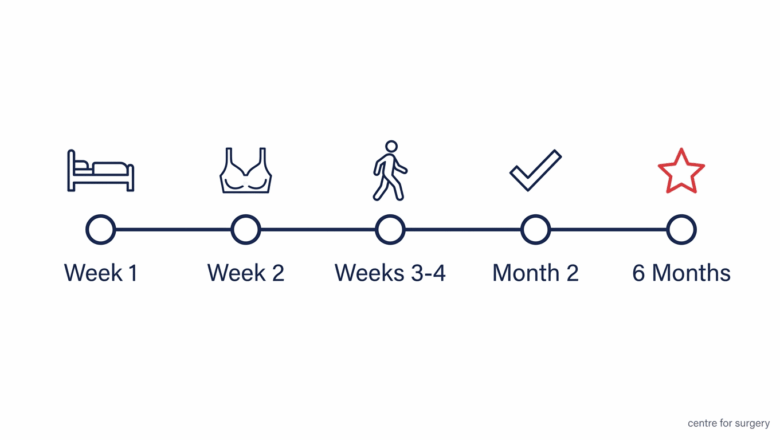
Breast augmentation recovery stages follow a predictable pattern: the biggest changes happen in the first two weeks, then the implants settle quietly for months. Timings vary with implant size, placement and your own healing, so always follow your surgeon’s instructions.
Day of surgery
You go home the same day once you are comfortable, eating, drinking and walking. A responsible adult must take you home and stay with you for 24 hours; the Royal College of Anaesthetists’ advice for the person looking after you ↗ explains what that involves. Your chest will feel tight and heavy, and you will be wearing your surgical bra. You are given your surgeon’s direct number for the first 24 hours on your discharge summary.
Days 1–3
This is usually the most uncomfortable part of breast augmentation recovery. Tightness, soreness and swelling peak, and reaching, lifting and getting up from lying down are awkward. Take your painkillers as prescribed, rest with your upper body raised, and take short walks around the house every few hours to keep your circulation moving.
Days 4–7
Most people notice a real improvement in comfort and movement by day four or five. Bruising starts to fade and you can manage light tasks around the home. Most people take this whole first week off work, and you should not drive yet.
Week 2
Discomfort, swelling and bruising ease noticeably, and many people go back to desk-based work. Keep your elbows close to your sides: avoid lifting your arms above shoulder height or lifting anything heavy, because both stretch the healing pocket around the implant. Physically demanding jobs usually need longer off.
Weeks 3–4
Most people feel much more like themselves. Light lower-body exercise can usually start if your surgeon agrees, but chest-focused activity is still off limits. Normal daily activities are largely back on track, and short-haul travel is often possible.
Weeks 5–6
Most swelling has gone. At your review around six weeks, most people are cleared for full exercise, including upper-body training, and to stop wearing the surgical bra at night.
Months 3–6
The implants soften and drop into a lower, more natural position as the skin and muscle relax, and any remaining tightness fades. By six months the shape is close to final, and scars keep fading for a year or more.
Does Implant Placement Affect Recovery?

Yes. Implants placed over the muscle (subglandular or subfascial) sit above the pectoral muscle, which is left undisturbed, so the first few days are usually more comfortable and recovery is quicker[1]. Implants placed under the muscle (submuscular or dual-plane) involve releasing part of the pectoral muscle to make the pocket, which usually means more discomfort and a tighter-feeling chest for the first one to two weeks.
The trade-off runs the other way over the longer term. A 2019 network meta-analysis of 19 studies and more than 25,000 augmentations found that implants placed directly under the breast tissue, on top of the muscle and its covering (subglandular), had higher rates of capsular contracture, haematoma and seroma than the other planes, while muscle movement of the implant was seen only with under-the-muscle placement[3]. Neither is better for everyone. Your surgeon recommends the placement that suits your anatomy, tissue cover and goals, and our guide to over vs under the muscle implant placement explains the choice in more detail.
Swelling, Bruising and Pain After Breast Augmentation
Bruising and swelling are a normal response to surgery, not a sign of a problem. Swelling is most obvious in the first few days, when the breasts feel tight and look higher and fuller than your final result. Most of it settles within six weeks, though a small amount can persist for a few months while the implants settle. Bruising usually fades within two weeks. It is also common for one side to swell more than the other for a while.
Discomfort is usually described as tightness, aching and pressure across the chest. In a prospective study of 225 women with implants under the muscle, the average pain score was 5.9 out of 10, and almost all said they would have the operation again[2]. It improves steadily from day three onwards, and most people need prescribed painkillers for only a few days.
How to reduce swelling and bruising
- Wear your surgical bra day and night as directed, usually for around six weeks, taking it off only to shower.
- Keep your upper body raised when resting or sleeping, and avoid lying flat or on your front.
- Use cold compresses for 15–20 minutes at a time in the first few days, only if your surgeon advises it, and never directly on the skin.
- Stay well hydrated and avoid alcohol and excess caffeine and salt, all of which can worsen fluid retention.
- Avoid strenuous activity and heavy lifting for the first few weeks, because raised blood pressure increases both swelling and bruising.
Drop and Fluff: When Do Breast Implants Settle?
In the first weeks, implants sit high and the upper part of the breast looks full, because the skin and muscle are tight and swollen. Over the next three to six months the tissues relax, the lower breast stretches to accommodate the implant, and the implant drops into a lower, rounder and softer position. This is called “drop and fluff”, and it happens more slowly with larger implants and implants under the muscle. Our guide to the drop and fluff timeline shows what to expect month by month.

When Can I Exercise After Breast Augmentation?

Gentle movement helps recovery; heavy strain on the chest too early can increase swelling and bleeding or move an implant before its pocket has healed. The evidence on early exercise is reassuring: in a 2022 randomised trial of 225 women in Plastic and Reconstructive Surgery ↗, returning to exercise from one week after surgery did not increase complications or reoperations and did not worsen scars at one year, and those who exercised early were more satisfied with their result[4]. We still build up in stages and keep chest work until last:
- Weeks 1–2: walking only, keeping your heart rate low.
- From about 2 weeks: low-impact, lower-body cardio such as a static bike on a light setting. No upper-body work.
- From about 4 weeks: lower-body exercise can usually increase in intensity. Chest exercises still wait.
- From about 6 weeks: after your review, most people are cleared for full exercise, including upper-body weights, swimming and high-intensity cardio.
Until you are cleared, avoid bench presses, push-ups and pull-ups, jumping and bouncing, rowing machines, weighted squats and deadlifts, and lifting anything over about 5kg, including young children. Stop and contact your surgeon if you notice new bleeding, fluid at an incision, sudden swelling or a change in shape after activity. Our guide to exercising after cosmetic surgery explains how to build back up safely.
Running after breast augmentation
Most people can start gentle jogging at around six weeks once their surgeon is happy, beginning with short, easy runs on flat ground and building up over the following weeks. Running is high-impact and the breasts move with every stride, so wait until you are cleared rather than returning early because you feel well.
Sports bras after breast augmentation
When you go back to exercise, wear a soft, supportive, non-wired sports bra designed for high-impact activity. It should hold the breasts still without digging in, leaving marks or pressing on your scars, and a front-fastening style is easier while arm movement is still limited.
Sleeping After Breast Augmentation
Sleep on your back with your upper body raised on two or three pillows or a wedge for at least the first two weeks. This reduces swelling, protects the incisions and stops you rolling onto the implants. Side sleeping usually waits until around four to six weeks, with a pillow to support the upper breast, and front sleeping waits until your surgeon confirms the implants have settled, often around three months. Our guide to sleeping after cosmetic surgery covers positions and pillows for each procedure.
Bras, Showering, Driving and Work After Breast Augmentation
Bras
A soft, supportive, wire-free surgical bra is worn day and night for around six weeks. Underwired bras wait until your surgeon is happy that the implants and the crease incisions have healed, often around three months. Our guide to compression bras after breast surgery covers which type to buy and how it should fit. Surgical bras and prescribed medicines are bought separately, and we confirm what you need before your operation.
Showering
Most people can shower within a day or two, following the wound-care instructions on their dressings. Avoid soaking the incisions in a bath, hot tub or pool until they have fully healed, usually at least two to four weeks.
Driving
Do not drive for at least 24 hours after an anaesthetic or sedation, and in practice not for at least a week after breast augmentation. Most people drive again from one to two weeks, once they can turn the wheel, wear a seat belt comfortably and do an emergency stop without pain, and are no longer taking painkillers that cause drowsiness. Check your insurance policy, as some insurers require a longer gap.
Going back to work
Most people manage desk-based work within one to two weeks. Jobs that involve lifting, reaching overhead or physical strain usually need four to six weeks, and your surgeon can advise on your own role.
Household tasks and childcare
Avoid reaching overhead, vacuuming, carrying shopping and lifting children for the first couple of weeks. Arrange help with heavier chores and childcare before your operation if you can.
Scars and Numbness After Breast Augmentation
Most breast augmentation incisions sit in the crease under the breast. The scar is pink and firm for the first few months, then gradually flattens and fades over 12–18 months. Keep it out of the sun for the first year, and your surgeon may suggest silicone gel or sheets once the wound has fully healed. Our guide to breast augmentation scars explains each incision type and how scars mature.
Changes in sensation are common and usually temporary. In a study of 162 women who had subfascial breast augmentation, sensation had returned to its pre-operative level across most of the breast by 12 weeks, and only 4% of nipples had not regained their normal sensitivity by then; the lower outer part of the breast, nearest the crease incision, was the area most often still affected[5]. In the study of 225 women, nipple numbness affected about four in ten at first, but lasting numbness was unusual, at 2.3%[2]. Nipples can also feel oversensitive for a few weeks as the nerves recover.
What Affects Your Breast Augmentation Recovery?
Recovery is not identical for everyone. Larger implants stretch the tissues more and usually mean a longer initial adjustment. Placement (covered above), the incision, your general health and fitness, skin elasticity and nutrition all play a part. Smoking matters most: nicotine reduces blood flow and slows healing, which is why we ask you to stop smoking and all nicotine products for four weeks before and four weeks after surgery.
What to eat during breast augmentation recovery
Lean protein such as chicken, fish, eggs and pulses supports tissue repair, and fruit and vegetables provide the vitamins your body needs to heal. Drink plenty of water, at least two litres a day, and keep salty and processed food to a minimum, because salt encourages fluid retention. A fibre-rich diet helps too, since painkillers can cause mild constipation in the first few days.
Breast Augmentation Aftercare: Dos and Don’ts
Do
- Wear your surgical bra consistently, exactly as your surgeon directs.
- Sleep on your back with your upper body raised for at least the first two weeks.
- Take painkillers as prescribed, especially in the first few days, so you can move about comfortably.
- Walk little and often from the first day to keep your circulation moving.
- Eat well and stay hydrated to support tissue repair.
- Attend every follow-up review so your surgeon can check your healing and answer questions early.
Don’t
- Lift heavy objects or raise your arms above your shoulders for the first two weeks, or do strenuous exercise for around six weeks.
- Smoke or use nicotine for at least four weeks after surgery.
- Drink alcohol while you are taking strong painkillers, and keep it to a minimum for the first couple of weeks; our guide to alcohol after cosmetic surgery explains why.
- Sleep on your side or front until your surgeon confirms it is safe.
- Expose your incisions to sun or soak them in water until they have fully healed.
- Ignore warning signs such as a high temperature, heavy bleeding, worsening pain or sudden swelling of one breast.
Breast Augmentation and Lift Recovery
Some people considering implants also have a degree of sagging that implants alone will not correct, and a breast lift may be recommended alongside the augmentation. Breast augmentation and lift recovery takes longer than augmentation alone, because the lift repositions the breast tissue and nipple and leaves longer scars; expect it to follow the longer of the two timelines. Our breast lift recovery guide covers that side of the healing, and your surgeon will discuss whether a combined or staged approach suits you better.
Long-Term Care: Implant Checks, Warranty and the Registry
Breast implants do not need routine scans if you have no symptoms, but they are not lifetime devices, and it is worth knowing what to look out for in the years after your recovery.
- Implant warranty. We use Silimed implants, which carry a 10-year warranty covering grade III–IV capsular contracture and rupture. Our guide to Silimed breast implants explains the implants and the warranty.
- The national registry. We submit details of every implant operation to the Breast and Cosmetic Implant Registry, so you can be traced if a safety concern ever arises with a type of implant.
- Hardening or a change in shape. A breast that becomes firm, tight, misshapen or painful, sometimes years later, may be capsular contracture and should be checked by a plastic surgeon.
- Late swelling or a lump. The MHRA’s advice for people with breast implants ↗ asks you to seek a check if one breast swells rapidly and painlessly, or if you find a lump.
We do not run a standalone implant scan service. If something changes, the first step is an examination by a plastic surgeon, and an ultrasound or MRI scan is arranged off site only if it is needed; our guide to breast implant checks explains how that works.
When to Contact Your Surgeon After Breast Augmentation
Serious problems after breast augmentation are uncommon. In a database of 18,544 implant augmentations, 2.3% had a major complication needing an emergency visit, hospital admission or a return to theatre within 45 days[6]. Contact your surgical team straight away if you have:
- sudden, painful swelling or tightness of one breast, or a breast that looks newly bruised and enlarged (a possible haematoma)
- a temperature, or increasing redness, heat or discharge around an incision
- bleeding that does not stop with gentle pressure, or a wound that opens
- pain that is getting worse rather than better after the first three days
- a painful, swollen calf or breathlessness (call 999 for chest pain or difficulty breathing)
For the first 24 hours, call your surgeon on the direct number on your discharge summary. After that, call the clinic on 020 7993 4849, 9am–6pm Monday to Saturday, and NHS 111 out of hours, or 999 in an emergency.
Breast Augmentation Recovery FAQs
What is the worst day of breast augmentation recovery?
Most people find days two and three the hardest, when tightness and swelling peak. Things usually improve noticeably by days four and five.
How long is breast augmentation recovery with under-the-muscle implants?
The overall timeline is similar: back to desk work in one to two weeks and full exercise from about six weeks. The first one to two weeks tend to feel tighter and more uncomfortable, and the implants can take a little longer to drop and settle.
How long after breast augmentation can I lift my arms?
You can use your arms for everyday tasks such as eating and brushing your hair from the first day. Avoid lifting them above shoulder height, or lifting anything heavy, for about two weeks, then build up gradually.
Will I need drains after breast augmentation?
Not routinely. Drains depend on the technique and on whether anything else is done at the same operation, and your surgeon will tell you in advance if you are likely to need them.
When can I wear an underwired bra after breast augmentation?
Usually from around three months, once your surgeon is happy that the crease incisions have healed and the implants have settled. Our guide to wearing a bra after breast augmentation covers longer-term support.
How long after breast augmentation can I go on holiday or fly?
Short-haul flights are often possible from around two weeks once the early swelling has settled. For long-haul flights, check with your surgeon first, because sitting still for long periods soon after surgery raises the risk of a blood clot. Avoid swimming and strong sun on the scars until your surgeon clears you.
Why does one breast look different during recovery?
Each side heals at its own pace, so temporary differences in swelling and height are common in the early weeks. They usually even out as the implants drop and fluff. Sudden or worsening asymmetry is different and should be checked.
Does breast size affect recovery time?
Larger implants stretch the tissues more, so the first few weeks can feel tighter and the implants can take longer to settle. The overall pattern of recovery is similar.
When will I see my final breast augmentation result?
At around three to six months, once the swelling has gone and the implants have dropped and softened. Scars keep fading for a year or more.
Can I see real breast augmentation recovery photos?
Our before and after gallery shows settled results from our own patients. We do not publish week-by-week recovery photos, because swelling and settling vary so much that a single case can be a misleading guide to your own recovery.
Breast Augmentation in London
Breast augmentation at Centre for Surgery is performed by GMC-registered surgeons at our CQC-regulated Baker Street hospital, rated Good overall by the CQC. The consultant who assesses you at consultation is the consultant who performs your surgery, and you have follow-up reviews as you heal. We use Silimed implants and submit every implant operation to the Breast and Cosmetic Implant Registry. We recommend a two-week cooling-off period between your consultation and surgery. Your initial consultation is £100, redeemable against the cost of surgery if you go ahead; our breast augmentation cost guide explains what the price includes, and finance is available, subject to status.
Phone: 020 7993 4849 | Address: 95–97 Baker Street, Marylebone, London W1U 6RN
Contact us to schedule a consultation
References
- Seren JM, Cervantes A, Fontbona M, et al. A decalogue on enhanced recovery after breast augmentation surgery (ERABAS). Aesthetic Plastic Surgery 2025;49(1):198–204. doi:10.1007/s00266-024-04231-7 ↗
- Swanson E. Prospective outcome study of 225 cases of breast augmentation. Plastic and Reconstructive Surgery 2013;131(5):1158–1166. doi:10.1097/PRS.0b013e318287a0e1 ↗
- Shen Z, Chen X, Sun J, et al. A comparative assessment of three planes of implant placement in breast augmentation: a Bayesian analysis. Journal of Plastic, Reconstructive and Aesthetic Surgery 2019;72(12):1986–1995. doi:10.1016/j.bjps.2019.09.010 ↗
- Basile FV, Oliveira TS. Exercise after breast augmentation: a randomized controlled trial. Plastic and Reconstructive Surgery 2022;149(1):18e–24e. doi:10.1097/PRS.0000000000008676 ↗
- Brown T. Objective sensory changes following subfascial breast augmentation. Aesthetic Surgery Journal 2016;36(7):784–789. doi:10.1093/asj/sjw005 ↗
- Nguyen L, Afshari A, Grotting JC, et al. Preoperative risk factors and complication rates of breast augmentation with fat grafting. Aesthetic Surgery Journal 2022;42(7):749–757. doi:10.1093/asj/sjac061 ↗