


In this guide11 sections
- Key points
- What is a B belly?
- What causes a B belly? Why the crease forms
- B belly not pregnant — what it means
- Is a B belly normal? B belly in females and men
- B belly and lipoedema — the connection worth knowing
- How to get rid of a B belly without surgery
- B belly surgery — when it is appropriate
- Am I a suitable candidate for surgery?
- Frequently asked questions
- Speak to a plastic surgeon
Key points
- A B belly is an abdomen divided by a horizontal crease, so that in profile it reads as the shape of a letter B rather than a single curve.
- It is a description, not a diagnosis. For many people it is normal fascial anatomy and needs nothing done to it.
- The crease is usually a tethering point where skin is anchored to the deeper fascia, holding the middle in while tissue above and below projects forward.
- Most online content is about pregnancy. If you are not pregnant, the causes and the answers are different.
- Four things account for most non-pregnancy B bellies — normal fascial anatomy, diastasis recti, skin laxity after weight loss or pregnancy, and lipoedema.
- Lipoedema is the one most often missed. It affects an estimated 11% of adult women and is routinely misdiagnosed as ordinary obesity.
- Exercise will not remove the crease if the cause is fascial tethering or skin laxity, however much weight is lost.
What is a B belly?
A B belly — also written B-shaped belly — is an abdominal shape in which a horizontal crease or indentation divides the stomach into an upper and a lower portion. Viewed from the side, the two curves with an indent between them resemble a capital letter B, which is where the name comes from. A single continuous curve is sometimes called a D belly by contrast.

It is worth saying at the outset that this is a descriptive term coined online rather than a medical diagnosis. Nobody is diagnosed with a B belly. What matters clinically is why the crease is there, because the answer determines whether anything can or should be done about it — and for a substantial number of people the honest answer is that this is simply how their fascia is arranged and no treatment is warranted.
A B belly overlaps with several other terms. Where the lower portion hangs forward over the pubic area it may also be described as an apron belly, a pannus, or a stomach overhang. Where the fullness sits lower still, directly over the pubic bone, it is usually called a FUPA. These are not competing conditions so much as different words for overlapping presentations.
What causes a B belly? Why the crease forms
The abdominal wall is not a uniform sheet. Skin sits over subcutaneous fat, which sits over fascia, which sits over the rectus abdominis muscles. At certain points the skin and superficial fascia are anchored more firmly to the deeper layer beneath — and where such an attachment runs horizontally across the abdomen, the tissue above and below it can project forward while the attachment point itself stays put.

That is the mechanism behind most B bellies. The crease is not fat sitting in a line — it is the absence of forward projection at a fixed point, with volume either side of it. This explains something that frustrates a great many people: losing weight often makes the crease more defined rather than less, because the tethering point does not change while the tissue around it reduces.
Where the attachment is a surgical scar rather than natural anatomy — most commonly a Caesarean section scar that has healed adherent to the tissue beneath — the same effect occurs but with a clear cause and a specific treatment. Our guide to belly overhang after a C-section covers that presentation in detail.
B belly not pregnant — what it means
Almost everything written about B bellies concerns pregnancy, where a growing uterus forms the upper curve and lower abdominal tissue forms the lower one. If you are not pregnant, that content does not apply to you, and the reassurance it offers — that it will resolve after delivery — is not relevant either.

In a non-pregnant adult, four explanations account for most cases.
1. Normal fascial anatomy
Some people simply have a firmer horizontal fascial attachment than others, and always have. Body shape varies enormously between individuals, and a great deal of what circulates online as a defect is ordinary variation — a point we make at more length in our guide to appearance-focused online culture. If the crease has been there as long as you can remember, is not painful, has not changed, and sits at your natural waist, this is the most likely explanation. It is a variation in how bodies are put together, not a condition.
2. Diastasis recti
Separation of the rectus abdominis muscles allows the abdominal contents to push forward between them, which changes the profile and can accentuate a crease. Diastasis recti is common after pregnancy and also occurs in men and in people who have gained weight rapidly. It is assessed by examination rather than by looking at a photograph, and the first line of treatment is specialist physiotherapy rather than surgery.
3. Skin laxity after weight loss or pregnancy
Where skin has been stretched and has lost elastic recoil, it drapes rather than retracts. The crease then reflects where the loose skin folds. This is the presentation most likely to be helped by surgery, and least likely to be helped by anything else — no amount of core work restores elasticity to skin that has lost it. Our guide to the mum tum covers the post-pregnancy version, and apronectomy for loose tummy skin covers the post-weight-loss version.
4. Lipoedema
The explanation most often missed, and the one most worth knowing about. See the section below.
Is a B belly normal? B belly in females and men
In most cases, yes. A B belly shape is a common anatomical variant and carries no health implication whatsoever. Although a B belly in females is discussed far more often online — largely because it is bound up with pregnancy and post-pregnancy body change — men develop the same B-shaped belly pattern, usually with weight gain or after abdominal surgery. The mechanism is identical. It is not a sign of visceral fat, it is not a marker of metabolic risk, and it does not indicate that anything has gone wrong.
What has changed is not how many people have it but how visible the concept has become. The term itself circulates largely on social media, and a great deal of the anxiety attached to it is manufactured by that framing rather than by anything clinical. Some content presents a B belly as a “warning sign” requiring identification and correction. It is not.
The circumstances in which a divided abdomen genuinely warrants assessment are narrower: where it is new rather than lifelong, where it is painful, where one side differs from the other, where it appeared after abdominal surgery, or where it comes with the leg findings described below.
B belly and lipoedema — the connection worth knowing
Lipoedema is a disorder of adipose tissue that causes disproportionate, often painful fat accumulation, characteristically affecting the legs and hips while sparing the feet. It affects women almost exclusively, and where it involves the lower abdomen it can produce exactly the divided appearance being described here.
It matters because it is so consistently missed. A review in Plastic and Reconstructive Surgery Global Open estimated that lipoedema affects close to 11% of adult women, and noted that patients are commonly misdiagnosed with lifestyle-induced obesity, subjected to unnecessary interventions, and — in the authors’ words — to fat-shaming, despite the condition characteristically failing to respond to even extreme weight loss (Buck & Herbst, 2016).
Part of the problem is measurement. A study of 607 lipoedema patients across Germany, the UK and Spain found that BMI systematically overestimates adiposity in this group and leads to misdiagnosis of obesity; assessed by waist-to-height ratio instead, 15.2% were underweight and 45.5% were of normal weight (Brenner et al., 2023). Distinguishing lipoedema from lymphoedema is a separate diagnostic challenge again, and remains an active research question (Stellmaker et al., 2024).
Features that should prompt you to ask about lipoedema:
- Fat distribution that is disproportionate between upper and lower body
- Legs affected symmetrically, with the feet spared — often a distinct “cuff” at the ankle
- Tenderness or pain on pressing the affected tissue, rather than it simply being soft
- Easy bruising without recalled injury
- A history of the shape appearing or worsening at puberty, pregnancy or menopause
- Fat that has not responded to sustained, genuine weight loss
If several of these apply, our lipoedema service page explains assessment and treatment. This is a diagnosis worth pursuing whether or not you ever want surgery, because knowing what you are dealing with changes how you approach it.
How to get rid of a B belly without surgery
What works depends entirely on the cause, and being honest about that is more useful than a list of exercises.
Where the cause is fat, weight loss reduces the volume above and below the crease. It will not remove the crease itself, and in many people the indentation becomes more visible as surrounding volume decreases. Expecting the shape to convert to a smooth curve usually leads to disappointment.
Where the cause is diastasis recti, specialist physiotherapy is genuinely effective and should be the first step. Generic abdominal exercises can make matters worse — traditional sit-ups and crunches increase intra-abdominal pressure and can widen the separation. A women’s health physiotherapist is the right referral.
Where the cause is skin laxity, nothing non-surgical restores elasticity to stretched skin. Radiofrequency and ultrasound devices produce modest tightening on mild laxity at best; they do not remove excess skin because they cannot.
Where the cause is fascial anatomy, no treatment changes it short of surgery, and in most cases surgery is not warranted.
Clothing genuinely helps in the meantime. High-waisted garments that sit above the crease rather than across it produce a smoother line, which is why this advice circulates so widely. It is a reasonable thing to do and requires nothing from anyone.
B belly surgery — when it is appropriate
Surgery is appropriate for a minority of people with this shape, and specifically for those in whom excess skin, a tethered scar, or diagnosed lipoedema is the driver.
Abdominoplasty
A tummy tuck removes excess skin and fat from the lower abdomen and repairs muscle separation where present. Where a fascial or scar attachment is creating the crease, that attachment is released during the procedure. This is the most comprehensive option and the one most likely to change the shape rather than just the volume.
Apronectomy
Where the priority is removing a hanging apron of skin and muscle repair is not required, an apronectomy removes the overhang with a shorter operation and recovery. Our comparison of abdominoplasty versus apronectomy sets out which suits whom.
Liposuction
Useful for reducing volume where skin quality is good, and central to the surgical management of lipoedema, where specialised technique is used to preserve lymphatic channels. Liposuction alone will not improve a crease caused by tethering or laxity, and in a patient with poor skin quality it can make loose skin more apparent.
Combined procedures
Where several components are present — skin, fat, muscle separation and a C-section scar — addressing them separately means several recoveries. Many patients combine them, which is what a mummy makeover refers to. Where the abdomen alone is the concern and skin excess is limited, a mini tummy tuck may be sufficient. Costs for each are set out in our tummy tuck cost guide, and recovery is covered in tummy tuck recovery.
Am I a suitable candidate for surgery?
The honest answer for many people reading this is no, and not because of any barrier — because there is nothing that needs operating on.
Where surgery is being considered, the usual criteria apply: a stable weight maintained for at least six months, no plans for further pregnancy, non-smoking or willing to stop, good general health, and expectations that match what the operation can deliver. Where diastasis is present, physiotherapy should have been tried first. Where lipoedema is suspected, it should be diagnosed before any surgery is planned, because it changes both the technique and the expected outcome.
We decline a meaningful proportion of consultations for abdominal surgery, most often because the patient’s weight is still changing, because a further pregnancy is planned, or because what they are describing is normal anatomy that surgery would not improve.
Which body procedure is right for you?
A few short questions, including a simple pinch test you can do now. You will get a suggested procedure, realistic recovery times, and a straight answer if surgery should wait.
Frequently asked questions
What is the difference between a B belly and an apron belly?
A B belly describes a crease dividing the abdomen into two portions. An apron belly describes tissue hanging forward over the lower abdomen or pubic area. They frequently coexist — the crease forms the upper boundary of the apron — but they are describing different features.
Does a B belly mean I have diastasis recti?
Not necessarily. Diastasis is one of several causes, and it is diagnosed by examination rather than appearance. If you can feel a gap between the abdominal muscles when lifting your head while lying down, that warrants assessment.
Will losing weight get rid of a B belly?
It will reduce the volume, but often makes the crease itself more visible rather than less, because the tethering point that creates it does not change. If your shape has persisted through significant weight loss, that tells you something useful about the cause.
Can exercise get rid of a B belly?
Exercise helps where fat is the main component and where diastasis responds to appropriate physiotherapy. It does nothing for fascial tethering or for skin laxity. Conventional crunches can worsen an existing diastasis.
Is a B belly caused by PCOS?
Polycystic ovary syndrome affects fat distribution and can contribute to central weight gain, so it may play a part in the volume. It does not create the crease itself. If you have other features of PCOS, that is a matter for your GP.
Is a B belly a sign of anything serious?
In itself, no. A crease that is new, painful, one-sided, or accompanied by a hard lump warrants examination — but a lifelong, painless, symmetrical crease is a variation in anatomy, not a disease.
Speak to a plastic surgeon
If you have a concern about your abdominal shape, an in-person assessment establishes what is actually causing it — which determines whether treatment would help and, frequently, that it would not.
Call 020 7993 4849 or contact us to arrange a consultation at 95–97 Baker Street, Marylebone, London W1U 6RN.
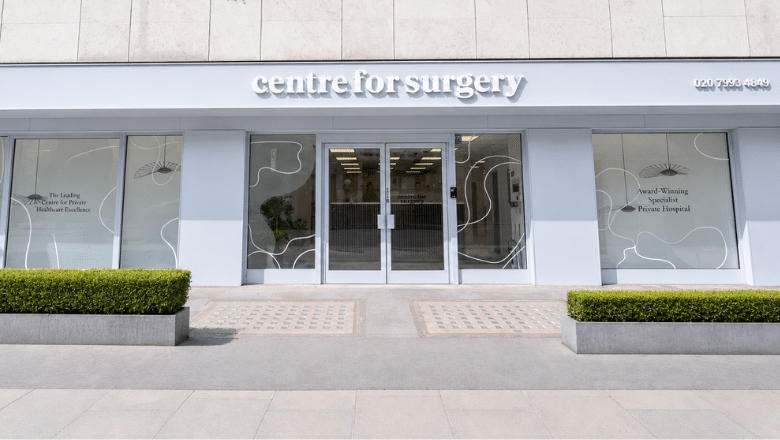
Consultations take place in person at our CQC-regulated private hospital in Marylebone, with all abdominal surgery performed by GMC-registered plastic surgeons. If you are travelling from outside London, our guide to travelling to us for surgery covers timings and accommodation, and finance options explains how treatment can be spread over a fixed term.
Further reading
- How to get rid of a stomach overhang
- How to get rid of an apron belly
- How to get rid of a mum tum
- Diastasis recti explained
- Lipoedema treatment
- Belly overhang after a C-section


