


In this guide17 sections
- Key Points
- What Is the Navel and Where Is It on the Body?
- How Is the Belly Button Formed, and What Is It For?
- What Is Your Belly Button Connected to Inside Your Body?
- What Are the Different Types of Belly Buttons?
- What Is a Lightbulb Belly Button?
- What Does a Normal Belly Button Look Like?
- What Determines Belly Button Shape, and Why Does It Change?
- Belly Button Problems: When Should You See a GP?
- What Is the Most Attractive Belly Button Shape?
- Can You Change the Shape of Your Belly Button?
- Who Is Suitable for Belly Button Surgery?
- Belly Button Surgery Recovery, Scarring and Risks
- How Much Does Belly Button Surgery Cost in London?
- Frequently Asked Questions
- Belly Button Surgery at Centre for Surgery
- References
Key Points
- The navel is the belly button. Navel, belly button and tummy button are everyday names for the umbilicus: the small scar in the middle of the abdomen where the umbilical cord was attached before birth.
- Almost every shape is normal. Innie, outie, deep, shallow, vertical, horizontal, T-shaped, round and slightly off-centre belly buttons are all normal variations, and shape says nothing about personality.
- Belly buttons change over a lifetime. Pregnancy, weight gain or loss, piercings, scarring and umbilical hernias can all change how the navel looks.
- Some changes need a GP check. A new outie in an adult, a lump that bulges when you cough, pain, redness, discharge or a smell that keeps coming back should be examined.
- Preferences have been studied. Attractiveness studies favour a small vertical or T-shaped navel with a hood of skin at the top in women and a horizontal oval in men, but there is no single “right” belly button.
- The navel can be reshaped. Umbilicoplasty reshapes the navel itself, a tummy tuck repositions it as part of a larger operation, and a hernia needs proper repair rather than cosmetic reshaping alone.
Your navel, also called your belly button or tummy button, is known medically as the umbilicus. It is the small dip or scar in the middle of the front of your abdomen, and it marks the spot where the umbilical cord connected you to the placenta before you were born. Belly buttons come in a wide range of shapes, including innies, outies, deep hollows, vertical slits and horizontal ones, and almost all of them are normal. This guide explains what the navel is, where it is and what it is connected to inside your body, the different belly button types, what changes their shape, when a belly button needs a medical check and, for anyone bothered by the way theirs looks, what can realistically be done about it, from umbilicoplasty (belly button surgery) to a full tummy tuck.
After you are born, the cord is clamped and cut. The small opening then heals over, and when the remaining stump dries and falls away, the navel is what remains. It no longer has any job to do, but it is one of the most noticeable features of the abdomen, which is why its appearance matters to so many people.
Some navels sit deeper, some are flatter, and some form an “outie”. Differences like these are completely normal, but if your navel looks very different from what you expect, it can affect how you feel about your body. If you are feeling self-conscious about your navel, you might:
- Feel uneasy about your stomach being seen in intimate situations.
- Avoid certain clothes, especially fitted gym wear, crop tops, or swimwear.
- Recall teasing or comments, which can leave lasting self-consciousness.
- Find yourself comparing your body to other people more than you would like.
If these feelings sound familiar, our guide to body dysmorphia and cosmetic surgery explains where to find support.
There is no single “right” belly button. Most variation is entirely normal. If the appearance of your navel is bothering you enough to change how you dress or how confident you feel, a consultation with a GMC-registered plastic surgeon at Centre for Surgery can help you explore what can be done and what result is realistic for you.
What Is the Navel and Where Is It on the Body?
The navel is a body part: the visible scar left on the abdomen once the umbilical cord stump has dropped off after birth. “Navel”, “belly button” and “tummy button” all mean the same thing, and doctors call it the umbilicus (the adjective is “umbilical”, as in umbilical cord or umbilical hernia). The word is sometimes misspelled “naval”, which refers to the navy rather than the body.
The navel sits in the midline of the front of the abdomen, somewhat lower than halfway between the lower tip of the breastbone and the crease above the pubic area. Doctors call the central part of the abdomen around it the umbilical region. Its exact height varies from person to person: in a study of photographs of 81 bikini models, navel position was “quite variable”, although the distance from the breastbone to the navel averaged about 1.6 times the distance from the navel to the lower abdominal crease[1].
Beneath the skin, the navel is anchored to the linea alba, the band of tough tissue that joins the two vertical stomach muscles (the rectus abdominis) down the midline. The navel is a natural weak point in this band, which is why changes in the abdominal wall, such as muscle separation in pregnancy or a hernia, often show at or around the belly button.
How Is the Belly Button Formed, and What Is It For?
The navel is essentially a scar, the only one almost everyone shares. The umbilicus begins to form as early as the fourth week of development in the womb, and the umbilical cord contains one vein and two arteries[2]. During pregnancy, the cord carries oxygen and nutrients from the placenta to the developing baby and removes waste, joining the baby’s body at the point that becomes the belly button. At birth the cord is clamped and cut, and over the following days to weeks the stump dries and drops away, leaving the umbilicus behind. Inside the body, the umbilical blood vessels close off after birth and gradually become thin ligaments[2].
After birth, the navel has no known function. That is why it can be reshaped surgically without any loss of function.
What Is Your Belly Button Connected to Inside Your Body?
In adults, the belly button is not an opening into the body: it is closed skin and scar tissue sitting on the abdominal wall. On the inside of the abdominal wall, though, several thin, cord-like ligaments meet at the navel. They are what remains of the structures that ran through the umbilical cord before birth[3]:
- The round ligament of the liver runs upwards to the liver, within the lower edge of the falciform ligament. It is the remnant of the umbilical vein, which carried oxygen-rich blood from the placenta.
- The two medial umbilical ligaments run downwards towards the pelvis. They are the remnants of the umbilical arteries.
- The median umbilical ligament runs down the midline to the top of the bladder. It is the remnant of the urachus, a channel connected to the developing bladder before birth.
None of these has an active role in adult life. Problems with them are uncommon, but they can become inflamed and can cause symptoms such as discharge from the navel, which is one reason a navel that leaks fluid should be checked by a doctor[3].
What is behind your belly button? Directly behind the navel lie the layers of the abdominal wall and then loops of bowel. Deeper still, in front of the spine, the aorta (the body’s main artery) divides into the two arteries that supply the pelvis and legs: in a CT study of 200 adults, this division lay a median of 8 mm below the level of the navel, although its position varied considerably from person to person[4].
What Are the Different Types of Belly Buttons?
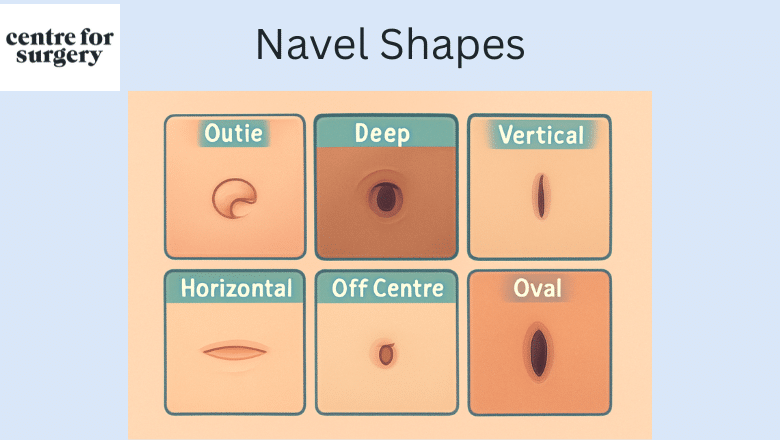
Belly button types vary a lot, and there is no single agreed list. In everyday terms, people talk about innies and outies, then describe the shape (vertical, horizontal, T-shaped, round or oval), the depth (deep or shallow) and whether the navel sits centrally. Surgeons use more structured descriptions. One of these, the SHAPE classification, introduced in a 2022 study of photographs of 81 male models, describes the navel by its Shape, Hood (the fold of skin above it), Adiposity (the fat around it), Protrusion and Position, and any External piercing[5].

Innie Belly Button
An innie is a navel that dips inwards, below the level of the surrounding skin, and it is what most people picture when they think of a belly button. Innies range from shallow to deep, and the opening can be vertical, horizontal, T-shaped, round or oval, as described below. A shallow innie, with only a slight dip, is just as normal as a deep one.
Outie Belly Button
An outie sits proud of the abdominal wall instead of dipping in. In babies, an outie can be a small umbilical hernia. These are common and most close on their own, which is why doctors usually watch and wait until about the age of four or five rather than operate on a hernia that is causing no problems[6]. Some people keep an outie shape from childhood. In adults, a change towards an outie can follow pregnancy, significant weight change, scarring, or weakening of the abdominal wall, and a new outie in an adult who previously had an innie is worth having checked for an underlying hernia. If an outie bothers you, our guide explains how umbilicoplasty can change an outie to an innie.
Deep (Hollow) Belly Button
A deep belly button forms a pronounced hollow with a relatively narrow opening. How deep a navel looks depends largely on the fat around it: the base of the navel is tethered to the abdominal wall, so the thicker the surrounding layer of fat, the deeper the hollow tends to be. The SHAPE classification records adiposity, the fat around the navel, as one of the features that make up its appearance[5]. A deep navel can trap sweat, lint, and dead skin, which may cause odour, irritation, or infection if moisture sits in the fold, so it needs gentle washing and careful drying.
Vertical Belly Button
A vertical belly button looks like a slim oval or slit running up and down. Some vertical navels have a small “hood” of skin at the top. This shape usually stays relatively stable over time but can widen after pregnancy or major weight changes, and in attractiveness studies it is one of the shapes rated most highly in women (see below).
T-Shaped Belly Button
A T-shaped belly button has a horizontal fold or hood of skin across the top, with a vertical dip below it, so the outline looks like the letter T. In a study of attractiveness ratings, T-shaped and vertical navels with a hood at the top scored highest[7].
Horizontal Belly Button
A horizontal belly button looks wider than it is tall, often with less depth and a softer edge. It can simply be a person’s natural shape, but navels also tend to widen and flatten sideways when the surrounding skin is stretched, for example after pregnancy or weight change.
Round and Oval Belly Buttons
An oval or round belly button has a smooth rounded outline and can be shallow or moderately deep. Scarring from a piercing or past inflammation can disrupt the smooth rim, making the oval look uneven or puckered.
Hooded Belly Button
Many navels have a small fold of skin overhanging the top edge, called a hood. A slight hood is normal, and in attractiveness studies it is one of the features rated most highly[7]. A heavier hood, often caused by loose skin or fat above the navel after weight loss or pregnancy, can partly cover the opening.
Off-Centre Belly Button
An off-centre belly button sits slightly left or right of the midline. Slight asymmetry is common and usually nothing to worry about. More noticeable off-centring can occur with abdominal muscle separation, previous surgery, or uneven scarring.

What Is a Lightbulb Belly Button?
A lightbulb belly button is an innie with a narrow upper part that widens into a rounded lower half, so its outline looks like an upside-down lightbulb or a teardrop. It is an everyday descriptive term rather than a medical category, and it is simply another normal variation. You may also see navels described as “spiral” or “swirl” shaped, where the folds inside the hollow appear to twist.
None of these shapes is fixed for life. In a 2018 study that measured the navels of 200 children and adults, the authors concluded that growth and the changing distribution of fat under the skin deepen the navel over the years and pull it into a more clearly vertical or horizontal shape[13]. Pregnancy and weight change can then stretch the outline further, as described below. If a lightbulb or irregular outline bothers you, belly button reshaping can narrow the wider lower part and refine the rim, and your surgeon will check first for an umbilical hernia, which needs repair rather than cosmetic reshaping alone.
What Does a Normal Belly Button Look Like?
There is no single normal belly button. A healthy navel can be an innie or an outie, deep or shallow, round, oval, vertical, horizontal or slightly off-centre, and it may change shape over the years. What matters more than shape is a change from how it used to look, or new symptoms. A belly button is usually nothing to worry about if it:
- does not hurt and is not red or swollen;
- stays dry, without discharge or a smell that keeps coming back;
- has no new lump, and no bulge that gets bigger when you cough or strain.
If any of these change, the section on belly button problems below explains when to see a GP.
What Determines Belly Button Shape, and Why Does It Change?

Why one person has an innie and another an outie has not been well studied, and you cannot control the natural shape or size of your navel at birth. A navel’s shape reflects how the cord stump healed, the strength of the abdominal wall beneath it, and the amount of fat and skin around it. All of these can change over a lifetime, so your belly button can change too.
Pregnancy
Pregnancy can change how your navel looks, usually from the middle of pregnancy onwards. As your abdomen expands, your belly button may start to pull wider, lose its usual depth and look flatter, or pop out, turning an “innie” into more of an “outie”. After delivery, many navels gradually look more like they did before, though for some the change is permanent, particularly where the abdominal muscles have separated (diastasis recti). Muscle separation is common after a first pregnancy: in a 2026 study that followed first-time mothers with ultrasound scans, about 3 in 10 had a gap of more than 3 cm between the muscles a year after giving birth[8]. Where pregnancy has left both a changed navel and loose skin, a mummy makeover can address several of these changes in one operation.
Weight Gain and Weight Loss
Large weight loss, or cycles of losing and regaining weight, can change the look of your belly button. Weight gain tends to make the navel deeper as fat builds up around it. After major weight loss, fat reduces faster than skin tightens, which can make the navel look wider, shallower, or slightly pulled out of position. Loose skin above the navel can also form a hood that partly covers it, one of the many changes covered in our guide to loose skin after weight loss.
Scarring and Piercings
Scar tissue in or around the navel can change how it looks and sits. This is most often linked to a belly button piercing, or can happen after surgery or an injury. Piercing scars in particular can distort the rim, making an otherwise smooth oval look uneven or puckered. Our guide to belly button piercing repair explains how these scars can be treated.
Umbilical Hernia
An umbilical hernia happens when the abdominal wall around the belly button weakens, allowing fat, tissue, or part of the bowel to push forward. You may notice a soft lump on or next to the navel that becomes more obvious when you cough or strain. If you think you may have an umbilical hernia, book a medical assessment promptly: a hernia needs proper repair, not just cosmetic reshaping, and can often be repaired at the same time as a tummy tuck. Guidelines from the European Hernia Society and the Americas Hernia Society recommend that umbilical hernias causing symptoms are repaired, using mesh to lower the chance of the hernia coming back[9]. A hernia that becomes painful, firm or red, or that will no longer push back in, needs urgent medical attention, especially if you are also being sick, because this can mean part of the bowel is trapped[10].
Belly Button Problems: When Should You See a GP?
Most belly button worries turn out to be harmless, but the navel is also a place where some medical problems first show. Any new lump, growth or nodule in the navel should be examined by a doctor. In children it can be a leftover from development before birth, and in adults it is occasionally a sign of a more serious condition, although non-cancerous causes are much more common[10].
Umbilical Granuloma
An umbilical granuloma is a small, moist lump of overgrown tissue inside the navel, most common in newborns but possible at any age. It can usually be managed without surgery[10], and a clinician can treat or remove it.
Infection, Smell and Discharge
The navel can trap sweat, dead skin, and moisture, creating a warm, damp place for bacteria or fungi to grow. Infections can cause redness, swelling, soreness, discharge, or a bad smell, and deep navels are harder to keep clean and dry. Gentle washing with soap and water and drying the navel well usually helps. See your GP if the skin is red, painful or weeping, or if discharge keeps coming back, because persistent discharge can occasionally come from one of the leftover structures described above rather than from the skin[3].
Ascites
Ascites is a build-up of fluid inside the abdomen, most often linked to advanced liver disease. As pressure builds, the belly button can flatten or start to protrude, and this warrants prompt medical assessment of the underlying cause.
What Is the Most Attractive Belly Button Shape?
There is no single “most attractive” belly button, and beauty standards for the navel vary between cultures and change over time. The question has been studied, though. In a 2000 study of 147 women aged 18 to 62, a panel rated photographs of each woman’s navel: T-shaped or vertical navels with a hood of skin at the top scored highest, while any protrusion, a horizontal orientation, a distorted shape or a large navel lowered the score[7]. A 2015 study that analysed photographs of 81 bikini models and surveyed 1,682 people online came to a similar conclusion: the vertical oval navel with a hood of skin at the top was the most appreciated shape, and horizontal and protruding navels were the least[1].
Belly Button Types in Men
Preferences appear to differ for men. In the 2022 study of male models that introduced the SHAPE classification, a horizontal oval navel with a hood of skin at the top was the ideal male shape, unlike the vertical oval found most pleasing in women, and the male navel sat marginally lower on the abdomen than the average female navel[5].
These studies reflect the opinions of particular panels and photographs of models, so they describe broad preferences rather than a standard anyone needs to meet. Navel shape is individual to each person, and what suits one abdomen will not suit another. If you are considering a procedure to change your navel, your surgeon will assess your anatomy during your consultation and explain the most appropriate options for your body, aiming for a natural result in proportion with the rest of your abdomen rather than a one-size-fits-all “ideal”.
Can You Change the Shape of Your Belly Button?
Yes, with surgery. Several treatments can improve navel shape and definition. The right option depends on what is causing the change, your skin quality, and whether there is any underlying issue such as a hernia.

Umbilicoplasty (Belly Button Surgery)
Umbilicoplasty is surgery to reshape the belly button. It can correct outie navel protrusion, stretched or distorted shape after pregnancy or weight loss, a heavy hood of skin, and scarring from piercings or previous surgery. The procedure usually takes up to two hours and can be done under local anaesthetic or TIVA (total intravenous anaesthesia). It works on the navel alone, so it is the least invasive of the surgical options and suits patients whose only concern is the belly button itself, with reasonable surrounding skin. Where a navel is missing or has been lost, surgeons can also create a new one (neoumbilicoplasty): a systematic review of 41 studies including 588 patients found generally pleasing results with relatively low complication rates[11].
Tummy Tuck (Abdominoplasty)
If you want to improve the overall look of your abdomen as well as your belly button, an abdominoplasty (tummy tuck) may be a better option than navel reshaping alone. This procedure suits people with loose, stretched skin after pregnancy or weight loss. Importantly, a tummy tuck also repositions and reshapes the navel: during the procedure the belly button is carefully preserved on its stalk and brought out through a new opening in the tightened skin, giving the surgeon the opportunity to create a neat, natural-looking navel as part of the overall result. You can read more in our guide to what happens to the belly button in a tummy tuck. Where a belly-button-only change is not enough because loose skin is the real problem, a tummy tuck usually addresses the concern more completely.
Umbilical Hernia Repair
Hernia repair treats an umbilical hernia by fixing the weakness in the abdominal wall around the belly button. Guidelines recommend reinforcing the repair with mesh to reduce the chance of the hernia coming back[9]. This is a functional repair, not a cosmetic one, but it also resolves the protrusion the hernia causes.
Some patients choose to combine hernia repair with umbilicoplasty or a tummy tuck. This can fix the underlying weakness and improve the belly button’s shape at the same time, under a single anaesthetic and recovery.
Who Is Suitable for Belly Button Surgery?
Umbilicoplasty suits patients who are bothered specifically by the shape of their navel (an outie, a stretched or distorted shape, or piercing scarring), who are in good general health, and who have realistic expectations about what reshaping one small area can achieve. It is not the right procedure where the real issue is loose abdominal skin, in which case a tummy tuck addresses both. Anyone with a suspected umbilical hernia should have that assessed and repaired rather than treated cosmetically. As with all procedures, being a non-smoker (or willing to stop), being at a stable weight and, for those planning pregnancy, considering timing all matter, since a future pregnancy can undo the result. An honest consultation is the only way to establish which procedure, if any, is right for you.
Belly Button Surgery Recovery, Scarring and Risks
Recovery depends on the procedure. After umbilicoplasty, most people are back to desk-based work within a few days to a week, with the navel healing steadily over three to four weeks and the final shape settling over a few months as any swelling resolves. Strenuous activity and heavy lifting are avoided for around four weeks. A tummy tuck, being far more extensive, involves a longer recovery (typically two weeks off work, a compression garment for around six weeks, and no strenuous activity for six to eight weeks) but treats a much larger area. Hernia repair recovery is broadly similar, with lifting restrictions for around six weeks to allow the abdominal wall to heal. Umbilicoplasty incisions are usually placed within the navel’s natural folds, where scars tend to be well hidden, although every scar heals differently; our guide on whether umbilicoplasty leaves scars explains more. Your surgeon will give you tailored aftercare guidance for whichever procedure you have.
Like any operation, belly button surgery carries risks. These include bleeding, infection, slow wound healing, a scar that thickens or stays red, asymmetry, a navel that ends up smaller or tighter than planned, and occasionally the need for a revision. In a systematic review of eight studies on reshaping the navel after breast reconstruction using tissue from the abdomen, reported complication rates were low, although the authors cautioned that complications may be under-reported; the problems most often reported were thickened (hypertrophic) scarring and narrowing of the navel opening (stenosis)[12]. A future pregnancy or significant weight change can also alter the result. Your surgeon will explain the risks that apply to you at consultation.
How Much Does Belly Button Surgery Cost in London?
The cost of navel surgery depends on the procedure and its complexity: umbilicoplasty, as a smaller procedure, sits at the lower end, while a tummy tuck that reshapes the navel as part of a full abdominal contour is a larger investment. The right procedure depends entirely on your anatomy and goals, so an accurate price is confirmed at consultation, and our guide to umbilicoplasty cost in London explains what affects the price. Finance is available through our partner Chrysalis Finance, subject to status. Visit our Finance Options page for details.
Which body procedure is right for you?
A few short questions, including a simple pinch test you can do now. You will get a suggested procedure, realistic recovery times, and a straight answer if surgery should wait.
Frequently Asked Questions
Is the navel the same as the belly button?
Yes. Navel, belly button and tummy button are everyday names for the same body part, and the medical term is the umbilicus. It is the scar left where the umbilical cord stump fell away after birth, and surgery to reshape it is called umbilicoplasty.
What do different belly button shapes mean?
Belly button shape reflects anatomy, not personality. Claims that a particular shape reveals character traits have no scientific basis. What can carry meaning is a change: a new outie in an adult, for example, can be a sign of an umbilical hernia.
Why is my belly button so deep?
A deep belly button usually reflects the layer of fat around it. The base of the navel is anchored to the abdominal wall, so as fat builds up around it the hollow becomes deeper. A deep navel is normal, but it needs regular gentle washing and drying because sweat and skin debris can collect inside.
Does your belly button change shape when you lose weight?
It can. Weight gain tends to deepen the navel, while large weight loss can leave it wider, shallower or hooded by loose skin, because fat reduces faster than skin tightens. Where the change persists and bothers you, reshaping is possible once your weight is stable.
Does everyone have a belly button?
Almost everyone does. A small number of people are born without one, or lose it through surgery or illness, for example when a tumour is removed. In these situations surgeons can create a new navel, an operation called neoumbilicoplasty[11].
Can I turn my outie into an innie?
Yes. Umbilicoplasty can convert a protruding outie into a neat innie by reshaping the navel. If the outie is caused by an umbilical hernia, the hernia must be repaired as part of the treatment rather than simply reshaping the skin.
Will a belly button piercing scar affect surgery?
Piercing scars can distort the navel’s rim, and umbilicoplasty can address this by removing or revising the scar tissue and reshaping the navel. Your surgeon will assess the extent of any scarring at consultation.
What are the warning signs of a belly button problem?
Belly button shape itself is rarely a medical problem, although deep navels can trap moisture and become infected more easily. See your GP if you notice a new lump, a bulge that grows when you cough or strain, pain, redness, discharge, or a sudden change in appearance. Seek urgent help if a bulge becomes painful and firm and will not go back in, especially if you are being sick.
What does navel mean?
Navel is the everyday English word for the belly button: the small scar in the middle of the abdomen where the umbilical cord was attached before birth, known medically as the umbilicus. The word is also used for the centre of something, and “navel-gazing” means being absorbed in your own thoughts, a phrase taken from the old practice of contemplating one’s navel during meditation. It is often confused with “naval”, which relates to the navy.
What is the most common belly button shape?
Round and vertical oval innies are the most common. In a 2018 study that measured the navels of 200 children and adults, these two shapes were seen most often[13]. Shape also depends on age: round and protruding navels were twice as frequent in under-18s as in adults, horizontal ovals twice as frequent in adults, and T-shaped navels appeared only in adults.
Why do I feel pain in my belly button?
Belly button pain usually comes from something in or near the navel rather than the scar itself. An infected or irritated navel is sore, red and sometimes weeping[10], while an umbilical hernia tends to cause a tender bulge that grows when you cough or strain[9]. Pain that starts around the belly button and then moves to the lower right side of the abdomen, with nausea, loss of appetite or a temperature, is the classic pattern of appendicitis[14] and needs same-day medical advice. Sudden, severe or persistent pain should always be assessed by a doctor.
Why is my belly button suddenly wet and smelly?
A damp, smelly navel is most often a skin infection: sweat, dead skin and moisture trapped in the fold let bacteria or yeast multiply, particularly in a deep navel or around a piercing. Gentle washing with soap and water and thorough drying usually settles mild cases. See your GP if the skin is red, sore or swollen, if pus or blood appears, or if the discharge keeps returning, as persistent leakage can occasionally come from an umbilical granuloma or a leftover channel from before birth, such as a urachal remnant, rather than from the skin[3][10].
Belly Button Surgery at Centre for Surgery
At Centre for Surgery, you will be assessed and treated by a GMC-registered plastic surgeon with a focus on safe planning and natural-looking results. We check for underlying causes, such as a hernia, before discussing cosmetic reshaping, and every surgical plan is personalised to your anatomy. Your procedure takes place in our Baker Street hospital, which is regulated by the CQC and rated Good overall. We recommend a two-week cooling-off period between your consultation and surgery. We offer flexible finance options and comprehensive aftercare throughout your recovery.
Phone: 020 7993 4849 | Email: contact@centreforsurgery.com | Address: 95-97 Baker Street, London W1U 6RN
References
- Visconti G, Visconti E, Bonomo L, et al. Concepts in navel aesthetic: a comprehensive surface anatomy analysis. Aesthetic Plastic Surgery 2015;39(1):43–50. doi:10.1007/s00266-014-0434-z
- Hegazy AA. Anatomy and embryology of umbilicus in newborns: a review and clinical correlations. Frontiers of Medicine 2016;10(3):271–277. doi:10.1007/s11684-016-0457-8
- Yamaoka T, Kurihara K, Kido A, et al. Four “fine” messages from four kinds of “fine” forgotten ligaments of the anterior abdominal wall: have you heard their voices? Japanese Journal of Radiology 2019;37(11):750–772. doi:10.1007/s11604-019-00869-5
- Sriprasad S, Yu DF, Muir GH, et al. Positional anatomy of vessels that may be damaged at laparoscopy: new access criteria based on CT and ultrasonography to avoid vascular injury. Journal of Endourology 2006;20(7):498–503. doi:10.1089/end.2006.20.498
- Graham KA, Livingston RJ. Ideal male umbilicus: an observational study of surface anatomy and introduction to the SHAPE classification. Aesthetic Plastic Surgery 2022;46(5):2333–2341. doi:10.1007/s00266-022-02798-7
- Zens T, Nichol PF, Cartmill R, et al. Management of asymptomatic pediatric umbilical hernias: a systematic review. Journal of Pediatric Surgery 2017;52(11):1723–1731. doi:10.1016/j.jpedsurg.2017.07.016
- Craig SB, Faller MS, Puckett CL. In search of the ideal female umbilicus. Plastic and Reconstructive Surgery 2000;105(1):389–392. doi:10.1097/00006534-200001000-00062
- Fitzpatrick SE, Crittenden T, Watson DI, et al. Prevalence of symptomatic established rectus diastasis of parity in primiparous women: a prospective cohort study from early pregnancy to 1-year postpartum. World Journal of Surgery 2026;50(2):344–352. doi:10.1002/wjs.70227
- Henriksen NA, Montgomery A, Kaufmann R, et al. Guidelines for treatment of umbilical and epigastric hernias from the European Hernia Society and Americas Hernia Society. British Journal of Surgery 2020;107(3):171–190. doi:10.1002/bjs.11489
- Das A. Umbilical lesions: a cluster of known unknowns and unknown unknowns. Cureus 2019;11(8):e5309. doi:10.7759/cureus.5309
- Guiotto M, Oranges CM, Cherubino M, et al. Indications, outcomes, and complications of neoumbilical reconstruction: a systematic review. Journal of Plastic, Reconstructive & Aesthetic Surgery 2024;88:83–98. doi:10.1016/j.bjps.2023.10.094
- Sorenson TJ, Romanowski L, Boyd CJ, et al. Umbilicoplasty techniques and outcomes in abdominally based autologous breast reconstruction: a systematic review. Aesthetic Plastic Surgery 2026;50(5):1881–1889. doi:10.1007/s00266-025-05453-z
- Correia N, Jayyosi L, Chiriac S, et al. Morphometric analysis of the umbilicus according to age. Aesthetic Surgery Journal 2018;38(6):627–634. doi:10.1093/asj/sjx184
- Moris D, Paulson EK, Pappas TN. Diagnosis and management of acute appendicitis in adults: a review. JAMA 2021;326(22):2299–2311. doi:10.1001/jama.2021.20502



