


In this guide15 sections
- Key Points
- What Are the Different Types of Labiaplasty?
- Trim Labiaplasty: What Is the Trim Technique?
- Wedge Labiaplasty: How the Labia Wedge Technique Works
- Trim vs Wedge Labiaplasty Compared
- Is Wedge or Trim Labiaplasty Safer? What the Evidence Shows
- De-epithelialisation Labiaplasty
- Curvilinear and “Barbie” Labiaplasty
- Laser Labiaplasty
- Which Type of Labiaplasty Is Right for Me?
- Recovery After Trim and Wedge Labiaplasty
- Labiaplasty Techniques at Centre for Surgery
- Frequently Asked Questions
- Labiaplasty in London
- References
Key Points
- What is the difference between trim and wedge labiaplasty? A trim removes a strip of tissue along the outer edge of the inner labia. A wedge removes a V-shaped section from the middle and stitches the upper and lower parts together, keeping the natural edge.
- Which technique removes dark edges? The trim. It takes away the darker, irregular border and leaves a smoother, often lighter edge. The wedge keeps the original edge, colour and texture.
- Is wedge or trim labiaplasty safer? Both have high satisfaction rates. Wound separation (dehiscence) is reported more often after wedge resection, around 3 to 8% in pooled analyses, and smoking raises the risk.
- What other types of labiaplasty are there? De-epithelialisation, extended or modified wedges, W-plasty, composite reduction and laser excision. Curvilinear and “Barbie” labiaplasty are variations of the trim.
- Which labiaplasty technique is best? No single technique suits everyone. The right choice depends on how long the labia are, where the excess sits, the edge you want, the clitoral hood, and whether you smoke.
- Do the techniques cost differently? Price depends on the area treated and the anaesthetic, not on whether trim or wedge is chosen.
Trim vs wedge labiaplasty is the first technical question most women ask once they have decided to look into labiaplasty (labia reduction). Both techniques reduce the labia minora, the inner lips, and both can produce excellent results. They differ in which tissue they remove, where the scar sits, what happens to the natural edge of the labia, and the complications each is more prone to. Understanding those differences helps you have a better conversation with your surgeon.
This guide explains the types of labiaplasty in plain language, from the trim and wedge to de-epithelialisation, curvilinear and so-called “Barbie” labiaplasty, with what the published evidence says about results and complications. If you want to see what different techniques look like after healing, our labiaplasty before and after photos include both trim and wedge cases. For prices, see our labiaplasty cost guide.
What Are the Different Types of Labiaplasty?
Labiaplasty is not one operation. A 2015 review of 38 studies and 1,981 patients in the Aesthetic Surgery Journal ↗ identified eight distinct labiaplasty techniques: edge resection (the trim), wedge resection, de-epithelialisation, W-plasty, laser labiaplasty, custom flask, fenestration and composite reduction. All eight produced satisfactory results with few complications[1]. In UK practice, the trim and the wedge are by far the most common, with de-epithelialisation used for selected anatomy.

The labia minora are thin folds of skin with a core of loose connective tissue, small blood vessels and nerves. They vary enormously in length, shape, thickness and colour between women, and visible inner labia are entirely normal; our guide to labia shapes explains the range. Labiaplasty techniques differ mainly in how they deal with the free edge of the labia, the part most likely to be darker and more wrinkled, and how much of the blood supply they leave intact.
Trim Labiaplasty: What Is the Trim Technique?
The trim technique, also called edge resection, edge excision or linear labiaplasty, removes a strip of tissue along the outer margin of each inner labium. The surgeon marks the new edge with the labia at rest, removes the excess, and closes the inner and outer surfaces together with fine dissolvable stitches. The new edge sits along the line of the old one, so the scar runs along the rim of the labia.
The trim is the most widely performed type of labiaplasty, and for good reason. It is straightforward to plan, it can reduce length along the whole labium, and it gives the surgeon direct control over the final width. It is particularly suited to labia that are long along their entire length, or where the edge is darker, thickened or irregular and the patient would like it removed.
Trim labiaplasty results
After a trim, the labia have a smoother edge that is often lighter in colour than before, as the darker border has been removed. Some women want exactly this; others prefer to keep a natural, wrinkled edge, and for them a wedge may suit better. The main risk specific to the trim is removing too much. Labial tissue is elastic, and if it is stretched while it is cut, more is removed than intended. Over-resection is the hardest labiaplasty problem to correct, which is why careful marking with the tissue relaxed matters more than any other step.
The trim also needs careful handling near the top of the labia, where the inner labia join the clitoral hood. If the labia are trimmed without considering the hood, the hood can look more prominent afterwards. That is why a clitoral hood reduction is often planned at the same time.
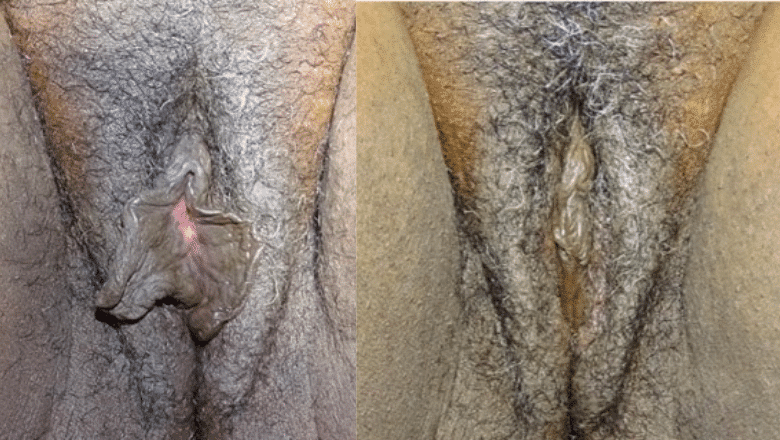
Trim labiaplasty before and after, performed at Centre for Surgery. Individual results vary.
Wedge Labiaplasty: How the Labia Wedge Technique Works
The wedge technique, also called central wedge or V-wedge labiaplasty, removes a triangular, V-shaped section from the widest part of each inner labium. Step by step, a wedge labiaplasty is performed like this:
- The surgeon identifies the point of greatest protrusion, usually in the middle third of the labium.
- A V-shaped wedge is marked, pointing inwards towards the vaginal opening, with its size calculated to bring the remaining labium to the desired width.
- The wedge is removed, taking a full-thickness segment of tissue.
- The upper and lower parts of the labium are brought together and stitched in layers, so that the original edge is preserved above and below a short scar that runs across the labium.
Several variations exist. An extended wedge carries the excision upwards to address excess tissue at the side of the clitoral hood. Modified anterior or posterior wedges place the excision towards the front or back of the labium, depending on where the excess sits, and some surgeons combine a wedge with de-epithelialisation to preserve more of the blood supply[2].
Wedge labiaplasty results
The main appeal of the wedge is that it keeps the natural edge of the labia, with its original colour, texture and wrinkles. The scar runs across the labium rather than along the rim, and once healed it is usually very difficult to see. The wedge suits women whose excess is concentrated in one area and who like the appearance of their edge.
The trade-off is that the wedge depends on the two stitched edges healing together under some tension. If the blood supply is poor or the repair is stressed, the join can separate, leaving a notch or a gap in the labium. A wedge also does less to change a dark or irregular edge, as the edge is mostly kept.
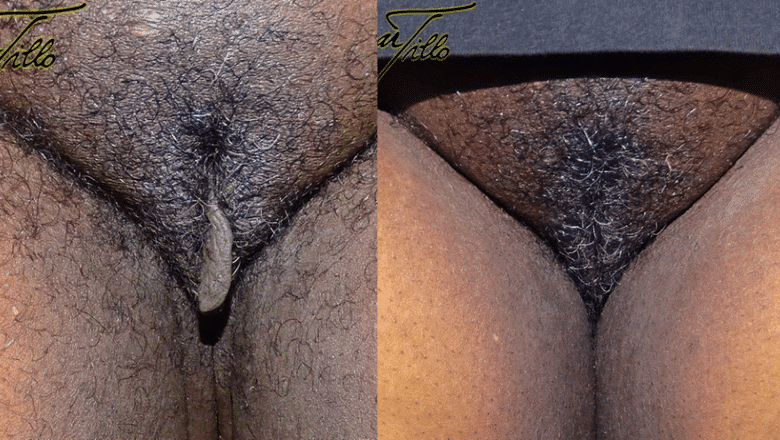
Wedge labiaplasty before and after, performed at Centre for Surgery. Individual results vary.
Trim vs Wedge Labiaplasty Compared
| Trim labiaplasty | Wedge labiaplasty | |
|---|---|---|
| Tissue removed | A strip along the outer edge | A V-shaped section from the middle |
| Natural edge and colour | Removed; edge usually smoother and lighter | Kept; original edge, colour and texture preserved |
| Scar position | Along the rim of the labium | Across the labium, within its folds |
| Best suited to | Excess along the whole length; dark or irregular edges | Excess concentrated in one area; a natural edge you want to keep |
| Main technical risk | Over-resection; a straighter, stiffer edge | Wound separation at the join; a notch |
| Smoking | Increases healing risks | Increases healing risks; many surgeons avoid the wedge in smokers |
Is Wedge or Trim Labiaplasty Safer? What the Evidence Shows
Both techniques are safe in experienced hands, and both are associated with high satisfaction. The difference lies in which complication each is more prone to.
A 2024 meta-analysis in the Aesthetic Surgery Journal ↗ pooled data from 86 studies and found an overall satisfaction rate of 94% across all techniques. Complications were generally rare, but wound dehiscence was notably more frequent after wedge resection, at around 8%. De-epithelialisation had the highest satisfaction, at 97%[3]. An earlier 2022 meta-analysis of 46 studies and 3,804 patients ↗ put the pooled dehiscence rate for wedge resection at 3%, and found that dehiscence and aesthetic concerns were the commonest reasons for revision surgery. Two of the three reported cases of flap necrosis occurred after wedge resection[4].
The two figures differ because the studies, surgeons and definitions differ, and most of the underlying research is observational. Read together, they suggest that a wedge carries a higher risk of wound separation than a trim, but that the absolute risk remains low.
Smoking matters. In a 2025 comparison of 40 women having trim or modified wedge labiaplasty, the only three cases of wound separation were all after wedge resection and all in active smokers[5]. An algorithm published by plastic surgeons in 2023 lists nicotine use among the factors that should steer the choice of technique, alongside the patient’s goals and the edge, texture, pigmentation, symmetry, shape and length of the labia[6]. If you smoke or vape, your surgeon will ask you to stop well before surgery whichever technique is used.
Does the technique affect sensation or sex?
This is one of the commonest worries. A 2025 systematic review of 11 studies found moderate improvements in sexual function and genital self-image after labiaplasty, with no technique clearly superior. One study using formal sensory testing found no reduction in clitoral or labial sensitivity. The evidence is low in certainty, as most studies were small and uncontrolled[7]. In the 2025 comparison above, the trim gave greater improvements in genital self-image and the wedge greater improvements in some sexual function scores[5]. Our article on whether labiaplasty affects sensation covers this in more depth.
De-epithelialisation Labiaplasty
De-epithelialisation, sometimes called central de-epithelialisation, removes only the surface layer of skin from an area on the inner and outer faces of the labium, rather than cutting through its full thickness. The deeper tissue, carrying the blood vessels and nerves, is left in place, and the edges of the treated area are stitched together. This folds and shortens the labium while keeping its natural edge.
Its strengths are preservation of the blood supply and sensation, and a natural edge. In the 2024 meta-analysis it had the highest satisfaction of any technique[3]. Its limitations are that it reduces width less than an excision, and because tissue is folded rather than removed, it can leave the labium thicker. Surgeons who use algorithms to choose between techniques list prevention of this thickening as one of the decisions to make, and de-epithelialisation is often reserved for moderate protrusion or combined with a wedge[2].
Curvilinear and “Barbie” Labiaplasty
These two terms come up often in searches but are descriptions of a result rather than separate operations.
Curvilinear labiaplasty is a contoured trim. Instead of cutting in a straight line, the surgeon follows the natural curve of the labium, often continuing the line up towards the clitoral hood so that the labia and hood are reduced in one smooth contour. It is essentially a refined trim technique with the same strengths and the same risk of over-resection.
“Barbie” labiaplasty is an informal term for removing almost all of the labia minora so that they do not show beyond the outer labia, sometimes described as a “clean” or “tucked” look. Some women request this, and it is a legitimate personal preference. It is worth knowing, though, that the labia minora protect the vaginal opening and urethra, and that very aggressive reduction cannot be reversed. Where too much has been removed, reconstruction is difficult and not always possible. A surgeon should discuss how much tissue can safely be removed for your anatomy, and whether a slightly more conservative result would meet your goals with less risk.
Laser Labiaplasty
Laser labiaplasty uses a laser instead of a scalpel to cut the tissue, usually as a trim. It is a cutting tool rather than a different technique, and it is not something Centre for Surgery offers. The evidence is mixed: the 2024 meta-analysis found that scalpel surgery had more bleeding, swelling and haematoma than laser[3], while the 2022 meta-analysis found the highest dehiscence rate after laser-assisted labiaplasty, at 5%[4]. Neither finding is strong enough to make one tool clearly better. What matters far more is the planning of the excision and the skill of the closure. If you are offered laser labiaplasty elsewhere, ask which technique the laser is being used for.
Which Type of Labiaplasty Is Right for Me?
The best labiaplasty technique is the one that fits your anatomy, your goals and your health, performed by a surgeon who is comfortable with it. At your consultation, the surgeon will examine you lying down and, where helpful, standing, and talk through:
- Where the excess is: along the whole length, or concentrated in one area.
- The edge: whether you want to keep its natural colour and texture, or would prefer a smoother, lighter edge.
- Symmetry: whether one side is longer than the other. Our article on labia asymmetry explains the options.
- The clitoral hood: whether there is excess hood or side-wall tissue that should be reduced at the same time.
- The outer labia: whether they are enlarged, or have lost volume and need a different approach, as covered in our guide to labia majora reduction.
- Smoking and health: smoking, vaping and some medical conditions make wound separation more likely, especially after a wedge.
As a broad guide, a trim may suit you if your labia are long along their full length or you would like a darker edge removed. A wedge may suit you if the excess is mostly in the middle, your edge is something you want to keep, and you do not smoke. Some patients are best served by a combination. If your labia cause rubbing or pain, our article on labial hypertrophy explains the functional side of the decision.
Recovery After Trim and Wedge Labiaplasty

Recovery is broadly the same after trim and wedge labiaplasty. Swelling peaks at around three to five days, most bruising has gone by two weeks, and the dissolvable stitches absorb over three to four weeks. Many people return to desk-based work within a week. For six weeks you should avoid strenuous exercise, cycling, swimming, baths, tampons and sex, and the final result is usually visible at around three months.
After a wedge, protecting the join matters a little more. Avoiding pressure and friction, keeping the area clean and dry, and not smoking give the repair its best chance of healing in one line. Our guides to labiaplasty recovery, labiaplasty stitches and reducing labiaplasty swelling go through each stage. If a wound does separate, it often heals well on its own; where it leaves a notch, correction is usually considered after six months, as explained in our article on revision labiaplasty.
Labiaplasty Techniques at Centre for Surgery
Labiaplasty at Centre for Surgery is performed by GMC-registered surgeons at our CQC-regulated hospital at 95–97 Baker Street, using the trim or wedge technique, or a combination, depending on your anatomy and goals. The surgeon who assesses you is the surgeon who performs your operation, and they will explain why they recommend a particular technique for you rather than offering one approach to everyone.
Straightforward labia minora reductions are performed under local anaesthetic with sedation; combined procedures and reconstruction are performed under TIVA (total intravenous anaesthesia). Our labiaplasty nursing team is all-female, we treat adults aged 18 and over, and we recommend a two-week cooling-off period between consent and surgery. Aftercare includes your surgeon’s direct number for the first 24 hours, a nurse wound check at 7 to 10 days and a surgeon review at 6 weeks. The questions to ask a labiaplasty surgeon are worth taking to your consultation.
Frequently Asked Questions
What is the trim technique used in labiaplasty?
The trim technique removes a strip of tissue along the outer edge of each inner labium and stitches the new edge with fine dissolvable sutures. It reduces length along the whole labium and removes any darker or irregular border. It is the most commonly performed type of labiaplasty, and its main risk is removing too much tissue if the labia are stretched while they are marked or cut.
What are the results of a wedge labiaplasty?
A wedge labiaplasty reduces the width of the labia while keeping the natural edge, colour and texture. The scar runs across the labium and is usually hard to see once healed. The main risk is the join separating, which happens in a small minority of cases and is more likely in smokers.
Can you explain step by step how a wedge labiaplasty is performed?
Under local anaesthetic with sedation or TIVA, the surgeon marks a V-shaped wedge at the widest part of each inner labium, removes it, and stitches the upper and lower parts together in layers with dissolvable sutures. The natural edge is preserved above and below the join. The operation usually takes one to two hours for both sides, and you go home the same day.
Which is better, trim or wedge labiaplasty?
Neither is better for everyone. A trim suits long labia and darker edges; a wedge suits excess concentrated in one area when you want to keep your natural edge. Satisfaction is high with both. Wound separation is more often reported after a wedge, so smokers are usually steered towards a trim.
What are the different types of labiaplasty?
The main labiaplasty techniques are the trim (edge resection), the wedge (central V-wedge and its extended or modified versions), de-epithelialisation, W-plasty, composite reduction and laser excision. Curvilinear and “Barbie” labiaplasty describe variations of the trim. Labia majora reduction and clitoral hood reduction are separate procedures often combined with labia minora reduction.
How long until labiaplasty looks normal?
Most swelling settles over the first six weeks, and the labia usually look settled at around three months. In the first fortnight the area is swollen, bruised and often uneven, which is normal and not a sign of a poor result. Scars continue to soften for several months after that.
What can go wrong during a labiaplasty?
The main risks are bleeding or a haematoma, infection, wound separation, asymmetry, over- or under-correction, scarring and altered sensation. Most are uncommon and many settle with simple care, but removing too much tissue is difficult to correct. Choosing an experienced surgeon and following aftercare advice reduce these risks.
Do I need anaesthesia for labiaplasty?
Yes. Most straightforward labiaplasties at Centre for Surgery are performed under local anaesthetic with sedation, so the area is completely numb and you are relaxed but awake. TIVA, where you are asleep, is used for combined and complex cases, or where you would prefer it. Your surgeon and anaesthetist will discuss which suits you at your consultation.
Labiaplasty in London
If you are weighing up trim vs wedge labiaplasty, a consultation is the best way to find out which technique suits your anatomy. Your surgeon will examine you, explain the options and their risks, and confirm a written quote before you decide.
Phone: 020 7993 4849 | Address: 95–97 Baker Street, Marylebone, London W1U 6RN
Contact us to schedule a consultation
References
- Oranges CM, Sisti A, Sisti G. Labia minora reduction techniques: a comprehensive literature review. Aesthetic Surgery Journal 2015;35(4):419–431. doi:10.1093/asj/sjv023 ↗
- Lange M, Hage JJ, Karim RB, Amant F. An algorithm for labia minora reduction based on a review of anatomical, configurational, and individual considerations. Archives of Plastic Surgery 2023;50(1):17–25. doi:10.1055/a-1938-0991 ↗
- Géczi AM, Varga T, Vajna R, et al. Comprehensive assessment of labiaplasty techniques and tools, satisfaction rates, and risk factors: a systematic review and meta-analysis. Aesthetic Surgery Journal 2024;44(11):NP798–NP808. doi:10.1093/asj/sjae143 ↗
- Escandón JM, Duarte-Bateman D, Bustos VP, et al. Maximizing safety and optimizing outcomes of labiaplasty: a systematic review and meta-analysis. Plastic and Reconstructive Surgery 2022;150(4):776e–788e. doi:10.1097/PRS.0000000000009552 ↗
- Ucar E, Bestel M, Ucar BH, Dogan O. The effect of technique selection in labiaplasty surgery: analysis of aesthetic and functional outcomes. Journal of Clinical Medicine 2025;14(24):8923. doi:10.3390/jcm14248923 ↗
- Zahedi S, Bhat D, Pedreira R, Canales FL, Furnas HJ. Algorithm for trim and wedge labiaplasties. Aesthetic Surgery Journal 2023;43(6):685–692. doi:10.1093/asj/sjad033 ↗
- Zulfikaroglu E, Kurban D. Sexual function after female genital cosmetic surgery: a systematic review and meta-analysis. European Journal of Obstetrics, Gynecology, and Reproductive Biology 2025;318:114894. doi:10.1016/j.ejogrb.2025.114894 ↗







