



In this guide10 sections
- Key Points
- Who Performs Labiaplasty in the UK?
- How to Choose a Labiaplasty Surgeon: A Practical Checklist
- Questions to Ask a Labiaplasty Surgeon
- Red Flags When Choosing a Labiaplasty Clinic
- How to Compare Labiaplasty Clinics Before Booking
- Choosing Labiaplasty at Centre for Surgery
- Frequently Asked Questions
- Finding a Labiaplasty Surgeon in London
- References
Key Points
- Who is the best labiaplasty surgeon in the UK? There is no independent ranking. The best surgeon for you is one whose registration, training and experience you can verify, who operates in a regulated hospital and who examines you before recommending anything.
- Check the GMC register: any doctor can legally perform labiaplasty in the UK, and “cosmetic surgeon” is not a protected title. The GMC register shows whether a doctor is licensed, whether they hold specialist registration and in which specialty.
- Check the hospital with the CQC: every independent hospital or clinic providing cosmetic surgery in England must be registered with the Care Quality Commission.
- Check professional memberships: BAAPS and BAPRAS keep public member registers, although some well-qualified surgeons are not members.
- Meet the operating surgeon: the person you consult should be the person who operates, and should explain which technique they recommend for you and why.
- Red flags: guaranteed results, time-limited discounts, no examination before booking, vague answers about aftercare, or surgery offered to under-18s.
How do you choose the best labiaplasty surgeon? Most women start by searching for the “best labiaplasty surgeon UK” or “top labiaplasty surgeons” and quickly find lists, directories and adverts that all claim to be the best. None of them can tell you whether a particular surgeon is right for you. What can tell you is a set of checks you can carry out yourself, and a consultation in which you ask the right questions. Labiaplasty is a delicate operation on a sensitive area, and choosing well is the single most effective way to avoid problems.
This guide gives you a practical checklist: how to verify a surgeon’s registration, how to check the hospital, what to ask at consultation, how to read labiaplasty before and after photos, and the red flags that should make you pause. If you are also comparing prices, our labiaplasty cost guide explains what a fair quote should include.
Who Performs Labiaplasty in the UK?
In the UK, labiaplasty is performed by plastic surgeons, gynaecologists and doctors who describe themselves as cosmetic surgeons. Plastic surgeons are trained in handling delicate tissue, reshaping and reconstruction, including surgery on the external genitalia. Gynaecologists are trained in the anatomy and surgery of the vulva and vagina. Either can be an excellent labiaplasty surgeon, and either can be inexperienced. What matters most is training and experience in this specific operation, and whether the surgeon works within a regulated hospital with proper aftercare.
The important point is that the law sets a low bar. Any doctor on the medical register can perform cosmetic surgery in the UK, and “cosmetic surgeon” is not a protected title. That makes your own checks essential.
A 2022 meta-analysis of 46 labiaplasty studies ↗ found high satisfaction overall, but its authors were clear that serious complications requiring surgery do occur, and that surgical experience, knowledge of female genital anatomy and careful selection of technique for each patient are essential[1]. Those three things are exactly what you are trying to assess when you choose a surgeon.
How to Choose a Labiaplasty Surgeon: A Practical Checklist
1. Check the surgeon on the GMC register
Search the surgeon’s name on the GMC medical register ↗. Check that they hold a licence to practise, whether they have any conditions or warnings on their registration, and whether they hold specialist registration and in which specialty. The NHS advises checking a surgeon’s registration before any cosmetic procedure. Specialist registration is not the only marker of competence, but it tells you what the surgeon has been formally trained in, and it is reasonable to ask a surgeon to explain their training if it is not shown.
2. Check the hospital is CQC-registered
Every independent hospital or clinic that provides cosmetic surgery in England must be registered with the Care Quality Commission. Search the hospital on the CQC website ↗ (this link shows our own Baker Street registration), check that it is registered for surgical procedures, and read its most recent inspection rating and report. A regulated hospital has to meet standards for infection control, resuscitation equipment, staffing and record keeping. Our CQC rating page explains what the ratings mean.
3. Check professional memberships
The British Association of Aesthetic Plastic Surgeons and the British Association of Plastic, Reconstructive and Aesthetic Surgeons keep searchable member lists: BAAPS ↗ and BAPRAS ↗. Gynaecologists may instead belong to the Royal College of Obstetricians and Gynaecologists. Membership shows a commitment to professional standards and audit, but some experienced, well-qualified surgeons choose not to join, so treat membership as one piece of evidence rather than the whole picture.
4. Ask about labiaplasty experience specifically
General surgical experience is not the same as experience in labiaplasty. Ask how many labiaplasties the surgeon performs each year, which techniques they use, how often their patients need a revision, and whether they also correct other surgeons’ results. A surgeon who performs revision surgery understands how primary labiaplasty goes wrong, which is useful knowledge. Our article on botched labiaplasty and revision explains the problems you are trying to avoid.
5. Meet the surgeon who will operate
The NHS recommends always meeting the surgeon before the procedure. Be cautious if your first appointment is with a sales adviser or nurse and you will meet the surgeon only on the day of surgery. The surgeon you consult should be the surgeon who operates, should examine you in person, and should give you time to ask questions without pressure. For an intimate examination, you can ask for a chaperone to be present.
6. Ask which technique they recommend, and why
There is more than one way to perform labiaplasty. The trim removes the outer edge of the labia; the wedge removes a V-shaped section from the middle and keeps the natural edge. Each suits different anatomy, and a published algorithm for choosing between them considers the patient’s goals, smoking, and the edge, texture, colour, symmetry, shape and length of the labia[2]. The same authors note that the best technique is always one the surgeon performs comfortably and safely. A good surgeon will explain their reasoning for your anatomy, and will tell you if a technique they do not use would suit you better. See our guide to trim vs wedge labiaplasty.
7. Look at before and after photos, critically
Before and after photographs show you a surgeon’s style and the kinds of result they aim for. They are useful, but they are a selected set, and they cannot show you complication rates or what happens in difficult cases. When you look at them, check that the photos are of the surgeon’s own patients, that the before and after images are taken in the same position and lighting, that there are cases similar to yours, and that both trim and wedge results are shown if the surgeon offers both.
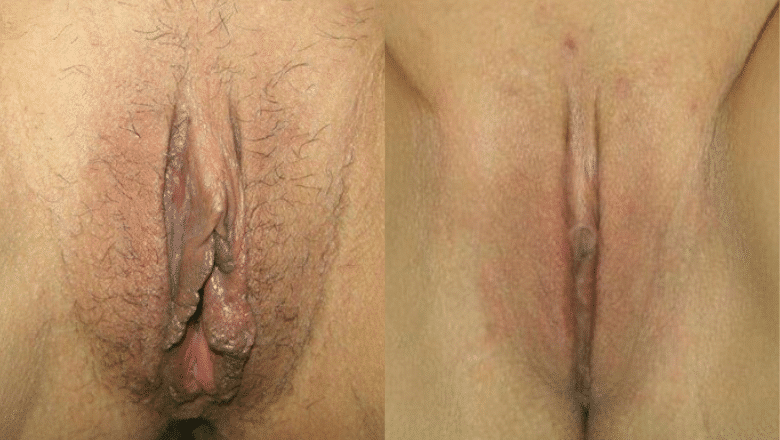
Labia minora reduction before and after, performed at Centre for Surgery. Individual results vary.
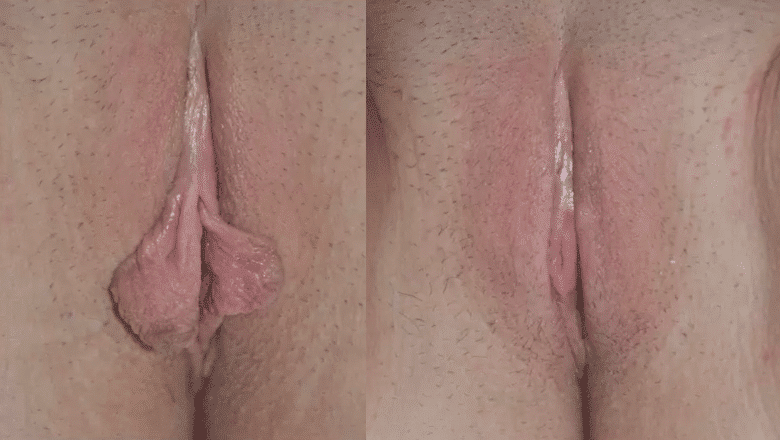
Labiaplasty before and after, performed at Centre for Surgery. Individual results vary.
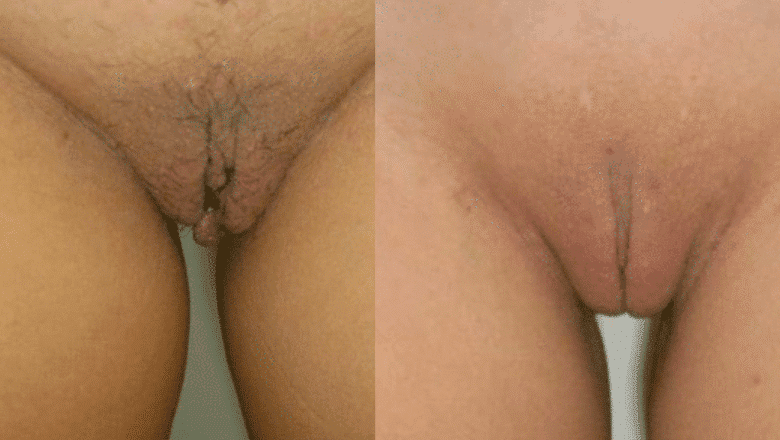
Labiaplasty with clitoral hood reduction before and after, performed at Centre for Surgery. Individual results vary.
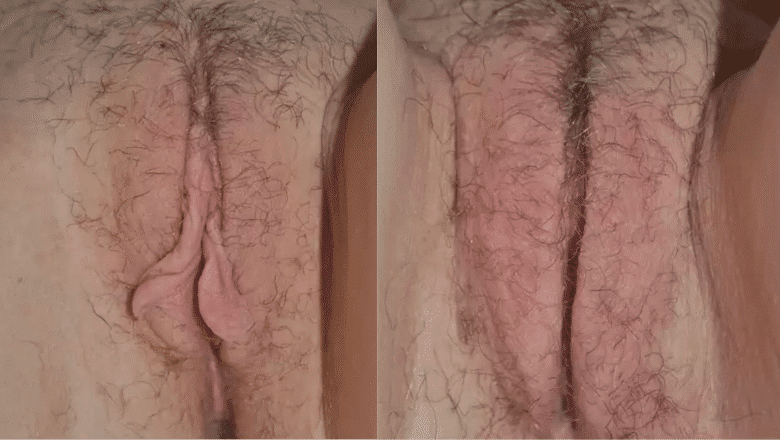
Labiaplasty before and after, performed at Centre for Surgery. Individual results vary.
Remember, too, that almost every “before” photo in any gallery shows normal anatomy. A London study measuring the genitals of 50 women found a wide range of labial sizes and shapes, unrelated to age, childbirth or ethnicity[3]. Our guide to labia shapes shows the normal range.
8. Expect questions about why you want surgery
A careful surgeon will ask why you want labiaplasty, how long you have felt this way, and what you hope will change. This is not intrusive; it is good practice. A controlled study in Psychological Medicine ↗ found that 10 of 55 women seeking labiaplasty met the criteria for body dysmorphic disorder, a condition in which surgery rarely relieves distress[4]. A surgeon who never asks about your motivation, or who agrees to everything you request without discussion, is not protecting you.
9. Ask exactly what aftercare is included
Labiaplasty heals over weeks to months. Ask who you contact out of hours in the first few days, when your wound will be checked and by whom, when you will see the surgeon again, and what happens if the wound opens or the result is uneven. Ask whether revision surgery is charged and on what terms. Our labiaplasty recovery guide shows what normal healing looks like at each stage.
10. Get a written, itemised quote and time to think
A reputable provider will give you a written quote showing what is and is not included, and will encourage you to take time before committing. We recommend a two-week cooling-off period between consent and surgery. If a clinic pushes you to book quickly, ask why.
Questions to Ask a Labiaplasty Surgeon
Take this list to your consultation. The first six are based on NHS advice for anyone considering labiaplasty.
- What are your qualifications, and what is your specialist training?
- Are you a member of any professional associations?
- How many labiaplasty operations have you performed?
- How many of your patients have had complications, and what were they?
- What follow-up should I expect, and what happens if things go wrong?
- What are your patient satisfaction rates?
- Which technique do you recommend for me, and why?
- How much tissue do you plan to remove, and how much will you leave?
- Do I need anything else addressed, such as the clitoral hood or outer labia?
- Which anaesthetic will I have, and who gives it?
- Will you personally perform my surgery and see me afterwards?
The NHS labiaplasty guide ↗ and the Royal College of Surgeons cosmetic surgery advice ↗ are both worth reading before your appointment.
Red Flags When Choosing a Labiaplasty Clinic
Be cautious about any provider that:
- Guarantees a result, or shows only flawless photographs with no discussion of risk.
- Offers time-limited discounts or pressures you to pay a deposit at the first appointment.
- Books surgery without an in-person examination, or lets you meet the surgeon only on the day.
- Is vague about who will operate, or about the surgeon’s registration and training.
- Cannot tell you who to call if you are worried at night in the first week.
- Offers labiaplasty to under-18s for cosmetic reasons. The labia continue to develop through puberty, and we do not perform labiaplasty before 18; see our guide to the minimum age for labiaplasty.
- Uses emotive marketing about “mutilated” or “botched” results without explaining risks. A study of websites advertising revision labiaplasty found that none provided outcome data and only two mentioned risks[5].
- Sells overseas packages with no local follow-up. A systematic review of 589 patients treated for complications after cosmetic surgery abroad found infection and wound breakdown were the commonest problems[6].
How to Compare Labiaplasty Clinics Before Booking
Once you have a shortlist, compare clinics on the same terms. Use the checklist above for each surgeon and hospital, then compare written quotes line by line: consultations, the anaesthetic, theatre fees, follow-up appointments, out-of-hours support and revision terms. A lower price that leaves out aftercare is not a saving.
Reviews are helpful when they come from verified platforms and describe the whole experience, including aftercare. Read the less positive reviews as well as the best ones, and look at how the clinic responds. Be wary of rankings and “top 10” lists: many are paid placements or directories, and the NHS warns that some clinics pay to advertise in search listings. If you want to see an example of how a hospital reports its own results, our clinical outcomes and patient safety page sets out ours.
Choosing Labiaplasty at Centre for Surgery
We would encourage you to apply every check in this guide to us, as well as to anyone else you are considering.
- GMC-registered surgeons: every labiaplasty at Centre for Surgery is performed by a GMC-registered surgeon, and you can look up your surgeon on the GMC register before you book.
- A CQC-regulated hospital: we are a private hospital at 95–97 Baker Street, regulated by the Care Quality Commission.
- The surgeon who assesses you operates: there are no sales intermediaries, and your surgeon explains which technique they recommend for your anatomy and why.
- Anaesthesia to suit the operation: straightforward cases under local anaesthetic with sedation, and combined or reconstructive cases under TIVA (total intravenous anaesthesia) with a consultant anaesthetist.
- An all-female labiaplasty nursing team and private, unhurried consultations.
- Adults only, with time to think: labiaplasty from age 18, and a recommended two-week cooling-off period.
- Structured aftercare: your surgeon’s direct number for the first 24 hours, nursing contact over two weeks, a wound check at 7 to 10 days and a surgeon review at 6 weeks.
- Published prices and an itemised written quote, with the consultation fee redeemable against surgery.
You can read what patients say on our patient reviews page, which brings together reviews from Google and Trustpilot.
Frequently Asked Questions
How do I choose a trusted labiaplasty specialist?
Check the surgeon on the GMC register for a licence to practise and their specialist training, check the hospital is registered with the CQC, look for professional memberships such as BAAPS or BAPRAS, and ask how many labiaplasties they perform. Then meet them in person: a trustworthy surgeon examines you, explains their recommended technique and its risks, and never rushes you.
Are before-and-after photos a reliable way to choose a labiaplasty clinic?
They are useful but not enough on their own. They show a surgeon’s style, but they are selected and cannot show complication rates. Check the photos are the surgeon’s own patients, taken in the same position and lighting, and include cases like yours. Combine them with registration checks, reviews and a consultation.
How can I compare labiaplasty clinics before booking?
Use the same checklist for each: surgeon registration and experience, CQC registration and rating, who you meet before surgery, the techniques offered, and what aftercare is included. Compare written quotes line by line, including the anaesthetic, follow-up and revision terms, rather than headline prices.
Who performs labiaplasty?
Labiaplasty in the UK is performed by plastic surgeons, gynaecologists and doctors working as cosmetic surgeons. Any doctor on the medical register can legally perform it, so it is worth checking a surgeon’s registration, specialist training and experience in labiaplasty specifically.
How risky is labiaplasty surgery?
Labiaplasty is generally a low-risk day-case procedure, and published studies report high satisfaction. The main risks are bleeding, haematoma, infection, wound separation, asymmetry, scarring and altered sensation. Removing too much tissue is the hardest problem to correct, which is why the surgeon’s experience matters so much.
What age is best for labiaplasty?
There is no single best age, but there is a firm minimum. We perform labiaplasty on adults aged 18 and over only, because the labia continue to develop through puberty. Beyond that, suitability depends on your health, anatomy, expectations and whether you plan more children.
Can I have labiaplasty on the NHS?
Rarely. The NHS does not fund labiaplasty for cosmetic reasons, though it may be offered for abnormal anatomy, repair after childbirth or vulval disease. Your GP is the starting point, and our guide to labiaplasty on the NHS explains the criteria.
Is a labiaplasty a major surgery?
Labiaplasty is not usually considered major surgery. It is a day-case operation, usually under local anaesthetic with sedation, taking one to two hours. It is still surgery, with real risks and six weeks of restrictions on exercise, tampons and sex, and someone needs to take you home and stay with you for the first 24 hours.
Can you tell if someone has had labiaplasty?
Once healed, a well-performed labiaplasty is usually hard to detect. A wedge scar runs across the labium within its folds, and a trim leaves a smooth edge that may be lighter in colour than before. An experienced surgeon aims for a natural-looking result rather than an obviously operated appearance.
Finding a Labiaplasty Surgeon in London
If you would like to meet a surgeon, ask your questions and be examined without any obligation to book, arrange a consultation at our Baker Street hospital. You will receive an honest recommendation and a written quote before you decide.
Phone: 020 7993 4849 | Address: 95–97 Baker Street, Marylebone, London W1U 6RN
Contact us to schedule a consultation
References
- Escandón JM, Duarte-Bateman D, Bustos VP, et al. Maximizing safety and optimizing outcomes of labiaplasty: a systematic review and meta-analysis. Plastic and Reconstructive Surgery 2022;150(4):776e–788e. doi:10.1097/PRS.0000000000009552 ↗
- Zahedi S, Bhat D, Pedreira R, Canales FL, Furnas HJ. Algorithm for trim and wedge labiaplasties. Aesthetic Surgery Journal 2023;43(6):685–692. doi:10.1093/asj/sjad033 ↗
- Lloyd J, Crouch NS, Minto CL, Liao LM, Creighton SM. Female genital appearance: “normality” unfolds. BJOG: An International Journal of Obstetrics and Gynaecology 2005;112(5):643–646. doi:10.1111/j.1471-0528.2004.00517.x ↗
- Veale D, Eshkevari E, Ellison N, et al. Psychological characteristics and motivation of women seeking labiaplasty. Psychological Medicine 2014;44(3):555–566. doi:10.1017/S0033291713001025 ↗
- Learner HI, Rundell C, Liao LM, Creighton SM. ‘Botched labiaplasty’: a content analysis of online advertising for revision labiaplasty. Journal of Obstetrics and Gynaecology 2020;40(7):1000–1005. doi:10.1080/01443615.2019.1679732 ↗
- Alkaelani MT, Koussayer B, Blount T, et al. Complications of medical tourism in aesthetic surgery: a systematic review. Annals of Plastic Surgery 2023;91(6):668–673. doi:10.1097/SAP.0000000000003683 ↗







