


In this guide14 sections
- Key Points
- Why Do Breasts Sag?
- What Causes Saggy Boobs? What the Evidence Shows
- Why Are My Boobs Saggy at a Young Age?
- What Do Saggy Breasts Look Like? How Sagging Is Graded
- Are Saggy Breasts a Sign of Cancer?
- How to Prevent Saggy Breasts
- Best Bra for Saggy Breasts: What to Look For
- Can Exercise Fix Saggy Breasts?
- Can Saggy Breasts Go Back to Normal Without Surgery?
- How to Fix Saggy Breasts
- Breast Lift Surgery at Centre for Surgery
- Frequently Asked Questions About Saggy Boobs
- References
Key Points
- Saggy boobs are normal. Sagging, medically called breast ptosis, happens when the skin and the Cooper’s ligaments that hold the breast up stretch, and the breast tissue and nipple drop lower on the chest. Almost every woman sees some degree of it with time.
- Six things are proven to make it worse. In a study of 132 women, age, the number of pregnancies, smoking, a higher BMI, a larger bra cup size and losing more than about 23 kg (50 lb) were all independent risk factors for sagging.
- Breastfeeding is not to blame. Two studies from the same research group found that breastfeeding was not a risk factor once age, weight and the number of pregnancies were taken into account. Pregnancy itself is what changes the breast.
- Prevention slows sagging but can’t stop it. A stable weight, not smoking and a supportive sports bra for high-impact exercise all help. Creams, oils and chest exercises cannot lift breast tissue.
- Gradual sagging is not a sign of cancer. A new change in the size or shape of one breast, a lump, a nipple that turns inward or dimpled skin is different, and needs a GP appointment.
- Surgery is the only fix for established sagging. A breast lift repositions the breast and nipple; implants suit mild sagging with lost volume; a lift with implants treats both; and a breast reduction lifts large, heavy breasts as it reduces them.
Saggy boobs are one of the most common reasons women come to see us, and one of the most misunderstood. Search online and you’ll be told that bras, push-ups, creams and even sleeping positions decide whether your breasts sag. The research says something much simpler: sagging is driven mainly by age, pregnancy, weight change, smoking and the size and weight of the breast, and most of the popular fixes do nothing to the tissue that has actually stretched.
This guide explains why breasts sag, what the evidence says causes it, what you can realistically do to slow it down, how to choose a bra for saggy breasts, and when a breast lift or another operation is the right answer. If your breasts changed after a specific event, our guides to sagging breasts after breastfeeding, sagging breasts after weight loss and how breasts change with age go into more depth, and our guide to breast ptosis covers the clinical grades in detail.
Why Do Breasts Sag?

A breast contains no muscle. It is made of glandular tissue and fat, wrapped in skin and held in shape by a web of connective tissue that sits on top of the pectoral muscle. The best-known part of that web is the Cooper’s ligaments: fine fibrous bands that run through the breast and attach to the underside of the skin. Cadaver dissections by Rehnke and colleagues showed that the system is more elaborate than a handful of ligaments. The breast sits inside a closed, three-dimensional envelope of fascia and fat, anchored to the skin by the Cooper’s ligaments and to the chest wall around its edge.
Sagging happens when that support system stretches. Each time the breast gets bigger, during puberty, pregnancy or weight gain, the skin and ligaments stretch to accommodate it. When the breast gets smaller again, after breastfeeding, weight loss or menopause, they don’t fully spring back. Skin also loses collagen and elastin with age and with smoking, so it becomes less able to hold the weight it carries. The result is breast tissue sliding down inside a looser skin envelope: the lower half becomes fuller, the upper half empties, and the nipple drops and starts to point down.
That is why sagging is a problem of skin and support rather than of the breast tissue itself, and why the treatments that work remove stretched skin rather than trying to tone the breast. Our guide to breast anatomy explains the structures in more detail.
What Causes Saggy Boobs? What the Evidence Shows

The most useful research on the causes of breast sagging comes from Rinker and colleagues at the University of Kentucky. They reviewed 132 women who came for breast augmentation or a breast lift, graded how far each woman’s breasts had dropped from standardised photographs, and used statistical modelling to find which factors independently predicted it. Six did: age, a history of losing more than about 23 kg (50 lb), a higher BMI, a larger bra cup size, the number of pregnancies, and smoking.
Just as useful is what didn’t make the list. Breastfeeding, the amount of weight gained during pregnancy and not doing regular upper-body exercise were not risk factors. The main causes are set out below.
Age and menopause
Age is the one factor nobody escapes. Skin makes less collagen and elastin every decade, so it slowly loses its ability to hold the breast in position. Around menopause, falling oestrogen means dense glandular tissue is gradually replaced by softer fat, which is less firm and more easily pulled down by gravity. Our guide to how ageing affects breast shape and size covers these changes stage by stage.
Pregnancy, and why breastfeeding isn’t to blame
Pregnancy is one of the biggest single causes of sagging. In Rinker’s study, 85% of women who had been pregnant reported an adverse change in breast shape afterwards; 35% said their breasts ended up smaller and 30% larger. The risk rises with each pregnancy, because the breast enlarges and then shrinks again every time.
Breastfeeding usually gets the blame, but the evidence doesn’t support it. An earlier study from the same group looked at 93 women who had had children and found that greater age, higher BMI, more pregnancies, a larger bra size before pregnancy and smoking all predicted sagging, while breastfeeding did not. The hormonal changes of pregnancy happen whether or not you go on to breastfeed. Our guide to sagging breasts after breastfeeding explains what happens to the breast after weaning and when it has settled enough to treat.
Weight loss and weight fluctuation
Breasts are partly fat, so they shrink when you lose weight, but the skin envelope doesn’t shrink at the same rate. Large or rapid losses, including after weight-loss surgery or on weight-loss injections, leave the most loose skin behind. A higher BMI is also a risk factor in its own right, because a heavier breast puts more strain on the skin and ligaments. See our guides to sagging breasts after weight loss and, where the main change is lost fullness rather than position, deflated breasts.
Smoking
Smoking was an independent risk factor in both of Rinker’s studies. Tobacco breaks down collagen and elastin and reduces blood flow to the skin, so the skin of the breast ages faster and supports the breast less well. Stopping smoking is also a requirement before any breast surgery: we ask patients to stop at least four weeks before and four weeks after an operation.
Breast size and genetics
Larger, heavier breasts put more load on their supporting tissues, which is why a bigger cup size was a risk factor. Skin quality and the natural shape of the breast are also inherited, so if your mother’s or sister’s breasts sagged early, yours are more likely to as well. Very large breasts that sag and cause neck, shoulder or back pain are covered in our guide to large, heavy breasts.
Why Are My Boobs Saggy at a Young Age?
Sagging in your twenties is more common than most women think, and it is rarely a sign that anything is wrong. The usual causes are the same as at any age, just arriving earlier:
- Genetics and skin quality. Some women simply have more elastic skin and weaker supporting tissue from the start.
- Breast size. Larger breasts carry more weight from the moment they develop.
- Weight changes. Gaining and losing weight through the teens and twenties stretches the skin repeatedly.
- An early pregnancy. Pregnancy changes breast shape at any age.
- Breast shape. Some naturally long or wide-set breasts look lower on the chest without the nipple actually having dropped. A tuberous breast, where a tight band at the base stops the breast developing normally, can look droopy with a nipple that sits low or points down; our tuberous breasts guide explains how to recognise it.
Our guide to the different breast shapes shows how much normal variation there is. If your breasts bother you and you are under 18, the right first step is a conversation with your GP; no reputable surgeon performs a cosmetic breast lift before 18, and our guide to the minimum age for a breast lift explains why it is usually worth waiting until the breasts have stopped changing.
What Do Saggy Breasts Look Like? How Sagging Is Graded
Droopy breasts or hanging boobs usually show some combination of the following:
- The nipple sits at or below the crease under the breast, the inframammary fold
- The nipple points down towards the floor rather than forward
- The upper part of the breast looks flat or empty, with most of the fullness in the lower half
- The lower part of the breast hangs over the crease, and the skin there touches the chest wall
Surgeons still use the classification described by the French plastic surgeon Paule Regnault in 1976, which grades true ptosis by where the nipple sits in relation to the breast crease. In mild sagging the nipple sits at the level of the crease; in moderate sagging it sits below the crease but above the lowest point of the breast; and in severe sagging it sits at the lowest point of the breast and points down. Some surgeons describe a further grade for the most extreme cases. Regnault also described pseudoptosis, where the nipple stays at or above the crease but the breast tissue below it has dropped. This is common in smaller breasts and after implants are removed.
The grade matters because it decides which operation will work. Our guide to breast ptosis explains each grade with diagrams, and at consultation your surgeon will measure the distance from your nipple to the crease and to the notch at the base of your neck on both sides, because many women sag more on one side than the other.
Are Saggy Breasts a Sign of Cancer?
No. Sagging that develops gradually in both breasts over months and years is a normal change in shape, not a symptom of disease. What does need checking is change that is new, recent or one-sided. The NHS advises seeing a GP if you notice:
- A change in the size or shape of one breast that has developed over weeks or months
- A new lump or area of thickening in the breast or armpit
- Discharge from a nipple, or a nipple that has recently turned inward
- Dimpling, puckering, redness or a rash on the skin of the breast
- Pain in one breast or armpit that doesn’t go away
Most of these turn out to be benign, but they need a clinical examination first. We will not plan cosmetic breast surgery on a breast that has an unexplained new change. If one breast has always sat lower than the other, that is a different and very common situation, covered in our guide to uneven breasts.
How to Prevent Saggy Breasts
Breast sagging can’t be prevented entirely. Ageing, genetics and pregnancy affect almost every woman to some degree, and no cream, supplement or exercise can stop the skin and ligaments stretching over time. What you can influence is how early and how far it progresses. The steps that genuinely help to avoid or reduce saggy breasts are:
- Keep your weight stable. Each cycle of weight gain and loss stretches the breast skin, and it doesn’t fully contract afterwards. If you’re losing a lot of weight, losing it gradually gives the skin more time to adapt.
- Don’t smoke. Smoking was an independent risk factor for sagging in both of the major studies on the subject.
- Wear a well-fitted sports bra for high-impact exercise. Running and jumping move the breasts considerably, and good support reduces that movement.
- Protect your chest from the sun. UV damage ages the skin of the décolletage and upper breast.
- Look after your posture. Rounded shoulders make the breasts sit lower and look flatter at the top.
Creams and oils marketed as firming or collagen-boosting can’t reach the ligaments that hold the breast up, so they won’t prevent or reverse sagging.
Does wearing a bra prevent sagging?
There is no good evidence either way that wearing or not wearing a bra day to day changes how much your breasts sag over the long term. Many women never wear one and don’t develop marked sagging; many who always do, still do. The case for support during exercise is stronger. In a study at the University of Portsmouth, Scurr and colleagues tracked women’s breast movement while they ran and found that a sports bra significantly reduced how far and how fast the breasts moved compared with an everyday bra or no bra. No study has followed women for decades to prove that this prevents sagging, but reducing repeated bouncing on the supporting tissues is a sensible precaution, and it makes exercise more comfortable.
Best Bra for Saggy Breasts: What to Look For
A bra can’t change the breast, but the right one makes a real difference to shape under clothes and to comfort. When you’re choosing a bra for saggy breasts, look for:
- A firm, level band. Most of a bra’s support comes from the band, not the straps. It should sit horizontally and stay put when you lift your arms. If it rides up at the back, it is too loose.
- Full-cup or balconette cups with side support. Cups that sit well under and around the breast, ideally with side panels or side slings, lift the tissue up and forward rather than letting it spread.
- Underwires that sit in the crease. A wire that rests on breast tissue rather than beneath it is the wrong size. Many women with lower breasts find a well-fitted underwired bra lifts better than a soft one.
- Wide, comfortable straps. They spread the load and stop digging, especially with fuller breasts.
- Moulded or spacer cups. They give a smoother, rounder outline under fitted clothes.
- An encapsulation sports bra for exercise. Styles with separate cups support each breast individually, rather than just flattening them.
- A longline band for strapless styles. With a lower or heavier breast, a strapless bra needs a deep band and a silicone grip to stay in place.
Get measured properly, and get measured again after a pregnancy, a big change in weight or around menopause, because size and shape change and many women keep buying the size they used to be.
Can Exercise Fix Saggy Breasts?
No, although it can help the way your chest looks. Push-ups, chest presses, dumbbell flyes and pullovers build the pectoral muscle, which sits behind the breast. A stronger, fuller muscle can add a little shape to the upper chest and improve your posture, which makes the breasts sit slightly higher. It can’t shorten stretched ligaments or tighten loose skin, and Rinker’s study found that women who didn’t do regular upper-body exercise were no more likely to have sagging breasts than women who did. Exercise is worth doing for its own sake. Our guides to how to get perky breasts and how to get firmer breasts cover the non-surgical options in more detail.
Can Saggy Breasts Go Back to Normal Without Surgery?
Once the skin and ligaments have stretched, they don’t tighten back up on their own, and nothing applied to the skin can reposition the breast. That leaves a few honest options:
- Bras, lifting tape and adhesive bras hold the breast higher while you wear them. The effect stops when you take them off.
- Skin-tightening treatments such as radiofrequency or laser can make the skin of the chest slightly firmer in very mild cases. They don’t move the nipple or the breast tissue.
- Thread lifts use barbed threads under the skin to pull the breast upwards. The results are short-lived and complications such as puckering are common, so Centre for Surgery does not offer them.
- Fillers are not used to lift or enlarge the breast in the UK, because of the risk of lumps, infection and interference with breast screening. We don’t offer them.
Our guide to the non-surgical breast lift goes through each option and what it can realistically achieve.
How to Fix Saggy Breasts

Surgery is the only way to raise a breast that has already dropped. Which operation is right depends on two questions: how far the breast and nipple have dropped, and whether you’re happy with the size of your breasts or would like more or less volume.
Breast lift (mastopexy)
A breast lift, also called a breast uplift or mastopexy, is the operation that treats sagging directly. It removes the stretched skin, reshapes the breast tissue and moves the nipple and areola higher on the chest. It doesn’t add volume, and because skin is removed, many women find their breasts look slightly smaller afterwards even though no breast tissue has been taken away.
The incision depends on how far the breast has dropped. Mild sagging can often be corrected with a mini breast lift around the areola, while more significant sagging needs a vertical or anchor-shaped incision. Our guide to the types of breast lift compares the four techniques and their scars. Results last many years; our guide on how long a breast lift lasts explains what affects that.

Breast implants for mild sagging
Where sagging is mild and the main change is lost volume, breast augmentation with implants alone can refill the skin envelope and give a fuller, slightly lifted shape without the scars of a lift. Implants can’t raise a nipple that sits well below the breast crease, so this route suits mild sagging with good skin quality only. Centre for Surgery uses Silimed implants as standard.
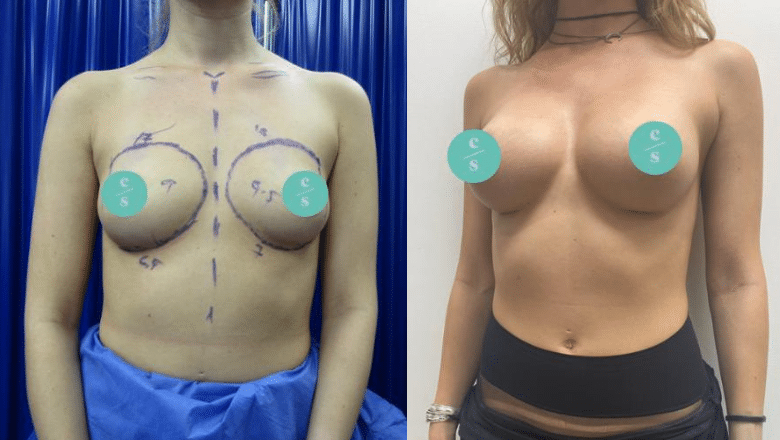

Breast lift with implants
When the breasts have both dropped and emptied, which is common after pregnancy or significant weight loss, a lift is combined with implants. The lift removes stretched skin and raises the nipple, and the implant restores fullness in the upper part of the breast. See our guide to breast lift with implants, and our comparison of a breast lift vs breast augmentation if you’re unsure which you need.

Breast reduction for large, sagging breasts
For large breasts that have also dropped, a breast reduction removes breast tissue as well as skin and raises the nipple at the same time, so the breasts end up both smaller and higher. Many women choose it for the relief of neck, shoulder and back strain as much as for the change in shape.


Fat transfer
Fat transfer to the breasts uses liposuction to take fat from the tummy, flanks or thighs and injects it into the breast. It adds a modest amount of natural volume and can soften the look of mild pseudoptosis, but it doesn’t lift the nipple or remove loose skin, so on its own it isn’t a treatment for true sagging.
When to have surgery
The best results come when your breasts have stopped changing. That means waiting until you have finished having children, until your weight has been stable for at least three to six months, and until at least three to six months after you have stopped breastfeeding. A future pregnancy or a big change in weight will stretch the breast again. If you also have loose skin on your tummy after pregnancy, a breast lift can be combined with a tummy tuck as a mummy makeover.
A breast lift is performed as a day case under TIVA (total intravenous anaesthesia). Most patients return to desk-based work within about ten days and to full exercise at around six weeks, and the final shape settles over six to twelve months as swelling goes down and scars mature. Our breast lift recovery guide covers the timeline week by week.
Breast Lift Surgery at Centre for Surgery
At Centre for Surgery, breast lifts, augmentations and reductions are performed by GMC-registered plastic surgeons, at our CQC-regulated hospital at 95–97 Baker Street, rated Good overall. The surgeon who assesses you at consultation is the surgeon who performs your operation. They will examine and measure both breasts, check your skin quality and ptosis grade, and recommend the least extensive operation that will give you a lasting result.
Your initial consultation is £100, redeemable against the cost of surgery if you go ahead. Our breast lift cost guide explains what affects the price, and the exact figure for your plan is confirmed in writing after your consultation. Finance is available through Chrysalis Finance, subject to status. You can see more results in our breast lift before and after gallery.
Frequently Asked Questions About Saggy Boobs
Can saggy boobs be fixed without surgery?
Not permanently. Once the skin and ligaments have stretched, they don’t tighten back up on their own. A good bra, lifting tape and better posture improve how the breasts look while you’re using them, and chest exercises can add a little shape to the upper chest, but only surgery repositions the breast and nipple.
Does breastfeeding make your boobs sag?
No. In a study of 93 women who had had children, breastfeeding was not a risk factor for sagging once age, weight, the number of pregnancies, pre-pregnancy bra size and smoking were taken into account. It is pregnancy itself that changes the breast, and the risk rises with each pregnancy.
Is breast sagging genetic?
Partly. Skin quality, breast size and breast shape are all inherited, so some women are predisposed to sagging earlier or more noticeably than others, whatever their lifestyle.
Does not wearing a bra make your breasts sag?
There is no good evidence that going without a bra day to day causes sagging. Wearing a well-fitted sports bra for running and other high-impact exercise is sensible, because it significantly reduces how much the breasts move.
At what age do breasts start to sag?
There is no fixed age. Some women notice sagging in their twenties, particularly with larger breasts, a strong family pattern or after weight changes, while others keep a high breast shape into their fifties. Pregnancy and menopause are the two periods when the biggest changes usually happen.
Is it normal to have saggy breasts in your 20s?
Yes. Genetics, breast size, weight changes and pregnancy can all cause sagging at a young age, and naturally long or tuberous breast shapes can look droopy from the start. It is common and not a sign that anything is wrong.
Do push-ups lift saggy breasts?
Not directly. Push-ups build the pectoral muscle behind the breast, which can improve the shape of the upper chest and your posture, but they can’t shorten stretched ligaments or tighten loose skin.
Are saggy breasts a sign of breast cancer?
Gradual sagging of both breasts is not. A new change in the size or shape of one breast, a lump, nipple discharge, a nipple that has turned inward or dimpled skin should be checked by your GP.
Will my breasts sag again after a breast lift?
A breast lift gives a long-lasting result, but it doesn’t stop the clock. Ageing, a future pregnancy or a big change in weight will affect the breast again over time. Keeping a stable weight and not smoking help the result last.
Can one breast sag more than the other?
Yes, and it is very common. Surgeons measure both sides separately and can adjust a lift on each side to bring them closer together. Our guide to uneven breasts explains the options.

If saggy breasts bother you, a consultation at Centre for Surgery will tell you what is causing the change, which grade of sagging you have, and which of the options above would give you the result you want. Call 020 7993 4849 or complete the form below.
References
- Rinker B, Veneracion M, Walsh CP. Breast ptosis: causes and cure. Ann Plast Surg. 2010;64(5):579-84. doi:10.1097/SAP.0b013e3181c39377 ↗
- Rinker B, Veneracion M, Walsh CP. The effect of breastfeeding on breast aesthetics. Aesthet Surg J. 2008;28(5):534-7. doi:10.1016/j.asj.2008.07.004 ↗
- Regnault P. Breast ptosis. Definition and treatment. Clin Plast Surg. 1976;3(2):193-203. PMID: 1261176 ↗
- Rehnke RD, Groening RM, Van Buskirk ER, Clarke JM. Anatomy of the superficial fascia system of the breast: a comprehensive theory of breast fascial anatomy. Plast Reconstr Surg. 2018;142(5):1135-1144. doi:10.1097/PRS.0000000000004948 ↗
- Scurr JC, White JL, Hedger W. The effect of breast support on the kinematics of the breast during the running gait cycle. J Sports Sci. 2010;28(10):1103-9. doi:10.1080/02640414.2010.497542 ↗
- NHS. Symptoms of breast cancer in women. nhs.uk ↗