

In this guide11 sections
- Key Points
- What Are Deflated Breasts?
- Deflated Breasts vs Sagging Breasts: What’s the Difference?
- What Causes Deflated Breasts?
- Symptoms and Signs of Deflated Breasts
- How to Fix Deflated Breasts: Treatment Options
- When to Have Surgery: Timing After Weight Loss, Pregnancy or Breastfeeding
- Which Treatment Is Right for You?
- Frequently Asked Questions
- Deflated Breast Treatment at Centre for Surgery
- References
Key Points
- Deflated breasts means lost volume in the upper pole, above the nipple. Sagging means the nipple and breast tissue have dropped. Many people have both.
- The main causes are ageing, pregnancy and weight loss. Research links sagging to the number of pregnancies rather than to breastfeeding itself.
- Creams, massage and exercise cannot restore lost upper pole volume.
- Implants or fat transfer restore volume. A breast lift repositions tissue but adds no volume, and a lift with implants treats both problems in one operation.
- Wait until your weight has been stable for 3–6 months, and until at least 3–6 months after you stop breastfeeding, before surgery.
Deflated breasts — sometimes called flat breasts, or breast flattening — is the loss of fullness in the upper part of the breast, above the nipple. It’s a distinct concern from sagging, though the two are often confused, and can develop after significant weight loss, following pregnancy and breastfeeding, or simply as a natural part of ageing. This guide explains exactly what’s happening when breasts deflate, why it happens, how to tell it apart from sagging, and the surgical options that genuinely address it — including where a breast lift alone won’t be enough, and where it will.
What Are Deflated Breasts?
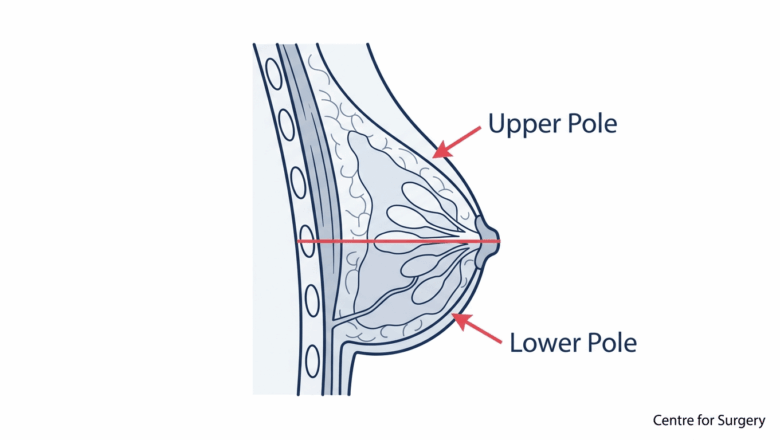
The breast is often thought of as a single unit, but for the purposes of understanding this concern, it helps to think of it in two halves: the upper pole (the section above the nipple, closer to the collarbone) and the lower pole (the section below the nipple, down towards the breast fold). Deflated breasts describes a loss of volume specifically in the upper pole — the breast tissue there thins out, and the smooth, rounded contour that would normally sit above the nipple flattens, sometimes concaving slightly. The result is a breast that looks emptied out at the top, even if the lower portion retains some fullness.
This can affect anyone, regardless of natural breast size, and its effects go beyond appearance: it commonly affects how clothing and swimwear fit, causes self-consciousness, and for many patients has a real impact on confidence in intimate settings.
Deflated Breasts vs Sagging Breasts: What’s the Difference?
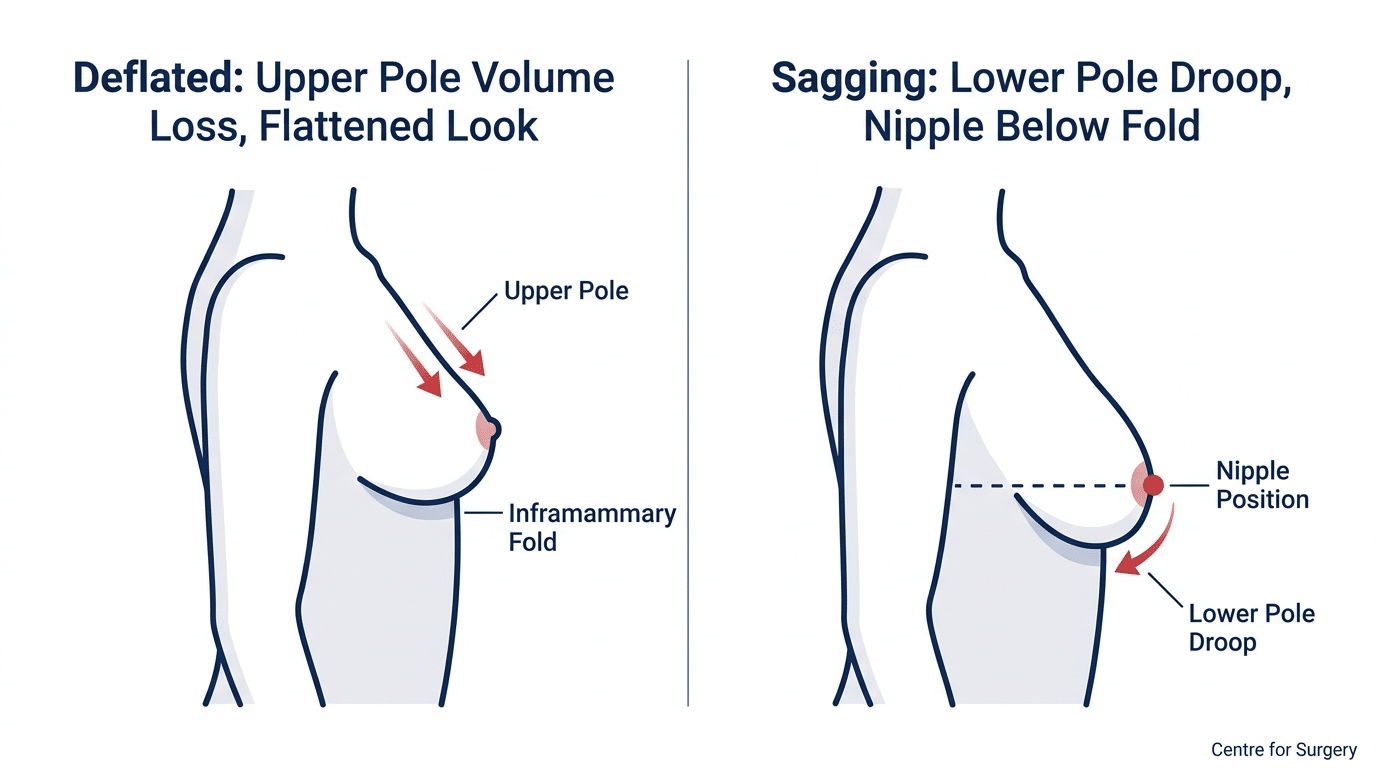
These two concerns are frequently used interchangeably, but they describe different anatomical problems, and getting the distinction right matters because it changes which treatment actually fixes it:
- Deflated (flat) breasts — volume is lost specifically from the upper pole. The breast looks flattened or emptied at the top, but the nipple may still sit at a reasonably normal height relative to the breast fold.
- Sagging breasts (ptosis) — volume and tissue descend into the lower pole, and the nipple itself drops, sitting at or below the breast fold. This is a positional problem more than a purely volume-based one — our detailed guide on how to fix saggy breasts covers ptosis specifically.
Many patients experience both at once — the upper pole empties out while the lower pole and nipple simultaneously drop — which is why an accurate assessment at consultation, not a label from an article, is what actually determines your treatment plan. If your primary concern is weight-loss-related sagging with less focus on upper pole flatness specifically, our companion guide on sagging breasts after weight loss covers that angle in more depth.
What Causes Deflated Breasts?
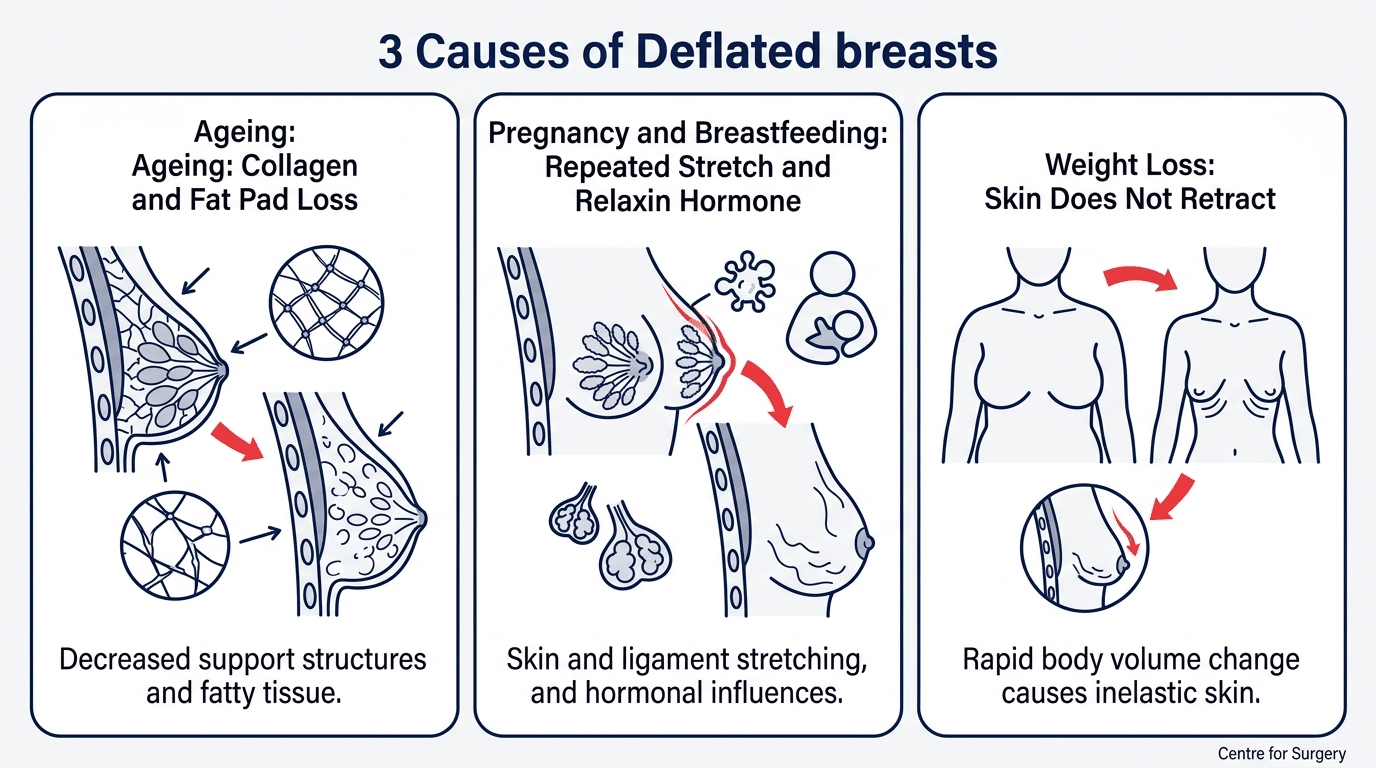
There are three principal causes, and identifying which one (or combination) applies to you is genuinely useful context to bring into your consultation.
Ageing
As we age, two structural components of the breast naturally break down: collagen and elastin — the proteins that give skin its strength and recoil — and the fat pads within breast tissue that provide volume and structure. This combination of weakening skin and gradual fat loss causes the upper pole specifically to thin and flatten over time. Hormonal changes during menopause compound this — the natural decline in oestrogen accelerates the loss of tissue integrity throughout the breast, including the fat and connective tissue that maintain upper pole fullness.
Pregnancy and Breastfeeding
Pregnancy is one of the most common reasons people notice their breasts have deflated. During pregnancy the breasts swell as milk-producing tissue develops, which stretches the skin and supporting tissue. When that tissue shrinks back afterwards, the upper pole is often the area that looks emptiest.
Many women assume breastfeeding is to blame, but the evidence points elsewhere. A 2008 study of 93 women seeking breast surgery after pregnancy ↗ found that the number of pregnancies, age, body mass index, pre-pregnancy bra size and smoking each predicted sagging, while breastfeeding did not.[1] The risk rises with each pregnancy whether or not you breastfeed.
Weight Loss
Both significant weight loss and repeated smaller fluctuations in weight can cause breasts to deflate. Breast tissue is partly fatty tissue, so when the body loses fat generally, breasts lose volume along with it — but the skin envelope that previously stretched to accommodate that volume doesn’t always retract to match. Fat loss isn’t evenly distributed and can’t be targeted to specific areas, so the upper pole is often disproportionately affected, since it typically holds comparatively less structural support than the lower pole to begin with. Repeated cycles of weight gain and loss compound this further: skin has a finite capacity to stretch and recoil, and with each cycle it becomes somewhat less able to spring back, leaving looser, more deflated-looking breasts over time. In a review of 132 women presenting for breast surgery, losing more than 50 lb (about 23 kg) was an independent risk factor for sagging.[2]
Symptoms and Signs of Deflated Breasts
Alongside the visible flattening itself, several related signs tend to accompany deflated breasts, and these are the same things your surgeon will assess at consultation:
- Excess or loose skin around the upper breast, chest, and sometimes extending towards the armpit
- Reduced projection — the breast sits flatter against the chest wall than it once did
- A change in how the breast moves — with less structural fullness, breasts can move more than they used to, which some patients find physically uncomfortable during exercise or daily activity
- Nipple position changes — often more subtle than in true sagging, but the nipple can point slightly downward as upper pole support is lost
- Skin irritation or discomfort where loose skin folds create friction, particularly in warmer weather
The severity of these signs varies significantly depending on the underlying cause and how long the change has been present, which is exactly why a face-to-face assessment matters more than trying to self-diagnose severity from a mirror.
How to Fix Deflated Breasts: Treatment Options
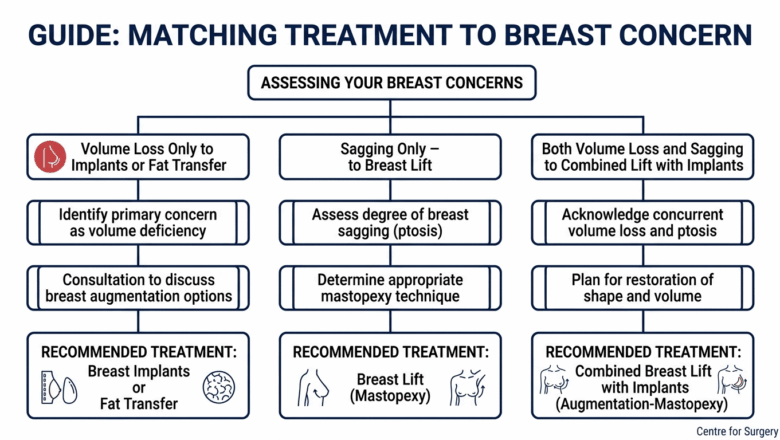
There’s no non-surgical treatment that meaningfully restores upper pole volume once genuine deflation has occurred — creams, massage, and exercise cannot rebuild lost fat pads or reverse collagen breakdown. The options that do work fall into three categories, and which one is right for you depends on whether your primary problem is volume loss, positional sagging, or both.
Breast Augmentation with Implants
Where the core problem is genuine loss of upper pole volume without significant nipple drop, breast augmentation with implants restores that fullness directly. An implant placed above or below the chest muscle physically fills out the upper pole in a way nothing else can replicate. Round implants are generally recommended specifically for this concern, since they distribute volume evenly across the upper and lower pole rather than concentrating it lower down, giving a natural-looking correction of a flattened upper pole — anatomical (teardrop) implants, by contrast, are designed to concentrate volume lower down and are usually a poorer match for upper pole deflation specifically. We use Silimed implants as our exclusive standard, and placement above or below the muscle is discussed individually at consultation — our guide on implant placement covers that decision in full.
Breast Lift (Mastopexy)
Where the primary problem is nipple position and excess skin — genuine sagging alongside or instead of pure volume loss — a breast lift removes the excess skin and repositions the breast tissue and nipple higher on the chest. It’s important to understand what a lift does and doesn’t do: it reshapes and repositions existing tissue, and it does not add volume. If your breasts are deflated because volume genuinely is gone — not just repositioned — a lift alone will give you a tidier, better-positioned breast that is still flat. Our full guide to breast lift techniques covers the four incision patterns (crescent, donut, lollipop, and anchor) used depending on the degree of correction needed.
Combined Breast Lift with Implants (Augmentation-Mastopexy)
For many patients experiencing genuine deflation — particularly after pregnancy, breastfeeding, or significant weight loss — both problems exist together: volume has been lost from the upper pole, and the nipple and remaining tissue have also dropped. In these cases, a lift alone leaves the breast flat but tidier, and an implant alone leaves the breast fuller but still positioned too low. Combining a lift with implants in a single procedure addresses both problems together — reshaping and repositioning the tissue while restoring upper pole fullness with an implant — and for patients with both concerns, this combined approach typically gives a meaningfully better result than either procedure alone, without the cost, recovery, and risk of two separate operations months apart.
Fat Transfer to the Breast
For patients who specifically want to avoid implants, fat transfer to the breast is a natural-tissue alternative. Fat is harvested by liposuction from another area of the body — commonly the abdomen, flanks, or thighs — processed, and then precisely injected into the upper pole to rebuild volume exactly where it’s been lost. This gives a natural result using your own tissue, but it has limits: the correction is more subtle than with implants, it isn’t suitable for severe deflation, and you need enough donor fat elsewhere on your body. Not all of the transferred fat survives. A 2023 systematic review of 35 studies ↗ found that, on average, 58% of the injected volume was retained, although patient satisfaction a year after surgery averaged 92%.[3] It doesn’t address significant sagging on its own, either — where genuine ptosis is also present, fat transfer is usually combined with a lift rather than used in isolation.
When to Have Surgery: Timing After Weight Loss, Pregnancy or Breastfeeding
Timing matters more than many patients expect, and having surgery too early is one of the more common reasons results end up less satisfying than they should have been.
After Weight Loss
Your weight should be stable — not still actively decreasing — for at least three to six months before surgery. If you’re still losing weight when implants are placed or a lift is performed, further changes to your body can affect how the result settles, and may mean revision surgery is needed sooner than it otherwise would be. If you’ve had bariatric surgery specifically, your surgeon will want to see your weight plateaued and your nutritional status stable before proceeding.
After Pregnancy and Breastfeeding
Most surgeons recommend waiting until breastfeeding has finished entirely, and until the breasts have had time to settle into their post-breastfeeding shape — typically a minimum of three to six months after stopping, sometimes longer. Operating too soon, while breast tissue is still involuting (returning to its non-lactating state), makes it harder to judge the true baseline you’re correcting from, and increases the chance the result changes shape again as involution completes. If further pregnancies are planned, it’s worth discussing timing carefully with your surgeon at consultation, since a subsequent pregnancy after surgery can affect the result.
Which Treatment Is Right for You?
As a general guide:
- Volume loss only, nipple position still reasonable — implants or fat transfer
- Sagging and nipple drop, upper pole volume still adequate — breast lift alone
- Both volume loss and sagging — combined lift with implants, or lift with fat transfer for a more subtle result
This is a genuine simplification for orientation purposes only — the actual decision depends on an in-person examination of your specific tissue quality, skin elasticity, and the degree of both volume loss and nipple position change, which is exactly what your consultation is for.
Frequently Asked Questions
What is upper pole fullness?
Upper pole fullness refers to the volume in the upper part of the breast, above the nipple. When this is lost — through ageing, pregnancy and breastfeeding, or weight loss — the breast can look deflated or flat, even if the lower breast retains reasonable shape.
Why do breasts deflate after breastfeeding?
The change is mostly linked to pregnancy rather than to breastfeeding itself. The breasts swell during pregnancy and shrink back afterwards, which stretches the skin and supporting tissue. Research on women seeking breast surgery found that the number of pregnancies, age, weight and smoking predicted sagging, while breastfeeding was not an independent risk factor.[1]
Can you prevent deflated breasts after breastfeeding?
There’s no guaranteed way to prevent it entirely, and it affects people very differently regardless of precautions taken. Maintaining a stable, healthy weight and general fitness may help limit the extent of the change, but it cannot fully offset the tissue and hormonal changes involved.
Why are my breasts flat?
Most commonly a combination of causes — ageing-related collagen and fat loss, the after-effects of pregnancy and breastfeeding, or weight loss where the skin hasn’t retracted to match the reduced volume. A consultation with a breast surgeon is the only reliable way to identify which factors apply to you specifically.
Will a breast lift alone fix deflated breasts?
Only if your problem is primarily positional (sagging) rather than genuine volume loss. A lift repositions existing tissue and removes excess skin — it does not restore volume that’s actually been lost. Where real upper pole volume loss is present, implants or fat transfer are needed, often combined with a lift.
Do deflated breasts always need surgery?
If the goal is to genuinely restore upper pole volume or correct significant sagging, yes — no non-surgical treatment can rebuild lost fat pads or meaningfully reverse skin laxity. For milder cases, some patients choose not to treat it at all; this is a personal decision, not a medical necessity.
How soon after weight loss can I have breast surgery?
Once your weight has been stable for at least three to six months. Operating while weight is still changing risks the result being affected by further changes to your body.
Deflated Breast Treatment at Centre for Surgery
At Centre for Surgery, breast augmentation, breast lift, combined lift-with-implants, and fat transfer to the breast are all performed by GMC-registered plastic surgeons, at our CQC-regulated Baker Street facility, rated Good overall, under TIVA (Total Intravenous Anaesthesia) as a day case.
These procedures are not weight-loss treatments in themselves, and maintaining a stable, healthy weight before and after surgery gives the best long-term result. See real patient outcomes in our breast lift before and after photo gallery, or read verified patient reviews on Google ↗ or on our own patient reviews page.
We offer flexible finance options through Chrysalis Finance, and a recommended two-week cooling-off period as standard. For pricing, see our breast lift cost guide.
To book a consultation, call 020 7993 4849 or complete the contact form below.
References
- Rinker B, Veneracion M, Walsh CP. The effect of breastfeeding on breast aesthetics. Aesthet Surg J. 2008;28(5):534-537. doi:10.1016/j.asj.2008.07.004 ↗
- Rinker B, Veneracion M, Walsh CP. Breast ptosis: causes and cure. Ann Plast Surg. 2010;64(5):579-584. doi:10.1097/SAP.0b013e3181c39377 ↗
- Seth I, Bulloch G, Gibson D, et al. Autologous fat grafting in breast augmentation: a systematic review highlighting the need for clinical caution. Plast Reconstr Surg. 2024;153(3):527e-538e. doi:10.1097/PRS.0000000000010614 ↗