

In this guide17 sections
- Key Points
- What Are Ozempic Breasts?
- Does Ozempic Make Your Breasts Smaller? Why Weight-Loss Injections Change the Breast
- Ozempic Breasts Symptoms: What Changes and How It Can Feel
- What Do Ozempic Breasts Look Like? Grades of Breast Sagging
- Who Is More Likely to Get Ozempic Breasts?
- Do Ozempic Breasts Go Back to Normal?
- How to Prevent Ozempic Breasts
- How to Fix Ozempic Breasts: Treatments and Before and After Results
- How Long After Ozempic or Mounjaro Can You Have a Breast Lift?
- Is It Safe to Have Breast Surgery While Taking Ozempic or Mounjaro?
- Ozempic, Pregnancy, Breastfeeding and Breast Surgery
- Ozempic Breasts in Men
- Breast Surgery After Weight-Loss Injections at Centre for Surgery
- Frequently Asked Questions About Ozempic Breasts
- References
- Talk to Us About Your Breasts After Weight Loss
Key Points
- “Ozempic breasts” is an informal name for breasts that have become smaller, emptier and lower after weight loss on a GLP-1 medicine such as semaglutide (Ozempic, Wegovy) or tirzepatide (Mounjaro). It is not a separate disease.
- The medicines do not act on breast tissue directly. They cause a large amount of weight loss, often within a year, and the breast loses fat faster than its stretched skin and ligaments can shrink back.
- Typical changes are an empty upper breast, sagging, nipples that sit lower or point down, and loose skin that can rub, trap moisture and cause a rash in the fold under the breast.
- Some fullness can return if weight is regained, but stretched skin and ligaments do not tighten again. Exercise, creams and supplements cannot lift a sagging breast.
- A breast lift corrects sagging, implants or fat transfer restore volume, and many people need both. Surgery is best planned once weight has been stable for at least six months, and ideally twelve.
If your breasts have shrunk and dropped since you started a weight-loss injection, you are far from alone. “Ozempic breasts”, sometimes “Ozempic boobs” or “Mounjaro breasts”, is the shorthand people use for the breast changes that follow rapid weight loss on GLP-1 medicines. The biology is the same as for sagging breasts after weight loss of any kind; what is different is the speed and the amount, which is why the change can feel so sudden.
This guide explains what these medicines actually do to the breast, why some people are affected far more than others, whether the changes reverse, and how they are treated, from a breast lift to breast implants and fat transfer to the breasts. The same process lies behind Ozempic face and Ozempic butt, so those guides may help if you have noticed changes elsewhere too.
What Are Ozempic Breasts?
Ozempic breasts is not a medical diagnosis. It is a popular name for two changes that surgeons have long seen after major weight loss: loss of breast volume (sometimes called breast deflation or involution) and breast sagging, which is known medically as breast ptosis. The term took off with the rise of weekly weight-loss injections, but the same changes happen after bariatric surgery, after pregnancy and breastfeeding, and after a large weight loss through diet and exercise.
The name covers several medicines. Ozempic is semaglutide licensed for type 2 diabetes; Wegovy is a higher dose of the same medicine licensed for weight management; and Mounjaro is tirzepatide, which acts on the GLP-1 hormone pathway and on a second gut hormone, GIP, and is licensed for both. All of them reduce appetite and slow the emptying of the stomach, and none of them is known to act on the breast directly. What they share is that they can produce a lot of weight loss in a short time.
Does Ozempic Make Your Breasts Smaller? Why Weight-Loss Injections Change the Breast
For most people who lose a significant amount of weight, yes, the breasts get smaller. The breast is made of milk-producing glandular tissue held in a framework of fat and fine supporting bands (Cooper’s ligaments), all wrapped in a skin envelope. The proportion of fat varies a great deal from person to person, and it tends to increase with age. When body fat falls, the fat within the breast falls with it.
The problem is what is left behind. The skin and ligaments were stretched to hold a larger breast, and they shrink back far more slowly than the fat disappears, if they shrink at all. The breast tissue that remains settles into the bottom of an envelope that is now too big for it, so the upper breast looks empty and the nipple sits lower.
How Much Weight Do People Lose on Ozempic and Mounjaro?
The scale of weight loss is what sets these medicines apart. In the 2021 STEP 1 trial in the New England Journal of Medicine ↗, 1,961 adults without diabetes took weekly semaglutide 2.4 mg (the Wegovy dose) or a placebo for 68 weeks. Average weight loss was 14.9% with semaglutide against 2.4% with placebo, and half of those on semaglutide lost 15% or more of their body weight[1]. In the separate SURMOUNT-1 trial, the highest dose of tirzepatide produced an average loss of 20.9% over 72 weeks, and around half or more of the people on the two higher doses lost at least a fifth of their weight[2]. For someone starting at 100 kg, that is 15 to 21 kg in a little over a year.
Does Mounjaro Make Your Breasts Smaller Than Ozempic?
Neither medicine has a special effect on the breast. The change follows how much weight you lose and how quickly, so a medicine that tends to produce more weight loss is likely to produce more breast change. In their separate trials, tirzepatide produced larger average losses than semaglutide[1],[2], but individual results vary widely, and two people on the same dose can end up with very different breasts.
Why the Speed of Weight Loss Matters
Skin adapts slowly. When weight comes off over several years, the skin has more time to contract as the volume underneath it shrinks; when it comes off over a few months, the skin is left behind. Weight loss on GLP-1 medicines also includes some loss of lean tissue, including muscle, as well as fat. A 2026 review of these medicines in aesthetic surgery highlighted that this lean-mass loss can affect tissue quality and change how surgeons plan body contouring[3]. The chest muscle sits behind the breast rather than inside it, so although keeping it strong helps the chest look firmer, it cannot hold the breast up.
Ozempic Breasts Symptoms: What Changes and How It Can Feel
Changes in Shape and Position
The most common changes people notice are:
- An empty upper breast, with fullness lost above the nipple first, so the top of the breast looks flat or hollow in a bra or swimsuit
- Sagging, where the breast tissue drops on the chest and sits on or below the crease underneath it
- Lower nipples, which may sit below the breast crease or point downwards
- A flatter, wider breast, with tissue drifting to the side towards the armpit, sometimes with a roll of loose skin at the side of the chest
- Uneven breasts, as one side often loses more than the other; our guide to uneven breasts explains why
- Thinner, looser skin, sometimes with new or more visible stretch marks
Breast change is one of the commonest reasons people seek surgery after GLP-1 weight loss. A 2026 study in Aesthetic Plastic Surgery ↗ compared people who had body contouring surgery after GLP-1 medicines with people who had it after bariatric surgery. Breast procedures made up 56.9% of operations in the GLP-1 group but only 21.7% in the bariatric group, who more often had their abdomen treated[4].
Physical Symptoms
For most people, the changes are about appearance and how clothes fit. Some also have physical symptoms:
- A rash under the breasts. When the lower breast rests on the chest wall, skin rubs on skin and sweat is trapped in the fold. This can cause intertrigo, an inflamed, sore and sometimes itchy rash that can become infected with yeast or bacteria[6]. Our guide to skin irritation after weight loss covers how to manage it.
- Hygiene difficulty in a deep fold that is hard to keep dry
- Chafing and poor bra fit, with cups that gap at the top, underwires that dig in, and straps that have to be pulled tight to give any lift
The emotional side matters too. Many people who have worked hard to lose weight find that their breasts do not look the way they expected, and reviews of the aesthetic effects of GLP-1 weight loss stress that psychological wellbeing is as important an outcome as the physical result[5]. Surgery to correct these changes is elective, and choosing not to have it is just as valid.
What Do Ozempic Breasts Look Like? Grades of Breast Sagging
Surgeons describe sagging by where the nipple sits in relation to the crease under the breast (the inframammary fold). Grading systems designed for people who have lost a lot of weight, such as the Pittsburgh Rating Scale, include the breast for this reason[7].

- Grade 1 (mild): the nipple is level with the crease.
- Grade 2 (moderate): the nipple is below the crease but still above the lowest point of the breast.
- Grade 3 (severe): the nipple is at the lowest point of the breast and points downwards.
- Pseudoptosis: the nipple stays above the crease, but the breast tissue has slid below it, which is common when the breast has mainly lost volume.
This matters because it decides the treatment. A breast that is mostly deflated with the nipple in a good position may only need volume, whereas a breast with grade 2 or 3 sagging needs a lift, whatever is done about volume. Our guide to breast ptosis explains the grades in more detail.
Who Is More Likely to Get Ozempic Breasts?
Not everyone who loses weight on an injection notices much change in their breasts. The things that make it more likely are:
- How much weight you lose. There is no fixed threshold, but the more weight lost, the more the breast changes.
- Your starting breast size. Larger, heavier breasts stretch the skin and ligaments more, so they often drop further once the volume goes.
- Age and skin quality. Skin makes less collagen and elastin with age and after the menopause, so it recoils less.
- Pregnancy and breastfeeding. Each pregnancy stretches the breast skin and ligaments, and these changes add to those from later weight loss.
- Genetics. Skin elasticity and the balance of fat and glandular tissue in the breast run in families.
- Smoking and sun damage, which weaken the skin over time.
- Repeated weight loss and regain, which stretches the skin again and again.
Do Ozempic Breasts Go Back to Normal?
Breast volume tracks body fat, so if weight goes back on, some fullness usually returns. What does not reverse is the stretch in the skin and ligaments. If weight is regained, the breast is often fuller but no higher than before, and if it is lost again the sagging can become more marked.
Regaining weight after stopping these medicines is common. A 2025 meta-analysis in Aesthetic Plastic Surgery ↗ of 12 studies and nearly 14,000 people found that weight on semaglutide levelled off at around 53 weeks, at an average loss of 16%. In the two studies that followed people after they stopped, they had regained 63% and 74% of the weight they had lost by the end of follow-up[8]. Breast glandular tissue does not regrow after weight loss, and no cream, supplement or exercise can tighten stretched breast skin enough to lift the breast.
How to Prevent Ozempic Breasts
It is not always possible to prevent breast changes after a large weight loss, and losing weight to improve your health is usually worth more than the change to your breasts. These steps may limit the effect and keep you well while you lose it:
- Use the medicine as prescribed, with regular reviews from your prescriber. Increasing the dose gradually, as intended, is safer and less likely to produce very rapid loss. Buying these medicines without a prescription is unsafe, as the MHRA guidance on GLP-1 medicines ↗ explains.
- Eat enough protein. Appetite falls sharply on these medicines, and protein intake often falls with it. Guidance for plastic surgeons recommends 60 to 120 g of protein a day around body contouring surgery and notes that many people on GLP-1 medicines fall short[9].
- Do resistance exercise to protect muscle while you lose weight[3]. It will not lift the breast, but it keeps the chest wall and posture strong.
- Wear a well-fitted, supportive bra, and have your size checked as you lose weight. This makes you more comfortable; there is no good evidence that it prevents sagging.
- Keep the fold under the breast clean and dry if you start to get a rash.
- Stop smoking.
How to Fix Ozempic Breasts: Treatments and Before and After Results
The right treatment depends on two questions: how much volume has the breast lost, and how far has the nipple dropped? Most people after major weight loss have some of both, which is why combined operations are common. Our guide to types of breast lift explains the main techniques.
Breast Lift (Mastopexy)
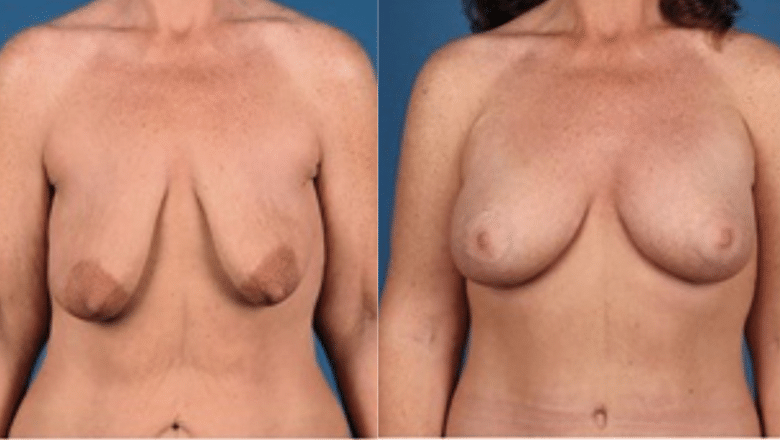
A breast lift removes the excess skin, reshapes the remaining breast tissue into a firmer cone, and raises the nipple and areola to a higher position. The areola can be made smaller at the same time. It corrects sagging but does not add volume, so it suits people who are happy with their breast size but not with its shape and position. Depending on how much skin needs to be removed, the scar runs around the areola, down from the areola to the crease, and sometimes along the crease itself. Our guide to breast lift recovery explains what to expect afterwards.
Breast Lift With Implants (Augmentation Mastopexy)
When the breast is both empty and low, a lift alone can leave it smaller than you would like, and implants alone would sit in a low, loose envelope. A lift combined with implants restores fullness to the upper breast and puts the nipple back in the right place in one operation, although some people are advised to have the two stages separately. This is often the most suitable option after a large weight loss. At Centre for Surgery, implants are inserted with a Keller funnel, a no-touch technique, and come with a 10-year warranty covering rupture and severe (grade III to IV) capsular contracture.


Breast Implants Without a Lift
If the breast has mainly lost volume, the skin is still reasonably firm, and the nipple sits at or above the crease (grade 1 sagging or pseudoptosis), breast augmentation alone can be enough. Implants fill the empty skin envelope and give back the upper fullness. They cannot correct more than mild sagging, and putting a large implant into a loose breast to “fill out” the skin tends to give a heavy result that drops further with time.
Fat Transfer to the Breasts
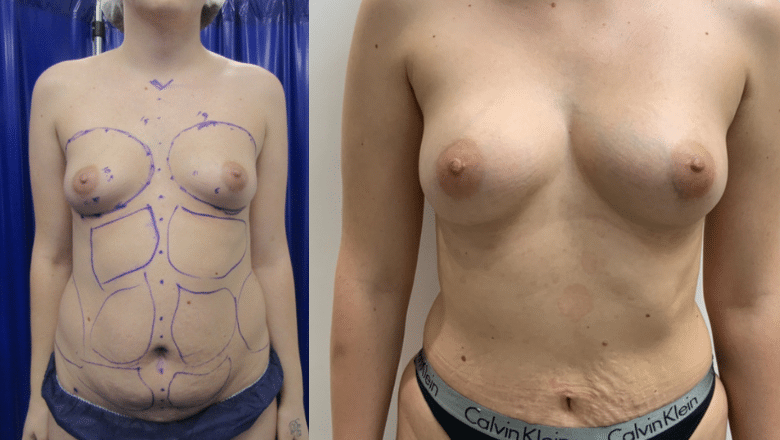
Fat transfer to the breasts uses liposuction to take fat from areas such as the tummy or thighs, which is then purified and injected into the breast. It gives a soft, natural increase, usually modest in size, with no implant. Some of the transferred fat does not survive, so more than one session is sometimes needed. Two points matter after weight-loss injections: there may not be much spare fat left to harvest, and fat transfer adds volume but cannot lift a sagging breast, so it is often combined with a lift.
Using Your Own Tissue: Breast Auto-Augmentation
After a very large weight loss, many people have a roll of loose skin and fat at the side of the chest, below the armpit. Rather than discarding it, surgeons can move this tissue into the breast to add volume while lifting it. Techniques include reshaping the breast and suspending it from deeper tissues[10], and using a flap of side-chest tissue with its own blood supply; in a 2025 study of 20 people after massive weight loss, these flaps gave a consistent increase in breast volume that held over a year, with no fat necrosis on follow-up imaging[11]. Our page on breast auto-augmentation explains who it suits.
Breast Reduction
Not everyone’s breasts get small. Some people still have large, heavy breasts after losing weight, and for them a breast reduction removes weight and excess skin while lifting and reshaping the breast at the same time.
Combining Breast Surgery With Other Procedures
Weight loss rarely affects the breasts alone. Breast surgery can be combined with an upper body lift or a bra line back lift to tighten the back and the side of the chest, with an arm lift for loose upper-arm skin, or with a tummy tuck. Whether operations are done together or in stages is decided by your surgeon at consultation, based on the length of surgery and your general health. Our post weight loss surgery page and our guide to loose skin after weight loss cover the wider options.
Can You Fix Ozempic Breasts Without Surgery?
No non-surgical treatment can lift a sagging breast or replace lost breast volume in a lasting way. Skin-tightening devices can make a modest difference to skin quality but will not raise the nipple, and we do not offer non-surgical breast fillers. Our article on the non-surgical breast lift looks at the evidence for each option honestly.
How Long After Ozempic or Mounjaro Can You Have a Breast Lift?
Timing is the single most important factor in getting a lasting result. If surgery is done while weight is still falling, the breast will change again afterwards, and if a lot of weight is regained after surgery, the shape can stretch.

Our standard for any breast or body contouring surgery after major weight loss is a stable weight for at least six months, and ideally twelve. On semaglutide, weight typically levels off at around a year of treatment[8], so for many people that means surgery around 18 months to two years after starting. People on GLP-1 medicines tend to have body contouring surgery earlier and at more varied times than people after bariatric surgery[4], which makes it all the more important to wait for a genuine plateau.
It also helps to think ahead about the medicine itself. Talk to your prescriber about whether you plan to stay on it, reduce the dose or stop, as the weight you expect to maintain afterwards is the weight your surgeon should plan around.
Is It Safe to Have Breast Surgery While Taking Ozempic or Mounjaro?
Many people have breast surgery safely while taking, or soon after stopping, these medicines, but there are three things to be aware of.
Anaesthesia
GLP-1 medicines slow the emptying of the stomach, and some people taking them still have food in the stomach despite fasting as instructed. This increases the risk of stomach contents being breathed into the lungs under anaesthesia or deep sedation[3]. You must tell your surgeon and anaesthetist that you take one of these medicines, and you will be given specific instructions about whether and when to pause it before your operation.
Wound Healing
The evidence on healing is still developing. A 2026 meta-analysis of 13 studies and more than 17,000 patients ↗ found that taking a GLP-1 medicine before plastic surgery was not linked to an overall increase in wound breakdown, infection, fluid collections, bleeding or blood clots, but it was linked to a modest increase in thickened (hypertrophic) scarring, and the authors rated the certainty of the evidence as very low[12]. A Danish study of 282 people having body contouring after massive weight loss did find higher rates of infection in those who had used these medicines[13]. Good nutrition, and enough protein in particular, is one of the most useful things you can do to help healing[9].
Smoking and Other Medicines
We ask patients to stop smoking for four weeks before and four weeks after surgery, and to stop aspirin two weeks before. Your surgeon will go through any other medicines and supplements at your pre-operative appointment.
Ozempic, Pregnancy, Breastfeeding and Breast Surgery
According to the MHRA ↗, GLP-1 medicines should not be taken during pregnancy, just before trying to get pregnant, or while breastfeeding, as there is not enough safety data on the effects on the baby. Semaglutide should be stopped at least two months, and tirzepatide at least one month, before trying to conceive, and anyone who could become pregnant should use effective contraception while taking them.
If you are planning a family, it is usually best to wait until afterwards before having breast surgery, as pregnancy and breastfeeding change the breast again. We advise waiting at least three months after completely stopping breastfeeding, and ideally around six, or six months after the birth if you have not breastfed. We do not carry out cosmetic breast surgery during pregnancy or while breastfeeding. Our guide to the mum tum covers the other common changes after pregnancy.
Ozempic Breasts in Men
Men notice chest changes after weight loss too. As fat is lost, the chest can be left with loose skin, or with firm, rubbery glandular tissue behind the nipples that was previously hidden by fat. This is gynaecomastia, and it does not go away with further weight loss or exercise. Gynaecomastia surgery removes the glandular tissue and, where needed, the excess skin, and we treat every grade, including severe and revision cases.
Breast Surgery After Weight-Loss Injections at Centre for Surgery
At our Baker Street hospital, your consultation is with the consultant plastic surgeon who will carry out your operation, and the surgeon who assesses you is always the surgeon who operates. You can have a virtual consultation first if you live further away, but a face-to-face consultation is needed before surgery, and further consultations before surgery are free.
At consultation, your surgeon will ask about:
- how much weight you have lost, over what time and on which medicine and dose
- whether your weight has settled, and whether you plan to stay on the medicine
- your plans for pregnancy and breastfeeding
- your skin quality, breast volume, nipple position and any difference between the two sides
- any rash or skin problems under the breasts, and other areas affected by weight loss
All of our breast surgeons specialise in breast surgery and are registered with the General Medical Council. You can read about them on our Meet the Team page. Follow-up appointments are included, and you will need a responsible adult to take you home and stay with you for 24 hours after an operation under TIVA or sedation. We recommend a two-week cooling-off period between your final consultation and surgery. For an idea of costs, see our guides to breast lift cost and breast augmentation cost.
Frequently Asked Questions About Ozempic Breasts
What does Ozempic do to breasts?
Ozempic does not act on breast tissue directly. It causes weight loss, and the fat inside the breast shrinks with the rest of the body. The skin and supporting ligaments do not shrink as quickly, so the breast can look emptier, flatter and lower, with the nipple sitting further down.
Can Ozempic reduce breast size?
Yes, for most people who lose a significant amount of weight. How much smaller the breasts become depends on how much weight is lost and how much of the breast was fat to begin with. Breasts with more fatty tissue tend to shrink more than those with more glandular tissue.
Does Mounjaro make your breasts smaller?
Yes, in the same way as Ozempic. Mounjaro (tirzepatide) has no direct effect on the breast, but it produced larger average weight loss in its trials than semaglutide did in its own, so the breast changes can be more marked. Individual results vary widely.
Does GLP-1 reduce breast size?
Only through weight loss. All GLP-1 medicines, including semaglutide, tirzepatide and liraglutide, reduce appetite, and the breast shrinks as body fat falls. There is no evidence that they shrink breast tissue in any other way.
Does Ozempic cause breast pain?
Breast pain is not among the side effects most commonly reported with semaglutide, which are mainly nausea, diarrhoea and other digestive symptoms. Soreness under the breast is more often a rash in the fold. A new lump, nipple discharge, skin dimpling or breast pain that does not settle should always be checked by your GP.
Can Ozempic cause breast lumps?
Breast lumps are not a recognised side effect of Ozempic or other GLP-1 medicines. Weight loss can make existing lumps, cysts or areas of dense tissue easier to feel as the fat around them shrinks, which is why some people notice them for the first time. Any new lump, or a change in one you already have, should be checked by your GP.
Is Ozempic safe to use while breastfeeding?
No. The MHRA advises that GLP-1 medicines, including Ozempic, Wegovy and Mounjaro, should not be taken while breastfeeding, as there is not enough safety data on whether they could harm the baby. Speak to your GP or prescriber if you are breastfeeding or planning to.
Will my breasts go back to normal if I stop Ozempic?
Not completely. If you regain weight, some breast volume usually returns, but the stretched skin and ligaments do not tighten again, so the breast is often fuller but still low. Many people do regain weight after stopping, which is why surgery is best planned around the weight you expect to keep.
How long after weight-loss injections should I wait for a breast lift?
Until your weight has been stable for at least six months, and ideally twelve. Weight usually levels off after about a year on semaglutide, so surgery is often around 18 months to two years after starting. You do not always need to stop the medicine, but your anaesthetist will advise on pausing it around the operation.
Can I have a boob job while on Ozempic?
Yes, many people can, once their weight is stable. You must tell your surgeon and anaesthetist, as these medicines slow stomach emptying, which matters for anaesthesia, and you will be told whether and when to pause it. If your breasts have sagged, implants alone may not be enough.
Can exercise fix Ozempic breasts?
No. Chest exercises strengthen the muscle behind the breast and improve posture, but the breast itself contains no muscle, so exercise cannot lift it or tighten stretched skin. Resistance training is still worthwhile while losing weight to protect muscle.
References
- Wilding JPH, Batterham RL, Calanna S, et al. Once-weekly semaglutide in adults with overweight or obesity. N Engl J Med. 2021;384(11):989-1002. doi:10.1056/NEJMoa2032183 ↗
- Jastreboff AM, Aronne LJ, Ahmad NN, et al. Tirzepatide once weekly for the treatment of obesity. N Engl J Med. 2022;387(3):205-216. doi:10.1056/NEJMoa2206038 ↗
- Venza M, Venza I. GLP-1 receptor agonists in aesthetic surgery: a narrative review on perioperative safety, sarcopenic morphologies, and adapted body contouring strategies. Aesthetic Plast Surg. 2026;50(15):6150-6160. doi:10.1007/s00266-026-05980-3 ↗
- Smith JE, Garbaccio NC, Mehdizadeh M, et al. Outcomes of body contouring surgery after bariatric surgery vs. GLP-1 receptor agonist-induced weight loss: a propensity score matched analysis. Aesthetic Plast Surg. 2026;50(11):4142-4150. doi:10.1007/s00266-026-05861-9 ↗
- Haykal D, Hersant B, Cartier H, Meningaud JP. The role of GLP-1 agonists in esthetic medicine: exploring the impact of semaglutide on body contouring and skin health. J Cosmet Dermatol. 2025;24(2):e16716. doi:10.1111/jocd.16716 ↗
- Voegeli D. Intertrigo: causes, prevention and management. Br J Nurs. 2020;29(12):S16-S22. doi:10.12968/bjon.2020.29.12.S16 ↗
- Song AY, Jean RD, Hurwitz DJ, Fernstrom MH, Scott JA, Rubin JP. A classification of contour deformities after bariatric weight loss: the Pittsburgh Rating Scale. Plast Reconstr Surg. 2005;116(5):1535-1544. doi:10.1097/01.prs.0000182606.92069.13 ↗
- Garbaccio NC, Smith JE, Posso A, et al. Plastic surgery in the Ozempidemic: considerations for the timing of body contouring surgery in patients with semaglutide-associated weight loss. Aesthetic Plast Surg. 2025;49(21):6078-6088. doi:10.1007/s00266-025-05112-3 ↗
- Mehta M, Rometo D, Gusenoff J, Rubin JP. Nutritional challenges in post-massive weight loss body contouring: guidance for plastic surgeons on GLP-1 agonists and sleeve gastrectomy. Plast Reconstr Surg. 2026;158(3):398-413. doi:10.1097/PRS.0000000000012672 ↗
- Rubin JP. Mastopexy after massive weight loss: dermal suspension and total parenchymal reshaping. Aesthet Surg J. 2006;26(2):214-222. doi:10.1016/j.asj.2006.01.010 ↗
- Hammad MRA, Badawy MS, Naguib EN, Mabrouk A. Reliability of chest wall perforator flaps for breast reshaping following massive weight loss. Aesthetic Plast Surg. 2025;49(3):749-757. doi:10.1007/s00266-024-04344-z ↗
- Cirino Follmann J, Orellana Correa RS, Alonso Campos E, et al. Preoperative GLP-1 receptor agonist use and postoperative outcomes across plastic and reconstructive surgery: a systematic review and meta-analysis. Plast Surg (Oakv). 2026. doi:10.1177/22925503261506737 ↗
- Djebbara-Bozo N, Yilmaz M, Saritas S, Birk-Sørensen L, Krag AE. GLP-1 receptor agonist use and postoperative complications after body contouring surgery following massive weight loss. J Plast Reconstr Aesthet Surg. 2026;123:169-175. doi:10.1016/j.bjps.2026.09.040 ↗
Talk to Us About Your Breasts After Weight Loss
If your breasts have changed after weight loss and you would like to talk through your options, you can book a consultation at our Baker Street clinic by calling 020 7993 4849 or using the form below. A patient coordinator will be your point of contact throughout.