

In this guide17 sections
- Key Points
- Can Rhinoplasty Improve Breathing?
- Does Rhinoplasty Affect Breathing? Can a Nose Job Make Breathing Worse?
- What Causes Breathing Problems Inside the Nose?
- Rhinoplasty vs Septoplasty vs Septorhinoplasty: What Is the Difference?
- Can Rhinoplasty and Septoplasty Be Done at the Same Time?
- How Do Surgeons Balance a Natural-Looking Nose With Good Breathing?
- Is Rhinoplasty for Breathing Worth It? What the Research Says
- Rhinoplasty Before and After: Breathing and Appearance
- What Happens at a Septorhinoplasty Consultation?
- Septorhinoplasty Recovery: When Will I Breathe Properly?
- What Are the Risks of Rhinoplasty for Breathing?
- Can You Get Rhinoplasty for Breathing on the NHS?
- When Should I See a Doctor About a Blocked Nose?
- Frequently Asked Questions
- Rhinoplasty for Breathing in London
- References
Key Points
- Can rhinoplasty improve breathing? Yes, when the blockage is structural. A deviated septum, a weak nasal valve or enlarged turbinates can be corrected in the same operation as cosmetic reshaping, called a septorhinoplasty.
- Rhinoplasty can also make breathing worse. Removing too much cartilage or weakening the nasal valve can narrow the airway, which is why planning the inside of the nose matters as much as the outside.
- The evidence for fixing a crooked septum is good. A 2019 randomised trial found septoplasty gave better quality of life than non-surgical treatment at 12 months, and the benefit lasted at least two years.
- Septoplasty, rhinoplasty and septorhinoplasty are different operations. Septoplasty straightens the septum, rhinoplasty reshapes the nose, and septorhinoplasty does both with one anaesthetic and one recovery.
- Recovery is gradual. The nose feels more blocked at first because of swelling, splints come out at about one week, and most people notice easier breathing by week three. The tip keeps refining for up to a year.
- Not every blocked nose needs surgery. Allergy, nasal polyps and sleep apnoea need the right diagnosis first, and a consultation with an endoscope examination establishes which problem you have.
Rhinoplasty for breathing is one of the most common reasons people book a nose consultation, and one of the most misunderstood. Many people assume a nose job is purely cosmetic, while others fear that changing the shape of the nose will make it harder to breathe. Both ideas contain some truth. Rhinoplasty changes the framework that shapes your airway, so it can open a blocked nose or narrow one, depending on how it is planned.
This guide explains how a nose job can improve breathing, what causes a blocked nose in the first place, how a surgeon balances appearance with airflow, and what the research says about results. If you already know you want both a straighter, better-proportioned nose and easier breathing, our septorhinoplasty page covers the operation itself, and our guide to functional rhinoplasty covers surgery done for breathing alone.
Can Rhinoplasty Improve Breathing?
Yes, but only when the cause of the blockage is structural and the operation is planned to correct it. A cosmetic rhinoplasty that reduces a hump or narrows the tip does not automatically improve airflow. Breathing improves when the surgery addresses the parts of the nose that limit the passage of air: the septum, the nasal valve and the turbinates.
The strongest evidence relates to the septum. In a 2019 randomised trial published in The Lancet ↗, 203 adults with a deviated septum and a blocked nose were assigned to septoplasty (with or without turbinate surgery) or to non-surgical management. At 12 months the surgical group scored 72.2 on a health-related quality-of-life scale against 63.9 for the non-surgical group, and the difference was sustained at 24 months[1]. A meta-analysis of three randomised trials involving 721 people reached a similar conclusion, with improved symptom scores at 6 and 12 months and low complication rates[2].
Measurements agree with what patients report. A systematic review of studies using rhinomanometry, a test that measures airflow resistance, found that every included study showed an objective improvement in nasal patency after septal surgery, with mean unilateral nasal resistance falling from 1.19 to 0.39 Pa/cm³/s[3]. In other words, a nose job that includes septal correction can measurably open the airway as well as change how it feels.
Does Rhinoplasty Affect Breathing? Can a Nose Job Make Breathing Worse?
It can, which is why this question deserves a straight answer. Every rhinoplasty alters the cartilage and bone that hold the airway open. If the surgery reduces the nose without keeping or rebuilding that support, the sidewalls of the nose can collapse inwards when you breathe in. Overly aggressive cartilage removal is a recognised reason patients later seek revision rhinoplasty.
Persistent obstruction after surgery is often traced to a nasal valve problem that was never addressed. A review in Otolaryngologic Clinics of North America notes that persistent airway obstruction from inadequately treated nasal valve compromise is common[6]. For that reason, a good surgeon examines the inside of your nose before planning the outside.
There is a second, temporary effect. For the first one to two weeks after any nose surgery, swelling and splints make the nose feel more blocked than before. This is expected, and our guide to a blocked nose after rhinoplasty explains how to tell normal congestion from a problem. If you already breathe well and want only a cosmetic change, the aim is to keep it that way, which means preserving support rather than simply removing tissue.
What Causes Breathing Problems Inside the Nose?
Breathing through the nose depends on three structures working together, and a problem with any of them can cause a blocked nose that tablets and sprays do not fix.

Deviated septum
The septum is the wall of bone and cartilage that divides the nose into two passages. When it bends to one side, usually after an injury or from birth, one passage is narrower than the other. People describe a nostril that always feels blocked, noisy breathing, nosebleeds or recurrent sinus symptoms. Fixing it is called septoplasty. A previous broken nose is a common cause, and a crooked outer nose often goes with a crooked septum inside.
Nasal valve collapse
The nasal valve is the narrowest part of the airway, just above the nostril. If the cartilage here is weak or has been weakened by earlier surgery, the sidewall draws inwards each time you breathe in, like a straw that flattens when you suck. It is a frequent cause of obstruction that people do not realise is structural. A 2024 Korean study of 57 patients with internal nasal valve dysfunction found that functional rhinoplasty, including septal correction and spreader grafts, improved both obstruction scores and appearance[7].
Enlarged turbinates
The turbinates are ridges of tissue along the side wall of the nose that warm and moisten air. Allergy and irritation can leave them swollen, which blocks the passage on one or both sides. Turbinate reduction shrinks them, using submucous resection or radiofrequency, and can be done at the same time as septorhinoplasty.
Previous injury or surgery
Scar tissue, cartilage that was removed in an earlier operation and the effects of an old injury can all narrow the airway. If your breathing changed after a previous nose job, our page on what counts as a bad result and what to do sets out the next steps.
Rhinoplasty vs Septoplasty vs Septorhinoplasty: What Is the Difference?
Three operation names appear in almost every search about breathing and nose surgery, and they are easy to mix up.

- Rhinoplasty changes the outside of the nose: a hump, a wide bridge, a drooping or bulbous tip. Its aim is appearance, although it can include support grafts.
- Septoplasty straightens the septum to improve breathing and does not change the external shape on purpose, although a straighter septum can make the nose look straighter.
- Septorhinoplasty combines the two, so that the inside and outside are treated together. Our guide to the different types of rhinoplasty compares these with open, closed, tip and revision approaches.
If breathing is your only problem, septoplasty alone is enough. If you only want a different shape and breathe freely, a cosmetic rhinoplasty is the right operation. If you want both, a septorhinoplasty gives you a single anaesthetic and one recovery.
Can Rhinoplasty and Septoplasty Be Done at the Same Time?
Yes, and it is usually the sensible approach when you need both. Having the operations together means one anaesthetic and one recovery period. There is also a surgical advantage: cartilage removed while straightening the septum can be reshaped and reused as graft material to support and refine the nose, so there is no need to borrow cartilage from your ear or rib. If septoplasty is done first and rhinoplasty years later, that septal cartilage may already be gone. Our article on whether rhinoplasty and septoplasty can be done together goes into the detail.
Turbinate reduction can be added in the same sitting. The evidence on whether this adds benefit is mixed. A large cohort of 567 patients who had functional septorhinoplasty found sustained improvement in nasal obstruction for at least 24 months, with a small additional gain when turbinate reduction was included[4], while a systematic review of eleven studies found that most reported no additional benefit from turbinate surgery, though the studies were at high risk of bias[5]. The sensible reading is that turbinates should be reduced when an examination shows they are genuinely enlarged, not by default.
How Do Surgeons Balance a Natural-Looking Nose With Good Breathing?
Balancing aesthetics and function means every change to the shape of the nose is checked against what it does to the airway. Three ideas guide the planning.
Support is rebuilt, not just removed
When a hump is lowered or the nose narrowed, the roof of the nose can become too narrow in the middle. Spreader grafts, thin strips of cartilage placed between the septum and the upper side cartilages, widen the internal valve and keep the bridge straight. Other grafts support the tip and the sidewalls. A review notes that spreader grafts are the most widely used valve repair, although evidence that they outperform alternatives is limited[6]. Our guide to rhinoplasty grafts explains where the cartilage comes from.
The look is planned around your face
A nose that is technically well supported can still look wrong on your face. Your surgeon considers your profile, skin thickness, cultural features and the way you want to look. For some people that means a small change, and for others a complete rebalance. Pages on ethnic rhinoplasty and male rhinoplasty cover the differences in planning for different noses. Our article on the perfect nose explains why a measurement-led ideal does not exist.
The approach is chosen for the job
Most septorhinoplasty is done as open surgery, with a small incision across the skin between the nostrils, because the surgeon needs a clear view of both the septum and the tip. Closed surgery keeps all incisions inside the nostrils and suits simpler cases. See open vs closed rhinoplasty for how the choice is made.
Is Rhinoplasty for Breathing Worth It? What the Research Says
For people with a real structural blockage, the research is encouraging. The 2019 Lancet trial described above showed a sustained quality-of-life gain, and a 2019 prospective cohort of 567 patients ↗ who had functional septorhinoplasty found significant improvements in nasal obstruction scores through at least 24 months, using the validated NOSE scale[4].
Satisfaction with appearance and function tends to rise together. A 2024 meta-analysis of 17 studies ↗ using the Rhinoplasty Outcome Evaluation questionnaire found average scores rose from 33.5 before surgery to about 70 within six months and about 80 at 12 months[8]. That questionnaire asks about both how the nose looks and how it works, which is the balance this article is about.
Two caveats are worth stating. First, surgery does not cure allergic rhinitis, so allergy treatment may still be needed. Second, breathing improvements are not guaranteed, and a small number of people need further surgery. Our guide on whether rhinoplasty is worth it gives an honest answer on expectations.
Rhinoplasty Before and After: Breathing and Appearance
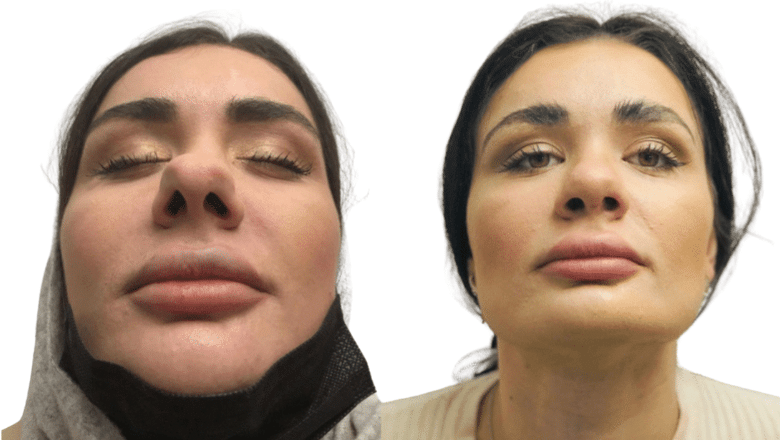
Photographs show the change in shape, though not the change in airflow, which only you can feel. These septorhinoplasty results from Centre for Surgery were treated for both reasons. A wider selection is available at consultation, and you can browse more in our rhinoplasty before and after photos.

What Happens at a Septorhinoplasty Consultation?
A thorough consultation covers both halves of the problem, and it is where the decision about which operation you need is made. At Centre for Surgery it lasts around 45 minutes, longer for complex cases.
- Your history: when the blockage started, whether it is one side or both, any injury, previous surgery, allergies, snoring and smoking.
- An examination inside the nose: usually with an endoscope, to see the septum, check for enlarged turbinates and look for valve collapse.
- Facial analysis: measurements and photographs from several angles, with digital imaging of a possible result where helpful.
- An honest plan: what is realistic, the risks, the recovery, and which medicines to pause beforehand.
- No pressure: a two-week cooling-off period is recommended, and you can come back for further consultations as often as you need.
Your surgeon is GMC-registered, and the surgeon who assesses you is the surgeon who operates. Costs are confirmed in writing after your consultation, and finance is available through our finance options, subject to status. If you are choosing a surgeon, our guide on how to choose a nose job surgeon in London sets out what to check.
Septorhinoplasty Recovery: When Will I Breathe Properly?
Septorhinoplasty is a day-case operation lasting around two to three hours, carried out under TIVA (total intravenous anaesthesia), so you are asleep throughout. You then spend three to four hours in our recovery unit before going home with a responsible adult. See anaesthesia for cosmetic surgery for what TIVA involves.
The breathing timeline surprises people, because it gets worse before it gets better:
- Days 1 to 7: the nose is blocked by swelling, and splints sit inside and outside it. Mouth breathing is normal. Swelling and bruising peak around days three to four.
- Around one week: the splints come out, and breathing usually improves straight away.
- Weeks 2 to 3: most people notice easier breathing by week three, and return to desk work at around 10 to 14 days.
- Weeks 4 to 6: congestion inside the nose largely settles. Glasses must stay off the nose for six weeks, although contact lenses are fine.
- Three to twelve months: about 80% of the swelling has gone by three months, and the tip keeps refining for up to a year.
Our guides to rhinoplasty recovery and rhinoplasty swelling go week by week. Stopping smoking and nicotine at least four weeks before and after surgery lowers the risk of graft loss and septal perforation.
What Are the Risks of Rhinoplasty for Breathing?
Rhinoplasty is low risk in experienced hands, although no surgery is risk-free. In a US study of 4,978 aesthetic rhinoplasty patients, 0.7% had a major complication needing hospital care or another operation within 30 days, and the risk was higher over 40 and when other procedures were combined[9]. Septoplasty carries its own small risks: a systematic review found revision rates as low as 0.31% and bleeding and infection up to 4.12%, and the Lancet trial recorded one septal abscess and two septal perforations among 102 surgical patients[2][1].
Risks that relate to breathing and appearance specifically include:
- breathing that stays blocked or becomes narrower than before;
- a septal perforation, a small hole in the septum that can cause whistling or crusting;
- temporary numbness of the tip, and swelling that takes months to settle;
- asymmetry or a shape you are unhappy with, which sometimes needs revision.
Our full guide to rhinoplasty risks lists what is expected, uncommon and rare. Not everyone is a suitable candidate, and who is not suitable for rhinoplasty explains the main reasons, including active infection, smoking and unrealistic expectations.
Can You Get Rhinoplasty for Breathing on the NHS?
The NHS may offer the septoplasty part of the operation where symptoms meet local referral criteria, usually through a GP referral and an ENT assessment, and waiting times can be long. It does not fund nose reshaping for appearance. Our guide to NHS rhinoplasty covers the criteria, and NHS guidance on nose reshaping ↗ explains what is and is not provided. Septorhinoplasty at Centre for Surgery is private. Some insurers may cover the functional part where a problem is documented but almost never the cosmetic part, so check your policy before booking.
When Should I See a Doctor About a Blocked Nose?
See your GP if one side of your nose has been blocked for more than a few weeks, if you get frequent nosebleeds, if you snore loudly or wake unrefreshed, or if your breathing changed after an injury or operation. A GP can check for allergy, polyps and infection, which are treated without surgery. Sleep apnoea needs its own assessment, since nasal surgery alone is not a reliable treatment for it. Our guide to snoring and sleep apnoea explains the difference. A non-surgical nose job with filler can change the look of a small bump, but filler adds volume and does not open the airway.
Frequently Asked Questions
Can rhinoplasty improve breathing?
Yes, when the blockage comes from a deviated septum, a weak nasal valve or enlarged turbinates. These can be corrected in the same operation as cosmetic changes. If the cause is allergy or polyps, surgery on the structure of the nose will not cure it.
Does rhinoplasty affect breathing?
It can in either direction. A well-planned operation that supports the airway keeps or improves breathing, while over-aggressive cartilage removal can narrow it. For the first one to two weeks everyone feels more blocked because of swelling and splints.
Can a nose job make breathing worse?
Yes, if the sidewalls of the nose lose support. This is usually a planning or technique problem, and it is often correctable with revision surgery using grafts. Asking how your surgeon will protect the nasal valve is a fair question at consultation.
How long after rhinoplasty can I breathe normally?
Splints come out at about one week and breathing usually improves immediately. Most people notice easier breathing by week three, and congestion inside the nose largely settles by four to six weeks. Final results take up to a year.
Is a septorhinoplasty the same as a rhinoplasty?
No. A rhinoplasty changes the shape of the nose, while a septorhinoplasty also straightens the septum inside it to improve breathing. It is a septoplasty and a rhinoplasty combined, with one anaesthetic and one recovery.
Is it worth fixing a slightly deviated septum?
Only if it causes symptoms. Many people have a mild deviation and breathe perfectly well, and surgery is not recommended for those without symptoms. If it blocks one nostril, causes nosebleeds or affects sleep, septoplasty is worth discussing.
Will rhinoplasty stop me snoring?
It can reduce snoring when a blocked nose is the cause. Snoring and sleep apnoea often involve the throat as well, so nasal surgery is not a reliable treatment for sleep apnoea, and a proper assessment comes first.
Can turbinates be reduced during rhinoplasty?
Yes. If an endoscope examination shows enlarged turbinates, they can be reduced after the septum is corrected, using submucous resection or radiofrequency. It adds a little to the operation and is not needed in every case.
Is rhinoplasty for breathing painful?
Most people describe pressure and a heavy, blocked feeling rather than sharp pain, with paracetamol enough for the first few days. The tip can feel numb for a few months, and breathing through the mouth is normal early on.
Rhinoplasty for Breathing in London
If you want a nose that looks right and works properly, a consultation with a GMC-registered surgeon will establish what is causing your blockage and whether surgery is the answer. Find out more about septorhinoplasty at Centre for Surgery.
Phone: 020 7993 4849 | Address: 95–97 Baker Street, Marylebone, London W1U 6RN
Contact us to schedule a consultation
References
- van Egmond MMHT, Rovers MM, Hannink G, Hendriks CTM, van Heerbeek N. Septoplasty with or without concurrent turbinate surgery versus non-surgical management for nasal obstruction in adults with a deviated septum: a pragmatic, randomised controlled trial. Lancet 2019;394(10195):314–321. doi:10.1016/S0140-6736(19)30354-X ↗
- Taha HI, Elgendy MS, Ezz MR, et al. Septoplasty versus non-surgical management for deviated nasal septum: a systematic review and meta-analysis of randomized controlled trials. European Archives of Oto-Rhino-Laryngology 2025;282(2):597–610. doi:10.1007/s00405-024-08937-x ↗
- Moore M, Eccles R. Objective evidence for the efficacy of surgical management of the deviated septum as a treatment for chronic nasal obstruction: a systematic review. Clinical Otolaryngology 2011;36(2):106–113. doi:10.1111/j.1749-4486.2011.02279.x ↗
- Yamasaki A, Levesque PA, Bleier BS, et al. Improvement in nasal obstruction and quality of life after septorhinoplasty and turbinate surgery. Laryngoscope 2019;129(7):1554–1560. doi:10.1002/lary.27859 ↗
- van Egmond MMHT, Rovers MM, Tillema AHJ, van Neerbeek N. Septoplasty for nasal obstruction due to a deviated nasal septum in adults: a systematic review. Rhinology 2018;56(3):195–208. doi:10.4193/Rhin18.016 ↗
- Rist TM, Clark JM. Indications and evolution of the butterfly graft in nasal valve repair. Otolaryngologic Clinics of North America 2025;58(2):279–293. doi:10.1016/j.otc.2024.07.026 ↗
- Jung HJ, Park MW, Shim WS, Wee JH. Functional and esthetic outcomes of functional rhinoplasty for internal nasal valve dysfunction in Asian patients. Brazilian Journal of Otorhinolaryngology 2024;90(4):101430. doi:10.1016/j.bjorl.2024.101430 ↗
- Rot P, Krzywdzińska S, Grab P, Jurkiewicz D, Chloupek A, Sobol M. The Rhinoplasty Outcome Evaluation (ROE) questionnaire in rhinoplasty: a systematic review and meta-analysis. Journal of Clinical Medicine 2024;13(16):4642. doi:10.3390/jcm13164642 ↗
- Layliev J, Gupta V, Kaoutzanis C, et al. Incidence and preoperative risk factors for major complications in aesthetic rhinoplasty: analysis of 4978 patients. Aesthetic Surgery Journal 2017;37(7):757–767. doi:10.1093/asj/sjx023 ↗