


In this guide13 sections
- Key Points
- What Is a Reverse Tummy Tuck?
- Reverse Tummy Tuck vs Standard and Mini Tummy Tuck
- Who Is a Good Candidate for a Reverse Tummy Tuck?
- Reverse Tummy Tuck Scar: What Does It Look Like?
- How Is a Reverse Tummy Tuck Performed?
- Can a Reverse Tummy Tuck Be Combined With Other Procedures?
- Reverse Tummy Tuck Recovery
- What Are the Side Effects and Risks of a Reverse Tummy Tuck?
- Reverse Tummy Tuck Before and After
- Frequently Asked Questions
- References
- Talk to a Surgeon About a Reverse Tummy Tuck
Key Points
- A reverse tummy tuck, also called a reverse abdominoplasty or upper abdominoplasty, removes loose skin from the upper abdomen, above the belly button. The incision is made in the crease under the breasts, so the scar is usually hidden by a bra or bikini top.
- It is the opposite of a standard tummy tuck, which treats the lower abdomen through a scar along the bikini line. It is not the same as a mini tummy tuck, which also treats only the lower abdomen.
- It suits a small group of people: those with loose upper abdominal skin but a firm lower abdomen, people with leftover upper laxity after a previous tummy tuck or liposuction, and people having breast surgery at the same time, who already need a breast crease scar.
- It does not usually repair separated stomach muscles along their full length. A full-length muscle gap, or loose skin above and below the belly button, is better treated with a full tummy tuck.
- Published series report mainly minor complications, but numbers are small. The main risks are scar problems, uneven breast creases, seroma and the breast crease being pulled down.
- Recovery is usually shorter than after a full tummy tuck: around two weeks before desk work and four to six weeks before strenuous exercise.
Most people know the standard tummy tuck, which tightens the stomach from below. Fewer know that loose skin above the belly button can be treated from above, through the crease under the breasts. That operation is the reverse tummy tuck, and it is one of the tummy tuck techniques we offer at Centre for Surgery. It suits a much smaller group of people than a standard tummy tuck, so working out whether you are one of them is the most important step.
This guide explains what a reverse tummy tuck is, how it compares with a standard and mini tummy tuck, who is a good candidate, what the scar looks like, what the evidence shows about results and risks, and what recovery involves. If your concern is a lower tummy overhang after pregnancy, our guides to loose skin after pregnancy and the apron belly are more likely to be relevant.
What Is a Reverse Tummy Tuck?
A reverse tummy tuck is an operation that removes a band of loose skin and fat from the upper abdomen and pulls the remaining skin upwards, rather than downwards as in a standard tummy tuck. The incision runs along the inframammary fold, the crease beneath each breast. It can be two separate crescent incisions, one under each breast, or a continuous incision across the midline when more skin needs to be removed. Our article on the inframammary fold explains this anatomy.
The surgeon lifts the upper abdominal skin off the muscle wall down towards the belly button, draws it up, removes the excess at the breast crease, and anchors the tissue so the crease stays in its natural position. Liposuction may be used to refine the area, and in some cases the upper part of the muscle wall is tightened.

Is a reverse tummy tuck the same as an upper abdominoplasty?
Yes. Reverse tummy tuck, reverse abdominoplasty and upper abdominoplasty all describe the same operation. You may also see it called an “upside down tummy tuck”. It is a different operation from an upper body lift, which is a larger procedure after major weight loss that treats the back, sides and chest as well, although a reverse abdominoplasty can form part of an upper body lift.
Reverse Tummy Tuck vs Standard and Mini Tummy Tuck

- Standard (full) tummy tuck: removes loose skin and fat below the belly button and usually repairs separated muscles from breastbone to pubic bone. Scar along the bikini line, plus around the belly button.
- Mini tummy tuck: a shorter bikini-line scar for a small pouch below the belly button only. The belly button is not moved.
- Reverse tummy tuck: removes loose skin above the belly button through the breast crease. The lower abdomen is not treated, and muscle repair, if any, is limited to the upper abdomen.
Our comparison of a mini vs full tummy tuck explains the lower-abdomen options in more detail.
Who Is a Good Candidate for a Reverse Tummy Tuck?
A reverse tummy tuck is a niche operation. You may be suitable if:
- Your loose skin is mainly above the belly button, with a lower abdomen that is already flat and firm.
- You have had a tummy tuck or liposuction before and are left with upper abdominal laxity or rippling. A UK series of 14 patients found that the ideal candidate was older, had excess upper abdominal skin and had often had a previous conventional tummy tuck[1].
- You are planning breast surgery, such as a breast lift or reduction, that already uses a breast crease scar, so the upper abdomen can be treated through the same incision.
- You are at a stable weight for at least six months, ideally twelve after major weight loss, and do not smoke.
It is usually not the right choice if:
- You have loose skin above and below the belly button, which a full or extended tummy tuck treats better.
- You have a significant muscle gap along the full length of the abdomen (diastasis recti), which needs a tummy tuck with muscle repair.
- Your main concern is fat rather than loose skin, which may be better treated with liposuction.
- You are planning further pregnancies.
Reverse Tummy Tuck Scar: What Does It Look Like?
The scar lies in the breast crease, either as two curved lines under each breast or as a single line that crosses the midline between them. It is usually hidden by a bra or bikini top, although a scar across the midline can be visible in low-cut clothing. Like all surgical scars, it is red and raised at first and fades over 12 to 18 months.

One issue specific to this operation is the position of the breast crease. Pulling the upper abdominal skin up places tension on the crease, and if it is not anchored properly, the crease can be pulled down. In a 2026 series of 50 patients in Aesthetic Surgery Journal[3], 38% had a crease that had already dropped, all from earlier breast surgery, and 58% had a breast procedure at the same time to correct it; with the crease anchored, all remained stable at 12 months. Our guide to tummy tuck scars covers scar care.
How Is a Reverse Tummy Tuck Performed?

At Centre for Surgery, body procedures of this kind are performed under TIVA (total intravenous anaesthesia) with local anaesthetic to the area; our guide to anaesthesia for cosmetic surgery explains how it works. The main steps are:
- Marking: the surgeon marks the breast crease and the amount of skin to remove with you standing.
- The incision: made along the breast crease, as two curves or one continuous line.
- Lifting the skin: the upper abdominal skin is freed from the muscle wall down towards the belly button.
- Tightening: the skin is drawn upwards, the excess removed, and the tissues anchored to the chest wall so the breast crease stays in place. Tension-reducing stitches spread the pull across the whole flap rather than the scar.
- Closure: the incision is closed in layers.
The technique of tensioned reverse abdominoplasty, described in a 2009 series of 18 procedures in Plastic and Reconstructive Surgery ↗[2], uses this approach to keep the breast crease in its original position and avoid tension on the scar; only minor complications occurred, with no lasting problems.
Can a Reverse Tummy Tuck Be Combined With Other Procedures?
Yes, and many are. As the incision is in the breast crease, a reverse tummy tuck is often planned alongside a breast lift, breast reduction or breast augmentation, or with liposuction of the upper abdomen and flanks. It can also form part of a mummy makeover when the upper abdomen is the main concern. Combining procedures means one anaesthetic and one recovery, but a longer operation, so your surgeon will advise whether it is appropriate for you. A tummy tuck is never combined with a BBL in the same operation at Centre for Surgery.
Reverse Tummy Tuck Recovery

Recovery is generally shorter than after a full tummy tuck because the lower abdomen is not operated on. A typical timeline:
- First week: gentle walking from the first day, with swelling, bruising and tightness under the breasts. Wear a supportive garment and a soft, wire-free bra as advised.
- Around 2 weeks: most people return to desk work and light daily activities.
- 4–6 weeks: avoid strenuous exercise and heavy lifting until about this point.
- 6–8 weeks: most people return to their full exercise routine.
Underwired bras press on the breast crease scar, so wait until your surgeon is happy before wearing one again. Our tummy tuck recovery guide covers the general principles.
What Are the Side Effects and Risks of a Reverse Tummy Tuck?
Swelling, bruising, tightness and some numbness of the upper abdominal skin are expected in the first weeks. The risks include:
- Scarring: thickened, widened or visible scars, especially across the midline.
- Breast crease changes: the crease being pulled down, or the two sides sitting at different levels.
- Seroma: fluid collecting under the skin, sometimes needing to be drained; see seroma after a tummy tuck.
- Bleeding, infection and wound healing problems, which are more likely in people who smoke.
- Blood clots, a risk after any body surgery, reduced by walking early; see blood clot after surgery.
- Residual laxity or a lower abdominal bulge, if the lower abdomen also needed treatment.
In the UK series of 14 patients, there were no major complications, and three patients had minor revision surgery[1]. Published series are small, so these figures are a guide rather than a guarantee. A 2026 review proposed a four-grade classification to help surgeons match the technique to the degree of upper abdominal laxity and muscle weakness, noting that the literature is still limited to small case series[4]. We recommend stopping smoking four weeks before and four weeks after surgery.
Reverse Tummy Tuck Before and After
Reverse tummy tucks are performed far less often than standard tummy tucks, and results vary with skin quality, the amount of excess tissue and whether breast surgery is done at the same time. At consultation, your surgeon will discuss what is realistic for your upper abdomen and can show you relevant results.
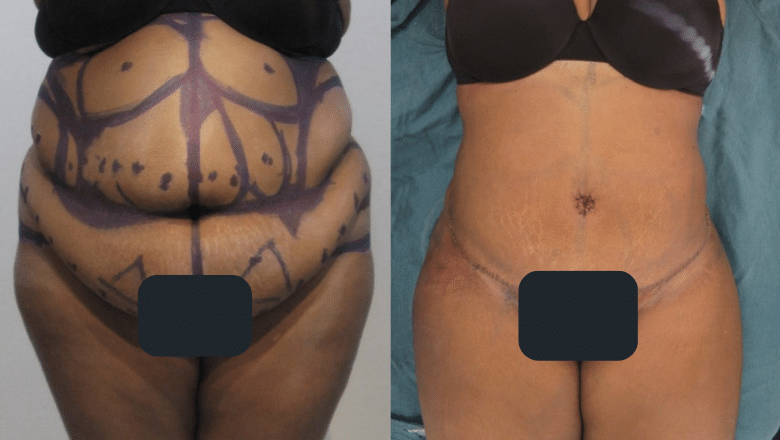
You can see more abdominal results in our tummy tuck before and after photos and the wider before and after gallery.
Frequently Asked Questions
What is a reverse tummy tuck?
A reverse tummy tuck is an operation that removes loose skin and some fat from the upper abdomen, above the belly button, through an incision in the crease under the breasts. The skin is pulled upwards rather than downwards, so the scar sits in the breast fold instead of along the bikini line.
Where is the scar after a reverse tummy tuck?
In the crease under the breasts, as two curved lines or one continuous line across the midline. It is usually hidden by a bra or bikini top and fades over 12 to 18 months.
How long does reverse tummy tuck recovery take?
Most people return to desk work after about two weeks, avoid strenuous exercise for four to six weeks and return to their full routine by six to eight weeks. Recovery is usually shorter than after a full tummy tuck.
What is an extended tummy tuck?
An extended tummy tuck is a larger version of the standard tummy tuck, with a longer scar that runs around the hips to remove loose skin from the flanks as well as the front of the abdomen. It is usually done after major weight loss, and it treats the lower and side abdomen rather than the upper abdomen.
Can a tummy tuck grow back?
The skin and fat removed in a tummy tuck do not grow back. Weight gain, a further pregnancy or ageing can stretch the remaining skin and add fat to the area, so the result lasts best at a stable weight. Our article on how long mummy makeover results last explains what affects longevity.
Can you have a reverse tummy tuck after a full tummy tuck?
Yes, and this is one of the more common reasons for it. Some people are left with loose skin above the belly button after a standard tummy tuck or liposuction, and a reverse tummy tuck can tighten this through the breast crease without reopening the lower scar.
References
- Pacifico MD, Mahendru S, Teixeira RP, et al. Refining trunk contouring with reverse abdominoplasty. Aesthet Surg J. 2010;30(2):225-234. doi:10.1177/1090820X10369690 ↗
- Deos MF, Arnt RA, Gus EI. Tensioned reverse abdominoplasty. Plast Reconstr Surg. 2009;124(6):2134-2141. doi:10.1097/PRS.0b013e3181bf8353 ↗
- Deos M. Inframammary fold control in tensioned reverse abdominoplasty: an anatomical reference for integrated breast and abdominal planning. Aesthet Surg J. 2026. doi:10.1093/asj/sjag220 ↗
- Gil Perez LA, Qaraqra A. The Gil classification: a novel anatomical and surgical staging system for reverse abdominoplasty. Cureus. 2026;18(9):e115724. doi:10.7759/cureus.115724 ↗
Talk to a Surgeon About a Reverse Tummy Tuck
We offer reverse tummy tuck surgery at Centre for Surgery. If you have loose skin above your belly button and want to know whether a reverse tummy tuck or another type of tummy tuck would suit you, you can book a consultation at our Baker Street clinic by calling 020 7993 4849 or using the form below. You can also read about costs in our tummy tuck cost guide.







