


In this guide11 sections
- Who Is a Good Candidate for a Non-Surgical Tummy Tuck?
- Is a Non-Surgical Tummy Tuck Effective?
- The One Factor That Rules Out a Non-Surgical Tummy Tuck
- What Are the Non-Surgical Options at Centre for Surgery?
- What Happens During a Non-Surgical Tummy Tuck Session?
- Surgical Tummy Tuck vs Non-Surgical Tummy Tuck
- Recovery After Non-Surgical Tummy Tuck Treatments
- How Long Do Results Last?
- How Much Does a Non-Surgical Tummy Tuck Cost?
- Frequently Asked Questions
- Non-Surgical and Surgical Tummy Tucks at Centre for Surgery
Non-surgical tummy tuck treatments have grown in popularity over the last few years, with many patients unable or unwilling to undergo a more invasive surgical tummy tuck or mini tummy tuck. But does a non-surgical tummy tuck actually work, and for whom? This guide covers exactly what non-invasive tummy tuck treatments can and can’t achieve, who’s genuinely a good candidate, the specific technologies we use at Centre for Surgery, the one clinical factor that rules non-surgical options out entirely, what treatment and recovery actually involve, honest pricing, and how to know which route is right for you.
At our Baker Street clinic, our aesthetic practitioners offer Morpheus8 microneedling radiofrequency for patients with mild skin laxity and modest excess fat. Patients with mild to moderate skin laxity may also be ideal candidates for Argo Plasma or BodyTite radiofrequency skin tightening.
Who Is a Good Candidate for a Non-Surgical Tummy Tuck?
Non-surgical tummy tuck treatments suit a fairly specific profile, and being honest about that upfront saves everyone’s time. You’re likely to be a good candidate if you:
- Have mild to moderate skin laxity, without significant loose, hanging skin
- Have modest, localised excess fat rather than a larger volume needing removal
- Have no diastasis recti (separated abdominal muscles) — see below for why this matters so much
- Are at or near a stable weight, with realistic expectations about a gradual, subtler improvement rather than a dramatic transformation
- Want to avoid the incisions, scarring, and multi-week recovery that come with surgery
If your main concern is significant loose skin, a larger volume of excess fat, or you suspect your abdominal muscles have separated, a consultation will usually point you toward a mini tummy tuck or full tummy tuck instead — and we’d rather tell you that honestly at consultation than sell you a course of non-surgical treatment that was never going to deliver what you’re after.
Is a Non-Surgical Tummy Tuck Effective?
Non-surgical tummy tuck treatments cannot achieve the results of a surgical tummy tuck, also known as abdominoplasty. Tummy tuck surgery achieves dramatic, long-lasting results with a very high patient satisfaction rate.


Non-surgical, non-invasive tummy tuck treatments can be genuinely effective for appropriately selected patients with minimal skin laxity and small, localised fat deposits. For most patients with more generalised skin laxity and loose, wrinkly skin, the ideal treatment is a full tummy tuck; for those with localised skin laxity confined to the lower abdomen, a mini tummy tuck is usually preferred.
If you are weighing up surgery instead, we separate fact from fiction in five common tummy tuck myths.
The One Factor That Rules Out a Non-Surgical Tummy Tuck
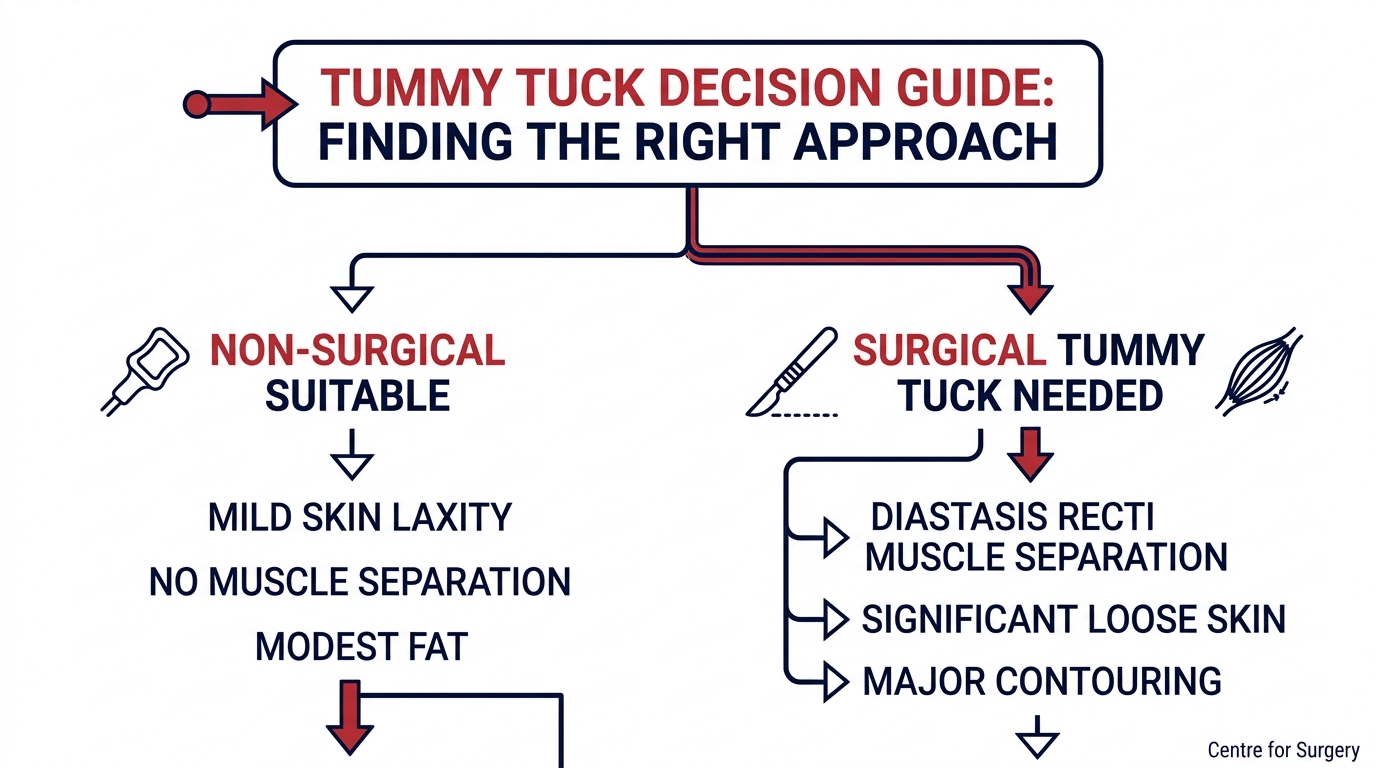
Skin laxity and fat volume are only part of the picture. The factor that decides this more definitively than anything else is whether the abdominal muscles themselves have separated — a condition called diastasis recti, common after pregnancy or significant weight fluctuation. No non-surgical treatment, however advanced, can repair separated muscle. Radiofrequency, microneedling, and plasma energy all work on the skin and superficial fat layer; none of them reach the muscle layer beneath. If diastasis recti is present, a surgical tummy tuck is the only treatment that will actually resolve it, since the muscles are surgically brought back together and stitched in their correct position.
Your surgeon or practitioner will check for this specifically during your consultation, usually by asking you to lift your head off the couch and feeling for a gap or bulge along the midline. If you’re not sure whether this applies to you, it’s worth having it checked before pursuing a non-surgical route, since no amount of non-invasive treatment will fix a genuine muscle separation.
What Are the Non-Surgical Options at Centre for Surgery?
Morpheus8
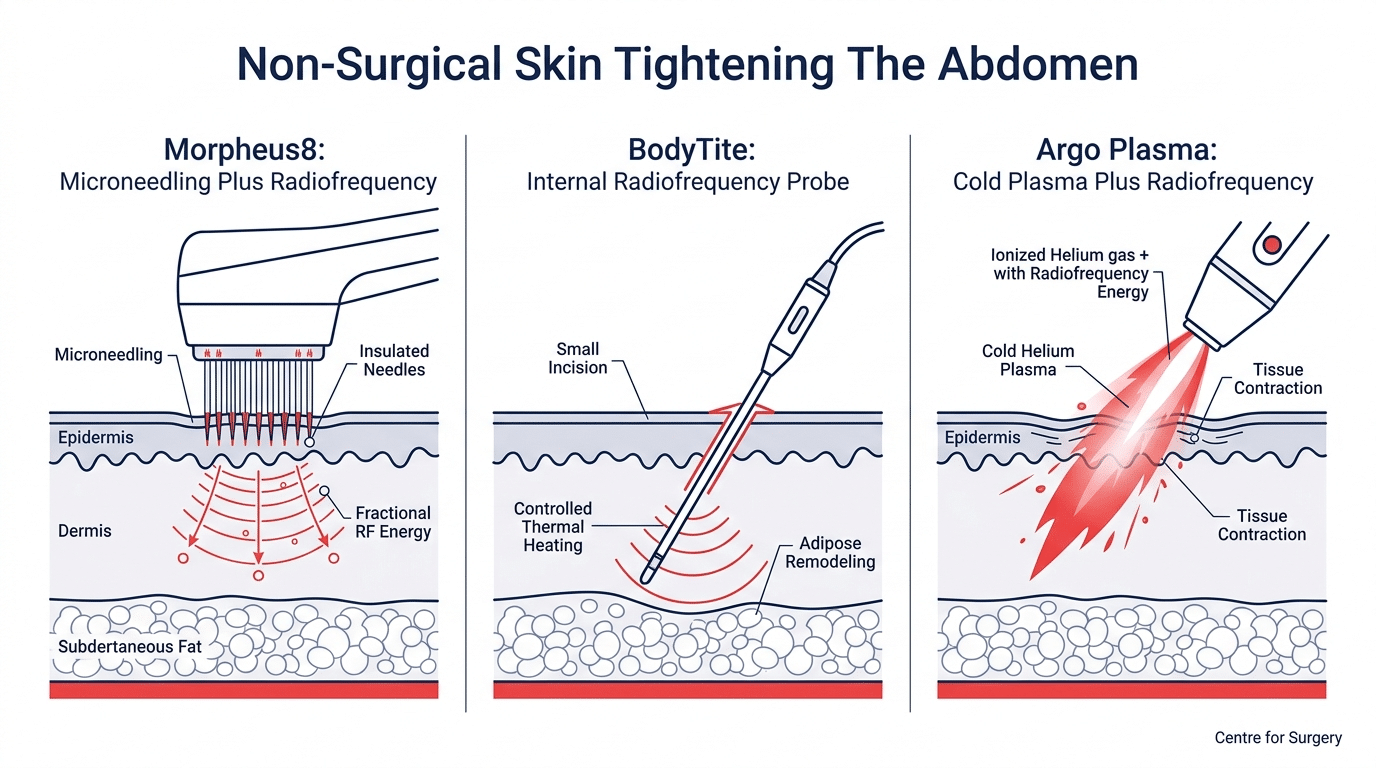
Morpheus8 combines microneedling with radiofrequency energy, delivering heat beneath the skin’s surface to remodel and contour tissue while stimulating new collagen and elastin production. Morpheus8 can be performed with a topical anaesthetic, taking approximately 60 minutes to treat the entire abdomen. Most patients notice favourable improvements after a course of around three sessions, spaced several weeks apart.
BodyTite
BodyTite involves the insertion of a specialised probe beneath the skin, followed by the application of bipolar radiofrequency energy that heats tissue from underneath while simultaneously removing a modest amount of fat, stimulating collagen and elastin production for tighter, firmer skin. It works from beneath the skin rather than only on the surface, so BodyTite tends to produce a more pronounced tightening effect than surface-only treatments, in exchange for being a more involved procedure requiring local anaesthetic and small incisions. Current pricing is set out in our BodyTite cost guide.
Argo Plasma
Argo Plasma combines cold plasma energy with radiofrequency to tighten skin through small incisions, and can be combined with BodyTite or Morpheus8 for even more comprehensive skin tightening without the need for more invasive surgery. Current pricing is set out in our Argo Plasma cost guide.
Unfortunately, several ineffective treatments marketed as “non-surgical tummy tucks” — including low-intensity cold-based fat treatments and unregulated at-home devices — are inappropriately promoted to prospective patients and are either largely ineffective or carry undesirable side effects when performed by inexperienced practitioners. It’s worth researching the specific treatment, the practitioner performing it, and the clinic itself before committing to any non-surgical body contouring treatment.
What Happens During a Non-Surgical Tummy Tuck Session?
The specific steps vary slightly by treatment, but the overall pattern is similar across Morpheus8, BodyTite, and Argo Plasma. Your practitioner first assesses the treatment area and marks it out. Anaesthetic is then applied — a topical numbing cream for Morpheus8, or local anaesthetic for the small incisions used in BodyTite and Argo Plasma. The device is then passed over (or, for BodyTite and Argo Plasma, worked beneath) the treatment area, delivering controlled energy to the target depth. Most sessions take between 45 and 90 minutes depending on the area size and technique. There’s no general anaesthetic and no hospital stay involved — you’re able to leave shortly after treatment and resume most normal activities the same day.
Surgical Tummy Tuck vs Non-Surgical Tummy Tuck
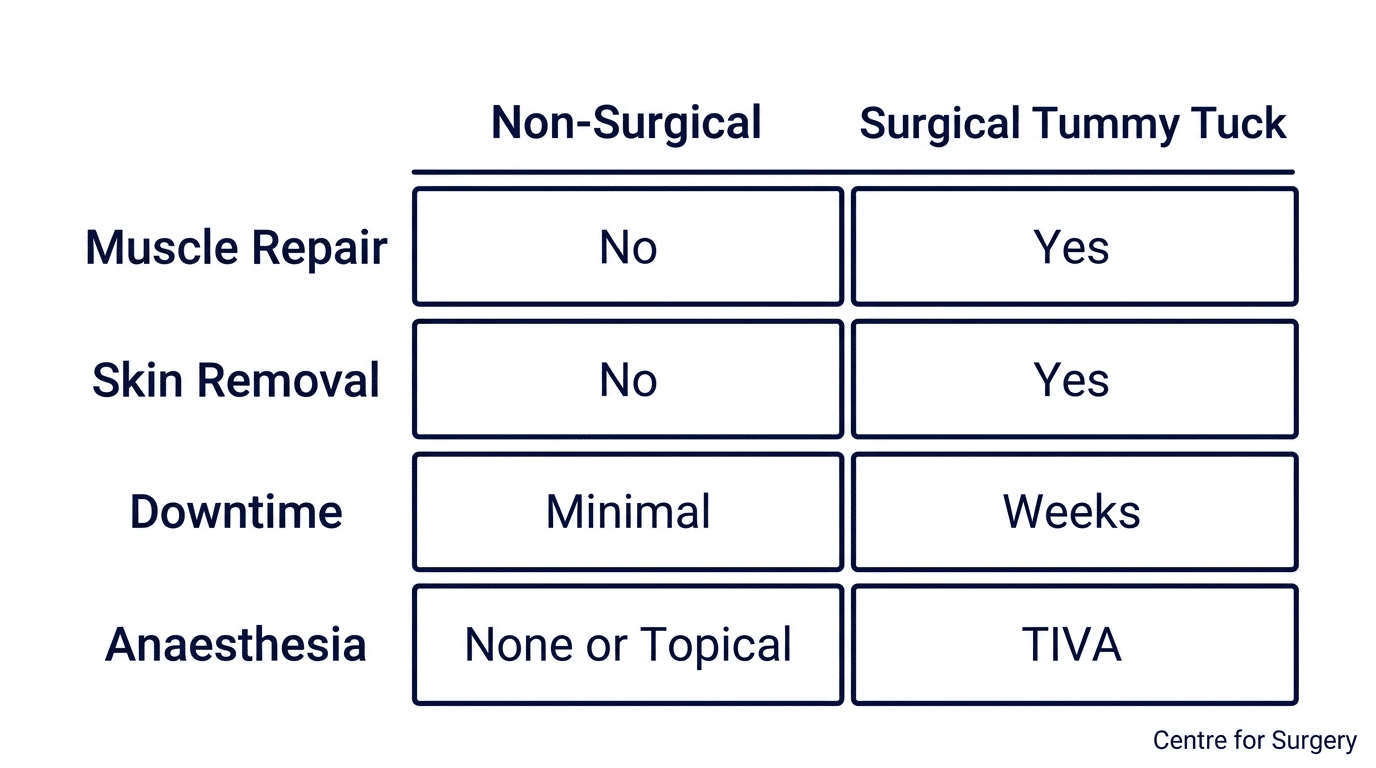
Tummy tuck surgery, including the Brazilian tummy tuck, involves a horizontal incision across the lower abdomen, followed by meticulous separation of the skin and fat from the underlying abdominal muscles. Where present, weakened or separated abdominal muscles are surgically repaired, before excess skin is removed. The skin is then carefully resutured while a new belly button is reconstructed. Tummy tuck surgery is carried out under TIVA (Total Intravenous Anaesthesia) — a well-established form of anaesthesia for day surgery, which eliminates many of the disadvantages associated with a traditional gas-based general anaesthetic.


Abdominoplasty surgery produces significant and long-lasting results as long as patients maintain a stable weight afterwards, with most patients noticing a significant improvement in body shape immediately after the procedure. Non-surgical tummy tuck treatments can produce genuinely effective results in appropriately selected patients who don’t need — or want — the more dramatic results only surgery can deliver. Many patients find the lack of incisions, scars, and downtime an attractive feature of non-surgical tummy tuck treatments.
Recovery After Non-Surgical Tummy Tuck Treatments
Recovery is one of the biggest genuine advantages non-surgical treatments have over surgery, and it’s worth setting out clearly what to expect. After Morpheus8, mild redness and slight swelling are common for 24 to 48 hours, similar to a moderate sunburn — most patients return to work and normal activities the same or next day, with only light makeup avoided for a day or so. After BodyTite or Argo Plasma, you can expect some swelling, mild bruising, and tenderness around the small incision sites for around one to two weeks, with a compression garment worn during this period to support the area and help the skin settle. Strenuous exercise is usually avoided for two to three weeks, though most patients are back to desk-based work within a few days.
Compare this with a full surgical tummy tuck, where most patients need one to two weeks before returning to work and around four to six weeks before resuming strenuous exercise — the non-surgical route is meaningfully faster to recover from, which is exactly why it appeals to patients who are candidates for it.
How Long Do Results Last?
Results from non-surgical skin-tightening treatments build gradually as collagen and elastin production increases over the weeks following treatment, typically becoming most visible around six to twelve weeks after a course is complete. Once achieved, results are generally long-lasting provided your weight stays stable, though the skin will continue to age naturally over time — most patients find the effect holds well for a year or more, with some choosing an occasional top-up session to maintain it. This is different from surgical tummy tuck results, where the skin and muscle changes are structural and permanent, aside from the ordinary ageing process.
How Much Does a Non-Surgical Tummy Tuck Cost?
- Argo Plasma skin tightening
- BodyTite
- Morpheus8: priced per session, confirmed at consultation based on the number of sessions your skin needs
- Full surgical tummy tuck (for comparison) — includes muscle repair and liposuction as standard
All packages include your practitioner or surgeon’s fee, any required anaesthesia, and follow-up review at our CQC-regulated Baker Street facility. Finance is available through Chrysalis Finance, subject to status. Non-surgical tummy tuck treatment is cosmetic and isn’t available on the NHS or covered by private medical insurance.
Frequently Asked Questions
Does a non-surgical tummy tuck actually work?
Yes, for the right candidate — someone with mild skin laxity, modest localised fat, and no muscle separation. It genuinely cannot replicate what surgery achieves for more significant skin excess or diastasis recti, and any provider claiming otherwise should be treated with caution.
How do I know if I need surgery instead of a non-surgical treatment?
The clearest sign is diastasis recti — separated abdominal muscles, usually from pregnancy or significant weight change. No non-surgical treatment can repair this; only a surgical tummy tuck can. Significant loose, hanging skin is the other main indicator that surgery, not a non-invasive treatment, is what’s actually needed.
Is a non-surgical tummy tuck painful?
Generally no. Morpheus8 is performed with topical anaesthetic and most patients describe mild heat and pressure rather than pain. BodyTite and Argo Plasma involve local anaesthetic for the small incisions used, keeping the procedure comfortable throughout.
How many sessions of Morpheus8 will I need?
Most patients notice favourable improvement after around three sessions, spaced several weeks apart to allow the skin to respond to each treatment. Your practitioner will confirm an expected number at consultation based on your skin’s starting point.
Can non-surgical tummy tuck treatments be combined?
Yes — BodyTite and Argo Plasma are often combined for more comprehensive skin tightening than either alone, and Morpheus8 can be layered in as a further course of sessions. Your practitioner will recommend a combination based on your skin quality and goals.
What’s the difference between a non-invasive tummy tuck and a non-surgical tummy tuck?
These terms are generally used interchangeably to describe the same category of treatment — Morpheus8, BodyTite, Argo Plasma, and similar radiofrequency or energy-based skin tightening options that avoid the incisions and downtime of surgery.
How long is recovery after a non-surgical tummy tuck compared to surgery?
Non-surgical treatments involve days, not weeks — Morpheus8 patients are often back to normal activity within 24 to 48 hours, and BodyTite or Argo Plasma within one to two weeks. A full surgical tummy tuck typically needs one to two weeks before returning to work and four to six weeks before resuming strenuous exercise.
Non-Surgical and Surgical Tummy Tucks at Centre for Surgery
Centre for Surgery is fortunate to offer both surgical and non-surgical tummy tuck options at our Marylebone site in central London, with treatments delivered by our aesthetic practitioners and GMC-registered plastic surgeons, at our CQC-regulated facility rated Good overall. Our medical content is reviewed by Specialist Plastic Surgeon Dr Spyridon Vlachos (GMC 7522950).
If you are keen to learn more about options for a non-surgical tummy tuck, please get in touch today to book a face-to-face consultation with an expert aesthetic practitioner at our Baker Street clinic in London.

Related Articles
- Liposuction in London
- How Long Does It Take After Liposuction To Be Swimsuit Ready?
- How long is Abdominoplasty Recovery?






