


In this guide17 sections
- Key Points
- How Long Is Breast Implant Removal Recovery?
- Does the Type of Explant Surgery Change Recovery?
- Breast Implant Removal Recovery Timeline: Week by Week
- Recovery After Breast Implant Replacement
- Explant Surgery With a Breast Lift or Fat Transfer
- What Do Breasts Look Like After Implant Removal?
- Drains, Stitches and Scars After Breast Implant Removal
- Surgical Bra and Compression After Explant Surgery
- When Can I Exercise After Breast Implant Removal?
- Sleeping, Driving, Work and Showering After Explant Surgery
- How to Prepare for Breast Implant Removal
- Breast Implant Removal Aftercare: Dos and Don’ts
- When to Contact Your Surgeon After Breast Implant Removal
- Breast Implant Removal Recovery FAQs
- Breast Implant Removal in London
- References
Key Points
- How long is breast implant removal recovery? Most people return to desk work within five to ten days and to full exercise at three to six weeks. The breasts keep changing shape for three to six months, and scars mature over a year.
- Does the type of surgery change recovery time? Yes. Removal alone is the quickest recovery. A capsulectomy, new implants or a breast lift each add healing time.
- Will I need drains? Not usually after simple removal. Drains are sometimes placed after a capsulectomy and are normally removed within a few days.
- How long do I wear a surgical bra? Day and night, usually for around six weeks, taking it off only to shower. Your surgeon may shorten or extend this.
- When can I drive and exercise? Driving from about one week, once you can brake and turn the wheel without pain. Walking from day one, light exercise from two to four weeks and upper body work from about six weeks.
- What will my breasts look like after explant surgery? Flatter and softer at first. Skin and breast tissue retract over the following months, and a lift or fat transfer can be added if needed.
Breast implant removal recovery is usually shorter than recovery from the original augmentation. After breast implant removal (explant surgery) most people are back at desk work within about a week and back to normal exercise by six weeks. How long it takes for you depends on what else is done at the same time: removing the capsule, fitting new implants or lifting the breast all add to the healing time.
This guide covers the breast implant removal recovery timeline week by week, how each type of explant surgery changes it, recovery after breast implant replacement, drains, the surgical bra, exercise, driving and the warning signs to look out for. If you are still deciding which operation is right for you, our guide to breast implant removal vs replacement compares the two. For advice that applies to every operation, see our recovery after cosmetic surgery hub.
How Long Is Breast Implant Removal Recovery?
For a simple explant, where only the implants are taken out, most people are back at desk work within five to seven days and back to full exercise at three to four weeks. With a capsulectomy, most people return to desk work within seven to ten days and to full exercise at about six weeks. Adding a breast lift brings the recovery in line with a lift on its own, with a surgical bra worn for six weeks.
Those milestones are broadly in line with the NHS guidance on recovering from breast implant surgery ↗, which advises a week or two off work, no driving for at least a week and no heavy lifting or strenuous exercise for at least a month. The final appearance takes longer: the skin and breast tissue continue to retract and settle for three to six months, and scars keep softening and fading for a year or more.
Does the Type of Explant Surgery Change Recovery?
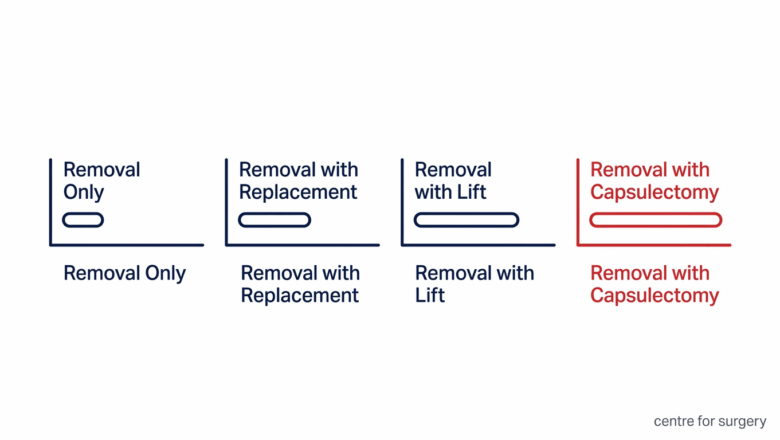
Yes, and it is the biggest single factor in how your recovery goes. Explant surgery is not one operation but several, and your surgeon will recommend the right one for your implants, your capsule and your goals at consultation[1].
- Removal only (simple explantation). The implants are taken out and the capsule, the layer of scar tissue the body forms around every implant, is left in place. This is the quickest recovery, and swelling usually settles within the first ten days.
- Removal with capsulectomy. Part or all of the capsule is removed as well, which is usually advised for capsular contracture or a ruptured implant. More tissue is removed, so there is more swelling and soreness, drains are sometimes used and recovery is closer to that of the original augmentation. An en bloc capsulectomy, which removes implant and capsule together in one piece, is the most extensive option and has the longest recovery of the group.
- Removal with replacement. New implants have to settle into position, so the chest often feels tight for the first two to three weeks.
- Removal with a breast lift or fat transfer. These improve the shape left behind once the implants are out, but they add incisions or a donor site, so recovery follows the timeline of the added procedure.
More extensive surgery does not always mean more complications. In a 2024 study of 384 women in Plastic and Reconstructive Surgery ↗ who had textured implants removed or exchanged, how much of the capsule was removed made no significant difference to complication rates. Complications were most common after removal without replacement, mostly minor problems such as a seroma (a collection of fluid in the space where the implant was)[2]. That is one reason your surgeon may use a drain or ask you to wear your surgical bra carefully.
Your implant removal and replacement recovery dates
Add your operation date to see the milestones in this guide as dates, then save them to your phone's calendar.
Breast Implant Removal Recovery Timeline: Week by Week

Recovery after breast implant removal varies from person to person and with the type of operation, but most people follow a similar pattern. Always follow your own surgeon’s instructions where they differ from the timings below.
Day of surgery
Breast implant removal is usually a day case at our CQC-regulated Baker Street hospital, typically under TIVA (total intravenous anaesthesia), although the anaesthetic for your operation is decided by your surgeon and anaesthetist; our guide to anaesthesia for cosmetic surgery explains the options. You go home once you are comfortable, eating and drinking, wearing your surgical bra. A responsible adult must take you home and stay with you for 24 hours, and you are given your surgeon’s direct number for the first 24 hours on your discharge summary.
Days 1–3
Expect tightness, soreness and swelling across the chest, usually controlled with the painkillers you are prescribed. If your implants were under the muscle, the chest wall and the area around the ribs may ache. Rest with your upper body raised, take short walks around the house every few hours to keep your circulation going, and avoid lifting anything heavier than a kettle.
Week 1
Discomfort eases steadily. Most stitches are dissolvable, and any drains are usually removed within the first few days, once the fluid has slowed. Keep dressings clean and dry as instructed. After a simple removal, many people are back at desk work by day five to seven. Mild itching around the incisions is a normal part of healing; avoid scratching.
Week 2
Bruising fades and swelling continues to go down. You can usually shower normally, and after a capsulectomy most people return to desk work during this week. Driving is usually possible once you are off strong painkillers and can wear a seatbelt and turn the wheel comfortably, normally from about a week.
Weeks 3–4
You should feel more energetic and be back to most daily activities. After a simple removal, many people can return to full exercise from three to four weeks if their surgeon agrees. After a capsulectomy, replacement or lift, keep to walking, a static bike and lower body work. If you have new implants, some tightness is normal as the tissues adjust.
Weeks 5–8
Most swelling has settled and the incisions have healed. Around six weeks you have a review with your surgeon, and most people are cleared to return to their full exercise routine, including upper body training, and to stop wearing the surgical bra at night. If you had a lift as well, your surgeon may ask you to keep wearing the bra a little longer.
3–12 months
The breasts continue to change shape as the skin and breast tissue retract, so judge the result at three to six months rather than in the first few weeks. Scars go through a red or pink phase before they soften and fade, which can take a year or more.
Recovery After Breast Implant Replacement
Breast implant replacement (implant exchange) follows a timeline close to the original breast augmentation: back to desk work in one to two weeks, gentle exercise from two to four weeks and full exercise, including upper body work, from about six weeks. Our breast augmentation recovery guide covers that timeline in detail. The chest often feels tight for the first two to three weeks as the tissues adjust around the new implants, and the implants take a few months to soften and settle into their final position.
If you are having implants replaced because of capsular contracture, your surgeon may change the pocket the implant sits in as well as removing the capsule. A 2016 systematic review in Plastic and Reconstructive Surgery ↗ found that changing the implant pocket and exchanging the implant were associated with lower rates of the contracture coming back, while the evidence for capsulectomy on its own was less clear[3].
When we fit new implants, we use Silimed breast implants, which come with a 10-year warranty covering grade III–IV capsular contracture and rupture. We submit implant operations to the Breast and Cosmetic Implant Registry ↗, which allows patients to be traced if a safety concern is ever raised about a type of implant.
Explant Surgery With a Breast Lift or Fat Transfer
Once implants are removed, some people are left with loose skin or a lower nipple position, especially after larger implants, several pregnancies or many years with implants. A breast lift at the same operation tightens the skin and raises the nipple, and fat transfer to the breasts can restore some volume using your own fat.
Both make recovery longer. With a lift, recovery follows the lift timeline: you wear the surgical bra day and night for about six weeks, avoid lifting and strenuous exercise for six weeks, and have more incisions to look after. Our breast lift recovery guide covers that in detail. With fat transfer, you also have a liposuction area to recover from, usually with a compression garment, and some of the transferred fat is reabsorbed over the first few months. Some people prefer to wait several months after removal to see how much the breasts retract before deciding on a lift.
What Do Breasts Look Like After Implant Removal?
Straight after explant surgery the breasts usually look flatter, softer and sometimes deflated or slightly wrinkled. This is expected: the skin was stretched to hold the implants and needs time to retract. Over the next three to six months the tissue settles and the shape usually improves, sometimes considerably.
How your breasts look in the end depends on the size of your implants, how long you have had them, your skin quality, and changes such as pregnancy and weight loss, so the result varies widely between people[1]. Your surgeon will examine you at consultation and tell you honestly whether removal alone is likely to give a shape you are happy with, or whether a lift or fat transfer is worth considering.
Drains, Stitches and Scars After Breast Implant Removal
Drains are not usually needed after a simple removal. After a capsulectomy, your surgeon may place a thin drain on each side to let fluid escape while the space where the implant sat closes down. Drains are usually removed within a few days, once the amount of fluid has dropped.
Most incisions are closed with dissolvable stitches, so there is nothing to remove. Where possible, your surgeon uses the scar from your original augmentation, usually in the crease under the breast, so explant surgery often adds little new scarring. A lift adds scars around the areola and sometimes down to the crease. Keep scars out of the sun, covered or with high-factor sunscreen once healed, for at least a year, as UV light can darken them.
Surgical Bra and Compression After Explant Surgery
You wear a soft, supportive surgical bra day and night, usually for around six weeks, taking it off only to shower. It supports the tissues, reduces swelling and helps the breast skin settle evenly over the space left by the implants. Avoid underwired bras until your surgeon is happy. Compression garments and prescribed medications are bought separately, and we confirm what you need in advance. Our guide to the compression bra after breast surgery explains what to buy and how it should fit.
When Can I Exercise After Breast Implant Removal?
Walking is encouraged from the first day, because gentle movement improves circulation and lowers the risk of blood clots. After that, build up gradually:
- Weeks 1–2: walking only, increasing the distance as you feel able. No lifting, pushing or pulling.
- Weeks 2–4: brisk walking, a static bike and lower body exercise that does not bounce or strain the chest.
- Weeks 3–4 (simple removal): most people can return to full exercise if their surgeon agrees.
- Week 6 onwards (capsulectomy, replacement or lift): running, swimming, upper body weights and press-ups, built up gradually.
Stop if anything causes pain or new swelling. Our guide to exercising after cosmetic surgery explains how to return to training safely.
Sleeping, Driving, Work and Showering After Explant Surgery
Sleeping
Sleep on your back with your head and shoulders raised on two or three pillows for the first two weeks or so. Avoid sleeping on your front until your surgeon is happy, usually around six weeks, and longer if you have new implants.
Driving
Do not drive for at least 24 hours after an anaesthetic or sedation, and for at least a week after breast implant removal. You need to be off painkillers that cause drowsiness and able to wear a seatbelt, turn the wheel and brake hard without pain. Check your insurance policy, as some insurers set their own rules after surgery.
Going back to work
Most people return to desk work within five to ten days. Jobs that involve lifting, carrying or caring for others usually need two to six weeks, depending on the operation.
Showering and bathing
You can usually shower within a day or two, following your surgeon’s advice on dressings. Avoid baths, swimming pools and hot tubs until the incisions have fully healed, usually at least three to four weeks.
How to Prepare for Breast Implant Removal
Good preparation makes recovery smoother.
- Consultation and assessment. Your consultant examines your breasts, discusses your goals and explains which type of explant surgery suits you. If a scan is needed to check for rupture, an ultrasound or MRI is arranged off site.
- Stop smoking and nicotine for at least four weeks before and four weeks after surgery, because nicotine restricts blood flow and slows healing.
- Review your medicines. Some medicines, including blood thinners, raise the risk of bleeding. Aspirin is usually stopped two weeks before surgery, but only on medical advice; your surgeon will tell you what to stop and when.
- Arrange help at home. A responsible adult must take you home and stay with you for 24 hours. Help with shopping, children and housework for the first week makes a real difference.
- Get your recovery space ready, with pillows to keep you propped up, loose front-fastening tops and everything you need within easy reach.
- Allow time to decide. We recommend a two-week cooling-off period between your consultation and surgery.
Breast Implant Removal Aftercare: Dos and Don’ts
Do
- Take your medication as prescribed and check with your surgical team before taking anything else over the counter.
- Eat well. Protein (chicken, fish, eggs, beans and lentils), fruit, vegetables and whole grains support healing, and plenty of water helps your body recover.
- Keep your incisions clean and dry, and follow your surgeon’s instructions on dressings and any creams.
- Attend your follow-up appointments, so that any problem is picked up early.
- Look after your emotional health. Many people feel relieved after explant surgery, but it is also normal to feel unsure about how your breasts look in the early weeks. Lean on your support network and talk to your surgical team if you are worried.
Don’t
- Lift, push or pull anything heavy for at least two weeks, and for six weeks after a capsulectomy, replacement or lift.
- Smoke or vape nicotine for at least four weeks after surgery.
- Drink alcohol in the first week or while taking strong painkillers, as it can worsen swelling and does not mix with some medicines.
- Soak in a bath or swim until your incisions have fully healed.
- Expose your scars to the sun, as UV light can darken them.
When to Contact Your Surgeon After Breast Implant Removal
Serious problems after explant surgery are uncommon. In a 2021 study of 248 women in Plastic and Reconstructive Surgery Global Open ↗ who had their implants removed with a capsulectomy, three (1%) had a haematoma (a collection of blood) needing a return to theatre, two (0.8%) had a blood clot in the leg and one (0.4%) had a pneumothorax, an air leak around the lung[4]. Contact your surgical team straight away if you have:
- sudden swelling, firmness or bruising on one side, which can be a sign of bleeding
- heavy bleeding from a wound or a drain
- a temperature, spreading redness, heat or discharge from an incision
- pain that is getting worse rather than better after the first few days
- a painful, swollen calf, or breathlessness (call 999 for chest pain or difficulty breathing); the NHS guidance on DVT ↗ explains the symptoms of a blood clot
For the first 24 hours, call your surgeon on the direct number on your discharge summary. After that, call the clinic on 020 7993 4849, 9am–6pm Monday to Saturday, and NHS 111 out of hours, or 999 in an emergency.
Breast Implant Removal Recovery FAQs
How long does it take to recover from breast implant removal and replacement?
Most people return to desk work within one to two weeks and to full exercise, including upper body work, at around six weeks. The new implants take a few months to soften and settle, so the final result is judged at three to six months.
Is breast implant removal major surgery?
It is a proper operation under anaesthetic, but it is usually a day case. A simple removal is one of the shorter breast operations, while a capsulectomy, en bloc removal or combined lift takes longer and has a longer recovery.
How painful is breast implant removal?
Most people describe tightness and soreness rather than severe pain, worst in the first two to three days and controlled with prescribed painkillers. A capsulectomy or a lift tends to cause more discomfort than removal alone, and the chest wall may ache if your implants were under the muscle.
What should you not do after breast implant removal?
Avoid lifting, strenuous exercise and upper body workouts until your surgeon clears you, usually three to six weeks depending on the operation. Do not smoke, soak in a bath, sleep on your front or leave off your surgical bra in the early weeks.
Will I feel better after breast implant removal?
If your implants were causing pain from capsular contracture, removal usually relieves it. For symptoms attributed to breast implant illness, such as fatigue and joint pain, many people report improvement after explantation, but the evidence comes mainly from observational studies and not everyone improves[5]. In the study of 248 women above, 90% reported high satisfaction with the outcome[4].
Do you lose weight after breast implant removal?
Only by the weight of the implants themselves. A silicone implant weighs roughly the same in grams as its volume in cc, so a pair of 400 cc implants weighs a little under a kilogram. Any further change in weight is down to diet and activity during recovery.
Will I need a breast lift after breast implant removal?
Not always. If you had large implants, have had them for many years or your skin is less elastic, the breasts are more likely to look deflated once the implants are out. Your surgeon can advise whether a lift at the same time, or later once the tissues have settled, is likely to help.
How often do breast implants need to be replaced?
There is no fixed expiry date. Implants are not lifetime devices, and the NHS notes that some people need further surgery after about 10 years. If your implants are not causing problems, their age alone is not usually a reason to remove them. Our guide to how long breast implants last explains the signs that they may need attention.
Is itching normal after explant surgery?
Yes. Mild itching around the incisions is a normal sign of healing. Avoid scratching, and contact your surgical team if it becomes severe or comes with a rash, redness or heat.
Breast Implant Removal in London
Breast implant removal and replacement at Centre for Surgery are performed by GMC-registered surgeons at our CQC-regulated Baker Street hospital, rated Good overall by the CQC. The consultant who assesses you at consultation is the consultant who performs your surgery, and you have follow-up reviews as you heal. Implant removal can be done alone or with a capsulectomy, new implants, a breast lift or fat transfer, as agreed at your consultation. Your initial consultation is £100, redeemable against the cost of surgery if you go ahead; our breast implant removal cost guide explains what the price includes, and our breast implant removal page explains the options in more detail.
Phone: 020 7993 4849 | Address: 95–97 Baker Street, Marylebone, London W1U 6RN
Contact us to schedule a consultation
References
- Tanna N, Calobrace MB, Clemens MW, et al. Not all breast explants are equal: contemporary strategies in breast explantation surgery. Plastic and Reconstructive Surgery 2021;147(4):808–818. doi:10.1097/PRS.0000000000007784
- Plotsker EL, Stern CS, Graziano FD, et al. Surgical management of textured breast implants: assessing risk and analyzing patient-reported outcomes. Plastic and Reconstructive Surgery 2024;154(1):39–52. doi:10.1097/PRS.0000000000010957
- Wan D, Rohrich RJ. Revisiting the management of capsular contracture in breast augmentation: a systematic review. Plastic and Reconstructive Surgery 2016;137(3):826–841. doi:10.1097/01.prs.0000480095.23356.ae
- Katsnelson JY, Spaniol JR, Buinewicz JC, et al. Outcomes of implant removal and capsulectomy for breast implant illness in 248 patients. Plastic and Reconstructive Surgery Global Open 2021;9(9):e3813. doi:10.1097/GOX.0000000000003813
- Alabdulkarim A, Albalawi IAS, Al Qurashi AA, et al. Comprehensive systematic review of breast implant illness: symptoms, management, and long-term outcomes. Aesthetic Plastic Surgery 2025;49(1):169–183. doi:10.1007/s00266-024-04129-4



