

In this guide15 sections
- Key Points
- Can You Lift Your Breasts Without Implants?
- What a Breast Lift Without Implants Can and Can’t Do
- Who Is a Good Candidate for a Breast Lift Without Implants?
- Can You Get Breast Implants Without a Lift?
- How to Tell Whether You Need a Lift, Implants or Both
- How to Get Fuller Breasts Without Implants
- Breast Lift Without Implants: Surgery and Recovery
- Is a Breast Lift Safer Than Implants?
- How Long Does a Breast Lift Without Implants Last?
- Breast Lift Without Implants Before and After
- Breast Lift Without Implants Cost
- Frequently Asked Questions
- Breast Lift at Centre for Surgery
- References
Key Points
- You can lift your breasts without implants. A breast lift (mastopexy) raises the breast and nipple and removes loose skin using your own tissue. Implants are only needed if you also want more volume.
- A lift on its own does not add size. Skin is removed, so many women find their breasts look slightly smaller afterwards. It suits women who are happy with their size but not with how low their breasts sit.
- Implants without a lift only work when sagging is mild. If your nipple sits at or above the crease under your breast, implants alone may be enough. If it sits below the crease, you will usually need a lift.
- Implants do not raise the nipple. In a study that measured 196 women before and after surgery, breast augmentation left the nipple at the same level; only operations that included a lift raised it.
- You can add some fullness without implants. A lift with auto-augmentation or with fat transfer can improve upper-breast fullness using your own tissue.
- A lift alone avoids implant risks. There is no capsular contracture, rupture or implant replacement to think about, and major complications after cosmetic breast surgery are uncommon.
Two of the most common questions we hear about sagging breasts are mirror images of each other: “Can I have a breast lift without implants?” and “Can I have implants without a lift?” The answer to both depends on the same two things: how far your breasts have dropped, and whether you’ve lost volume.
This guide explains what a breast lift can achieve on its own, when breast implants can work without a lift, and how to get fuller breasts without implants. If you’re weighing up all three options, including a lift with implants, our guide to breast lift vs breast augmentation compares them side by side.
Can You Lift Your Breasts Without Implants?

Yes. A breast lift, known medically as a mastopexy, is designed to work without implants. The surgeon removes stretched skin, reshapes and tightens the breast tissue you already have, and moves the nipple and areola to a higher position on the chest. Implants are an optional extra for women who also want more volume; they are not part of the lift itself.
Most modern lifts reshape the internal breast tissue as well as tightening the skin, rather than relying on the skin alone to hold the new shape, which helps the result last longer.1 The technique depends on how much the breast has dropped: there are four main types of breast lift, from a periareolar (doughnut) lift for mild sagging to an anchor (inverted-T) lift for severe sagging. Some surgeons also use internal support techniques to help hold the new shape.
What a Breast Lift Without Implants Can and Can’t Do
A lift is very good at fixing position and shape, but it works with the volume you already have. It helps to be clear about both sides before you decide.
A breast lift without implants can:
- raise the nipple and areola back above the crease under the breast
- remove loose, stretched skin and make the breast firmer and rounder
- reduce the size of large or stretched areolas at the same time
- improve mild differences between the two breasts
A breast lift without implants can’t:
- add real volume, or make your bra cup bigger
- fully restore a flat or empty upper breast
- stop the breasts changing again with age, weight change or pregnancy
Measurements back this up. In a prospective study of 196 women, the plastic surgeon Eric Swanson found that a vertical breast lift raised the nipple and the breast mound and gave a modest increase in projection and upper-breast fullness, but a lift combined with implants gave a significantly greater boost to upper-breast fullness.2 So if a full upper breast matters to you, a lift on its own may not be enough.
Who Is a Good Candidate for a Breast Lift Without Implants?
A lift on its own tends to suit you if:
- your breasts have dropped, with the nipple at or below the crease under the breast
- you’re happy with your cup size, or would be happy with slightly smaller breasts
- you have enough breast tissue to reshape into a fuller-looking breast
- your weight is stable and you’ve finished having children, or are happy to accept that pregnancy may change the result
- you don’t smoke, or can stop for four weeks before and four weeks after surgery
- you’re comfortable with permanent scars in exchange for the improvement in shape
Women with larger breasts often do especially well with a lift alone, because there is plenty of tissue to reshape. If your breasts are also too heavy, a breast reduction lifts the breast as it reduces it. Our guide Do I Need a Breast Lift? has a checklist you can work through before your consultation.
Can You Get Breast Implants Without a Lift?

Yes, but only for the right breast. Implants add volume and fill out the upper part of the breast, which can make mild sagging look much better. What they do not do is move the nipple or tighten loose skin. In Swanson’s study, breast augmentation increased projection and upper-breast fullness but produced no change in nipple level, and it lowered the bottom of the breast slightly.2
Implants alone are most likely to work if:
- your nipple sits at or above the crease under your breast (no sagging, or grade 1 sagging)
- you have pseudoptosis, where the nipple is still above the crease but the lower breast hangs below it, often after pregnancy or weight loss
- your main concern is size or an empty upper breast rather than how low your breasts sit
- your skin still has reasonable elasticity
These grades come from a system first described by Regnault in 1976, which classifies sagging by where the nipple sits compared with the crease.3 Our guide to breast ptosis grades explains each one in more detail.
What Happens If You Have Implants When You Need a Lift?
If the nipple has dropped below the crease, an implant on its own usually gives you larger breasts that still sag. The nipple can end up pointing downwards on a bigger breast, and the breast tissue may slide down off the front of the implant, which surgeons call a waterfall deformity. Choosing a bigger implant to “fill out” the sag doesn’t solve this, because the extra weight puts more strain on skin that is already stretched. In that situation, a breast lift with implants is usually the better option. Implant choice matters too: see our guides to breast implant options and over vs under the muscle.
How to Tell Whether You Need a Lift, Implants or Both
You can get a rough idea at home. Stand side-on to a mirror without a bra, with your arms relaxed, and look at where your nipple sits compared with the crease under your breast:
- Nipple above the crease, breast looks empty: implants alone may be enough.
- Nipple level with the crease: borderline. Implants alone or a small lift, depending on your skin and the shape you want.
- Nipple below the crease: you will usually need a lift, with or without implants.
Then ask yourself whether you’re happy with your size. If you are, a lift alone is likely. If you want more volume as well, you’re probably looking at a lift with implants. This is only a starting point: a surgeon also looks at skin quality, the direction the nipple points, how much tissue you have and any differences between the two sides. Our breast lift vs augmentation guide walks through the full decision.
How to Get Fuller Breasts Without Implants

If you want your breasts lifted and a little fuller, but don’t want implants, there are two surgical options that use your own tissue:
- A breast lift with auto-augmentation reshapes tissue from the lower part of your breast, which would otherwise be removed, and moves it up to fill the upper breast. It adds fullness where it is most wanted, without adding overall volume.
- A breast lift with fat transfer uses fat taken by liposuction from another area, such as the tummy or thighs, and injects it into the breast. In a study of 140 women who had a lift combined with fat grafting, surgeons rated upper-breast fullness, sagging and overall appearance as significantly improved, with few complications.4 Not all of the transferred fat survives, so the increase is more modest than an implant.
Non-surgical treatments cannot lift a breast that has dropped. Creams, exercise and supplements don’t shorten stretched skin or move the nipple, although exercises that strengthen the chest muscles can improve how firm the chest feels. Our guides to non-surgical breast lifts and how to get firmer breasts explain what these treatments can and can’t do.
Breast Lift Without Implants: Surgery and Recovery
At Centre for Surgery, a breast lift on its own is performed by a plastic surgeon as a day case under TIVA (total intravenous anaesthesia) and takes around two to three hours, shorter than a lift with implants. Dissolvable stitches are used, so there are no stitches to remove.
- First week: rest, keep your arms below shoulder height and avoid lifting. Your wounds are checked at 7 to 10 days.
- 7 to 10 days: most patients return to desk work.
- 4 to 6 weeks: physical work that involves lifting.
- 6 weeks: after your surgeon review, full exercise including upper-body work. A surgical bra is worn day and night until then.
- 3 to 6 months: the final shape settles, and scars keep fading for about a year.
You’ll need a responsible adult to take you home and stay with you for the first 24 hours. For the week-by-week detail, see our breast lift recovery guide.
Is a Breast Lift Safer Than Implants?
Every operation carries risks, but a lift without implants avoids the problems that are specific to implants: capsular contracture (scar tissue tightening around the implant), implant rupture and the possibility of needing the implants replaced in future (see how long breast implants last).
The risks of a lift itself include scarring, changes in nipple sensation, slow wound healing, a haematoma (a collection of blood), asymmetry and, rarely, loss of some of the skin of the nipple or areola. Smoking increases most of these risks, which is why we ask you to stop well before surgery.
Serious problems are uncommon. In a study of 73,608 cosmetic breast operations, major complications needing another operation, a hospital admission or an emergency visit within 30 days occurred in 1.46%, with haematoma the most common. Combining a lift with implants carried a higher risk, particularly of infection, than having a single breast procedure.5
How Long Does a Breast Lift Without Implants Last?
The lift itself is permanent: skin that has been removed doesn’t grow back, and the nipple stays in its new position. But the breasts keep ageing, so some gradual settling over the years is normal, and weight change or pregnancy can undo part of the result. Reshaping the internal breast tissue, rather than relying on the skin alone, is one of the ways surgeons try to make the correction last longer.1 Our guide to how long a breast lift lasts covers what helps the result hold.
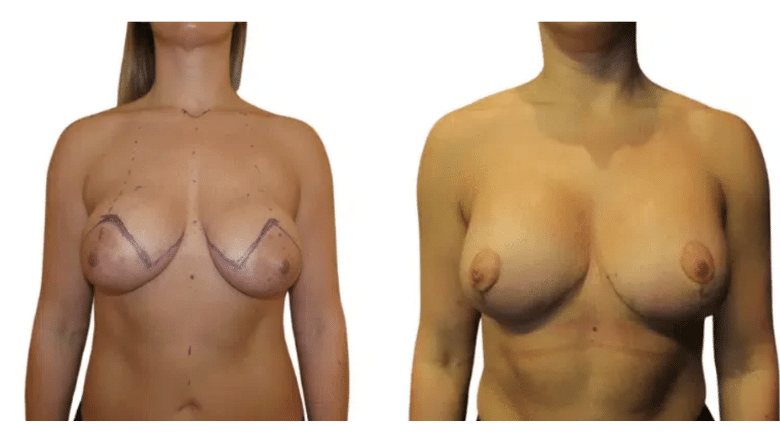
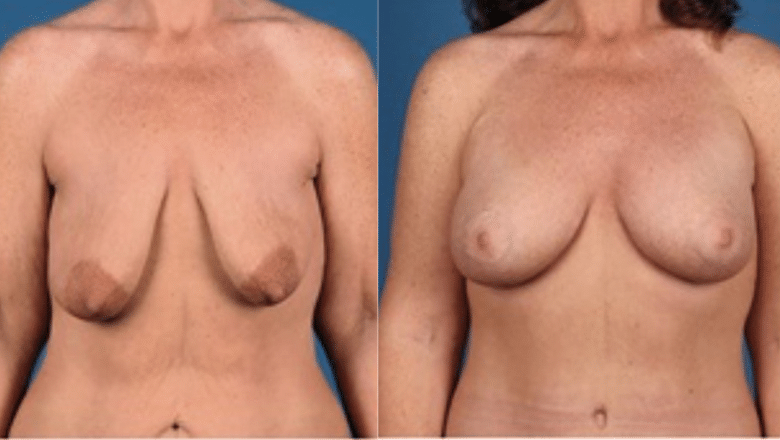
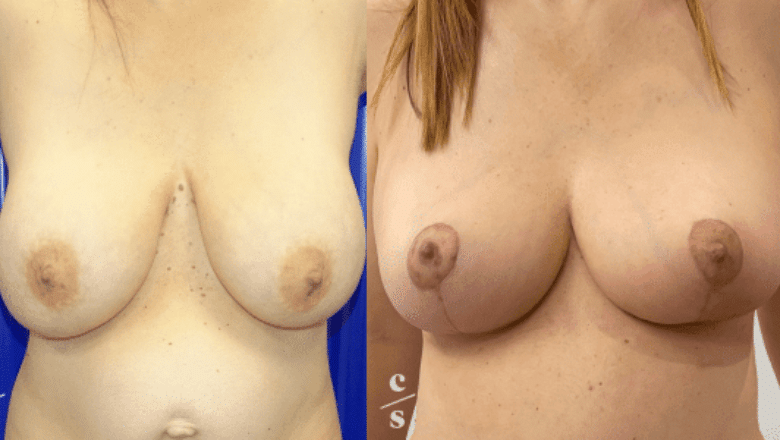
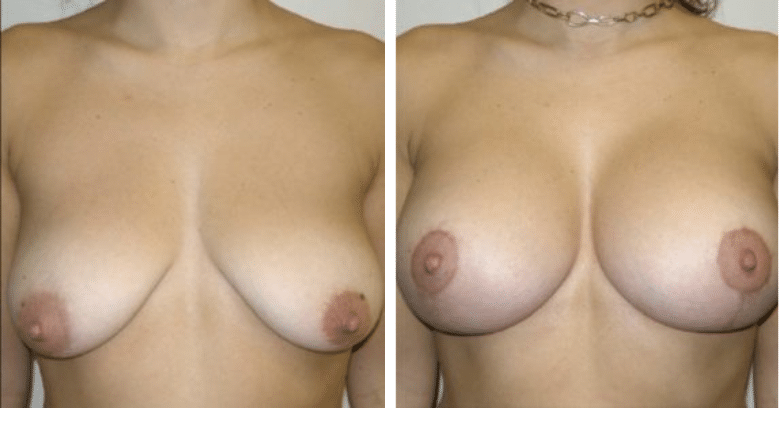
Breast Lift Without Implants Before and After
These are Centre for Surgery patients who have consented to their photographs being used. Individual results vary.
Breast Augmentation Before and After
For comparison, these are breast augmentation patients, where implants were used to add volume.
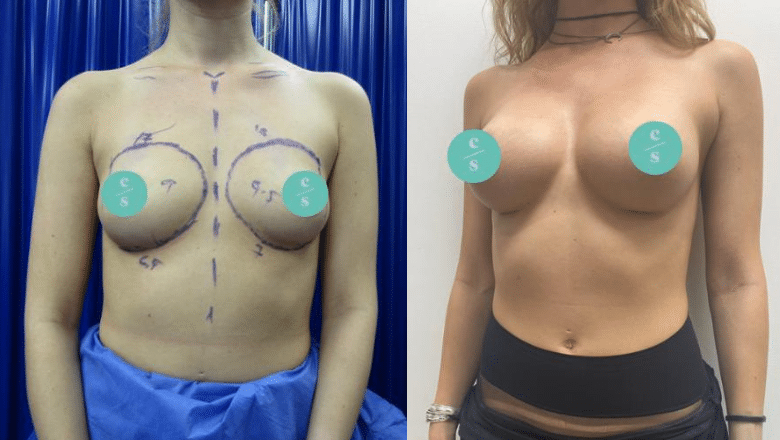
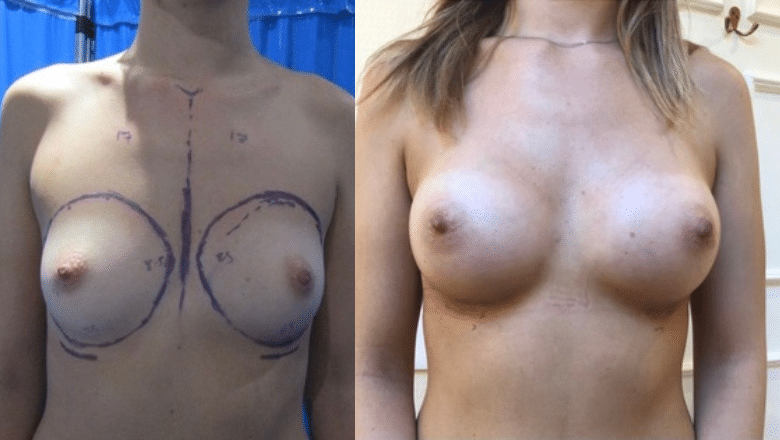
You can see more results in our breast lift before and after and breast augmentation before and after galleries.
Breast Lift Without Implants Cost
A breast lift on its own costs less than a breast lift with implants, because there are no implants to pay for and the operation is shorter. The exact price depends on the technique you need, so it is quoted after your consultation. For what affects the price, see our breast lift cost guide. Finance options are also available.
Frequently Asked Questions
Which is more painful, a breast lift or breast implants?
Most women find both manageable with simple painkillers after the first few days. Implants placed under the chest muscle tend to cause more of a deep ache in the first week, while a lift has longer wounds but usually less deep discomfort. Pain generally eases considerably by the end of the first week.
Will a breast lift without implants make my breasts smaller?
They may look slightly smaller, because loose skin is removed and the breast becomes more compact, even though no breast tissue is taken away. Many women find their bra cup size is a little smaller afterwards, but the breasts look fuller and firmer because they sit higher.
Can a breast lift without implants improve my cleavage?
Often, yes. Lifting the breast tissue higher and bringing it together can improve the shape of your cleavage, particularly in a bra. It won’t create the upper-breast fullness that implants give, so if a full cleavage is your main goal, a lift with implants or fat transfer may suit you better.
Can I have a boob job without implants?
If by “boob job” you mean bigger breasts, the main option without implants is fat transfer, which uses your own fat and typically adds around half to one cup size per session. If your breasts have also dropped, it can be combined with a lift.
Can I have implants later if I have a lift now?
Yes. Some women start with a lift and decide later that they’d like more volume, and some surgeons deliberately stage the two operations. We explain when that makes sense in Is It Better to Separate a Breast Lift and Implants into Two Procedures?
Can I breastfeed after a breast lift?
Many women can, because most lift techniques keep the nipple attached to the breast tissue underneath. However, any breast surgery can affect milk supply, and it can’t be guaranteed. If you’re planning more children, it’s usually best to wait until you’ve finished before having a lift.
Will the NHS pay for a breast lift?
A cosmetic breast lift isn’t available on the NHS or covered by private health insurance. Exceptions can apply where surgery addresses a genuine reconstructive need, such as after cancer treatment, and this is assessed case by case.
Breast Lift at Centre for Surgery
At Centre for Surgery, breast lifts, breast augmentation and combined procedures are performed by GMC-registered plastic surgeons at our CQC-regulated hospital at 95–97 Baker Street, rated Good overall. The surgeon who assesses you at your consultation is the same surgeon who performs your surgery, and we recommend a two-week cooling-off period before any surgery is booked. Our medical content is reviewed by Specialist Plastic Surgeon Dr Spyridon Vlachos (GMC 7522950).
Read verified patient reviews on Google ↗ or on our patient reviews page. To book a consultation, call 020 7993 4849 or complete the form below.
References
- Qureshi AA, Myckatyn TM, Tenenbaum MM. Mastopexy and mastopexy-augmentation. Aesthet Surg J. 2018;38(4):374–384. doi:10.1093/asj/sjx181 ↗
- Swanson E. Prospective photographic measurement study of 196 cases of breast augmentation, mastopexy, augmentation/mastopexy, and breast reduction. Plast Reconstr Surg. 2013;131(5):802e–819e. doi:10.1097/PRS.0b013e3182865e20 ↗
- Regnault P. Breast ptosis: definition and treatment. Clin Plast Surg. 1976;3(2):193–203. PMID 1261176 ↗
- Walters J, Bourn L, Tessler O, Patterson C, Khoobehi K. Single staged mastopexy with autologous fat grafting: an alternative to augmentation mastopexy with implants. Aesthet Surg J. 2020;40(4):NP152–NP158. doi:10.1093/asj/sjz217 ↗
- Gupta V, Yeslev M, Winocour J, et al. Aesthetic breast surgery and concomitant procedures: incidence and risk factors for major complications in 73,608 cases. Aesthet Surg J. 2017;37(5):515–527. doi:10.1093/asj/sjw238 ↗