


In this guide9 sections
- Why poor outcomes happen more often than they should
- Verify the surgeon, not the clinic’s marketing
- Verify the facility
- Be honest about your motivation and your suitability
- Avoid the structural risks of overseas surgery
- What a safe consultation looks like
- Practical pre-booking checklist
- Procedure-specific guides
- Consultation at Centre for Surgery
“Botched” results in cosmetic surgery rarely come down to bad luck. They are almost always the predictable outcome of an unqualified operator, a poorly regulated facility, an unsuitable patient, or a combination of all three. The UK regulatory framework gives you the tools to filter most of this risk out before you sign a consent form — provided you know what to check, and what the labels actually mean.
This guide explains how to identify a properly qualified surgeon, what to verify about the facility, and the warning signs that should make you walk away from a quote, however attractive the price.
Why poor outcomes happen more often than they should
The UK cosmetic sector has a regulatory gap that catches patients out. Any doctor on the General Medical Council register can legally perform cosmetic surgery in the private sector, regardless of whether they have completed specialist plastic surgery training. The title “cosmetic surgeon” is not legally protected. A general practitioner, a dentist, or a doctor whose specialist training is in an unrelated field can use it.
Save Face, the Professional Standards Authority-accredited register of medical aesthetic practitioners, received more than 3,000 reports of complications and adverse outcomes in 2023. Of the women who lodged complaints, 48% were aged between 18 and 25 — a vulnerable group disproportionately exposed to under-trained practitioners marketing through social media. In 2024 the Joint Council for Cosmetic Practitioners reported a surge in local-authority complaints about poor practice, rising from two in 2023 to 65 by year-end. Patients are being harmed at scale, and most of the harm is concentrated where regulation is weakest: non-surgical injectables performed in non-clinical settings, and surgical procedures sold by unqualified intermediaries.
The defensive position is straightforward. Use the regulatory tools that already exist — the GMC Specialist Register, the Care Quality Commission, FRCS (Plast) accreditation, BAAPS and BAPRAS membership — and refuse to proceed without them. The rest of this guide covers each in turn.
Verify the surgeon, not the clinic’s marketing
The single most important check is whether the person operating on you holds entry on the GMC Specialist Register ↗ for Plastic Surgery. This is a legal register, free to search, and it is the only meaningful evidence that a doctor has completed the full plastic surgery training pathway in the UK or an equivalent jurisdiction.
The corresponding postgraduate qualification is FRCS (Plast) — Fellowship of the Royal College of Surgeons in Plastic Surgery. This is the specialist exit examination administered by the Joint Committee on Intercollegiate Examinations and required to enter the Specialist Register for Plastic Surgery. A surgeon who holds MRCS but not FRCS (Plast) has passed only the general surgical membership examination and has not completed specialist plastic surgery training.
Beyond the GMC register, two professional bodies provide additional reassurance:
- BAAPS ↗ (British Association of Aesthetic Plastic Surgeons) — full members are required to be on the GMC Specialist Register for Plastic Surgery and to demonstrate active aesthetic practice.
- BAPRAS ↗ (British Association of Plastic, Reconstructive and Aesthetic Surgeons) — the academic body for UK plastic surgery, with the same baseline registration requirements.
Ask your surgeon directly for their GMC number and confirm it on the GMC website. A surgeon who is reluctant to give this information should not be on your shortlist. For a more detailed comparison of how these titles work in practice, see our explainer on the difference between a plastic surgeon and a cosmetic surgeon.
Verify the facility
All providers of cosmetic surgery in England must be registered with and inspected by the Care Quality Commission ↗. The CQC publishes inspection reports against five key questions: is the service safe, effective, caring, responsive, and well-led. A clinic’s rating and inspection history are public.
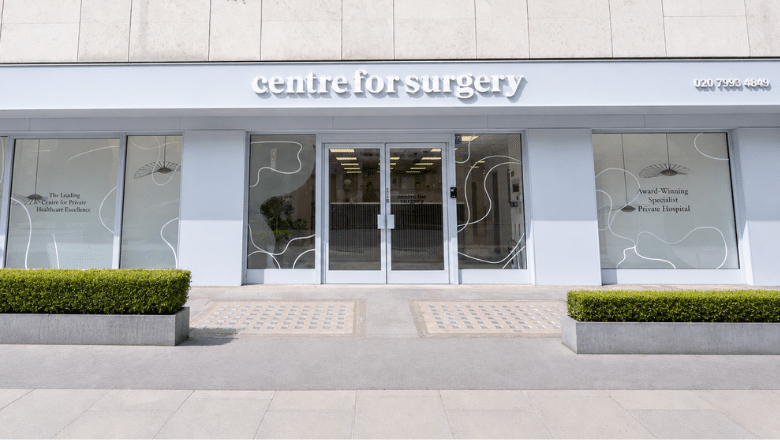
“CQC-registered” is the minimum. A “Good” or “Outstanding” rating, with a current inspection report, is what you should be looking for. Centre for Surgery operates from a CQC-registered facility at 95–97 Baker Street, Marylebone, and our current inspection rating is published on our CQC page.
Check three things on the inspection report itself, not just the headline rating:
- When was the last inspection? A rating from several years ago is less informative than a recent one.
- Are there any conditions on registration, or warning notices?
- Does the rating cover the specific service you are booking (surgical procedures), or only consultations?
For more on what the CQC framework means for cosmetic surgery patients specifically, see what a CQC Good rating means for cosmetic surgery patients.
Be honest about your motivation and your suitability
A good surgeon will turn down patients. A surgeon who agrees to operate on everyone who walks through the door is selling a transaction, not delivering care. The patients most likely to be dissatisfied with their results — and most likely to label an outcome “botched” when the technical result is actually acceptable — share recognisable patterns:
- Pursuing surgery to satisfy a partner, parent, or social media audience rather than for themselves.
- Expecting surgery to resolve a relationship, career, or mood problem.
- Showing signs of body dysmorphia — fixation on a perceived flaw that is mild or invisible to others, with a history of multiple consultations for minor adjustments.
- Booking surgery during acute emotional upheaval (recent bereavement, divorce, redundancy).
If any of these apply, the right answer is to delay surgery and address the underlying issue first. A consultation with your GP, a counsellor, or — where body dysmorphia is suspected — a clinical psychologist is more useful than another surgical opinion. The BDD Foundation ↗ and the NHS BDD guidance ↗ are both useful starting points. Our longer piece on body dysmorphia and cosmetic surgery covers what surgeons screen for and why.
Physical suitability also matters. A high BMI, uncontrolled diabetes, active smoking, or a recent significant weight loss without stabilisation will all push a procedure from low-risk to high-risk. A reputable surgeon will discuss this honestly and may decline to operate, defer, or recommend a smaller procedure. A surgeon who waves these factors away is not protecting you.
Avoid the structural risks of overseas surgery
The marketing for cosmetic surgery abroad — particularly in Turkey — focuses on headline price. The structural risks are harder to see from a glossy package brochure:
- No CQC equivalent. Standards of facility hygiene, surgical infection control, and post-operative monitoring vary widely between countries and between hospitals within the same country.
- No specialist register check. The surgeon’s qualifications cannot be verified through the GMC.
- No realistic follow-up. Most overseas providers see patients for 5 to 10 days post-operatively and then send them home. If a complication develops in week three — which is when many wound problems and infections present — your only realistic option is the NHS, and the original surgeon is unreachable.
- Flight risk. Cabin pressure changes and prolonged immobility within two to four weeks of surgery materially raise the risk of deep vein thrombosis and pulmonary embolism. Several overseas packages return patients to the UK well inside that window. After eyelid surgery the most dangerous period is even shorter, the first few hours, which low-cost bleph packages often spend travelling; see our guide to blepharoplasty abroad.
- No legal recourse. Pursuing a clinical negligence claim against a foreign provider in their own jurisdiction is, in practice, prohibitive for most patients.
In 2024 the CQC began investigating whether organisations hosting Turkish-clinic appointments in England were operating unlawfully — a response to evidence that sales staff without medical qualifications were signing patients up for high-risk procedures abroad under time pressure, often with inadequate consent and no psychological screening. Discount-stacking for multiple procedures booked together compounds the risk.
For a fuller analysis, see the dangers of cosmetic surgery tourism and how soon you can travel after cosmetic surgery.
What a safe consultation looks like
The consultation is where most of the assessment work happens, and where you should be doing your own assessment of the surgeon at the same time. The following are reasonable expectations from any UK consultation for cosmetic surgery:
- The consultation is conducted by the surgeon who will perform your operation — not a “patient coordinator” or sales agent.
- The surgeon takes a full medical history, examines you, and explains the technique they would use, the alternatives, and the specific risks of those techniques.
- You are given a written quotation and a copy of the consent material to take home.
- We recommend a two-week cooling-off period between consultation and surgery. You are not pressured to book on the day.
- You are told the realistic limits of what surgery can achieve in your specific case, including any features that will not change.
If any of these are missing, that is itself a warning sign. Walking out of a consultation — politely, without booking — is one of the most underused patient safety tools available.
Practical pre-booking checklist
Before you put down a deposit, run through the following:
- Surgeon is on the GMC Specialist Register for Plastic Surgery (verified on gmc-uk.org).
- Surgeon holds FRCS (Plast) or equivalent specialist exit examination.
- Surgeon is a full member of BAAPS or BAPRAS.
- Facility is CQC-registered with a current inspection rating of Good or Outstanding.
- The consultation is conducted by the operating surgeon.
- A written quotation covers all fees including the surgeon, anaesthetist, facility, implants (if applicable), and follow-up appointments.
- Aftercare arrangements are explicit — who you call out of hours, what happens if you need a revision, what is and isn’t included.
- You have a two-week cooling-off period and have not been pressured to commit on the day.
If you would like to read more on the wider decision-making process, see factors that influence your cosmetic surgery results and choosing your plastic surgeon.
Procedure-specific guides
Where common procedures have specific botched-outcome patterns and revision considerations, we have published detailed guides:
- Botched eyelid surgery — how to avoid blepharoplasty complications
- How to avoid botched breast surgery
- How to avoid botched gynecomastia surgery
- Botched liposuction — can it be corrected?
- Revision BBL — correcting Brazilian Butt Lift complications
Consultation at Centre for Surgery
Centre for Surgery is a CQC-registered cosmetic surgery clinic at 95–97 Baker Street, Marylebone. All our surgeons are registered with the General Medical Council, and several are members of BAPRAS and ISAPS. Consultations are conducted by the operating surgeon, with a two-week cooling-off period before any surgery is booked.
To arrange a consultation, call 020 7993 4849 or use the contact form. For funding information, see finance options through our FCA-regulated finance partner Chrysalis Finance, subject to status.
Related reading
- Plastic surgeon vs cosmetic surgeon — which should I choose?
- What does a CQC Good rating mean for cosmetic surgery patients?
- The dangers of cosmetic surgery tourism
Centre for Surgery · CQC-regulated · GMC-registered surgeons · 95–97 Baker Street, Marylebone, London W1U 6RN · 020 7993 4849 · Book a consultation · Finance available, subject to status