


In this guide14 sections
- Key Points
- Why Is My Neck So Fat? Causes of Neck Fat
- Is a Fat Neck Dangerous?
- Fat Neck vs Double Chin vs Turkey Neck: What Is the Difference?
- How to Get Rid of Neck Fat Without Surgery
- Fat Neck Removal Surgery: Chin and Neck Liposuction
- Do I Need a Neck Lift for a Fat Neck?
- Which Fat Neck Treatment Is Right for Me?
- How Do You Get Rid of Fat at the Back of the Neck?
- Can a Fat Neck Cause Snoring or Sleep Apnoea?
- Fat Neck Treatment in London: What Happens at a Consultation
- Frequently Asked Questions
- Fat Neck Treatment in London
- References
Key Points
- What is a fat neck? Fullness across the front or sides of the neck, caused by fat above or below the platysma muscle, loose skin, weak muscle bands, or a mix of all three. It is not always a weight problem, and slim people get it too.
- How to get rid of neck fat: general weight loss can reduce it, but fat cannot be spot-reduced from the neck with exercise. Chin and neck liposuction removes localised neck fat permanently, while a neck lift treats loose skin and muscle bands.
- Is a fat neck dangerous? Usually not. A larger neck circumference is linked to higher cardiometabolic risk, though, and fat at the back of the neck, a lump, or a sudden change deserves a medical check.
- Neck exercises and creams do not melt neck fat. Exercises can tone the muscles underneath. They do not remove the fat sitting on top of them.
- Surgery depends on the cause. Fat only suits chin and neck liposuction, fat with mild loose skin may suit liposuction with FaceTite, and bands with hanging skin need a neck lift.
- At Centre for Surgery a GMC-registered plastic surgeon assesses your fat, skin and muscle at a face-to-face consultation, and the surgeon who assesses you is the surgeon who operates.
Fat neck is one of the most searched neck concerns in the UK, and the question behind it is simple: why is my neck so fat, and can it be reversed? A fat neck softens the jawline, hides the angle between chin and neck, and can make you look heavier or older than you feel. The answer depends on what the fullness is made of. Fat responds to liposuction, loose skin and muscle bands respond to a neck lift, and a few medical causes need a doctor before anyone considers cosmetic treatment.
This guide covers the causes of neck fat, whether it is dangerous, what works without surgery, how chin and neck liposuction works, and when a neck lift is the better option. If your main concern is the pocket directly under the chin, our guide to how to get rid of a double chin goes into that in more detail, while this page looks at fullness across the whole neck.
At Centre for Surgery, neck contouring is carried out by GMC-registered plastic surgeons at our CQC-regulated Baker Street hospital in London.
Why Is My Neck So Fat? Causes of Neck Fat
Neck fullness rarely has a single cause. Most people have a combination, and the mix decides which treatment will work. A surgeon looks at the thickness of the fat, the quality of the skin, the muscle underneath and the shape of the bones.
Genetics and neck anatomy
Some people simply store fat in the neck, regardless of their overall weight, and the tendency often runs in families. Anatomy matters as well: the position of the hyoid bone, which supports the tongue and windpipe, helps set how sharp the angle between chin and neck looks, and a low-set hyoid softens it however slim you are. A receding chin has a similar effect, and our guide to a weak chin explains how to tell bone from fat.
Weight gain and body fat
Gaining weight adds fat to the neck as it does elsewhere, and losing weight can reduce it. The neck is often one of the last places to slim down, and a surgeon will usually ask for a stable weight before any neck surgery. Our guide to visceral and subcutaneous fat explains why fat sitting under the skin behaves differently from fat around the organs.
Ageing and loose skin
With age, skin loses collagen and elastin and the platysma, the thin sheet of muscle across the front of the neck, loosens. Fat that was once held firm starts to hang, and the neck looks fuller even if the amount of fat has not changed. This is why a neck that looks fat in your fifties may be mostly loose skin and platysmal bands rather than fat.
Posture and tech neck
Looking down at a phone or laptop for hours pushes the head forward, folds the skin at the front of the neck and can make the area under the chin look fuller. Our guide to tech neck covers the lines and strain that come with it.
Medical conditions and medicines
A few medical causes are worth knowing about. Long-term steroid tablets and Cushing’s syndrome, a rare condition in which the body has too much cortisol, can build up fat at the back of the neck and round the face. An underactive thyroid can contribute to weight gain, and an enlarged thyroid (a goitre) can make the front of the neck look swollen even though no fat is involved. Lipomas, which are soft, slow-growing lumps of fat, can also appear on the neck. Anything lumpy, one-sided, fast-growing or accompanied by hoarseness, difficulty swallowing or breathing should be checked by a GP first.
Is a Fat Neck Dangerous?
For most people a fat neck is a cosmetic concern, not a health emergency. Still, neck size is a recognised health marker. A 2018 systematic review and meta-analysis in Diabetology & Metabolic Syndrome ↗ found that a larger neck circumference was positively associated with most cardiometabolic risk factors, including blood sugar, insulin resistance and triglycerides, although the authors cautioned that results varied a lot between studies[1]. In other words, a thick neck can be a clue to upper-body fat and metabolic risk, but it cannot diagnose anything on its own.
Fat at the back of the neck is worth a closer look. A 2016 review of Cushing’s syndrome screening in High Blood Pressure & Cardiovascular Prevention ↗ lists a dorsocervical fat pad alongside facial rounding, high blood pressure, diabetes, thin skin and purple stretch marks as typical features of the condition[2]. Cushing’s is rare, and most neck fat has nothing to do with it, but if you have several of these features together, see your GP before thinking about cosmetic treatment.
See a doctor promptly if the swelling is sudden, painful, one-sided or hard, if a lump is growing, if your voice changes, or if swallowing or breathing is affected.
Fat Neck vs Double Chin vs Turkey Neck: What Is the Difference?
These terms overlap, and people often use them for the same concern.
- Double chin (submental fat): a pocket of fat directly beneath the chin. It is the commonest form of neck fat and the one chin liposuction is designed to treat.
- Fat neck: fullness that extends beyond the chin pocket, across the front and sides of the neck, sometimes with fat deeper than the muscle.
- Turkey neck: hanging skin and vertical cords, usually from ageing or weight loss, with or without fat. Our guide to turkey neck compares the treatments.
- Jowls: sagging along the jawline, see our guide to sagging jowls.
If the main problem is a soft jaw, jawline fillers can add definition, although they add volume to the jaw and do not remove fat from the neck. A consultation will sort out which of these you are actually dealing with.
How to Get Rid of Neck Fat Without Surgery
If your neck fat is mild, or you would rather avoid an operation, there are things worth trying first. It helps to be honest about their limits.
Can you lose neck fat by losing weight?
Yes, to a degree. If excess body fat is part of the cause, a sustained calorie deficit with regular exercise reduces fat all over, including the neck. If your weight is already healthy and the neck is still full, the cause is more likely genetics or anatomy, and no amount of dieting will change it. Our guide to the face and neck after significant weight loss covers loose skin afterwards.
Do neck exercises reduce fat?
Not directly. Chin tucks, neck curls and jaw exercises can tone the muscles under the fat and improve posture, and some people notice a firmer-looking jawline. Exercise cannot take fat out of one chosen spot, so treat it as a supporting measure, not a fat neck treatment.
Does fat freezing work on the neck?
Cryolipolysis, or fat freezing, can reduce a small pocket of fat in selected people over several weeks, and a 2026 narrative review in the Journal of Craniofacial Surgery ↗ describes it alongside radiofrequency and ultrasound devices as a non-invasive option with minimal downtime[5]. Results are modest and less predictable than surgery. Fat freezing is not offered at Centre for Surgery, and our guide to whether fat freezing works sets out what it can and cannot do.
Do fat-dissolving injections work?
Deoxycholic acid injections, licensed in some countries for fat under the chin, destroy fat cells gradually. A 2018 pooled analysis of the phase 3 REFINE trials in Aesthetic Surgery Journal ↗ found that most treated patients improved within two to four sessions, with up to six permitted, and that injection-site swelling, bruising and discomfort were common but declined with later sessions[3]. A 2025 systematic review of injectable fat-reducing agents in other body areas found satisfaction rates of 57% to 86% and noted that repeated sessions make them costlier than single-session liposuction[4]. Injections can suit a small, soft pocket of fat, and they need several visits.
Skin tightening and injectable treatments
If the fullness is mostly slack skin rather than fat, tightening treatments are more relevant than fat reduction. Morpheus8 combines microneedling with radiofrequency to stimulate collagen and improve skin quality, and our guide to tightening neck skin without surgery compares the options in more detail. Where vertical neck bands are the main concern, anti-wrinkle injections can relax the platysma and soften them, and dermal fillers can smooth fine horizontal neck lines. Our guide to neck lines covers both. Thread lifts are sometimes suggested for a loose neck, but they give a modest, short-lived effect and are not something Centre for Surgery offers. Our non-surgical neck lift guide explains what non-surgical treatment can realistically achieve.
None of these treats a thick layer of fat. If fat is the problem, the reliable way to remove it is surgical.
Fat Neck Removal Surgery: Chin and Neck Liposuction
When fat is the main cause and your skin is still reasonably elastic, chin and neck liposuction, also called submental liposuction, neck lipo or neck liposculpture, is the most direct treatment. It removes fat cells permanently from beneath the chin and along the front of the neck, which sharpens the angle between jaw and neck.
How is neck liposuction done?
The surgeon makes a tiny incision, around 3 to 5 mm, in the natural crease under the chin and sometimes one behind each earlobe. A fine cannula is passed through the fat layer to break up and remove the excess fat, and the surgeon checks the contour by hand throughout so that it comes out even. At Centre for Surgery this uses power-assisted liposuction, which is gentler on tissue than manual technique. Each incision closes with one or two fine stitches. Standalone, the operation takes around an hour and is usually done under local anaesthetic with sedation, or under TIVA when combined with other procedures. You go home the same day.

What can neck liposuction remove, and what can it not?
Liposuction removes fat that sits above the platysma. It does not tighten loose skin, it does not touch the muscle, and it cannot reach fat that lies deeper than the muscle. Reviews of neck platysma rejuvenation cover submental liposuction alongside platysma techniques and cervical rhytidectomy as separate tools chosen according to what is wrong[6]. If you have visible vertical bands, a procedure that only removes fat leaves them in place, and research on minimally invasive platysma band treatment makes the same point: it improves bands but does not address excess fat or extensive loose skin[7]. This is why your surgeon assesses fat, skin and muscle before recommending anything.
Before and after neck liposuction
These before and after photographs show chin and neck liposuction carried out at Centre for Surgery, published with the patient’s written consent. Individual results vary.
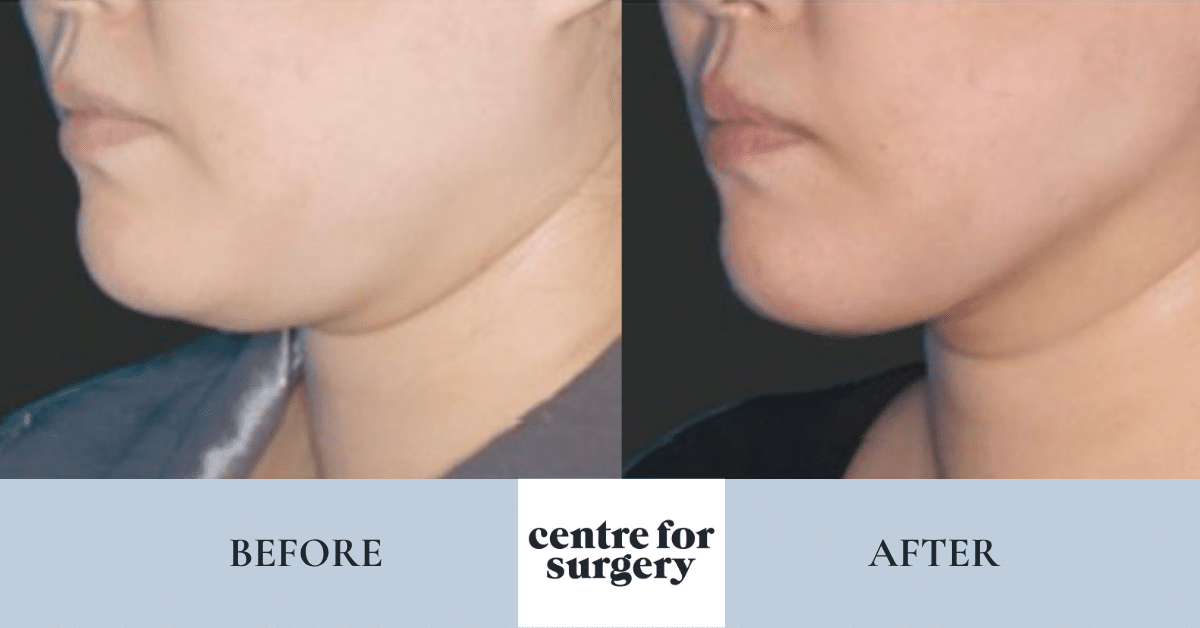
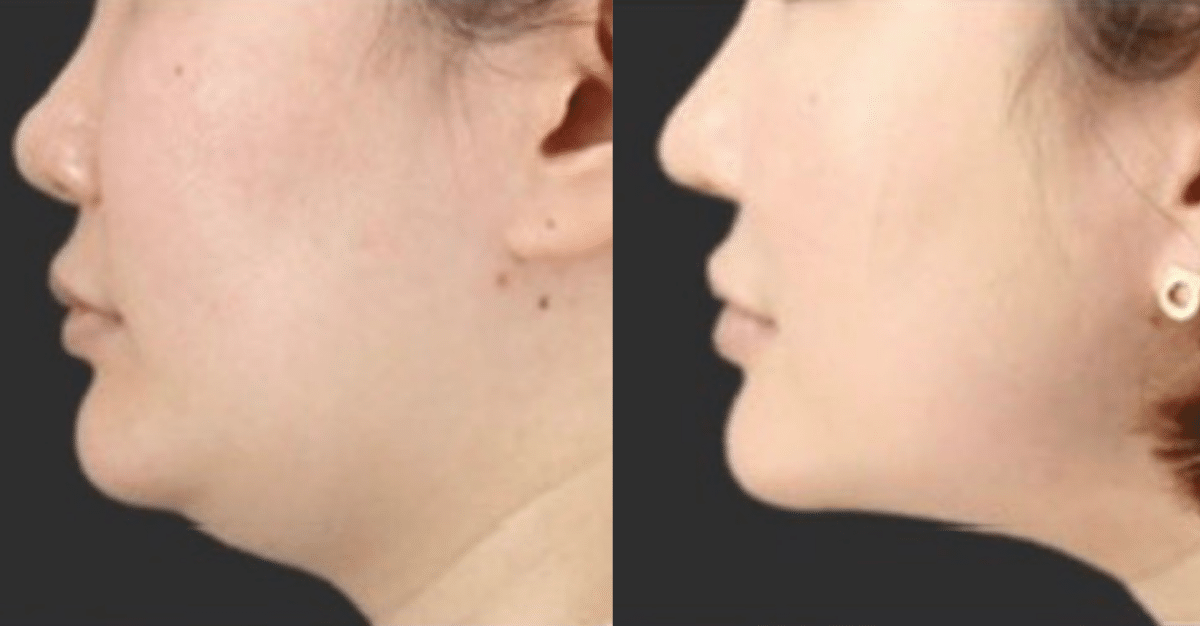
You can compare more cases in our liposuction before and after photos.
Recovery after neck liposuction
Expect swelling and bruising that peak around days three to four, stitches out at five to seven days, and a snug compression garment worn continuously at first. Most people are back at desk work after 7 to 10 days, when bruising can be covered, and gentle exercise restarts from about week two, with weights from week four. Numbness under the chin is common for two to three months while small nerves recover, and the final contour settles over several months. Our chin liposuction recovery guide and our advice on how to sleep after chin liposuction cover each stage.
Is neck liposuction permanent?
The fat cells that are removed do not grow back. If you gain a lot of weight afterwards, the remaining fat cells can still enlarge, which is why a stable weight matters before and after surgery. Your neck will keep ageing, so looser skin or bands may appear years later, and that is new ageing rather than the fat returning.
What are the risks of neck liposuction?
All surgery carries risk. With neck liposuction these include temporary numbness, swelling, bruising, an uneven contour, loose skin if the skin does not retract, infection, a collection of blood or fluid under the skin and, rarely, injury to the nerve that moves the lower lip. A 2026 ten-year series of 80 patients who had a facelift with platysmaplasty and neck liposuction under local anaesthesia reported an overall complication rate of 10%, including haematoma in 2.5% and seroma in 1.25%[8]. That series covers a larger operation than liposuction alone, so it overstates the risk of liposuction by itself. The commonest cause of disappointment is choosing liposuction when skin or muscle was the real problem.
Do I Need a Neck Lift for a Fat Neck?
A neck lift is the better choice when fat is only part of the picture. If your skin is loose, if platysmal bands show when you tense your neck, or if fat lies beneath the muscle, liposuction alone is likely to leave a looser neck than you started with. A neck lift tightens the platysma, removes excess skin and can include liposuction at the same operation, usually through incisions behind the ears and sometimes under the chin.
For earlier changes, a mini neck lift uses a shorter incision and suits mild laxity or early bands. Men often have thicker necks and a beard line that affects incision placement, and our male neck lift and male liposuction pages explain how that is planned. When jowls are involved, a neck lift is often combined with a lower facelift, and our guide to the types of neck lift explains how they differ.
A neck lift is a bigger operation than liposuction, with a longer recovery, and our neck lift recovery guide sets out what to expect. See examples in our neck lift before and after photos.
Can liposuction be combined with skin tightening?
Yes. For mild skin laxity, FaceTite uses radiofrequency energy under the skin to tighten it, and it can be added to neck liposuction in the same operation. It suits people whose skin has some laxity but is not yet hanging, and your surgeon will say honestly if the skin is too loose for it to be enough.
Which Fat Neck Treatment Is Right for Me?
The right treatment follows the cause: fat only suits liposuction, fat with mild laxity may suit liposuction with FaceTite or a mini neck lift, and bands with hanging skin need a neck lift. Use the chart as a rough guide, then have a surgeon check your own neck.

How Do You Get Rid of Fat at the Back of the Neck?
A fat pad at the base of the neck, often called a buffalo hump or dorsocervical fat pad, is a separate problem from fullness at the front. Posture, weight gain, long-term steroids and hormonal conditions can all be behind it, so the first step is to find out why it has appeared. A GP can check for Cushing’s syndrome and for the effect of any medicines, and any underlying cause needs to be treated first.
Once a medical cause is excluded or managed, a firm pad of fat can be reduced with liposuction, although this fat is denser than fat under the chin and results are less predictable. Our guide to buffalo hump removal covers the causes and options. A discrete soft lump, rather than a general thickening, may be a lipoma, which is removed as a minor procedure. See our page on lipoma removal.
Can a Fat Neck Cause Snoring or Sleep Apnoea?
It can contribute. Fat stored around the neck also builds up around the upper airway and narrows it when the throat muscles relax in sleep, which is why neck size is one of the measurements doctors use when screening for obstructive sleep apnoea (OSA), where breathing repeatedly stops and starts at night. A 2025 meta-analysis of 35 studies and 13,854 patients ↗ found that people with more severe sleep apnoea had necks on average 3.7 cm larger than those with milder or no apnoea.[9]
Signs worth raising with your GP are loud snoring, a partner noticing you stop breathing or gasp in your sleep, waking unrefreshed and feeling very sleepy in the day (NHS: sleep apnoea ↗). OSA is diagnosed with a sleep study, not by looking at the neck. Chin and neck liposuction removes fat under the skin, not the tissue around the airway, so it is a contouring operation and not a treatment for sleep apnoea. Overall weight loss is what helps: a 2026 meta-analysis of 18 trials ↗ found non-surgical weight loss significantly reduced sleep apnoea severity.[10] Loose neck skin after weight loss is a different problem again, treated with a neck lift rather than liposuction.
Fat Neck Treatment in London: What Happens at a Consultation
A consultation at our Baker Street hospital is face to face with a GMC-registered plastic surgeon, and it is the right place to find out what your neck is made of. The surgeon assesses the fat, the elasticity of your skin and the state of the platysma, takes clinical photographs for planning, and talks through risks and recovery. If a non-surgical option or a medical check would serve you better, we will say so.
The surgeon who assesses you is the surgeon who operates. Costs are confirmed in writing after your consultation, and our chin liposuction cost guide explains what affects the total, with finance options available through our finance page, subject to status. We recommend a two-week cooling-off period after your consultation before surgery is confirmed. Our guide to preparing for your consultation lists what to bring, and it is worth stopping smoking, including vaping, at least four weeks before and after surgery because it slows healing.
Frequently Asked Questions
How can I reduce fat around my neck?
Start with overall weight loss if you are carrying extra weight, and keep your posture upright. Exercises tone muscle but cannot remove fat from the neck. For fat that does not respond to diet, chin and neck liposuction removes it permanently, while a neck lift treats loose skin and bands. A consultation shows which of these your neck needs.
Why is my neck so fat when I am slim?
Fat distribution is largely inherited, so some slim people store fat under the chin and in the neck. Anatomy plays a part too, including the position of the hyoid bone and the shape of the chin. Loose skin and muscle bands can also make the neck look fuller. A surgeon can tell you which applies.
Is a fat neck dangerous?
Usually not, but a larger neck circumference is linked to higher cardiometabolic risk, and fat at the back of the neck can occasionally point to a hormonal condition. See your GP about a sudden, painful or one-sided swelling, a growing lump, voice change, or trouble swallowing or breathing.
Does neck fat go away on its own?
It can shrink if you lose weight, but inherited neck fat and fat with loose skin rarely disappear without treatment. As the skin ages, the neck often looks fuller over time rather than slimmer.
Do neck exercises get rid of a fat neck?
No. Exercises such as chin tucks can improve muscle tone and posture, and may make the jawline look slightly firmer, but fat cannot be burned from one area of the body. They are a useful extra and not a substitute for treatment when fat is the cause.
How can I treat a neck hump?
First find the cause with your GP, because long-term steroids, Cushing’s syndrome and posture can all contribute. Posture work and weight loss help some people. A firm fat pad that persists can be reduced with liposuction once any medical cause has been dealt with.
Is neck liposuction worth it?
For the right person it is a reliable way to remove neck fat: someone with localised fat, reasonably elastic skin, a stable weight and realistic expectations. It is not worth it where skin laxity or platysmal bands are the real problem, because liposuction cannot fix those. The assessment decides this.
How long do neck liposuction results last?
The fat cells removed do not grow back, so the improvement is long-lasting provided your weight stays stable. Remaining fat cells can still enlarge with significant weight gain, and your neck will continue to age naturally.
Why is my neck getting thicker?
Most often weight gain, as fat builds up under the chin and around the neck, sometimes alongside skin loosening with age. Less often there is a medical cause: an enlarged thyroid (goitre) causes a swelling at the front of the neck that moves when you swallow, Cushing’s syndrome or long-term steroid tablets can build fat at the back of the neck, and swollen glands cause lumps at the sides. See your GP about any new lump, one-sided swelling, or change in your voice or swallowing.
What dissolves double chin fat?
Deoxycholic acid injections are the licensed fat-dissolving treatment for fat under the chin. They destroy fat cells gradually, usually over several sessions, and cause swelling and tenderness for some days after each one. Unlicensed “lipolysis” products sold online have much weaker evidence. For a larger amount of fat, chin liposuction removes it in a single procedure.
Which body part is hardest to lose fat?
It depends largely on your genes and sex hormones. The lower tummy, the flanks and the area under the chin are common holdouts, and in women the hips and thighs. If fat under your chin stays once you are close to your goal weight, that is the pattern chin and neck liposuction is designed for.
Fat Neck Treatment in London
If a fat neck is affecting how you look or feel, a consultation with a plastic surgeon will establish whether fat, skin or muscle is responsible and which treatment would change it. Find out more about chin and neck liposuction at Centre for Surgery.
Phone: 020 7993 4849 | Address: 95–97 Baker Street, Marylebone, London W1U 6RN
Contact us to schedule a consultation
References
- Ataie-Jafari A, Namazi N, Djalalinia S, et al. Neck circumference and its association with cardiometabolic risk factors: a systematic review and meta-analysis. Diabetology & Metabolic Syndrome 2018;10:72. doi:10.1186/s13098-018-0373-y ↗
- Ceccato F, Boscaro M. Cushing’s syndrome: screening and diagnosis. High Blood Pressure & Cardiovascular Prevention 2016;23(3):209–215. doi:10.1007/s40292-016-0153-4 ↗
- Dayan SH, Schlessinger J, Beer K, et al. Efficacy and safety of ATX-101 by treatment session: pooled analysis of data from the phase 3 REFINE trials. Aesthetic Surgery Journal 2018;38(9):998–1010. doi:10.1093/asj/sjy008 ↗
- Carrion K, Salingaros S, Bernal C, et al. A systematic review of injectable lipolytic agents for nonsubmental fat reduction. Plastic and Reconstructive Surgery 2025;158(3):414–423. doi:10.1097/PRS.0000000000012648 ↗
- Chaudry A, Lam W, DeVries A, Lawson A, Nestor MS. Non-light-based energy devices in aesthetics: current evidence and emerging innovations. Journal of Craniofacial Surgery 2026 (published online 17 July). doi:10.1097/SCS.0000000000013184 ↗
- Farrior E, Eisler L, Wright HV. Techniques for rejuvenation of the neck platysma. Facial Plastic Surgery Clinics of North America 2014;22(2):243–252. doi:10.1016/j.fsc.2014.01.012 ↗
- Gomez DA, James IB, Turer DM, et al. Light-guided percutaneous neck rejuvenation with division of platysma bands and suture suspension: a multicenter retrospective study. Aesthetic Surgery Journal 2023;43(4):393–404. doi:10.1093/asj/sjac287 ↗
- De Riso S, Ziani F, Arrica G, et al. SMAS plication facelift and platysmaplasty under tumescent local anesthesia: a 10-year retrospective evaluation of safety, efficacy, and patient satisfaction in an outpatient setting. Aesthetic Plastic Surgery 2026. doi:10.1007/s00266-026-06228-w ↗
- Punjabi N, Qu RW, Vacaru A, Pandey B, Tamares S, Inman JC. The obstructive sleep apnea physical exam: a systematic review and meta-analysis. Laryngoscope Investigative Otolaryngology 2025;10(3):e70154. doi:10.1002/lio2.70154 ↗
- Chen X. Effectiveness of non-surgical weight loss interventions on obstructive sleep apnoea severity and cardiometabolic outcomes: a systematic review and meta-analysis. Sleep Medicine 2026;142:108878. doi:10.1016/j.sleep.2026.108878 ↗







