

In this guide13 sections
- Key Points
- What Is a BodyTite Arm Lift?
- Is a BodyTite Arm Lift Really Scarless?
- BodyTite Arm Lift vs Surgical Arm Lift
- Am I Suitable for a BodyTite Arm Lift?
- What Happens During a BodyTite Arm Lift?
- BodyTite Arm Lift Recovery
- When Will I See Results From BodyTite?
- Risks of a BodyTite Arm Lift
- Other Areas BodyTite Can Treat
- How Much Does a BodyTite Arm Lift Cost?
- Frequently Asked Questions
- References
Key Points
- A BodyTite arm lift uses radiofrequency energy beneath and on the surface of the skin to tighten the upper arms, usually alongside liposuction.
- It needs only a few tiny entry points, so there is no long scar along the arm.
- It suits mild to moderate loose skin with some fat. It does not remove skin, so larger folds still need a surgical arm lift.
- Skin tightening develops gradually, with results usually clearer at three to six months.
- Most people return to desk-based work within a few days.
Loose skin on the upper arms, often called bingo wings or bat wings, can develop with age, genetics or weight loss. Many people assume an arm lift (brachioplasty) with a scar from armpit to elbow is the only fix. For milder laxity there is another option: BodyTite, sometimes called a scarless or non-excisional arm lift.
This guide explains how a BodyTite arm lift works, who it suits, how it compares with surgery, and what recovery and results look like. At Centre for Surgery, BodyTite is carried out by our GMC-registered surgeons at our Baker Street hospital in London.
What Is a BodyTite Arm Lift?
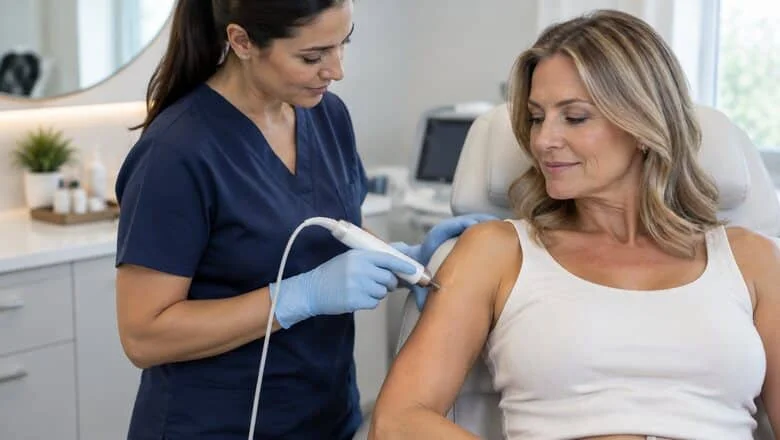
BodyTite is a radiofrequency-assisted liposuction (RFAL) device made by InMode. A thin probe is passed under the skin through a tiny entry point while an external electrode glides over the skin surface. Radiofrequency energy flows between the two, heating the fat and the deeper layers of the skin. The heat helps loosen fat for removal and causes the connective tissue under the skin to contract, which tightens the skin over the following months.
In the arms, BodyTite is usually combined with liposuction: the liposuction refines the shape, and the radiofrequency tightens the skin so it sits better over the slimmer contour. Laboratory work on arm tissue has shown that bipolar radiofrequency increases collagen production in the deeper skin layers.[4]
Is a BodyTite Arm Lift Really Scarless?
Not completely, but close. The probe enters through a few incisions of only a few millimetres, usually placed near the elbow or in the armpit. These heal as small marks that are hard to see once faded. That compares with a surgical arm lift scar running along the inner arm, often from the armpit to the elbow.
BodyTite Arm Lift vs Surgical Arm Lift
| BodyTite arm lift | Surgical arm lift (brachioplasty) | |
|---|---|---|
| Suits | Mild to moderate laxity with some fat | Moderate to severe loose skin, including after major weight loss |
| Removes skin? | No, tightens it | Yes |
| Scar | A few tiny entry points | Scar along the inner arm, or in the armpit for a mini arm lift |
| Time off work | Usually a few days | Around 1 to 2 weeks |
| Strenuous exercise | Usually after 3 to 4 weeks | Usually after around 6 weeks |
| When results show | Gradually, over 3 to 6 months | Shape change is immediate; swelling settles over months |
The deciding factor is how much loose skin there is. A study of 50 women having upper arm contouring used exactly this approach: liposuction alone for mild cases, radiofrequency-assisted liposuction for moderate cases and brachioplasty for severe laxity, and patient satisfaction improved in every group.[3] Our guide to arm lift vs arm liposuction covers the wider choice.
Am I Suitable for a BodyTite Arm Lift?
You may be suitable if:
- You have mild to moderate loose skin on the upper arms, often with some excess fat.
- You are aged 18 or over and in good general health.
- Your BMI is ideally 30 or below and your weight is stable.
- You prefer to avoid a long scar and accept a more gradual, subtler change than surgery gives.
- You do not smoke, or are willing to stop before and after treatment.
BodyTite is unlikely to be enough if your arm skin hangs in a large fold when you hold your arm out, as is common after major weight loss. In that case a surgical arm lift will give a far more predictable result. Our guide to types of arm lift explains the surgical options.
What Happens During a BodyTite Arm Lift?
A BodyTite arm lift usually takes one to two hours. It is typically carried out under local anaesthetic, with or without sedation. If you would prefer to be fully asleep, this is done with TIVA (total intravenous anaesthesia), and the choice is discussed at your consultation.
- Marking: the areas to treat are marked with you standing.
- Numbing fluid: tumescent fluid containing local anaesthetic is injected to numb the area and reduce bruising.
- Radiofrequency treatment: the BodyTite probe is passed under the skin through a tiny entry point, with the external electrode moving over the surface. Built-in temperature sensors monitor the skin and deeper tissues throughout.
- Liposuction: the loosened fat is removed to refine the arm shape.
- Finishing: the entry points are closed or left to drain, and a compression garment is fitted.
You go home the same day.
BodyTite Arm Lift Recovery
- First few days: swelling, bruising and tenderness are normal. Some fluid may leak from the entry points for a day or two.
- Return to work: most people return to desk-based work within two to five days.
- Compression: a compression garment is usually worn for several weeks to support the skin as it tightens.
- Exercise: light activity can resume within days; strenuous upper body exercise is usually avoided for three to four weeks.
- Firmness: the treated area can feel firm or lumpy for a few weeks, which usually settles with time and massage if advised.
Our arm lift recovery guide has more on aftercare.
When Will I See Results From BodyTite?
The fat reduction is visible once the swelling goes down, after a few weeks. Skin tightening is gradual, as the tissues contract and new collagen forms: most people notice it from around three months, with the result clearer at six months and still improving for up to a year. In a study that treated one arm with radiofrequency-assisted liposuction and the other with liposuction alone ↗, the RF-treated arms showed greater skin surface area reduction at one year (15.0% vs 10.9% on the front of the arm).[1]
The fat cells removed do not come back, but your skin will continue to age naturally, and significant weight gain will affect the result.
Risks of a BodyTite Arm Lift
BodyTite is less invasive than surgery, but it is still a procedure with risks, including:
- Swelling, bruising and temporary numbness.
- Seroma (a fluid collection).
- Burns to the skin, which are uncommon with modern temperature monitoring.
- Contour irregularities or lumpiness.
- Infection.
- Less skin tightening than hoped, which may mean a surgical arm lift is needed later.
In a series of 40 patients treated under local anaesthetic ↗, there was one burn near the elbow, which healed with dressings, and one seroma, and most patients were satisfied with the degree of skin tightening.[2]
Other Areas BodyTite Can Treat
As well as the arms, BodyTite is used on the abdomen, flanks, back, chest, inner thighs, knees and the saddlebags on the outer thighs. Smaller areas such as the mons pubis can also be treated. For skin tightening on the surface with no downtime, Morpheus8 is another option.
How Much Does a BodyTite Arm Lift Cost?
The cost depends on whether liposuction is included and how many areas are treated, and is confirmed after your consultation. Current prices are in our BodyTite cost guide, and you can compare with our arm lift cost guide. Finance is available, subject to status.
Frequently Asked Questions

Does a BodyTite arm lift hurt?
The area is numbed with local anaesthetic, so you should not feel pain during the treatment, and TIVA is available if you would rather be asleep. Afterwards the arms feel bruised and tender for a few days.
Is BodyTite better than an arm lift?
Neither is better in every case. BodyTite avoids a long scar and has a quicker recovery, but it only tightens skin. A surgical arm lift removes skin, so it is the right choice for moderate to severe laxity.
Will BodyTite work on bingo wings after weight loss?
It can help mild laxity after moderate weight loss. After major weight loss, the amount of loose skin is usually too great for radiofrequency alone, and an arm lift is more effective.
How long do BodyTite results last?
The removed fat cells do not return and the tightening is long-lasting, but your skin will continue to age, and weight changes will affect the result.
When can I exercise after BodyTite?
Walking and light activity can resume within days. Most people wait three to four weeks before strenuous exercise or upper body weights.
How soon can I go back to work?
Usually within two to five days for desk-based work, depending on how much was treated and how you feel.
References
- Chia CT, Theodorou SJ, Hoyos AE, Pitman GH. Radiofrequency-assisted liposuction compared with aggressive superficial, subdermal liposuction of the arms: a bilateral quantitative comparison. Plast Reconstr Surg Glob Open. 2015;3(7):e459. doi:10.1097/GOX.0000000000000429 ↗
- Theodorou S, Chia C. Radiofrequency-assisted liposuction for arm contouring: technique under local anesthesia. Plast Reconstr Surg Glob Open. 2013;1(5):e37. doi:10.1097/GOX.0b013e3182a58c80 ↗
- Zhu J, Zhao F, Li F. A retrospective analysis of upper arm rejuvenation surgery in 50 patients. Aesthet Surg J. 2024;44(4):NP254-NP262. doi:10.1093/asj/sjad370 ↗
- Cala Uribe LC, Perez Pachon ME, Zannin Ferrero A, et al. Effects of bipolar radiofrequency on collagen synthesis from patients with brachial ptosis. Plast Reconstr Surg Glob Open. 2023;11(4):e4924. doi:10.1097/GOX.0000000000004924 ↗