

In this guide15 sections
- Key Points
- Breast Lift vs Breast Augmentation: What’s the Difference?
- Does Breast Augmentation Lift Your Breasts?
- Do I Need Implants With a Breast Lift?
- Breast Lift or Implants: Which Do I Need?
- Breast Lift and Augmentation Together (Augmentation Mastopexy)
- Breast Lift vs Augmentation Recovery
- Breast Lift vs Augmentation Scars
- How Long Do the Results Last?
- Breast Lift vs Breast Augmentation Cost
- Breast Lift and Augmentation Before and After
- Other Options Worth Knowing About
- Frequently Asked Questions
- Breast Lift and Augmentation at Centre for Surgery
- References
Key Points
- A lift changes position; implants change size. A breast lift raises the breast and nipple and removes loose skin, but adds no volume. Implants add size and upper-breast fullness, but do not raise the nipple.
- Implants alone do not lift a sagging breast. In a study that measured 196 women before and after surgery, breast augmentation left the nipple at the same level. Only operations that included a lift raised it.
- The choice comes down to two questions. Sagging with enough volume usually means a lift. Volume loss with little sagging usually means implants. Both together usually means a breast lift with implants, called augmentation mastopexy.
- A lift with implants can be one operation or two. In a single operation, implants are usually kept to around 360cc. Larger implants, severe sagging or thin skin can make a staged approach safer.
- Recovery is similar for all three. At Centre for Surgery most patients return to desk work at 7 to 10 days and to full exercise at six weeks.
- The combined operation is the most demanding. A review of 4,856 single-stage lift-with-implant operations found a 13.1% complication rate and a 10.7% reoperation rate, which is why careful case selection matters.
“Breast lift or implants?” is one of the most common questions women bring to a consultation, and the two operations are easy to confuse. A breast lift (mastopexy, also called a breast uplift or boob lift) and a breast augmentation (a boob job with implants) fix different problems, and choosing the wrong one is one of the most common reasons women end up disappointed with their result.
This guide explains what each operation actually changes, how surgeons decide between a lift, implants or both, and what the evidence says about doing them together. If you’re not sure whether your breasts have dropped enough to need a lift at all, our guide to breast ptosis grades explains how sagging is measured, and what causes saggy breasts covers why it happens.
Breast Lift vs Breast Augmentation: What’s the Difference?

The simplest way to think about it: a breast lift deals with position, and breast augmentation deals with volume.
A breast lift removes stretched skin, reshapes the breast tissue and moves the nipple and areola higher on the chest. It corrects sagging (ptosis) but does not add size. Skin is removed and the breast becomes more compact, so many women find their breasts look slightly smaller afterwards, even though no breast tissue is taken away. There are four main types of breast lift, from the small crescent lift to the anchor lift, chosen according to how far the breast has dropped.
Breast augmentation places an implant behind the breast tissue, either over or under the chest muscle. It increases size, projection and fullness in the upper part of the breast. It does not remove skin or move the nipple.
| What changes | Breast lift | Breast augmentation |
|---|---|---|
| Nipple height and breast position | Raised | Unchanged |
| Breast size | Unchanged or slightly smaller | Larger |
| Upper-breast fullness | Modest improvement | Clearly increased |
| Loose skin | Removed | Not removed |
| Scars | Around the areola, often down to the crease | Usually one short scar in the crease |
| Implants to maintain | None | Implants may need replacing in future |
Does Breast Augmentation Lift Your Breasts?
Not really, and this is the misunderstanding we see most often. Implants fill out the upper part of a deflated breast, which can make mild sagging look better, but they do not move the nipple or tighten loose skin.
The clearest evidence comes from a prospective study by the plastic surgeon Eric Swanson, who measured 196 women before and after four different breast operations. Augmentation increased breast projection and upper-breast fullness but produced no change in nipple level; if anything, it lowered the bottom of the breast slightly. The operations that included a lift raised the nipple and the breast mound, and a lift combined with implants was the most effective way to treat an empty upper breast and sagging together.1 A 10-year follow-up found the same patterns were still present a decade after surgery.2
That is why implants alone suit women whose nipples still sit at or above the crease under the breast, and whose main concern is size or emptiness. If the nipple has dropped below the crease, an implant on its own tends to produce a larger breast that still sags, and it can look heavier. Our guide to breast implants without a lift, and a lift without implants covers both situations in more detail.
Do I Need Implants With a Breast Lift?
Only if you want more volume than you have. A lift reshapes the tissue you already have, so if you’re happy with your size and simply want your breasts to sit higher, a lift on its own is often all you need.
Implants become worth considering when the upper part of the breast looks empty or flat, which is common after pregnancy and breastfeeding or significant weight loss. A lift alone will put that breast in a better position, but it cannot put back volume that has gone. And because a lift removes skin, a breast that is already on the small side can look smaller after a lift on its own.
If you’d like more upper-breast fullness but would rather not have implants, there are two alternatives. A breast lift with auto-augmentation reshapes your own lower breast tissue to fill the upper breast, and fat transfer to the breasts uses fat taken by liposuction from elsewhere. Both give a more modest increase than an implant.
Breast Lift or Implants: Which Do I Need?

Surgeons decide by examining two things: how far the breast has dropped, and how much volume there is. Sagging is graded by where the nipple sits compared with the crease under the breast, using a system first described by Regnault in 1976:3
- Pseudoptosis: the nipple is above the crease but the lower breast hangs below it. Implants, a small lift, or both can help.
- Grade 1 (mild): the nipple is level with the crease. Implants alone or a small lift are often enough.
- Grade 2 (moderate): the nipple is below the crease but above the lowest part of the breast. A lift is usually needed.
- Grade 3 (severe): the nipple sits at the lowest point of the breast and points downwards. A lift is needed, usually a vertical or anchor lift.
Putting the two questions together:
- Happy with your size, but your breasts have dropped: a breast lift.
- Lost volume, but your breasts sit well: breast augmentation.
- Lost volume and your breasts have dropped: a breast lift with implants.
- Your breasts are too large or heavy as well as low: a breast reduction, which lifts the breast as it reduces it.
The right answer for any one person comes from an examination rather than a photo. Our guide Do I Need a Breast Lift? has a checklist you can work through before your consultation.
Breast Lift and Augmentation Together (Augmentation Mastopexy)
When both volume and position need correcting, the two operations can be combined. The medical name is augmentation mastopexy, and you’ll also see it called a breast lift with implants, a breast uplift with implants, or mastopexy and implants. At Centre for Surgery it is performed by a plastic surgeon as a day case under TIVA (total intravenous anaesthesia) and usually takes three to four hours. Our breast lift page covers the combined procedure alongside each lift technique.
How Is a Breast Lift With Implants Done?
The surgeon places the implant and performs the lift in the same operation, working through the lift incisions: usually around the areola and down to the crease, and sometimes along the crease as well. The order varies. Some surgeons shape the lift first and then place the implant; others create the implant pocket first. Your surgeon decides this for your case. Dissolvable stitches are used, and a small drain is sometimes placed at the surgeon’s discretion.
How Big Can the Implants Be With a Breast Lift?
Smaller than many women expect. A lift tightens the skin while an implant stretches it, so a large implant under a freshly tightened lift puts strain on the healing wounds. For a single-stage operation, implants are usually kept to around 360cc. If you want larger implants, your surgeon is likely to suggest doing the lift and the augmentation as two separate operations. Implant shape is a separate choice, which we cover in our guide to round vs teardrop implants.
One Operation or Two?
Most women who need both can have them in a single operation, with one anaesthetic and one recovery. A staged approach, with the lift first and the implants around three to six months later, is generally safer for very severe sagging, thin or poor-quality skin, or large implants. We explain the trade-offs in full in Is It Better to Separate a Breast Lift and Implants into Two Procedures?
Is a Combined Breast Lift and Augmentation Riskier?
Somewhat, yes. In their review of the operation, Spring and colleagues describe it as one of the most difficult cosmetic breast operations because its goals pull in opposite directions: adding volume and improving shape while making the skin envelope smaller.4
A systematic review of 23 studies, covering 4,856 single-stage operations, found a pooled complication rate of 13.1%. The most common problem was the breast dropping again (5.2%), followed by poor scarring (3.7%), capsular contracture (3.0%) and asymmetry (2.9%). Infection, bleeding and fluid collections were each under 2%, and 10.7% of patients had a further operation. The authors concluded that with careful patient selection these rates are acceptably low.5
In practice, careful selection means being realistic about implant size, being willing to stage the operation when the tissue calls for it, and not smoking for four weeks before and four weeks after surgery.
Breast Lift vs Augmentation Recovery

At Centre for Surgery, recovery follows a similar timeline whether you have a lift, an augmentation or both:
- Day of surgery: all three are day cases. You’ll need a responsible adult to take you home and stay with you for the first 24 hours.
- First week: rest, keep your arms below shoulder height and avoid lifting. Your wounds are checked at 7 to 10 days.
- 7 to 10 days: most patients return to desk work.
- 4 to 6 weeks: physical work that involves lifting.
- 6 weeks: after your surgeon review, full exercise including upper-body work. A surgical bra is worn day and night until then.
- 3 to 6 months: the final shape settles, and scars keep fading for about a year.
The combined operation takes longer, so the first few days tend to be a little more uncomfortable, but it does not usually add weeks to your recovery. For the week-by-week detail, see our breast lift recovery and breast augmentation recovery guides.
Breast Lift vs Augmentation Scars
This is where the two operations differ most. Breast augmentation usually leaves one short scar hidden in the crease under each breast. A breast lift leaves longer scars, and their length depends on the technique:
- Crescent or periareolar (doughnut) lift: a scar around part or all of the edge of the areola.
- Vertical (lollipop) lift: around the areola and straight down to the crease.
- Anchor (inverted-T) lift: as a vertical lift, plus a scar along the crease.
A lift with implants leaves the lift scars. The implant usually goes in through one of the lift incisions, so it does not add a separate scar. Lift scars are permanent, but they fade over about 12 months. Our guide to breast lift scars shows how they change as they heal.
How Long Do the Results Last?
Both operations are long-lasting, but neither stops the breasts ageing. A lift keeps the breasts higher than they would otherwise be for many years, but they will continue to change with age, weight and any future pregnancy; see how long a breast lift lasts. Implants do not have a fixed expiry date, but they are not lifetime devices, and some women need them replaced at some point; see how long breast implants last. At Centre for Surgery we use Silimed implants.
One practical point: implants add weight. In women with heavy breasts or poor skin quality, a very large implant can speed up sagging over time, which is another reason surgeons favour moderate sizes when a lift is involved.
Breast Lift vs Breast Augmentation Cost
A breast lift with implants costs more than either operation on its own, because it takes longer in theatre and involves both the lift and the implants. Having both in one operation usually costs less than two separate operations, since there is one theatre booking, one anaesthetic and one recovery; staging means paying for two operations. Prices are quoted after your consultation, once your surgeon knows which technique you need. For what affects the price, see our breast lift cost guide and breast augmentation cost guide. Finance options are also available.
Breast Lift and Augmentation Before and After
These are Centre for Surgery patients who have consented to their photographs being used. Individual results vary.
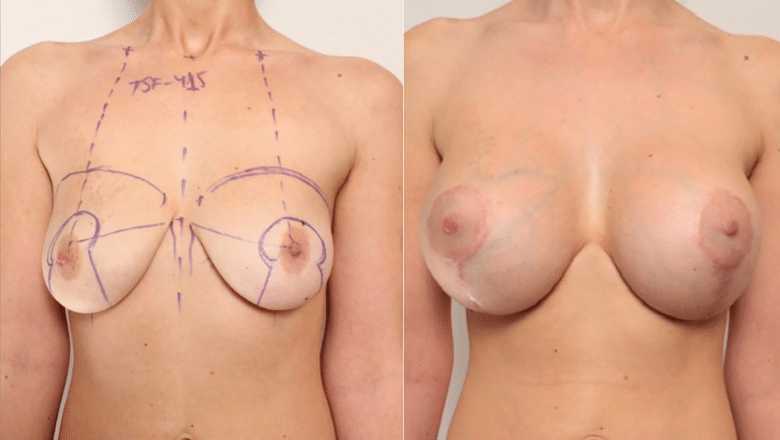
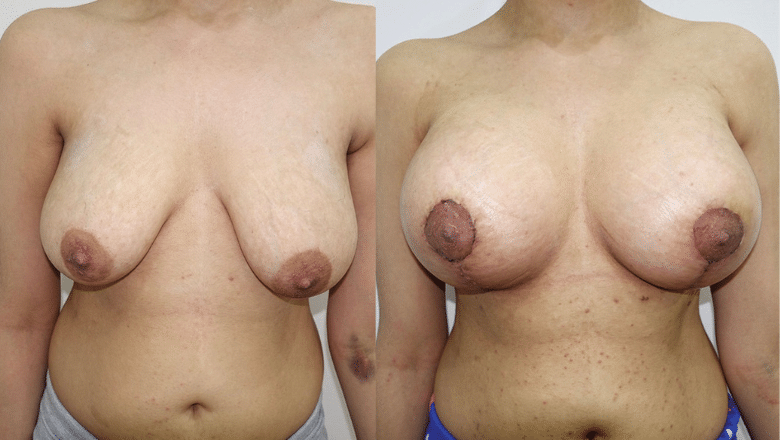
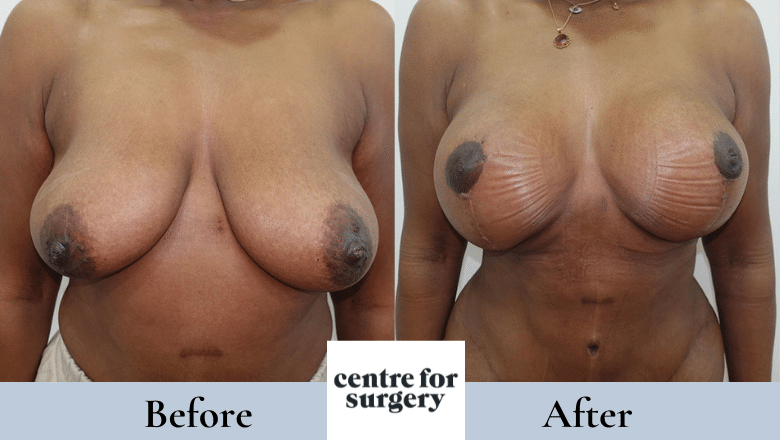
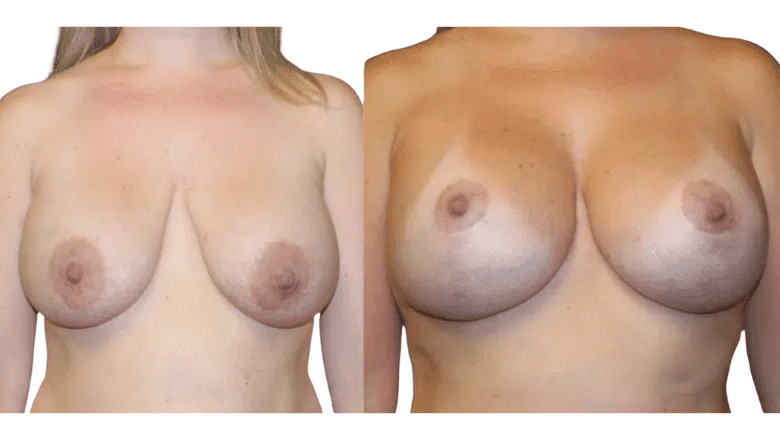
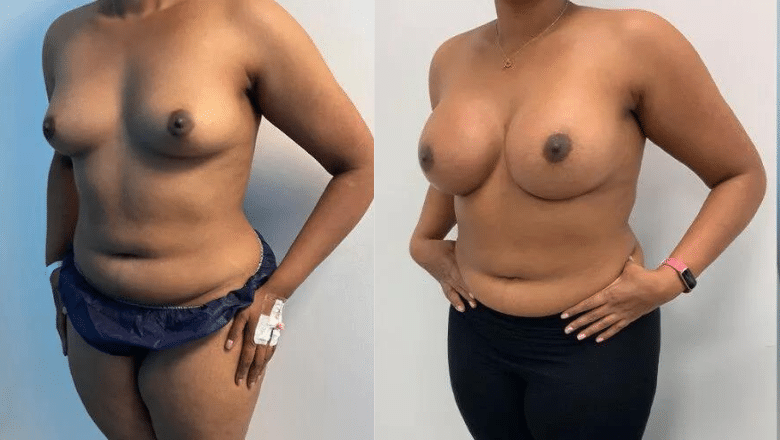
You can see more results in our breast lift before and after and breast augmentation before and after galleries.
Other Options Worth Knowing About
A lift and implants are not the only options. Depending on what bothers you, your surgeon may also discuss:
- Nipple and areola surgery: areola reduction for large or stretched areolas (often done as part of a lift), inverted nipple correction and nipple reduction.
- Fat transfer or auto-augmentation: a more modest, natural increase in fullness without an implant, alone or with a lift.
- Breast reduction: for breasts that are too large as well as low.
- A mummy makeover: a lift or a lift with implants combined with a tummy tuck after pregnancy. See our mummy makeover page.
Frequently Asked Questions
Is a boob lift the same as a boob job?
No. “Boob lift” is an informal name for a breast lift (mastopexy), which raises and reshapes the breast. “Boob job” usually means breast augmentation with implants, which makes the breasts bigger. Some women need one, some need the other, and some need both.
Does a breast lift make your breasts smaller?
It can make them look slightly smaller, because loose skin is removed and the breast becomes more compact, even though no breast tissue is taken away. Many women find their bra cup size is a little smaller afterwards. If you want to keep or increase your size, adding implants is usually the better route.
Can a breast lift make my breasts look fuller without implants?
To a degree. Gathering the tissue higher and tighter can make the breast look fuller from the front, much like a well-fitting bra, but it does not add true volume or much fullness to the upper breast.
Which is more painful, a breast lift or implants?
Most women find both manageable with simple painkillers after the first few days. Implants placed under the muscle tend to cause more aching in the first week, while a lift has longer wounds to look after. The combined operation involves both.
Can I have a breast lift if I already have implants?
Yes. If your breasts have dropped around existing implants, a lift can be done with the implants kept, replaced or removed. See breast implant removal with a breast lift.
Can I have a breast lift or implants before having children?
You can, but pregnancy and breastfeeding usually change the breasts again, so many women wait until their family is complete. If you’re planning a pregnancy soon, your surgeon will usually suggest waiting.
Will the NHS pay for a breast lift or augmentation?
Cosmetic breast lift and augmentation surgery isn’t covered by the NHS or by private health insurance. Exceptions can apply where surgery addresses a genuine reconstructive need, such as after a mastectomy, and this is assessed case by case.
How common are breast lift and augmentation surgery in the UK?
Breast augmentation is the most common cosmetic operation in the UK. In the latest audit by the British Association of Aesthetic Plastic Surgeons, its members performed 4,761 breast augmentations in 2025, just ahead of breast reduction (4,673).6
Breast Lift and Augmentation at Centre for Surgery
At Centre for Surgery, breast lifts, breast augmentation and combined procedures are performed by GMC-registered plastic surgeons at our CQC-regulated hospital at 95–97 Baker Street, rated Good overall. The surgeon who assesses you at your consultation is the same surgeon who performs your surgery. At your consultation you can try implant sizers in a bra to get a feel for different volumes, and we recommend a two-week cooling-off period before any surgery is booked. Our medical content is reviewed by Specialist Plastic Surgeon Dr Spyridon Vlachos (GMC 7522950).
Read verified patient reviews on Google or on our patient reviews page. To book a consultation, call 020 7993 4849 or complete the form below.
References
- Swanson E. Prospective photographic measurement study of 196 cases of breast augmentation, mastopexy, augmentation/mastopexy, and breast reduction. Plast Reconstr Surg. 2013;131(5):802e–819e. doi:10.1097/PRS.0b013e3182865e20
- Swanson E. Photometric evaluation of long-term changes in breast shape after breast augmentation and vertical mammaplasty. Plast Reconstr Surg Glob Open. 2018;6(6):e1844. doi:10.1097/GOX.0000000000001844
- Regnault P. Breast ptosis: definition and treatment. Clin Plast Surg. 1976;3(2):193–203. PMID 1261176
- Spring MA, Hartmann EC, Stevens WG. Strategies and challenges in simultaneous augmentation mastopexy. Clin Plast Surg. 2015;42(4):505–518. doi:10.1016/j.cps.2015.06.008
- Khavanin N, Jordan SW, Rambachan A, Kim JYS. A systematic review of single-stage augmentation-mastopexy. Plast Reconstr Surg. 2014;134(5):922–931. doi:10.1097/PRS.0000000000000582
- British Association of Aesthetic Plastic Surgeons. Analysis of BAAPS Audit 2024–2025. baaps.org.uk