


In this guide12 sections
- Key points
- What is a V-taper body?
- Shoulder-to-waist ratio and the Adonis index explained
- How to get a V-taper: what actually changes the shape
- V-taper exercises and workouts — what they can and cannot do
- Why some men can’t get a V-taper no matter how hard they train
- Surgical options for a V-taper body
- When surgery is not the answer
- Combining procedures
- Frequently asked questions
- Why choose Centre for Surgery
- Further reading
Key points
- The V-taper body is the shape created by broad shoulders narrowing to a slim waist. It is measured as the shoulder-to-waist ratio, and the widely cited ideal — the Adonis index — is 1.618.
- Three things determine your V-taper: skeletal frame (fixed), muscle (trainable), and fat distribution (partly trainable). Only two of the three respond to the gym.
- Clavicle width and pelvic width are set by your skeleton. No training programme, supplement or procedure widens the bones of an adult male frame.
- V-taper exercises build the lats and deltoids, which widens the appearance of the upper body considerably — but the waist half of the ratio is largely a fat-distribution problem.
- Flank fat — love handles — is the most training-resistant deposit on the male body, and it is the single biggest reason men who train hard still do not see a taper.
- Where fat is the limiting factor, love handle liposuction, HD lipo and abdominal etching change the waist measurement directly.
- Where chest tissue breaks the line, that is usually gynaecomastia rather than fat, and no amount of training removes it.
- Where the shoulders are the limiting factor, deltoid fat grafting and pectoral fat grafting can add width and projection using your own fat.
- None of this applies if the fat you are carrying is visceral. If your abdomen is firm and protruding rather than pinchable, surgery cannot reach it.
What is a V-taper body?
The V-taper is the silhouette formed when the shoulders and upper back are substantially wider than the waist, so the torso reads as an inverted triangle. It is sometimes called a V-shaped body or a V-taper physique, and it is the shape most men have in mind when they say they want to look athletic rather than simply lean.
It is worth separating it from the Adonis belt — the pair of oblique grooves running from the hips toward the pubic area — which is a related but distinct feature. The V-taper is the whole torso outline; the Adonis belt is a specific detail of lower abdominal definition. They tend to appear together at low body fat, and the surgical routes to each overlap, but they are not the same thing and are limited by different factors.
What makes it striking is not the absolute width of the shoulders or the absolute narrowness of the waist. It is the difference between them. Two men with identical shoulder measurements can look entirely different depending on their waist, and a change of a few centimetres at the waist alters the impression more than several kilos of upper body muscle.
That single fact explains most of what follows. The V-taper is a ratio, and there are two ways to change a ratio — build the top, or reduce the bottom. For most men who have already trained, the bottom is where the remaining change is, which is why love handle liposuction and HD lipo come up more often than shoulder procedures.
Shoulder-to-waist ratio and the Adonis index explained
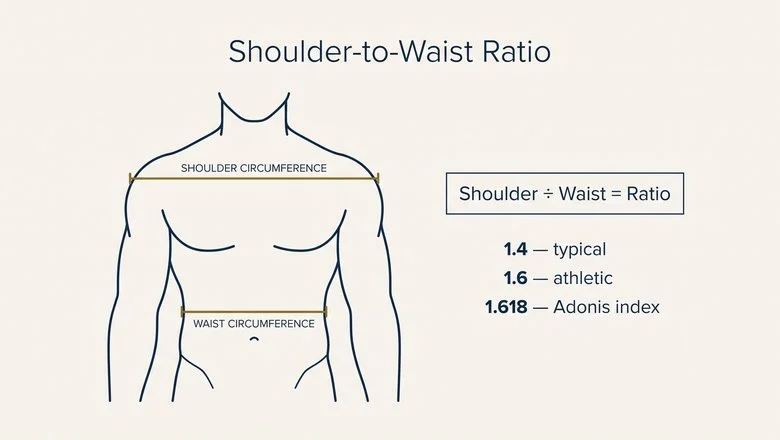
How the shoulder-to-waist ratio is measured, and where the commonly cited values sit.
The shoulder-to-waist ratio is calculated by dividing shoulder circumference — measured around the widest point of the deltoids — by waist circumference measured at the narrowest point, usually just above the navel. It is the male counterpart to the waist-to-hip ratio used more often for female proportions, and it behaves the same way: partly trainable, partly fixed by skeleton.
The Adonis index is the name given to a shoulder-to-waist ratio of approximately 1.618, the golden ratio. It appears throughout fitness writing as an ideal, and it has some grounding in preference research — cross-cultural studies consistently find that observers rate male torsos with a higher shoulder-to-waist ratio as more physically attractive, with preference clustering somewhere near that figure.
Rough reference points:
- 1.3 to 1.4 — typical untrained adult male
- 1.5 to 1.6 — visibly athletic, achievable for most men with consistent training and low body fat
- 1.618 — the Adonis index, achievable for men whose frame permits it
- 1.7 and above — competitive physique athletes, and generally requiring a naturally wide clavicle
Two cautions are worth stating plainly. First, the golden ratio’s application to the human body is aesthetic convention rather than physiology — there is nothing biologically privileged about 1.618, and the research on preference is a good deal messier than the number suggests. Second, and more practically: the ratio can be improved from either end, and for most men the waist end moves further and faster than the shoulder end.
If you measure 120 cm at the shoulders and 90 cm at the waist, your ratio is 1.33. Adding 5 cm of shoulder width — which is a great deal of muscle — takes you to 1.39. Taking 8 cm off the waist takes you to 1.46. The second is usually the more accessible route, and it is the one most training programmes underplay.
How to get a V-taper: what actually changes the shape
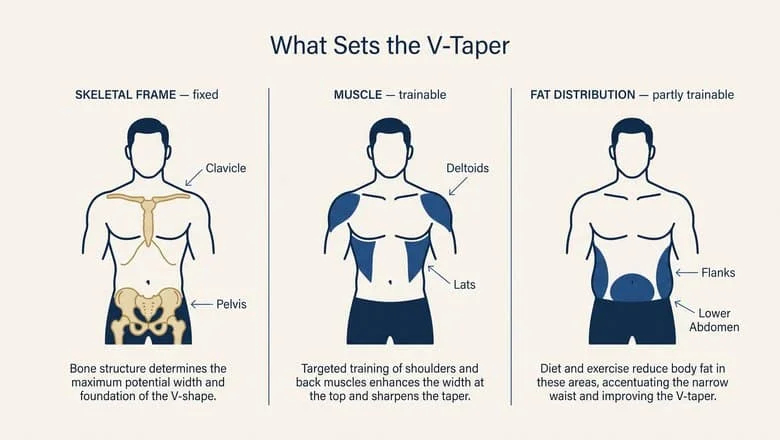
The three components of a V-taper. Only two of them respond to training.
Your V-taper is produced by three things layered on top of each other, and it is worth being clear about which is which before spending years on the wrong one.
1. Skeletal frame — fixed
The width of your clavicles sets the maximum width of your shoulders. The width of your pelvis and the flare of your lower ribcage set the minimum circumference of your waist. Both are determined by genetics and finished growing when your growth plates closed.
This is the part no programme addresses honestly. A man with narrow clavicles and a wide pelvis is working from a different starting ratio than a man with the reverse, and no amount of training changes the underlying architecture. Anyone selling you a method to widen your shoulder frame is selling you muscle growth under a misleading name.
The same logic applies here as on the waist-to-hip ratio and the thigh gap: when a body proportion is set by bone, the honest answer is to say so rather than sell effort against it.
2. Muscle — trainable, and worth training
The latissimus dorsi is the muscle that creates apparent width through the upper back, and the lateral head of the deltoid creates it at the shoulder. Both respond well to training, and developing them changes the silhouette substantially even though the skeleton has not moved.
This is the legitimate core of every V-taper workout ever written, and it works. Pull-ups, lat pulldowns, rows, and lateral raises are the standard tools. Someone starting untrained can add meaningful width over one to two years of consistent training.
The limit is that muscle growth is slow, finite, and subject to diminishing returns. Most men reach the majority of their realistic lat and delt development within a few years, after which the shoulder half of the ratio essentially stops moving.
3. Fat distribution — partly trainable, and the usual bottleneck
Where your body stores fat is inherited. Men predominantly store abdominally and at the flanks, and within that pattern there is considerable individual variation in which deposit resists longest.
Overall fat loss reduces the waist. But you cannot choose where it comes off — spot reduction is not physiologically possible, and no exercise burns fat from the flanks specifically. For a large number of men, the flank deposit is the last to go and sometimes does not go at all at a body fat percentage they can sustain.
V-taper exercises and workouts — what they can and cannot do
Search for V-taper exercises and you will find hundreds of programmes, most of them built around the same handful of movements. They are not wrong. Lat and deltoid work genuinely widens the upper body, and if you have not trained seriously that is where your first and largest gains will come from.
What most of them do not say:
- Ab training does not narrow your waist. Direct abdominal work builds the rectus abdominis and the obliques. Building the obliques can make the waist marginally thicker, not thinner. Visible abdominal definition comes from low body fat, not from crunches. If you are slim but still soft around the middle, with little muscle, you may be skinny fat, and building muscle will change your shape more than losing weight.
- There is no such thing as a flank-burning exercise. Side bends, oblique twists and similar movements train muscle beneath the fat; they do not remove the fat above it.
- Waist trainers and corsets do nothing lasting. They compress soft tissue temporarily and have no effect on fat, muscle or bone.
- Training plateaus at the frame. Once your lats and delts are developed, further training changes very little about the ratio.
If you have trained consistently for years, hold a reasonable body fat percentage, and still do not see the taper you expected, that is usually not a training failure. It is a frame-and-fat-distribution outcome, and it is worth knowing that rather than adding a fifth year of the same programme.
V-taper vs Y-taper: what is the difference?
The distinction comes up frequently and is mostly about where the width sits. A V-taper describes width across the lats and mid-back narrowing progressively to the waist — the widest point is below the shoulders. A Y-taper describes a physique where the width is concentrated high, at the deltoids and traps, with less lat spread, so the outline narrows sharply just below the shoulders rather than tapering gradually.
Neither is better. Which one you present with depends largely on clavicle width and where your muscle mass distributes, and both are legitimate athletic shapes. The Y pattern is more common in men with wide clavicles and comparatively less lat development; the V in men with strong lat development relative to their shoulder width.
Why some men can’t get a V-taper no matter how hard they train
Four situations account for most cases where a genuinely committed training history has not produced the expected shape.
A wide pelvis or flared lower ribcage. The waist has a floor set by your skeleton. If your lower ribs flare, no reduction in body fat brings the waist below that width.
Narrow clavicles. Deltoid and lat development improve the appearance considerably, but the frame beneath them does not widen.
Stubborn flank fat. Genuinely training-resistant in a large proportion of men. This is the most common single limiter, and it is also the most treatable.
Glandular chest tissue. Where the chest carries firm tissue beneath the nipple rather than soft fat, that is gynaecomastia — and it is not fat, does not respond to training, and can be made more prominent by building the pectoral muscle underneath it. Several men arrive at consultation having trained chest hard for a year and found exactly that. Our guide to man boobs and how to get rid of them covers the distinction between glandular tissue and chest fat.
Surgical options for a V-taper body
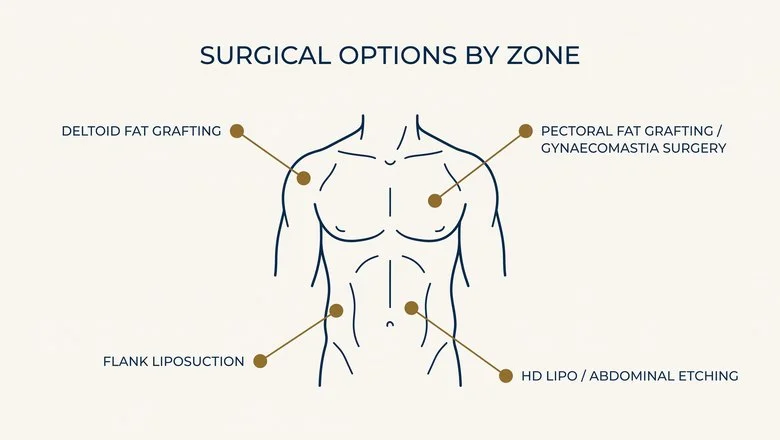
Surgical options by zone. Each addresses a different limiter, and most patients need one rather than all of them.
Surgery does not build a physique, and nothing below is a shortcut past training. What these procedures do is remove specific obstacles for men who have already done the work and hit an anatomical limit. At Centre for Surgery all are performed under TIVA (total intravenous anaesthesia) as day cases at our CQC-regulated Baker Street clinic by GMC-registered plastic surgeons.
Who performs male body contouring at Centre for Surgery
Male body contouring here is performed by GMC-registered plastic surgeons, several of whom take on this work — including Mr Metin Nizamoglu. The full range of techniques discussed on this page is available in-house — HD lipo, abdominal etching, VASER and power-assisted liposuction (PAL) contouring, gynaecomastia surgery, and fat transfer to the chest and deltoids.
Mr Nizamoglu is a Consultant Plastic, Reconstructive and Aesthetic Surgeon holding FRCS (Plast) and Fellowship of the European Board of Plastic, Reconstructive and Aesthetic Surgeons (EBOPRAS), with over 14 years of NHS experience including a prior consultant post at the St Andrew’s Centre for Burns and Plastic Surgery, the BAAPS mentorship programme and a dedicated aesthetic fellowship (GMC 7041067). You will meet the surgeon who will carry out your operation at consultation, and that same surgeon performs your surgery and reviews you afterwards. You can check any surgeon’s registration and specialist status on the GMC medical register.
That range matters more than it might appear. Male torso contouring is rarely one procedure — the man whose taper is limited by flank fat often also has glandular chest tissue, and the man wanting pectoral projection is usually also a candidate for flank liposuction to harvest the graft. Having the full set of techniques available in-house means the plan can follow your anatomy rather than being shaped by what the clinic happens to offer.
Love handle liposuction — narrowing the waist
The single most effective intervention for the V-taper, because it addresses the denominator of the ratio directly. Love handle liposuction removes the flank deposit permanently — the fat cells are taken out and do not regenerate.
This is the right procedure for the man who is lean elsewhere, trains consistently, and still carries a defined roll at the waistband. It is not a weight-loss procedure and will not help someone significantly above their target weight. See also our male liposuction page and the male liposuction cost guide.
HD lipo and abdominal etching — definition rather than volume
HD lipo works in the superficial fat layer immediately above the muscle, selectively removing fat to reveal the underlying architecture rather than simply debulking. Applied to the flanks and abdomen it both narrows the waist and sharpens the transition from ribcage to waist that reads as taper.
Abdominal etching goes further, defining the tendinous inscriptions to produce visible abdominal separation.
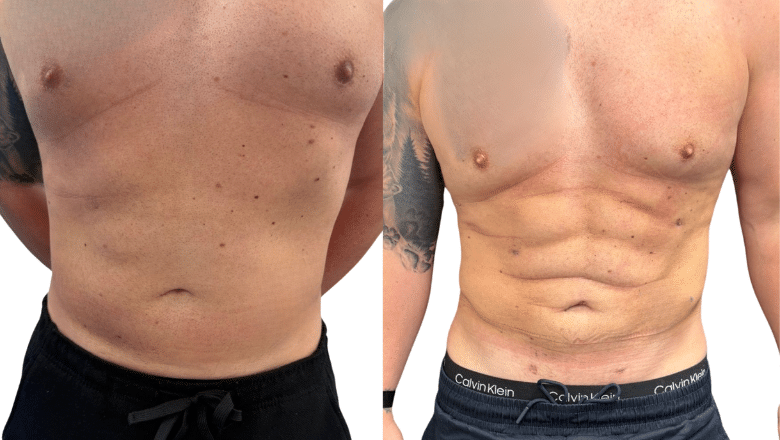
Abdominal etching before and after at Centre for Surgery. The technique reveals existing muscular anatomy and narrows the waist — it does not create musculature. Individual results vary.
Both require an already low body fat percentage and existing muscle development — they reveal what is there rather than creating it, and in a patient without underlying development the result looks artificial.
Either technique may use VASER or power-assisted lipo (PAL) depending on tissue quality. Male flank fat is frequently fibrous, which is one of the situations where VASER is preferred.
Gynaecomastia surgery — removing what breaks the line
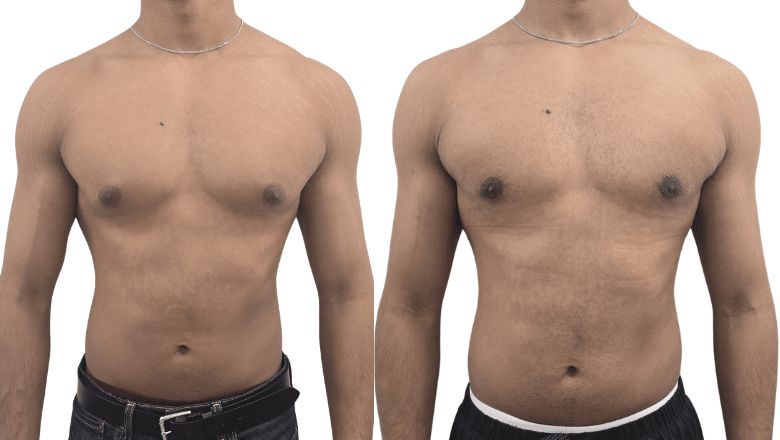
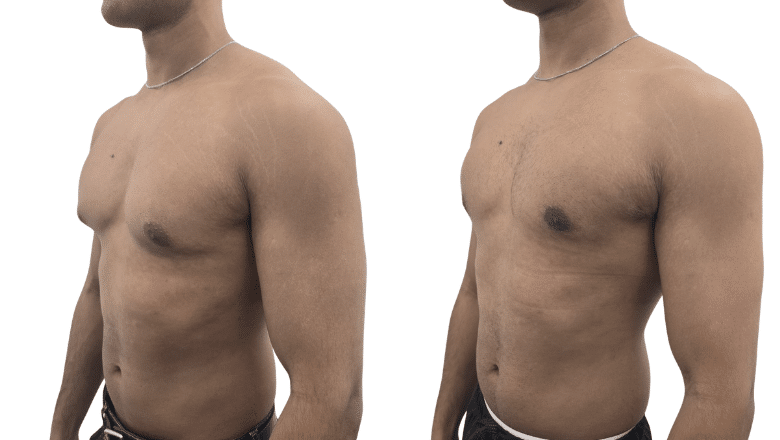
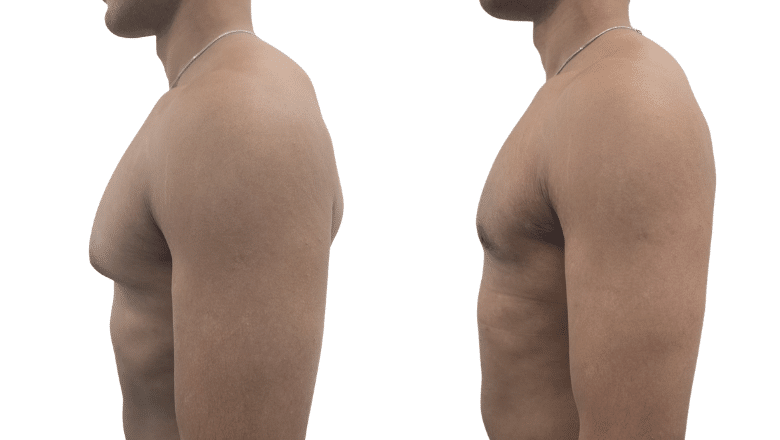
Gynaecomastia surgery before and after at Centre for Surgery — enlarged breast tissue reduced, shown in anterior, oblique and lateral views. Where glandular tissue breaks the chest line, removing it restores the taper in a way training cannot. Individual results vary.
Where firm glandular tissue sits beneath the nipple, it disrupts the chest contour regardless of how developed the pectoral muscle is. Male breast reduction excises the glandular tissue, usually combined with liposuction of the surrounding chest fat. For men whose taper is broken at the chest rather than the waist, this is the operation that matters, and no amount of flank liposuction substitutes for it.
Pectoral fat grafting — adding chest projection
Where the chest lacks projection despite training, fat can be harvested by liposuction from the flanks or abdomen and transferred to the pectoral region. The appeal is that it does two things at once: it removes fat from the waist and adds it to the chest, improving both ends of the ratio in a single procedure.
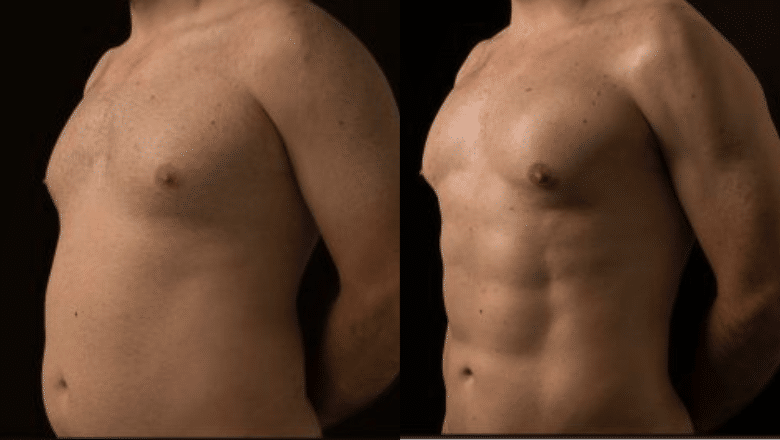
HD Lipo — full torso VASER and power-assisted liposuction with fat transfer to chest. Male patient, anterior view showing defined pectoral and abdominal anatomy with chest volume enhancement. Both ends of the shoulder-to-waist ratio improved in one operation. Individual results vary.
Realistic expectations matter. Fat transfer produces a moderate, natural increase in fullness — not the step change of an implant. A proportion of transferred fat does not survive, typically 30 to 50 percent, and the final result is assessed at around six months. Where a larger and more defined change is wanted, pectoral implants are the alternative, with the trade-offs set out on that page. General information on the technique is on our fat transfer page.
Deltoid fat grafting — widening the shoulders
Fat transfer to the deltoid region adds width and roundness at the shoulder, improving the numerator of the shoulder-to-waist ratio. As with the chest, the fat is harvested by liposuction — usually from the flanks and abdomen, which means the same operation narrows the waist.
This is a more limited procedure than patients often expect. It adds soft tissue volume over the deltoid; it does not lengthen the clavicle, and the change is measured in centimetres rather than transformative. It suits men who are already well developed and want a specific refinement, not men looking to bypass training. Deltoid fat grafting is assessed case by case at consultation, and we will tell you if your frame means the gain would not justify the procedure.
Latissimus dorsi contouring — width through the back
The lats create the widest part of a V-taper, and where fat sits over the upper and mid-back it blurs the line between the lat and the waist. Contouring liposuction to the back and posterior flank sharpens the lateral border of the latissimus dorsi so existing muscle development becomes visible.
Upper back fat is among the most fibrous on the body and responds poorly to conventional liposuction, which is one of the clearest indications for VASER. Where excess skin rather than fat is the issue — usually after major weight loss — a bra line back lift or an upper body lift is the more appropriate route, since liposuction removes volume and leaves the skin envelope behind.
Lower abdominal definition — the Adonis belt
The oblique grooves running from the hips toward the pubic area — the Adonis belt, sometimes called the Apollo belt — are a separate feature from the V-taper but frequently part of the same goal. They are produced by the inguinal ligament and the border of the external oblique, and become visible only at low body fat. Our Adonis belt guide covers what makes it visible, why some men never see it regardless of body fat, and where etching genuinely helps.
When surgery is not the answer
We would rather set this out plainly than have you book a consultation you do not need.
If you have not yet trained seriously. Lat and deltoid development is the largest single change available to most men, it costs nothing, and it is the foundation any surgical refinement sits on. Etching an undeveloped abdomen looks wrong.
If you are significantly above your target weight. Liposuction contours localised fat. It is not a weight-loss procedure, and results in a patient who is still losing weight are unpredictable.
If your abdomen is firm and protruding rather than pinchable. That pattern usually indicates visceral fat behind the abdominal wall rather than subcutaneous fat above it. No procedure reaches it — visceral fat responds only to weight loss, exercise and medical management. Being able to grasp a fold of tissue between your fingers is the simplest indication that what you are seeing is fat that liposuction can remove.
If your frame is the limit and you are expecting a frame change. A surgeon who promises to change your shoulder-to-waist ratio to 1.618 when your clavicles do not permit it is not being straight with you. We will tell you what your anatomy allows at consultation, including when the answer is that the gain would be modest.
If the goal is causing you real distress. Body image concerns focused on a specific measurement can indicate body dysmorphic disorder, and surgery reliably fails to resolve them. Assessment for BDD forms part of consultation for every cosmetic procedure here, and we decline to operate where surgery is unlikely to help. If your feelings about your physique are occupying a lot of your thinking or driving restrictive eating or compulsive training, speaking to your GP is a better first step than booking a consultation.
Combining procedures
Most men who proceed need one procedure, not several. Where more than one applies, the common combinations are:
- Flank liposuction with gynaecomastia surgery — the two most frequent limiters, addressed in one session
- Flank liposuction with pectoral or deltoid fat grafting — the harvested fat is the graft material, so both ends of the ratio improve together
- HD lipo across abdomen, flanks and back — treating the torso as a single unit rather than isolated zones, which is generally what produces a coherent result. The case above is exactly this: full torso VASER and power-assisted lipo with fat transfer to the chest, narrowing the waist and adding pectoral projection in the same session
Our male body contouring guide covers sequencing where several areas are involved.
Frequently asked questions
What is a good shoulder-to-waist ratio for a man?
Around 1.4 is typical for an untrained man, 1.5 to 1.6 reads as visibly athletic, and 1.618 is the commonly cited Adonis index. Where you can realistically land depends substantially on clavicle and pelvic width, which are fixed.
Can you build a V-taper without a wide frame?
You can improve it considerably. Lat and deltoid development plus a lower waist measurement will change the silhouette markedly. What you cannot do is change the skeletal proportions underneath, so a man with narrow clavicles will generally not reach the ratios of a man with wide ones, however hard either trains.
How long does it take to get a V-taper?
For someone starting untrained, one to two years of consistent training produces most of the achievable muscular change. The fat side depends on your starting body fat and how much needs to come off. Men who have already trained for years and stalled are usually limited by frame or fat distribution rather than by time.
Does liposuction give you a V-taper?
It changes the waist measurement, which is one half of the ratio, and for men whose flank fat is the limiting factor that is often the change that makes the difference. It does not build muscle and does not widen the frame. It works best on men who have already trained.
Is the Adonis index real?
It is a convention rather than a physiological law. Preference research does consistently find that higher shoulder-to-waist ratios are rated more attractive, but the precise figure of 1.618 owes more to the appeal of the golden ratio than to the data.
Can women have a V-taper?
Yes, though the term is used mainly for male physiques and female fat distribution and pelvic proportions differ. The same principles apply — frame sets the limits, muscle and fat distribution do the rest.
Why choose Centre for Surgery
Centre for Surgery is a CQC-regulated cosmetic surgery clinic at 95–97 Baker Street in London’s medical district.
- Several plastic surgeons performing male body contouring — the full range of techniques available in-house
- All procedures performed by GMC-registered plastic surgeons
- TIVA administered by a consultant anaesthetist — not gas-based general anaesthetic
- Day-case surgery with same-day discharge
- Power-assisted liposuction (PAL) and VASER both available, chosen on tissue quality rather than price
- Two-week cooling-off period from the date of consent
- Your surgeon’s direct number for the first 24 hours
- Honest assessment — including when the answer is that surgery would not help

Phone: 020 7993 4849
Address: 95–97 Baker Street, London W1U 6RN
Further reading
- Love handle liposuction
- Male liposuction | Male liposuction cost
- HD lipo | Abdominal etching
- Gynaecomastia surgery (male breast reduction) | How to get rid of man boobs
- Pectoral implants | Fat transfer
- Male body contouring | Male tummy tuck
- Back liposuction | Bra line back lift
- Adonis belt (Apollo belt) | Waist-to-hip ratio
- VASER liposuction | Liposuction and liposculpture


