


In this guide14 sections
- Key Points
- How Do I Choose the Right Surgeon for a Mummy Makeover?
- Who Is the Best Mummy Makeover Surgeon in the UK?
- What Should I Look for in Mummy Makeover Before and After Photos?
- What Questions Should I Ask a Mummy Makeover Surgeon?
- Does the Hospital Matter as Much as the Surgeon?
- Is a Mummy Makeover Safer in the UK Than Abroad?
- What Are the Red Flags When Choosing a Mummy Makeover Surgeon?
- How Do I Know Which Procedures I Need for a Mummy Makeover?
- What Happens at a Mummy Makeover Consultation at Centre for Surgery?
- Are the Results Worth It? What the Research Says
- Frequently Asked Questions
- Mummy Makeover Surgeon in London
- References
Key Points
- How do I choose a mummy makeover surgeon? Check that the surgeon is on the GMC specialist register for plastic surgery, has regular experience of combined breast and tummy operations, shows you consistent before and after photos, and is happy to explain the risks as plainly as the benefits.
- There is no single best mummy makeover surgeon in the UK. Rankings and awards cannot tell you who is right for your body, so compare surgeons on training, experience, honesty and aftercare instead.
- The hospital matters as much as the surgeon. A mummy makeover is a long operation, so look for a CQC-regulated hospital, a consultant anaesthetist and a clear plan for out-of-hours care.
- Combining procedures raises risk. A 2025 retrospective study found higher complication rates when abdominoplasty was combined with other procedures, which is why a surgeon who is willing to stage your surgery is a good sign[2].
- Surgery abroad carries extra risks. Surgeons across Europe report treating complications from overseas operations, and tummy tucks are among the most common[1].
- Take your time. You should receive a written plan and quote, meet the surgeon who will operate, and have a cooling-off period before you commit.
Searching for the best mummy makeover surgeon in the UK can feel overwhelming, because a mummy makeover (also called a mommy makeover) is not one operation but a combination of breast and tummy surgery tailored to you. The choice of surgeon influences your safety, your scars, your recovery and how natural the result looks, so it deserves more care than choosing a clinic from a search result or a social media feed.
This guide explains how to choose a mummy makeover surgeon in London or anywhere in the UK: the qualifications that matter, the questions to ask, how to read before and after photos, and the red flags that should make you pause. If you are still deciding whether the operation is right for you, our guides to whether a mummy makeover is worth it and how soon you can have a mummy makeover after pregnancy are a good place to start.
How Do I Choose the Right Surgeon for a Mummy Makeover?
Start with the surgeon, then the hospital, then the plan. A mummy makeover usually combines a tummy tuck with a breast augmentation, breast lift or breast reduction, sometimes with liposuction, so you are looking for a surgeon who is trained in both breast and body surgery and who operates on these areas every week.
The sections below follow the order in which most women make their decision, from checking credentials to booking a consultation.
What qualifications should a mummy makeover surgeon have?
In the UK, any registered doctor can legally call themselves a cosmetic surgeon, because the title is not protected. The reliable check is the General Medical Council (GMC) specialist register. A surgeon listed there for plastic surgery has completed a recognised higher surgical training programme and passed the specialty exams, which is why many patients make it their first filter. You can search any doctor by name on the GMC website ↗, where you will also see any conditions or restrictions on their practice.
The evidence from surgeons themselves points the same way. In a 2026 survey of 250 board-certified plastic surgeons from 36 countries, published in the Journal of Plastic, Reconstructive and Aesthetic Surgery ↗, 79% named board certification as the single most important thing patients should verify[1]. Membership of professional bodies such as BAAPS ↗ or BAPRAS ↗ is a useful extra signal, although it is no substitute for the specialist register.
Should I choose a plastic surgeon or a cosmetic surgeon?
Choose a plastic surgeon whose training covers both aesthetic and reconstructive surgery. Reconstructive training matters for a mummy makeover because it teaches the handling of skin, scars and wound healing that combined breast and abdominal surgery demands. Our guide to how to choose a plastic surgeon sets out the same checks for any procedure.
Does my surgeon need experience of combined mummy makeover surgery?
Yes. Ask how many mummy makeovers they perform each year and how often they combine the specific procedures you are considering, such as a tummy tuck with breast augmentation and a lift. Experience of each operation separately is not quite the same as planning them together, because the surgeon has to balance the breast and the waist against each other and keep the operating time sensible.
Is a mummy makeover riskier than separate operations?
It can be. A 2025 retrospective study of 670 patients in Aesthetic Plastic Surgery ↗ found that combined procedures carried significantly higher complication rates than single procedures, particularly abdominoplasty combined with breast surgery or liposuction[2]. That does not mean combining is wrong for everyone. It means that the right surgeon will tell you honestly when staging the operations is safer, and will not push the biggest package. Our guides to combining cosmetic surgery procedures and how safe a mummy makeover is explain how that decision is made.
Who Is the Best Mummy Makeover Surgeon in the UK?
There is no official ranking, and anyone who names a single best surgeon is selling something. Lists of the best mummy makeover surgeons, search rankings and review scores are shaped by marketing budgets as much as by results. What you can do is compare surgeons on the same objective points:
- Entry on the GMC specialist register for plastic surgery.
- Regular experience of the exact combination you want.
- Before and after photos of patients with a similar starting point to yours.
- Willingness to explain risks, alternatives and staging.
- A clear written plan, aftercare and follow-up.
- Operating in a regulated hospital rather than a rented room.

Where is the best place to get a mummy makeover?
For most women in the UK, the best place is a regulated UK hospital where the surgeon, anaesthetist and nursing team work together and where you can return easily if you need a review. A London mummy makeover at a hospital such as our Baker Street hospital also suits women travelling from elsewhere in the UK, and our guide to travelling to us for surgery explains how appointments, hotels and the day itself are arranged.
What Should I Look for in Mummy Makeover Before and After Photos?
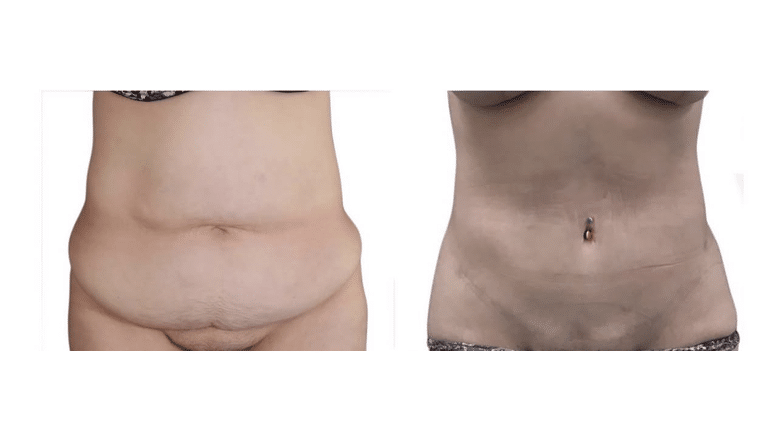
Before and after photos are the nearest thing to evidence of a surgeon’s work, and they are only useful if you read them critically. Look for:
- Consistent photography. The same angle, lighting, background and distance in both photos, with no change in posture or camera height.
- Patients like you. A similar body shape, skin laxity and starting point to your own, including women who have had children.
- Results at a realistic time. Photos taken weeks after surgery show swelling, while results at six months or more show the real outcome.
- Scars shown honestly. Photos from several angles, including the scars, rather than only the flattering front view.
- The surgeon’s own patients. Photos should come from the surgeon or hospital you are considering, with patient consent, rather than stock images or another clinic’s results.
A 2026 survey study of patients and plastic surgeons in Germany, published in the journal Handchirurgie, Mikrochirurgie, Plastische Chirurgie, found clear demand for before and after images from both groups, and recommended safeguards such as authenticity labels so that they do not mislead[3]. You can see real examples in our mummy makeover before and after photos, and more of the surgeon’s own cases are available to view at consultation.
What Questions Should I Ask a Mummy Makeover Surgeon?
A good consultation is a conversation, not a sales pitch, and your questions should be answered directly. Take this list with you:
- Are you on the GMC specialist register for plastic surgery, and will you personally perform my operation?
- How many mummy makeovers like mine do you perform each year?
- Which procedures do I actually need, and which could wait or be left out?
- Would you recommend one operation or staging in two, and why?
- What are the risks for my body, including seroma, wound healing problems and blood clots, and how do you reduce them?
- How do you prevent blood clots in a long operation?
- Who is my anaesthetist, and how long will the operation take?
- What are the scars, where will they sit and how will they look in a bikini or underwear?
- What happens if I need a revision, and who pays for it?
- Who do I contact out of hours, and who reviews me after surgery?
The question about clots is worth asking directly. Venous thromboembolism, the formation of blood clots in the legs or lungs, is a recognised risk of long abdominal operations. A 2010 20-year outcomes review in Plastic and Reconstructive Surgery ↗ found that clot events fell significantly once a surgeon adopted aggressive prophylaxis[4]. Your surgeon should be able to describe their own approach, from early walking to compression and, where appropriate, medication.
What should I expect from a mummy makeover consultation?
You should meet the surgeon who will operate, be examined, and discuss your goals, health and family plans. The surgeon should tell you plainly if you are not yet a suitable candidate. At Centre for Surgery, suitability follows clear rules: at least six months since your last delivery, at least three months (ideally around six) after you stop breastfeeding, a stable weight for at least six months, and a BMI of 30 or below for the tummy tuck part. Our mummy makeover recovery guide explains what the weeks afterwards involve, and the consultation itself is also the right time to ask about having more children after a mummy makeover.
Does the Hospital Matter as Much as the Surgeon?
Yes. A mummy makeover is usually a five to six hour operation, and the people and equipment around the surgeon affect your safety as much as the surgeon does. Check these points:
- Regulation. The hospital should be registered with and inspected by the Care Quality Commission, whose published reports you can read on the CQC website ↗. Our page on what a CQC Good rating means for cosmetic surgery patients explains what the inspectors look at.
- A consultant anaesthetist. Long operations need an experienced anaesthetist. At Centre for Surgery, mummy makeovers are done under TIVA (total intravenous anaesthesia) given by a consultant anaesthetist, and our guide to anaesthesia for cosmetic surgery explains what that means.
- Nursing and aftercare. Drains, wound checks and the first review should happen with the same team, not at a different clinic.
- Emergency arrangements. Ask what happens if you become unwell after you go home, and who you call at night.
The same checks apply if you are comparing a mummy makeover with a single procedure. Even in a well-run outpatient series, complications occur: a 2026 study of 164 outpatient extended abdominoplasties in Aesthetic Surgery Journal ↗ reported a complication in about one patient in six (15.9%), nearly all managed without admission, with higher rates after greater weight loss[5]. The aim is not to avoid every risk but to be treated where complications are recognised and managed quickly.
Is a Mummy Makeover Safer in the UK Than Abroad?
For most women, a regulated UK hospital is the safer choice, mainly because of aftercare and accountability. A 2026 analysis of 198 cases in the British Association of Aesthetic Plastic Surgeons (BAAPS) cosmetic tourism complications database, published in Aesthetic Surgery Journal ↗, found that abdominoplasty was the most common procedure behind complications from overseas surgery. Wound breakdown, infection, seroma and tissue loss were the usual problems, and inadequate aftercare, poor preoperative preparation and flying too soon contributed[6]. A separate five-year study from a UK tertiary hospital found that almost half of hospital presentations after cosmetic surgery abroad were repeat visits[7].
If you are tempted by a lower price abroad, our guide to mummy makeover abroad sets out the risks in detail. Whichever country you choose, ask who will look after you if something goes wrong once you are home.
What Are the Red Flags When Choosing a Mummy Makeover Surgeon?
Walk away, or at least pause, if you notice any of the following:
- Pressure to book quickly. Time-limited offers, deposits demanded on the day and no cooling-off period are all warning signs.
- A fixed package for everyone. Your combination should be based on what has changed in your body, not on a menu.
- The surgeon is not the person you meet. If a salesperson or coordinator does the assessment and you do not meet the operating surgeon until the day, think again.
- No mention of risks. Every operation has them, and a surgeon who only talks about results is not giving you consent-quality information.
- Heavy filters or reused photos. Images that look edited, or that appear on other clinics’ pages, should not reassure you.
- No clear aftercare. You should know exactly who reviews you, when, and where.
- Willingness to operate regardless. A good surgeon will turn you down, or ask you to wait, if your weight, health, smoking or timing makes surgery unsafe.
Our page on the two-week cooling-off period explains why a gap between consent and surgery protects you.
How Do I Know Which Procedures I Need for a Mummy Makeover?
You will know once a surgeon has examined you, and the answer is often fewer procedures than you expect. Breast changes after pregnancy usually fall into volume loss, drooping or both, which points towards augmentation, a lift or a combination. Abdominal changes depend on skin laxity, muscle separation and fat, and may call for a full tummy tuck or a mini tummy tuck. Our guides to the mum tum and diastasis recti explain what is behind the changes, and tummy tuck with muscle repair covers how the separated muscles are treated.
A mummy makeover does not include everything by default. Liposuction is added only where your surgeon recommends it, and a Brazilian butt lift is always a separate operation, as we explain in does a mummy makeover include a BBL. If you also want help with facial ageing, we offer anti-wrinkle injections and dermal fillers, which are separate, non-surgical treatments.
What Happens at a Mummy Makeover Consultation at Centre for Surgery?
At our CQC-regulated Baker Street hospital, you meet the GMC-registered surgeon who would perform your operation. You are examined, we discuss which procedures fit your goals, and you receive a written plan and quote afterwards rather than a price on the day. We recommend a two-week cooling-off period before you confirm, and finance options are available subject to status through our finance options page. You can also read more about why patients choose us.
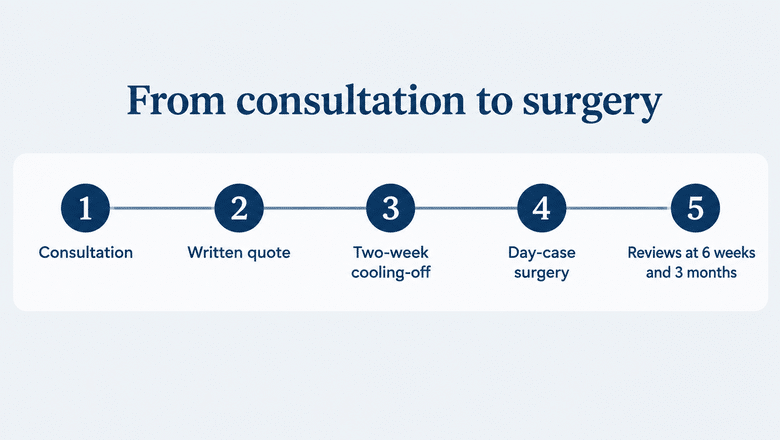
Surgery is a day case, so you go home the same day with a responsible adult staying with you for at least 24 hours. After the operation you wear compression garments for six weeks, return to desk work after about two weeks and are reviewed at six weeks and again at three months. Our guide to how to sleep after a mummy makeover and how to minimise scars after a mummy makeover cover two of the most common practical worries.
How much does a mummy makeover cost in the UK?
The cost depends on which breast and tummy procedures you combine, whether liposuction is recommended and any extras, so a fair quote can only follow a face-to-face assessment. Compare quotes on what they include, such as the surgeon’s fee, anaesthetist, hospital stay, implants, garments and follow-up, rather than on the headline figure alone. Our mummy makeover cost guide explains what drives the cost.
Are the Results Worth It? What the Research Says
For women who are well selected and well informed, the research is encouraging. In a 2026 prospective study of 36 postpartum women in the Journal of Plastic, Reconstructive and Aesthetic Surgery ↗, women who had abdominoplasty combined with breast surgery reported better quality of life and higher self-esteem 12 months later, with no major complications[8]. The study was small, from a single centre and had no comparison group, so it shows what is possible rather than what to expect. Results are long-lasting rather than permanent, which is why how long mummy makeover results last is worth reading before you commit.
Frequently Asked Questions
What is the average cost of a mummy makeover in the UK?
It varies with the combination of procedures, the hospital and the surgeon, so there is no single average that applies to you. A written quote after your consultation is the only reliable figure, and combining procedures is usually less expensive than staging them separately. Be wary of quotes that look far lower than others, and check what is included.
Is 40 too old for a mummy makeover?
No. Suitability depends on your general health, a stable weight, being a non-smoker and having finished your family, not on age alone. Many women in their forties have a mummy makeover safely when assessed by an experienced surgeon.
What is the best age for a mummy makeover?
There is no best age. Timing matters more: at least six months after your last delivery, at least three months (ideally about six) after you stop breastfeeding, and a stable weight for six months. Your family should also be complete.
Can you get a mummy makeover on the NHS?
No. A mummy makeover is cosmetic surgery, so it is not funded by the NHS or by private medical insurance. There are narrow exceptions where a functional problem is being treated, such as significant back pain from very large breasts.
Which is better, a tummy tuck or a mummy makeover?
Neither is better, because they treat different problems. A tummy tuck treats loose skin, fat and separated muscles on the abdomen, while a mummy makeover adds breast surgery in the same operation. If only your tummy bothers you, a tummy tuck alone is enough.
How long does a mummy makeover take, and is it a day case?
A tummy tuck combined with breast augmentation usually takes five to six hours. At Centre for Surgery it is done under TIVA as a day case, so you go home the same day with a responsible adult for at least 24 hours.
How long is the recovery after a mummy makeover?
Most women return to desk work after about two weeks and to full activity after around six weeks. You cannot lift young children for at least three weeks, and core exercises wait for three months. The final result takes 12 to 18 months to settle.
Is a mummy makeover permanent?
The results are long-lasting, because removed skin does not grow back and the muscle repair stays in place. A later pregnancy or a large change in weight can undo some of the improvement, and your body continues to age naturally.
Is there a non-surgical mummy makeover?
No. Stretched skin, separated muscles and deflated or drooping breasts are structural changes, and non-surgical treatments cannot reverse them. Diet and exercise can reduce fat but not loose skin.
Mummy Makeover Surgeon in London
If you would like to meet a GMC-registered surgeon and have your questions answered in person, book a consultation at our Baker Street hospital. Read more about our mummy makeover in London, or browse the wider cosmetic surgery FAQs.
Phone: 020 7993 4849 | Address: 95–97 Baker Street, Marylebone, London W1U 6RN
Contact us to schedule a consultation
References
- Demirdöver C, Henley M, Schaefer DJ, et al. Medical tourism in plastic surgery: a European survey on professional practices, perspectives, and challenges. Journal of Plastic, Reconstructive & Aesthetic Surgery 2026;121:35–45. doi:10.1016/j.bjps.2026.07.022 ↗
- Neel OF, Al-Khafaji MQM, Alrashoud NM, et al. Safety and outcomes of combined aesthetic surgical procedures: a retrospective study of risk factors, complication rates, and outcomes. Aesthetic Plastic Surgery 2025;50(3):1190–1198. doi:10.1007/s00266-025-05348-z ↗
- Ehrmanntraut J, Aitzetmüller M, Motamedi M, Allert S. Before-and-after pictures in aesthetic plastic surgery: European legal perspectives and an approach for Germany. Handchirurgie, Mikrochirurgie, Plastische Chirurgie 2026;58(4):338–343. doi:10.1055/a-2787-5156 ↗
- Trussler AP, Kurkjian TJ, Hatef DA, Farkas JP, Rohrich RJ. Refinements in abdominoplasty: a critical outcomes analysis over a 20-year period. Plastic and Reconstructive Surgery 2010;126(3):1063–1074. doi:10.1097/PRS.0b013e3181e60537 ↗
- Daniel Pereira D, Milkovich J, Austin R, Lista F, Ahmad J. Safety of outpatient drainless extended abdominoplasty: an analysis of 164 consecutive cases. Aesthetic Surgery Journal 2026. doi:10.1093/asj/sjag175 ↗
- Goodarzi MR, Nugent NF, Pacifico MD, Tyler M, Wokes JET. Beauty abroad, burden at home: complications and National Health Service impact of cosmetic tourism, insights from the British Association of Aesthetic Plastic Surgeons national database. Aesthetic Surgery Journal 2026;46(11):1177–1183. doi:10.1093/asj/sjag056 ↗
- Mafi P, Patel K, Hoque-Uddin S, Warner R. Recurrent clinical burden and cost of cosmetic surgery tourism complications: a five-year retrospective study from a UK tertiary centre. Cureus 2026;18(5):e109006. doi:10.7759/cureus.109006 ↗
- Toto V, Faiola A, Ponzo M, et al. Long-term psychosocial benefits after combined abdominoplasty and breast surgery in postpartum women: a prospective 12-month study. Journal of Plastic, Reconstructive & Aesthetic Surgery 2026;121:49–55. doi:10.1016/j.bjps.2026.07.006 ↗





