

In this guide11 sections
- Key Points
- Why Does Choosing the Right BBL Surgeon Matter So Much?
- How Do You Choose a BBL Surgeon in the UK?
- Questions to Ask Your BBL Surgeon: The Checklist
- What Are the Red Flags When Choosing a BBL Surgeon?
- Is It Safe to Get a BBL Abroad?
- Who Can Legally Perform a BBL in the UK?
- Am I a Candidate for a BBL?
- Frequently Asked Questions
- Brazilian Butt Lift in London
- References
Key Points
- Check your surgeon on the GMC register. Look for a licence to practise and, ideally, an entry on the Specialist Register for plastic surgery, which shows full specialty training.
- Ask exactly where the fat will go. The safest BBL places fat only in the layer under the skin, above the gluteal muscle. Injecting into the muscle raised the risk of death 16-fold in one large survey.
- Ask whether ultrasound is used. Real-time ultrasound lets the surgeon see the cannula tip and confirm the fat stays above the muscle throughout the BBL.
- Check where and how you will be treated. Your BBL should take place in a CQC-registered hospital, with an anaesthetist, monitored recovery and a clear aftercare plan.
- Know the red flags. Package deals abroad, pressure to book, guaranteed results and treatment by non-doctors are all reasons to walk away.
- UK rules are tightening. In 2025 and 2026 the government moved to restrict liquid BBLs to qualified professionals and then to doctors only.
To choose a BBL surgeon in the UK, check that they are a GMC-registered doctor with full plastic surgery training, ask how many Brazilian butt lifts they perform, and confirm that they place fat only above the gluteal muscle under ultrasound guidance in a CQC-registered hospital. The surgeon matters more for a BBL than for almost any other cosmetic operation: deaths from this procedure have been linked to fat injected into or under the buttock muscle, and that is a matter of surgical technique[1].
This guide gives you a checklist of questions to ask your BBL surgeon, what a good answer sounds like, the red flags to watch for and how BBL is regulated in the UK. For how the operation itself works, see our Brazilian butt lift page, and for the numbers behind BBL safety, our article on BBL death rate and safety statistics.
Why Does Choosing the Right BBL Surgeon Matter So Much?
A Brazilian butt lift moves your own fat from areas such as the tummy, flanks and back into the buttocks. The danger lies in the buttock’s anatomy. Large veins run beneath and within the gluteal muscle, and fat that enters these veins can travel to the lungs, causing a pulmonary fat embolism.
The scale of the problem became clear in a 2017 international task force survey of 692 surgeons, published in the Aesthetic Surgery Journal ↗. It estimated a death rate from gluteal fat grafting of around 1 in 3,448, higher than for any other cosmetic operation, and found that surgeons who injected into the deep muscle had significantly more fatal and non-fatal fat emboli. The task force advised against injecting into the muscle, against cannulas smaller than 4 mm and against angling the cannula downwards[1].
Technique changed quickly. When surgeons were surveyed again two years later, only 0.8% reported injecting into deep muscle, compared with 13.1% before, and the estimated death rate had fallen to around 1 in 14,952[2]. A 2019 survey of 853 board-certified Brazilian plastic surgeons in Plastic and Reconstructive Surgery ↗ found the risk of death was 16 times greater when fat was injected into the muscle. Most of those surgeons had learned the procedure during their plastic surgery residency, and they recommended injecting fat only under the skin[3].
The setting matters too. In a study of BBL deaths in South Florida, every autopsy showed fat in the gluteal muscle, and 92% of those who died had surgery in high-volume, budget clinics with operations lasting around 90 minutes[4]. Our article on BBL risks covers the other complications, such as seroma, infection and fat necrosis.
How Do You Choose a BBL Surgeon in the UK?
Start with credentials you can check yourself, then use the consultation to test the surgeon’s technique, setting and aftercare. A good BBL surgeon will welcome detailed questions. See at least two surgeons, ask each the same questions and note the answers so you can compare them.

Questions to Ask Your BBL Surgeon: The Checklist
Take these questions to your consultation.
1. Are you GMC registered, and are you on the Specialist Register?
Every doctor practising in the UK must be registered with the General Medical Council (GMC) and hold a licence to practise. You can check any doctor in seconds using the GMC medical register ↗: search their name and look at their registration status and whether they are listed on the Specialist Register, and for which specialty.
In the UK, any registered doctor can legally call themselves a cosmetic surgeon. An entry on the Specialist Register in plastic surgery tells you the surgeon has completed full, supervised specialty training. If a surgeon is not on it, ask them to explain their training and body contouring experience.
2. What is your plastic surgery training?
Ask where the surgeon trained, how long they spent in plastic surgery, and whether they hold the specialty exam in plastic surgery (FRCS Plast) or an equivalent overseas qualification. Ask how much of their practice is body contouring and fat grafting: a surgeon who does liposuction and fat transfer every week is more practised at judging how much fat to take and where to place it.
3. Are you a member of BAAPS or BAPRAS?
The British Association of Aesthetic Plastic Surgeons (BAAPS) ↗ and the British Association of Plastic, Reconstructive and Aesthetic Surgeons (BAPRAS) ↗ are the main UK professional bodies for plastic surgeons. Membership is voluntary, so non-membership is not automatically a concern, but it shows engagement with the specialty’s audit and safety guidance, including BAAPS guidance on gluteal fat grafting.
4. How many BBLs do you perform?
Ask how many Brazilian butt lifts the surgeon has performed, how many they do in a typical month and for how long. There is no magic number, but BBL should be routine for them, not occasional. Ask about their most common complications too: an experienced surgeon will talk openly about seroma, contour irregularities and fat loss.
5. Where exactly will you place the fat, and do you use ultrasound?
This is the most important question on the list. The answer you want is that fat is placed only in the subcutaneous layer, under the skin and above the gluteal muscle, never into or beneath the muscle.
The muscle is wrapped in a strong layer of tissue called fascia. Cadaver research has shown that fat placed above this layer stays above it, but fat placed just beneath it can spread deep through the muscle towards the large veins underneath[5]. The problem is that the surgeon cannot see the cannula tip without imaging. Real-time ultrasound solves this: in a series of 4,150 ultrasound-guided BBLs, the surgeons could confirm on screen that fat stayed above the deep gluteal fascia throughout[6]. A 2026 scoping review found no fat embolism or procedure-related deaths across the published ultrasound-guided series, while noting that the evidence is still largely observational[7]. BAAPS guidance, updated in 2022, states that gluteal fat grafting should be performed only into the subcutaneous layer, with intraoperative ultrasound used to confirm the cannula’s position[8].
At Centre for Surgery, every BBL is performed under real-time ultrasound guidance, with fat injected only into the subcutaneous layer above the muscle. Our article on ultrasound-guided BBL explains the technique in detail.
6. What cannula size do you use, and how do you harvest the fat?
The cannula is the thin, blunt-tipped tube used to inject the fat. The 2017 task force advised against cannulas smaller than 4 mm, and the Brazilian survey recommended cannulas of 3 mm or more, as thicker, stiffer, blunt cannulas are less likely to bend into the muscle[1][3]. A surgeon should be able to tell you which cannula they use, which direction they inject in and how they keep the tip in the right layer.
Ask how the fat is harvested. At Centre for Surgery, fat is taken by power-assisted or VASER liposuction, both equally available, and placed with a blunt cannula using expansion vibration lipofilling (EVL). Ask what volume the surgeon plans to transfer: around 50 to 70% of transferred fat survives, and our guide to how much fat is transferred in a BBL explains how surgeons plan for this.
7. Where will my BBL be done?
In England, any provider carrying out surgical procedures must be registered with the Care Quality Commission (CQC). Ask for the name of the hospital and look up its registration and inspection rating on the CQC website ↗. Ask whether the theatre has full monitoring and resuscitation equipment, and what happens if you need to stay overnight or be transferred. Centre for Surgery is a private hospital at 95–97 Baker Street, rated Good overall by the CQC.
8. What anaesthesia will I have, and who gives it?
Ask what type of anaesthesia is used and who will be responsible for it. You want a consultant anaesthetist present throughout, giving the anaesthetic and monitoring you, while the surgeon concentrates on the operation. At Centre for Surgery, BBL is carried out as a day case under total intravenous anaesthesia (TIVA), in which the anaesthetic drugs are given continuously through a drip. Our page on TIVA anaesthesia for cosmetic surgery explains how it works. We run regular post-operative pain audits, and combining TIVA with local anaesthetic has minimised or even eliminated the need for strong opioid painkillers after surgery for many patients.
Ask how long the operation will take. A BBL usually takes 3 to 4 hours, longer with 360 liposuction, and a much faster operation may mean the most delicate part is being rushed.
9. What aftercare is included, and who do I call if something is wrong?
Ask for a written aftercare plan: when your reviews take place, who you contact in the first 24 hours and afterwards, what happens out of hours, and which symptoms need urgent help.
At Centre for Surgery, you are monitored for 1 to 3 hours after your BBL and go home the same day with a responsible adult, who stays with you for 24 hours. You have your surgeon’s direct number for the first 24 hours, then our team on 020 7993 4849 (9am to 6pm, Monday to Saturday), and our nursing team stays in touch over the first two weeks. A nurse-led wound check takes place at 7 to 14 days and a surgeon review at 6 weeks, with reviews at 3 and 6 months available. Breathlessness, chest pain or coughing blood need a 999 call. Calf pain or swelling, fever, or a red, hot incision mean you should call us, or NHS 111 out of hours. Compression garments and prescribed medication are bought separately, and you will need a BBL cushion ready before surgery, as you cannot sit directly on your buttocks for 2 weeks. Our BBL recovery guide sets out each stage.
10. What is your revision policy?
Some fat is always reabsorbed, and a few patients have asymmetry, dents or less volume than they hoped for. Ask when a revision would be considered and what it would cost. At Centre for Surgery, if you have concerns you are seen sooner for assessment, and the option of a revision BBL is discussed at your 6-month review, once the result has settled. A BBL cannot be fully reversed, as the surviving fat develops its own blood supply, but it can be revised with liposuction to reduce volume or further grafting for dents and asymmetry. Our article on revision BBL explains the options. If you had your BBL elsewhere and want it assessed, a different consultation fee applies and it is not redeemable.
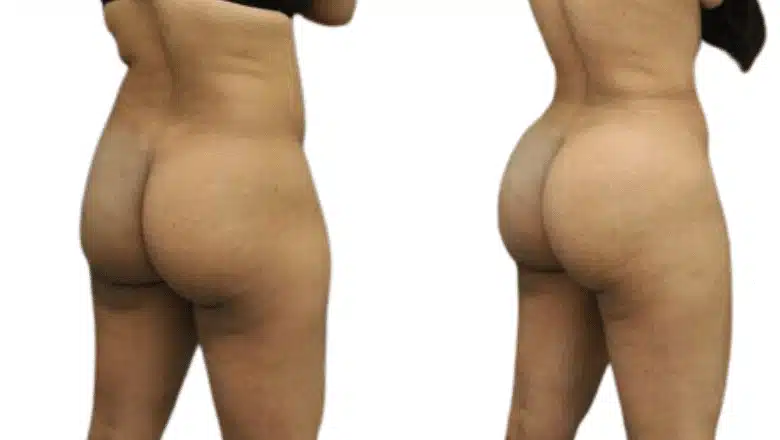
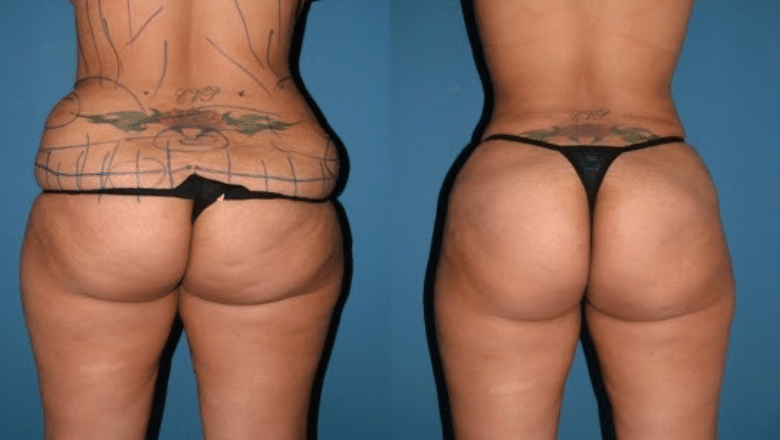
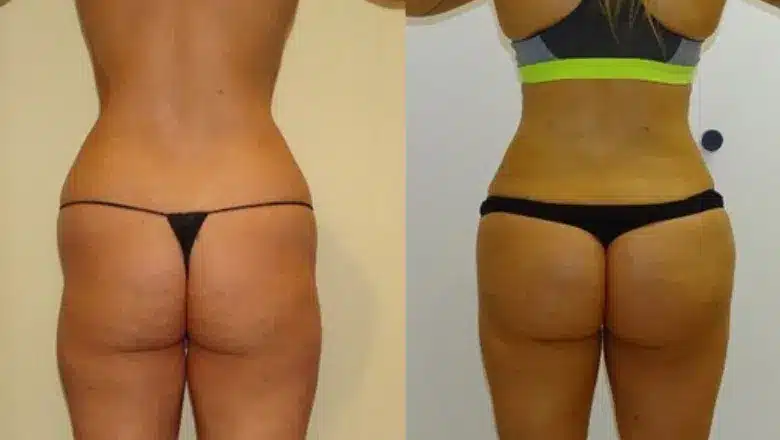
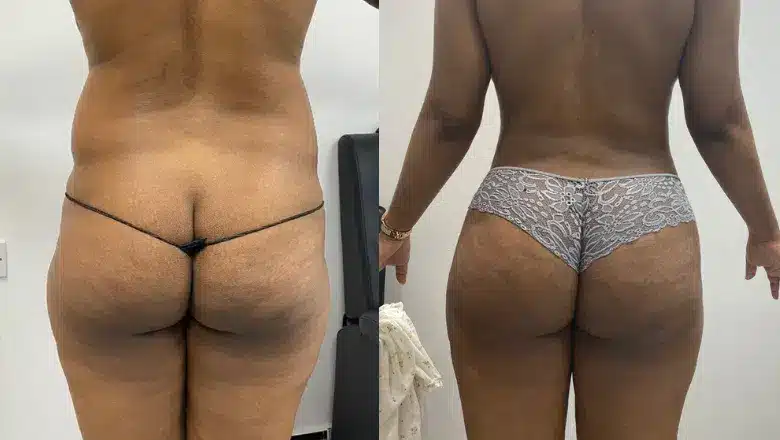
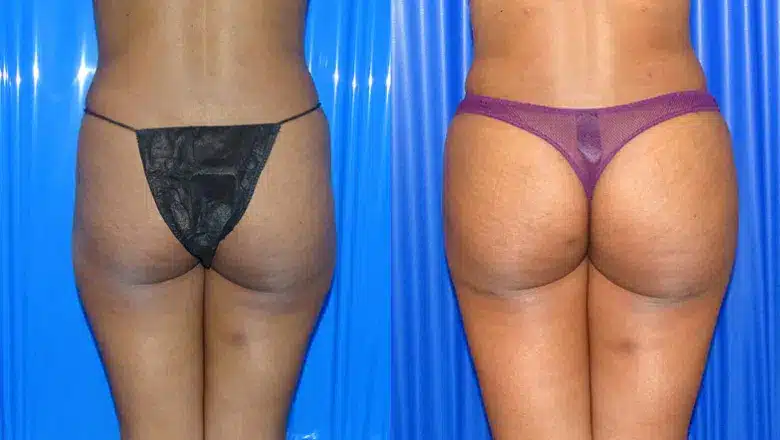
11. Can I see before-and-after photos of your BBL patients?
Ask to see photos of the surgeon’s own patients, not stock images. Look for the same lighting, pose and camera distance in each pair, side and back views, photos taken at least six months after surgery, and patients with a body shape like yours. Images that look filtered or edited are a warning sign.

Real Centre for Surgery patient, photographed at least six months after BBL surgery.
More real results are in our BBL before and after photos gallery.





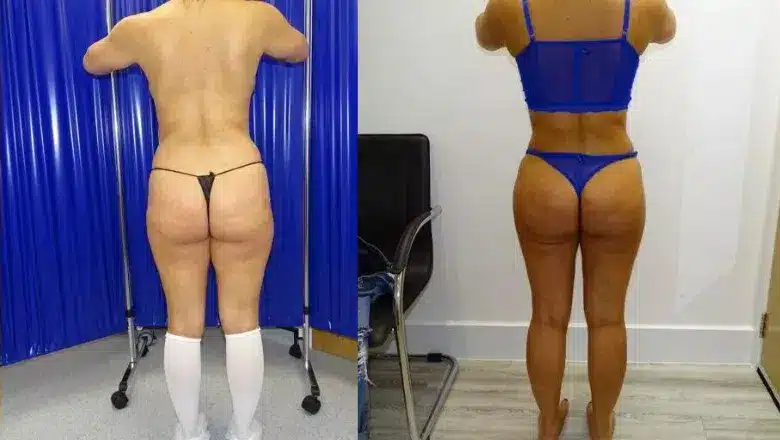

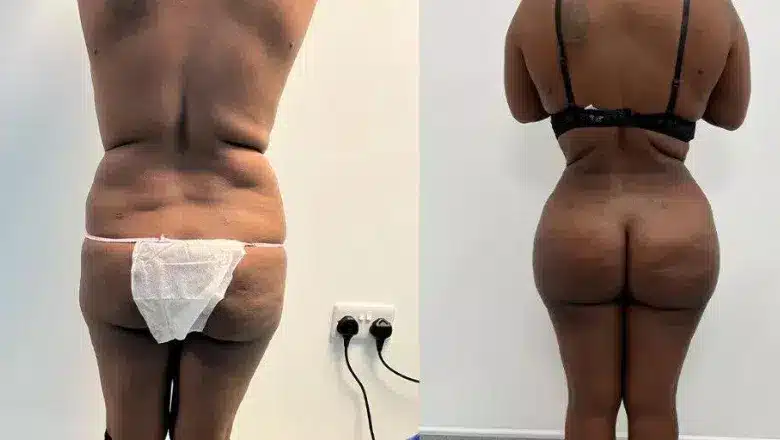
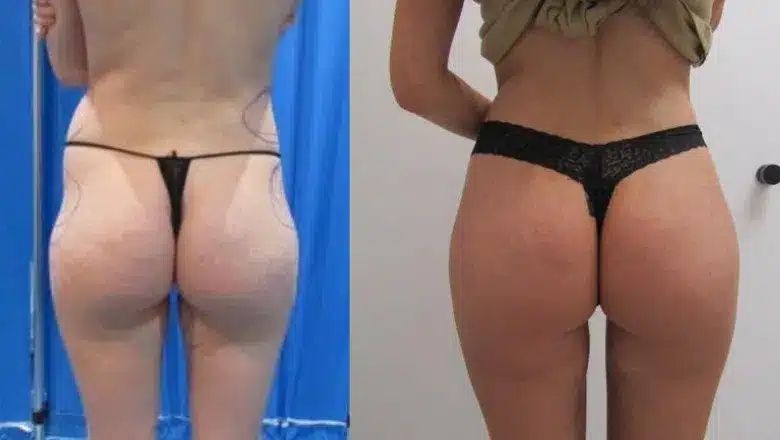
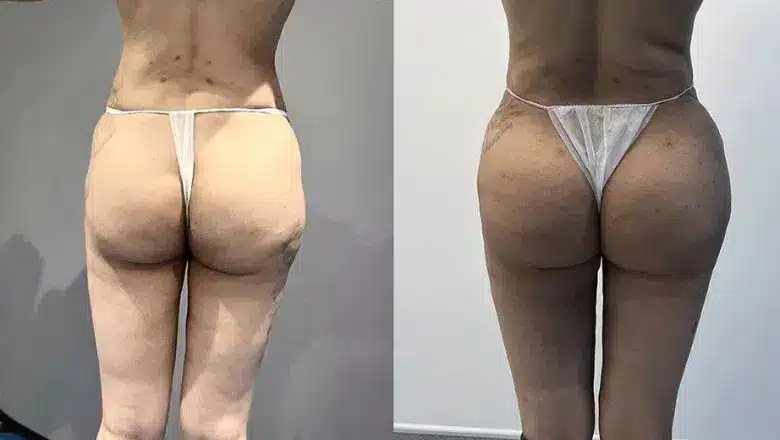


Tap to reveal
12. Do you recommend a cooling-off period?
You should never feel rushed into a BBL. Ask whether the clinic recommends a cooling-off period before booking. At Centre for Surgery we recommend a two-week cooling-off period, further consultations before surgery are free, and the consultant who assesses you is the consultant who performs your surgery. Use the time to read your quote, check the surgeon’s registration and go back with further questions.
What Are the Red Flags When Choosing a BBL Surgeon?
Some warning signs are reasons to pause and ask more questions. Others are reasons to walk away:
- Package deals abroad. All-inclusive offers that bundle surgery, flights and a hotel, often with a “recovery house”, put price first. You may not meet your surgeon until the day of surgery and may have no aftercare once you fly home.
- Pressure selling. Discounts that expire if you do not book today, deposits taken at the first consultation, or messages from sales staff chasing you to commit are not how a responsible clinic works.
- Unrealistic promises. No surgeon can guarantee a specific size or shape, full fat survival or a risk-free operation. Be wary of anyone who shows you a celebrity’s figure and promises the same.
- Non-doctors. A surgical BBL must be performed by a doctor. Buttock injections by beauticians or other non-medical practitioners, often marketed as a liquid BBL, have caused serious infections and sepsis. Our guide to liquid BBL in the UK explains the difference.
- Vague answers about technique. If a surgeon will not tell you where the fat goes or whether they use ultrasound, you do not have enough information to decide.
- Not knowing who operates. If you are told “one of our surgeons” will operate, or the person at your consultation is not the person who will perform your surgery, ask why.
- A very short operating time or very low price. In the South Florida deaths, short operations in high-volume, budget clinics were a common thread[4].
Is It Safe to Get a BBL Abroad?
Many people consider travelling for a cheaper BBL, most often to Turkey. Having it abroad makes it much harder to check the things on this list, such as the surgeon’s training, the fat placement plane and ultrasound use. Flying soon after surgery raises the risk of blood clots and clashes with the advice not to sit on your buttocks for 2 weeks. If something goes wrong once you are home, you will be treated by doctors who did not perform your operation, which the NHS has warned about.
UK evidence backs this up. A 2026 study from a London NHS plastic surgery unit, published in the Journal of Plastic, Reconstructive and Aesthetic Surgery ↗, reviewed 103 patients treated over ten years for complications after cosmetic surgery abroad. Among those surveyed, cost was the main reason for travelling, more than half had found their surgeon by word of mouth, and 26 of 48 regretted having surgery outside the UK[9]. A systematic review of 589 patients with complications after cosmetic surgery abroad found infection to be the most common, followed by wound breakdown, fluid collections and tissue death[10]. Our article on BBL in Turkey looks at the UK data in detail.
Who Can Legally Perform a BBL in the UK?
A surgical BBL in the UK must be performed by a GMC-registered doctor, and in England it must take place in premises registered with the CQC. Rules on non-surgical buttock injections have been much looser, and the government is now tightening them. The key moves so far:
- 2018: BAAPS asked its members not to perform BBL until more safety data were available, after reports of deaths from fat embolism[8].
- October 2022: BAAPS issued guidance that gluteal fat grafting should be performed only into the layer under the skin, with ultrasound used during surgery to confirm the position of the cannula[8].
- August 2025: the Department of Health and Social Care announced that the highest-risk non-surgical procedures, such as non-surgical BBLs, would be restricted to qualified healthcare professionals working in CQC-registered providers[11].
- October 2026: the Department proposed that fillers injected anywhere other than the face, including liquid BBLs, be legally defined as cosmetic surgery, so only doctors could perform them. It also proposed banning cosmetic surgery for under-18s. The draft regulations are out for consultation, with Parliament due to consider them in spring 2027[12].
Until the new rules are in force, it is up to you to check who is treating you. The questions above apply to any buttock procedure, surgical or non-surgical.
Am I a Candidate for a BBL?
At your consultation, a careful surgeon will take a full medical history, examine your buttocks, donor areas and skin quality, photograph you, and ask what result you hope for, being honest if it is not achievable.
You are more likely to be a good candidate for a BBL if:
- you are 18 or over, in good general health and not pregnant or breastfeeding
- you have enough spare fat to transfer; a BMI of about 23 to 28 usually provides this
- your weight has been stable for at least 3 months, or 6 to 12 months after major weight loss
- you can stop smoking and all nicotine, including vaping, for 4 weeks before and 4 weeks after surgery
- you can follow the recovery rules, including no sitting directly on your buttocks for 2 weeks
If you are slim, a skinny BBL uses more donor sites to gather enough fat, and if you have loose skin, a buttock lift may suit you better or be needed as well. Our guide to the right body weight for a BBL explains how BMI affects your options.
Frequently Asked Questions
How do I find a good BBL surgeon in the UK?
Start by checking the surgeon on the GMC register and looking for an entry on the Specialist Register for plastic surgery. Then book consultations and ask how many BBLs they perform, where they place the fat, whether they use ultrasound, which hospital they operate in and what aftercare is included. Compare at least two surgeons, look at their own patients’ before-and-after photos and never book under pressure.
Who is the best BBL surgeon in the UK?
There is no single best BBL surgeon for everyone. The right surgeon for you is a GMC-registered doctor with full plastic surgery training and regular BBL experience, who places fat only above the muscle under ultrasound guidance, operates in a CQC-registered hospital, explains risks honestly and gives you a clear aftercare plan. Online rankings and social media followers are not a reliable guide.
Can I get a BBL in the UK?
Yes. Surgical BBL is available in the UK from GMC-registered surgeons working in CQC-registered hospitals. Many UK surgeons now use the safer approach recommended by BAAPS, placing fat only in the layer under the skin, above the gluteal muscle, with ultrasound guidance. Costs vary between clinics, and our guide to BBL cost in London explains what is usually included.
What questions should I ask at a BBL consultation?
Ask about the surgeon’s registration and training, how many BBLs they perform, where the fat will be placed, whether ultrasound is used, which cannula they use, where the operation happens, what anaesthesia you will have, what aftercare is included, who to call if something goes wrong, and what happens if you need a revision. Ask to see before-and-after photos of their own patients.
What safety questions should I ask before choosing a surgeon and hospital for a BBL?
The key safety questions are whether fat is placed only above the gluteal muscle, whether real-time ultrasound confirms this, which cannula size is used, whether a consultant anaesthetist is present, whether the hospital is CQC-registered with full monitoring and emergency equipment, and how long the operation is expected to take. Also ask how complications are handled and who you contact after hours.
What are the signs of a good plastic surgeon?
A good plastic surgeon is fully trained and registered, explains the procedure, risks and recovery clearly, answers detailed questions without becoming defensive, shows you their own results, and is willing to say no if an operation is not right for you. They should never pressure you to book, and should give you time to think before going ahead.
Brazilian Butt Lift in London
Brazilian butt lift surgery at Centre for Surgery is performed by GMC-registered surgeons at our CQC-regulated Baker Street hospital, rated Good overall by the CQC. Every BBL is carried out under real-time ultrasound guidance, with fat placed only in the subcutaneous layer above the gluteal muscle using a blunt cannula, and harvested by power-assisted or VASER liposuction. Surgery is a day case under TIVA, and the consultant who assesses you is the consultant who performs your surgery. We recommend a two-week cooling-off period before you go ahead, and further consultations before surgery are free. Your initial consultation is £100, redeemable against the cost of surgery if you go ahead. Finance isn’t available for BBL at Centre for Surgery, so the procedure is self-funded.
Phone: 020 7993 4849 | Address: 95–97 Baker Street, Marylebone, London W1U 6RN
Contact us to schedule a consultation
References
- Mofid MM, Teitelbaum S, Suissa D, et al. Report on mortality from gluteal fat grafting: recommendations from the ASERF Task Force. Aesthetic Surgery Journal 2017;37(7):796–806. doi:10.1093/asj/sjx004 ↗
- Rios L, Gupta V. Improvement in Brazilian butt lift (BBL) safety with the current recommendations from ASERF, ASAPS, and ISAPS. Aesthetic Surgery Journal 2020;40(8):864–870. doi:10.1093/asj/sjaa098 ↗
- Cansancao AL, Condé-Green A, Gouvea Rosique R, et al. “Brazilian butt lift” performed by board-certified Brazilian plastic surgeons: reports of an expert opinion survey. Plastic and Reconstructive Surgery 2019;144(3):601–609. doi:10.1097/PRS.0000000000006020 ↗
- Pazmiño P, Garcia O. Brazilian butt lift-associated mortality: the South Florida experience. Aesthetic Surgery Journal 2023;43(2):162–178. doi:10.1093/asj/sjac224 ↗
- Wall S, Delvecchio D, Teitelbaum S, et al. Subcutaneous migration: a dynamic anatomical study of gluteal fat grafting. Plastic and Reconstructive Surgery 2019;143(5):1343–1351. doi:10.1097/PRS.0000000000005521 ↗
- Pazmiño P, Del Vecchio D. Static injection, migration, and equalization (SIME): a new paradigm for safe ultrasound-guided Brazilian butt lift: safer, faster, better. Aesthetic Surgery Journal 2023;43(11):1295–1306. doi:10.1093/asj/sjad142 ↗
- Vázquez-Guerra XC, Alvarez-Lozada LA, Altuzar-Abadía JJ, et al. Ultrasound in gluteal fat grafting: safety tool, standard of care, or emerging evidence? A scoping review. Aesthetic Surgery Journal 2026. doi:10.1093/asj/sjag120 ↗
- British Association of Aesthetic Plastic Surgeons. Bottoms up: surgeons say no to BBL but yes to SGL. October 2022. baaps.org.uk ↗
- Pezas T, Oregi P, Hussein S, et al. Outbound cosmetic tourism from the United Kingdom: patient experiences following a decade of complication management at a tertiary plastic surgery unit. Journal of Plastic, Reconstructive and Aesthetic Surgery 2026;114:273–281. doi:10.1016/j.bjps.2026.01.035 ↗
- Alkaelani MT, Koussayer B, Blount T, et al. Complications of medical tourism in aesthetic surgery: a systematic review. Annals of Plastic Surgery 2023;91(6):668–673. doi:10.1097/SAP.0000000000003683 ↗
- Department of Health and Social Care. Crackdown on unsafe cosmetic procedures to protect the public. GOV.UK, 6 August 2025. gov.uk ↗
- Department of Health and Social Care. Cosmetic cowboys crackdown continues with new restrictions. GOV.UK, 21 October 2026. gov.uk ↗
Related Articles
- Safe BBL: What Is an Ultrasound-Guided BBL and Is It Safer?
- BBL Death Rate and Safety Statistics 2026
- Is BBL in Turkey Safe? What UK Data Shows About BBL Abroad
- Brazilian Butt Lift (BBL) Before & After Photos