


In this guide11 sections
- Key Points
- Can You Be Fit and Have Gyno?
- Why Do Fit Men Get Gyno?
- Does Gyno Affect Muscle Growth?
- Gyno With Muscle: Why Chest Training Can Make It Look Worse
- Gyno or Pecs? How to Tell
- How Fit Men Can Get Rid of Gyno
- Getting Back to Training After Surgery
- Frequently Asked Questions
- Gynecomastia Surgery at Centre for Surgery
- References
Key Points
- Fit, muscular men get gyno too. Gynecomastia is gland tissue behind the nipple, not fat, so being lean and strong does not protect you from it.
- Low body fat often makes gyno more visible, as there is no fat layer to blur the outline of the gland.
- Common causes in men who train include gyno left over from puberty, anabolic steroids, prohormones, SARMs and supplements contaminated with undeclared steroids.
- Gyno does not stop your muscles growing. If it comes with tiredness, low sex drive or poor recovery, though, it can be a sign of a hormone problem worth checking.
- Training the chest cannot remove gland tissue and can push it forward, making it more noticeable.
- Surgery to remove the gland works well in muscular men, and a well-trained chest underneath gives a sharper result.
Many men are surprised to find gyno on a body they have worked hard for. You can be lean, train five days a week and eat well, and still have puffy nipples or a firm lump behind one or both of them. It is one of the most frustrating things men bring to a consultation, as the usual advice to lose weight and train harder does not apply.
The reason is simple: gynecomastia is the growth of glandular breast tissue, driven by hormones rather than body fat.[1] This guide explains why fit men get gyno, whether it affects muscle growth, why training can make it look worse, and what actually gets rid of it. If you train competitively or use performance-enhancing drugs, our guide to bodybuilder gynecomastia covers that group in more detail.
Can You Be Fit and Have Gyno?
Yes, and it is common. In a study of 954 healthy young men aged 18 to 26, 40.5% had breast tissue over 2 cm, and most of them were ordinary, active young men rather than people with a medical condition.[2] Gyno is also well documented in men at the peak of physical condition: one surgical series reported 1,574 bodybuilders treated for gynecomastia,[3] and another study of 312 men who had surgery for it included 97 with a high muscle mass.[4]
Fitness changes the shape of the chest around the gland, but not the gland itself. That is why gyno in a muscular man can look quite different from gyno in a heavier man: instead of a soft, full chest, it is often a tight, puffy nipple or a cone-shaped bulge sitting on top of a well-developed pectoral muscle. Our guide to puffy nipples covers the mildest form.
Why Do Fit Men Get Gyno?
Gynecomastia develops when the effect of oestrogen on breast tissue outweighs the effect of testosterone.[1] In men who train, the usual triggers are these.
Gyno left over from puberty
Most boys develop some breast tissue during puberty, and in most it settles within one to three years. In some it does not, and once it has been there for a couple of years it becomes fibrous and stays.[5] Many fit men with gyno have had it since their teens and simply notice it more once they get lean. Our guide to how common gynecomastia is explains how often it happens at each age.
Low body fat makes it visible
In a heavier man, a small disc of gland is hidden in surrounding fat. Strip the fat away and the same disc stands out, particularly under a tight t-shirt or in a vest at the gym. Men often say their gyno “appeared” during a cut, when in fact it was there all along.
Anabolic steroids, prohormones and SARMs
Excess testosterone from steroid cycles is converted to oestrogen in the body, and when a cycle ends, natural testosterone takes weeks or months to recover, leaving oestrogen relatively high. Both phases can trigger gland growth. In a survey of steroid users recruited from British gyms ↗, 52% of the men reported gynaecomastia.[6] Our guide to steroid gyno explains how this happens and what to do about it.
Supplements that are not what they say
Natural lifters are not always as natural as they think. An international study of 634 non-hormonal supplements ↗ found that 14.8% contained anabolic steroids not declared on the label, including 18.8% of those bought in the UK.[7] In one case report, a 40-year-old man developed gyno and low testosterone after six months of taking commercial gym supplements that turned out to contain a SARM and undeclared hormones; both settled once he stopped.[8]
Cannabis, alcohol and medicines
Cannabis, heavy drinking and a range of prescribed medicines are linked to gyno, including some treatments for hair loss, acid reflux and high blood pressure.[9] Our guides to finasteride and gynecomastia and cannabis and gynecomastia cover two of the commonest examples. Never stop a prescribed medicine without talking to your doctor first.
No obvious cause
In around a quarter of men who see a doctor about gyno, no cause is found.[1] This is known as idiopathic gynecomastia, and it is no less treatable than gyno with a known trigger. The full list of triggers is in our guide to the causes of gynecomastia.
Does Gyno Affect Muscle Growth?
The gland itself does not. It sits in front of the pectoral muscle and has no effect on how your muscles respond to training. Plenty of men with gyno are strong and well developed.
The underlying cause can matter, though. Gyno is sometimes a sign of low testosterone, for example after a steroid cycle, or of another hormone problem, and low testosterone does make it harder to build and keep muscle.[5] If your gyno came on recently, or comes with tiredness, low sex drive, erection problems, poor recovery or shrinking testicles, see your GP. Simple blood tests can check your hormone levels.
Gyno With Muscle: Why Chest Training Can Make It Look Worse
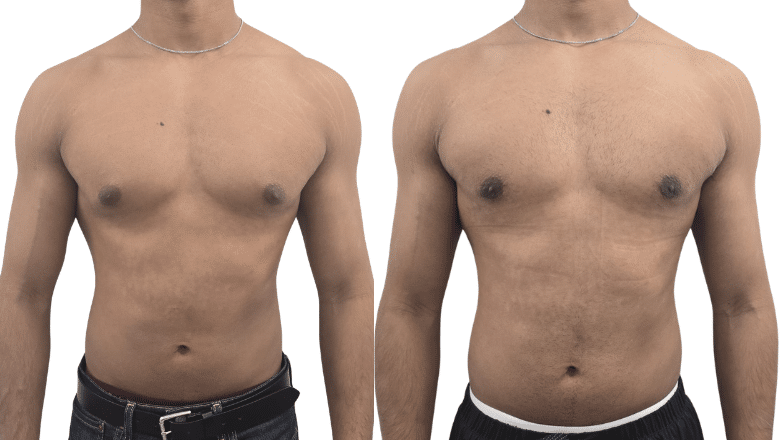
Gland tissue sits directly in front of the pectoral muscle, behind the nipple. As the muscle grows, it pushes the gland forward, so the nipple can look puffier and the outline of the disc sharper. Many men train their chest harder to “fix” their gyno and find it looks worse a year later.
Exercise still has a place. Losing body fat can reduce any fatty part of the chest, and training the back and shoulders improves your overall shape. But no training plan can shrink gland, as our guide to whether exercise gets rid of gynecomastia explains.
Gyno or Pecs? How to Tell
Lean men sometimes worry that a well-developed chest is gyno. The difference is in what you can feel behind the nipple:
- Muscle: firm across the whole chest, hardens when you flex, and has no separate lump behind the nipple.
- Gland: a rubbery disc directly under the nipple that stays the same when you flex, often with a puffy areola, and sometimes tender.
Our guide to gyno vs chest fat includes a self-check, and our guide to what gynecomastia feels like describes the lump in more detail. A one-sided, hard or rapidly growing lump should always be checked by a GP.
How Fit Men Can Get Rid of Gyno
Find and remove the cause
If gyno appeared recently, stopping the trigger can let it settle. That might mean stopping steroids, SARMs or a suspect supplement, or reviewing a medicine with your doctor. Recent, tender gyno sometimes responds to an anti-oestrogen medicine prescribed by a specialist, but long-standing gland usually does not.[5]
Accept what training can and cannot do
Training improves the chest around the gland but not the gland itself. If you are lean and the lump has been there for more than a year or two, more training will not change it.
Surgery
Gynecomastia surgery removes the gland through a small incision, usually at the lower edge of the areola, with liposuction where there is fat to smooth. In muscular men, removing the gland directly matters more than liposuction: in a series of 1,574 bodybuilders in Plastic and Reconstructive Surgery ↗, the gland was excised in virtually all cases, liposuction was needed in fewer than 2%, and 98% had a good aesthetic result with no recurrences.[3] In the 312-patient study, direct gland removal gave stable results with no recurrences across all body types, including the muscular group.[4]
The scar is usually a fine line at the edge of the areola that fades well, and some suitable cases can be treated through very small incisions with the pull-through technique. A well-trained chest under the gland is an advantage: once the gland has gone, the muscle gives the chest a flat, defined shape. See our gynecomastia before and after photos for real results.
Getting Back to Training After Surgery
Most men walk from the first day, return to lower body training from about three to four weeks, and go back to chest and upper body weights from about six weeks, starting light. The final shape settles over three to six months. Our gynecomastia recovery guide sets out the full timeline.
Training does not bring gyno back after surgery, but the same triggers can grow new gland tissue. Steroids, SARMs and contaminated supplements are the usual reasons gyno returns in men who train, as our guide to whether gynecomastia can come back after surgery explains.
Frequently Asked Questions
Can you have gyno and be muscular?
Yes. Gyno is gland tissue rather than fat or muscle, so it can sit on top of a well-developed chest. In muscular men it often shows as puffy nipples or a cone-shaped bulge behind the nipple.
Does gyno go away if you get lean?
Any fat around the gland will reduce, but the gland itself will not. Getting lean often makes gyno more noticeable, as there is less fat to hide its outline.
Does gyno mean low testosterone?
Not always. Gyno reflects the balance between oestrogen and testosterone, and most men with it have normal hormone levels. If you have other symptoms such as low sex drive, tiredness or poor recovery, a GP can check your testosterone.
Can protein powder or creatine cause gyno?
Protein and creatine themselves are not known to cause gyno. The risk comes from products that contain undeclared steroids or other banned compounds, which is why it is worth choosing independently tested supplements.
Will gyno stop me building a bigger chest?
No. Your chest muscle can still grow, but the gland can look more prominent as the muscle underneath gets bigger.
Can a natural lifter get gyno?
Yes. Leftover pubertal gyno, medicines, cannabis, alcohol and contaminated supplements can all cause gyno in men who have never used steroids, and sometimes there is no clear cause.
Is gyno surgery different for fit men?
The principle is the same, but in lean, muscular men the gland is usually removed directly, with little or no liposuction. The result is often sharper as the muscle underneath is already well developed.
Gynecomastia Surgery at Centre for Surgery
Centre for Surgery treats gynecomastia in adults aged 18 and over. Surgery is performed by GMC-registered plastic surgeons as a day case under TIVA at our Baker Street hospital, rated Good by the Care Quality Commission, and the surgeon who assesses you is the surgeon who performs your operation. Our gynecomastia surgery cost guide sets out the prices.
Phone: 020 7993 4849 | Email: contact@centreforsurgery.com | Address: 95–97 Baker Street, London W1U 6RN
References
- Braunstein GD. Clinical practice. Gynecomastia. New England Journal of Medicine 2007;357(12):1229–1237. doi:10.1056/NEJMcp070677 ↗
- Georgiadis E, Papandreou L, Evangelopoulou C, et al. Incidence of gynaecomastia in 954 young males and its relationship to somatometric parameters. Annals of Human Biology 1994;21(6):579–587. doi:10.1080/03014469400003582 ↗
- Blau M, Hazani R. Correction of gynecomastia in body builders and patients with good physique. Plastic and Reconstructive Surgery 2015;135(2):425–432. doi:10.1097/PRS.0000000000000887 ↗
- Innocenti A, Melita D, Mori F, et al. Management of gynecomastia in patients with different body types: considerations on 312 consecutive treated cases. Annals of Plastic Surgery 2017;78(5):492–496. doi:10.1097/SAP.0000000000000940 ↗
- Kanakis GA, Nordkap L, Bang AK, et al. EAA clinical practice guidelines: gynecomastia evaluation and management. Andrology 2019;7(6):778–793. doi:10.1111/andr.12636 ↗
- Korkia P, Stimson GV. Indications of prevalence, practice and effects of anabolic steroid use in Great Britain. International Journal of Sports Medicine 1997;18(7):557–562. doi:10.1055/s-2007-972681 ↗
- Geyer H, Parr MK, Mareck U, et al. Analysis of non-hormonal nutritional supplements for anabolic-androgenic steroids: results of an international study. International Journal of Sports Medicine 2004;25(2):124–129. doi:10.1055/s-2004-819955 ↗
- Chong S, Woolnough CA, Koyyalamudi SR, Perera NJ. Reversible gynecomastia and hypogonadism due to usage of commercial performance-enhancing supplement use. JCEM Case Reports 2024;2(8):luae148. doi:10.1210/jcemcr/luae148 ↗
- Deepinder F, Braunstein GD. Drug-induced gynecomastia: an evidence-based review. Expert Opinion on Drug Safety 2012;11(5):779–795. doi:10.1517/14740338.2012.712109 ↗







