


In this guide14 sections
- Key Points
- What Is a BBL Belly Button?
- Does a BBL Change Your Belly Button?
- Why Does Your Belly Button Change After a BBL?
- Why Do BBL Stomachs Look Weird?
- Does Your Belly Button Go Back to Normal After Lipo?
- How Can You Protect Your Belly Button Shape?
- Is Liposuction Around the Belly Button Safe?
- How Do You Fix a BBL Belly Button?
- BBL Belly Button vs Tummy Tuck Belly Button
- Do Men Get a BBL Belly Button?
- Frequently Asked Questions
- Brazilian Butt Lift in London
- References
Key Points
- A BBL itself does not touch your belly button. The fat transfer goes into the buttocks; any change to the navel comes from the liposuction used to harvest fat from the tummy and flanks.
- The “BBL belly button” is a liposuction effect. Swelling, loose skin, over-thinning of the fat around the navel or scar tissue can leave it looking stretched, flattened, hooded or “frowning”.
- Most changes are temporary. Puffiness around the navel usually settles over 6 to 12 weeks, and the final shape is judged at 3 to 6 months once swelling and skin retraction have finished.
- Careful technique protects the navel. Even, conservative liposuction around the umbilicus, an honest assessment of skin elasticity and good compression all reduce the risk of a lasting change.
- A lasting change can be fixed. Umbilicoplasty (belly button surgery) is a short day case, usually under local anaesthetic, best done once healing has settled at around 6 months or later.
- A tummy tuck belly button is different. A full tummy tuck brings the navel out through a new opening with a scar around it, while a BBL leaves the navel in place. At Centre for Surgery the two operations are never done together.
A BBL does not change your belly button on its own. The Brazilian butt lift transfers fat into the buttocks, and nothing is done to the navel itself. What can change it is the liposuction of the abdomen that supplies the fat. Swelling, skin that does not tighten evenly, too much fat taken from around the navel, or scar tissue can make the belly button look wider, flatter, hooded or downturned for a while, and occasionally for good.
This guide explains what people mean by a “BBL belly button”, why the navel changes after abdominal liposuction, which changes are temporary, how to protect its shape, how a lasting change is corrected with umbilicoplasty (belly button surgery), and how it differs from a tummy tuck belly button. If your tummy, flanks and back are all being treated, our 360 liposuction page explains how all-round contouring is combined with fat transfer.
What Is a BBL Belly Button?
“BBL belly button” is the online name for a navel that looks unnatural after a Brazilian butt lift. The phrase is usually used to describe one of four looks:
- A stretched or widened navel that has lost its neat vertical oval and looks more horizontal or round.
- A flattened or shallow navel that has lost the soft shadow and depth around it.
- A “frowning” or “sad” belly button, where loose skin above or below the navel droops so that it looks downturned.
- A hooded or puckered navel, with a fold of skin overhanging the top, or creases radiating out from it where scar tissue has pulled.
None of these is caused by the fat transfer. They are all effects of liposuction on the abdomen, which is why the same changes are searched as “belly button after lipo” by people who have never had a BBL.
BBL belly button vs normal belly button
There is no single “normal” navel. In a computer analysis of 37 images of women chosen as examples of an attractive abdomen, the most common shape was an oval with no hooding (29.8%) or an oval with a small hood of skin at the top (21.6%), sitting in the midline a little above the halfway point between the bottom of the breastbone and the pubic area[1]. A 2025 study of 63 young volunteers found a similar spread of natural shapes: vertical oval with a hood at the top (29%), round (27%), vertical diamond (21%) and protruding (11%)[2]. A review of the published research concluded that a smaller, vertically oriented navel is generally seen as the most attractive[3].
Set against that, the typical BBL belly button is the opposite: wider than it is tall, shallow, and sometimes with loose or creased skin around it. A small hood at the top of the navel is normal and often attractive; a heavy fold that hides the navel, or skin that droops below it, is not. Our guide to the different navel shapes shows the full range of normal belly button types.
Does a BBL Change Your Belly Button?
Not directly. A BBL has two stages: liposuction to harvest fat, and injection of that purified fat into the buttocks. At Centre for Surgery the fat is placed only in the layer under the skin, above the buttock muscle and never into or beneath it, with real-time ultrasound guidance on every case. Our article on ultrasound-guided BBL explains why that matters for safety. None of this involves the navel.
The fat has to come from somewhere, though, and the abdomen and flanks are usually the richest donor areas. A full BBL typically uses 1,600 to 2,000 ml of fat, so the tummy is often treated thoroughly. If fat comes only from the flanks, lower back and thighs, your belly button is very unlikely to change. Where the abdomen is treated, the navel sits in the middle of the area being contoured, so it is the liposuction plan, not the BBL, that decides how it looks afterwards. That is why a liposuction patient who never has fat transferred can develop exactly the same navel changes.
Why Does Your Belly Button Change After a BBL?
There are six common reasons, and several can happen together.
1. Incision placement
Liposuction incisions are tiny, around 3 to 4 mm, and placed in natural creases where possible. To reach the upper and central tummy evenly, some surgeons use an access point just inside the rim of the navel, where the scar hides in the natural fold; others use the bikini line and flanks. An incision inside the navel normally heals invisibly, but if it heals with a thickened or tight scar it can pucker or slightly distort the rim. Ask your surgeon where your incisions will be.
2. Swelling around the navel
The navel is tethered to the deep tissues by a short stalk, while the skin and fat around it swell after liposuction. This makes the belly button look sunken, smaller or oddly shaped in the first weeks, and the tummy can look puffy or bloated above it. Swelling peaks in the first 3 to 5 days and then settles gradually; most is gone by 6 to 12 weeks, with the last of it taking 3 to 6 months.
3. Skin retraction and loose skin
Once fat is removed, the skin has to shrink back over the new, slimmer contour. Skin with good elasticity tightens well; skin stretched by pregnancy, large weight changes or age may not. When it does not retract evenly, the extra skin tends to gather just above or below the navel, because the navel is fixed in place while the skin around it moves. This is how the hooded or frowning belly button develops.
4. “Frowning”, hooding and umbilical sagging
Surgeons describe the loss of the navel’s vertical shape after liposuction as umbilical sagging. A 2021 study in the Aesthetic Surgery Journal ↗ called this horizontal deformity a current aesthetic issue after abdominal liposuction and tested a technique of fixing the umbilical stalk with a stitch during surgery in 62 patients: at 9 months, 96.7% had kept or improved their navel shape, and 2 patients (3.2%) still had a worse shape despite the stitch[4]. The study shows two things worth knowing. The problem is real and recognised, and careful technique can reduce it, although no method guarantees an unchanged navel.
5. Over-aggressive liposuction
The soft layer of fat around the navel gives it depth and shadow. Taking too much from this area, or taking it unevenly, can flatten the navel, leave a hollow or ridge beside it, or create a step between treated and untreated areas. Even, conservative liposuction around the umbilicus with a blunt cannula is the main protection. At Centre for Surgery fat is harvested with power-assisted liposuction (PAL) or VASER, and your surgeon will recommend which suits your tissues.
6. Scar tissue and fibrosis
As liposuction heals, bands of internal scar tissue can form under the skin. Early on these feel like firm ridges or a “marble” near the navel, and if they contract unevenly they can pull the navel off-centre or crease the skin around it. Most fibrosis softens over the first few months; persistent tight bands can be released or treated later if needed.

Why Do BBL Stomachs Look Weird?
A “BBL stomach” usually looks very flat and tight from the front, with a sharply pulled-in waist and a much rounder bottom. When the contrast is extreme, the stomach can look out of proportion, especially in profile. The usual causes are:
- Early swelling, which makes the tummy puffy above the navel and the belly button look sunken.
- Very aggressive abdominal liposuction, which leaves skin lying directly over muscle and a navel that has lost its shadow.
- Loose skin that creases or folds across the lower tummy.
- Muscle separation (diastasis) after pregnancy, which liposuction cannot tighten, so a bulge can look more obvious once the fat is gone.
A well-planned BBL aims for a natural waist-to-hip ratio and a stomach that looks slim but still soft, with a navel that keeps its depth.
Does Your Belly Button Go Back to Normal After Lipo?
In most people, yes. It helps to separate the expected, temporary changes from the less common ones that last.
Temporary changes (usually settle without treatment)
- Weeks 1 to 2: bruising, swelling and tenderness; the navel may look deep, small or lopsided. The liposuction incisions close in the first week or two.
- Weeks 3 to 8: swelling reduces steadily; the tummy may still feel firm, with lumpy areas or tight bands near the navel as early fibrosis forms.
- Months 3 to 6: most of the final contour is visible, firmness softens and the navel settles into its long-term shape as the skin finishes retracting.
Permanent changes (less common)
- Persistent loose skin that hoods the navel or makes it frown.
- A navel that stays wider or flatter than before, from loss of the surrounding fat.
- Asymmetry or a hollow next to the navel from uneven fat removal.
- A tight or visible scar inside the rim of the navel.
Wait until at least 6 months before deciding a change is permanent. Your surgeon reviews you at 6 weeks, and reviews at 3 and 6 months are available. Our BBL recovery guide sets out the full week-by-week timeline.
How Can You Protect Your Belly Button Shape?
Most of what protects the navel happens before surgery, in how the operation is planned.
Before your BBL
- Have your skin quality assessed honestly. If your tummy skin is stretched or marked, liposuction alone may leave loose skin around the navel, and taking less from the central abdomen may be wiser than chasing maximum fat volume.
- Discuss your donor areas. Ask whether more fat can come from the flanks, back and thighs, with lighter treatment around the navel.
- Get any umbilical hernia checked. A soft bulge at the navel that grows when you cough may be a hernia. It must be identified before liposuction near the navel.
- Keep a stable weight for at least 3 months before surgery, and avoid large swings afterwards.
- Stop smoking and vaping for 4 weeks before and 4 weeks after surgery, as nicotine reduces blood flow to the skin.
- Ask where the incisions will go and how much fat will be taken from around the navel.
After your BBL
- Wear your compression garment day and night for 6 weeks. An evenly fitting garment helps the skin settle smoothly around the navel; tell your nurse if it creases or digs in across your tummy.
- Keep the navel clean and dry, especially if an incision sits inside it.
- Use a navel insert only if your surgeon advises it. There is no good evidence that foam “belly button shapers” change the final shape, and nothing should be pushed into an unhealed incision.
- Massage only as advised. If your surgeon recommends lymphatic drainage massage, Centre for Surgery refers you to a qualified therapist, who you pay directly. Our guide to lymphatic drainage massage after a BBL explains when it may help.
- Be patient. Monthly photos give a fairer picture than the mirror each morning.

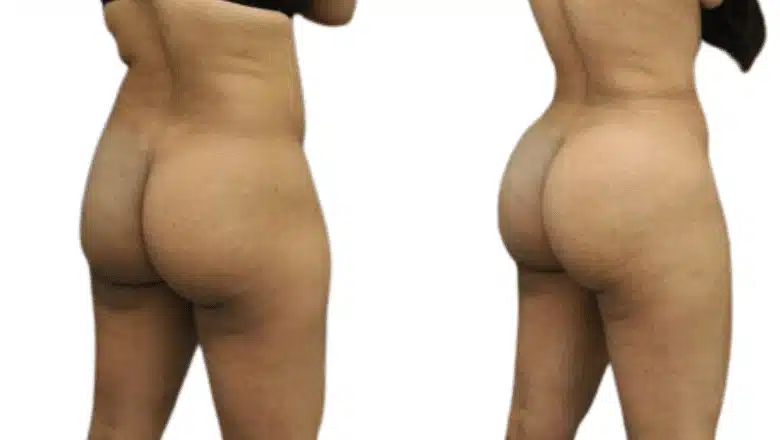
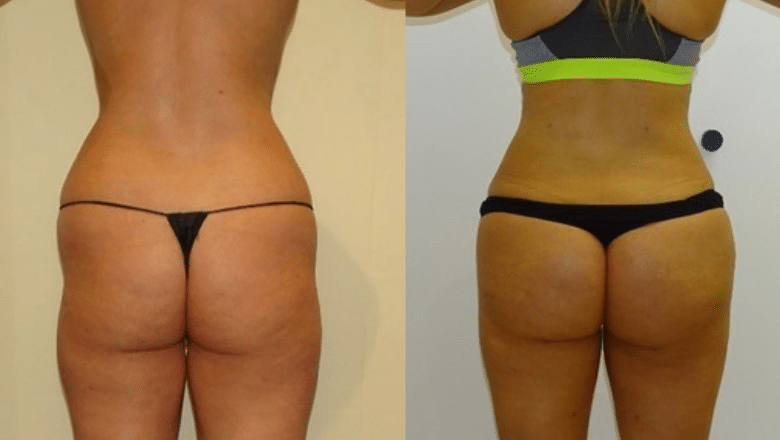
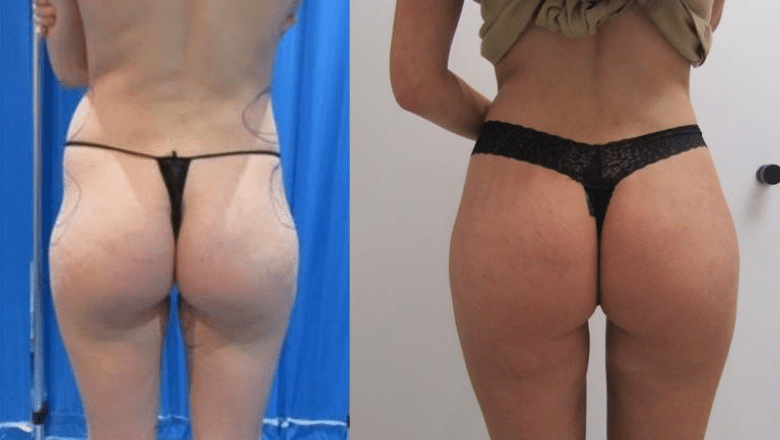
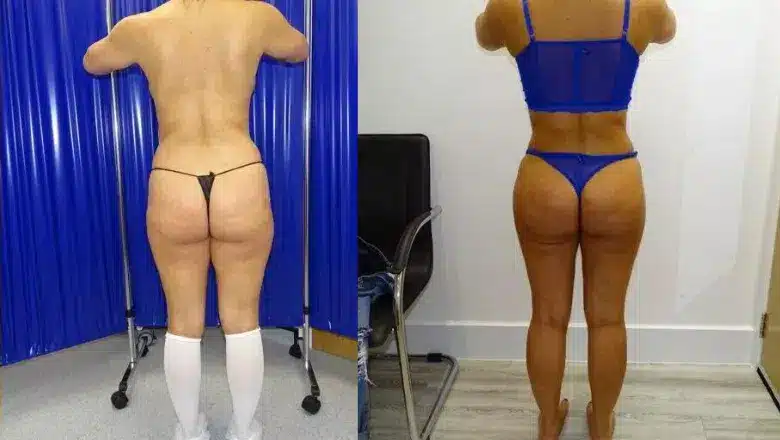
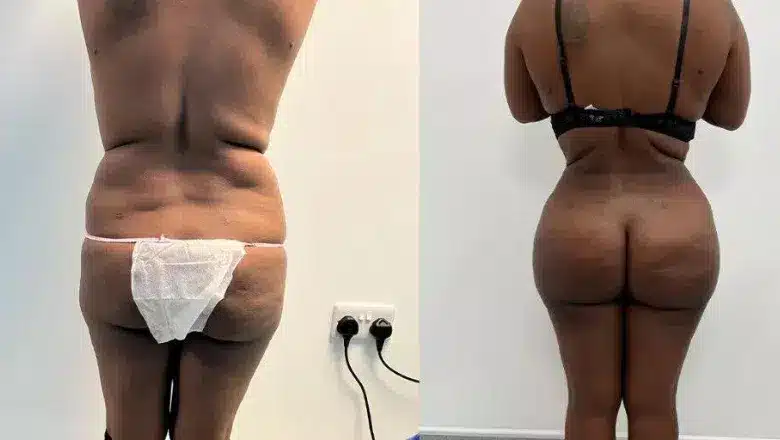
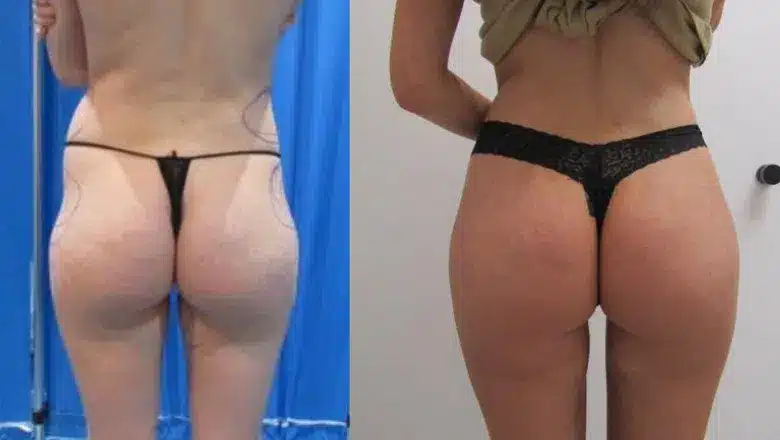
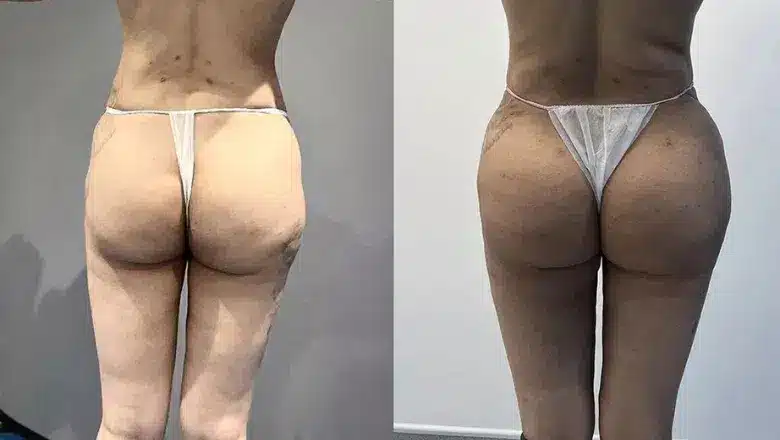
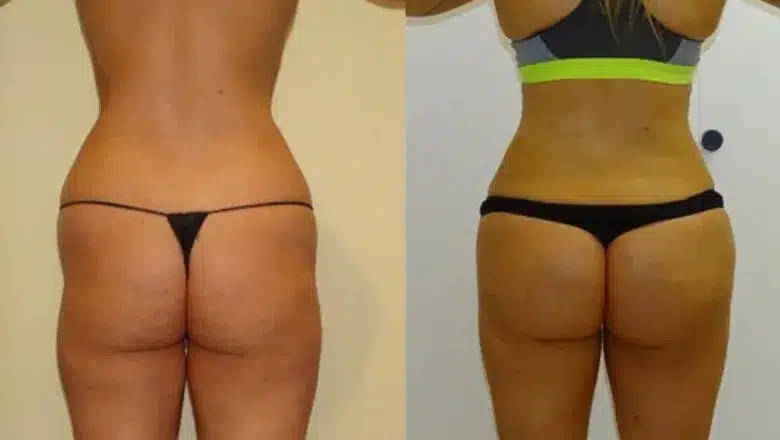
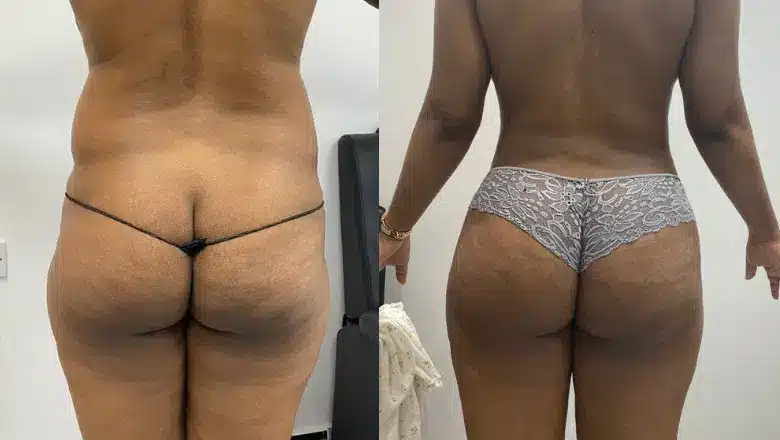
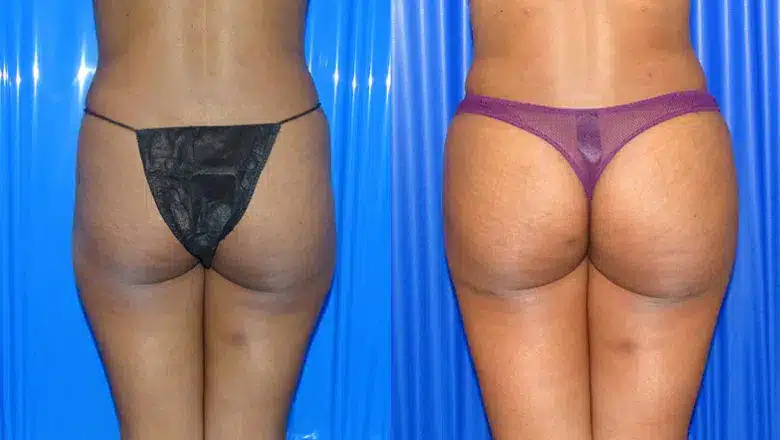
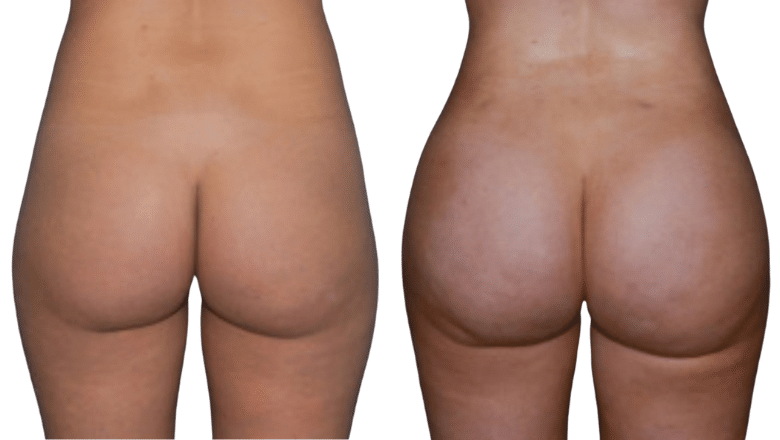
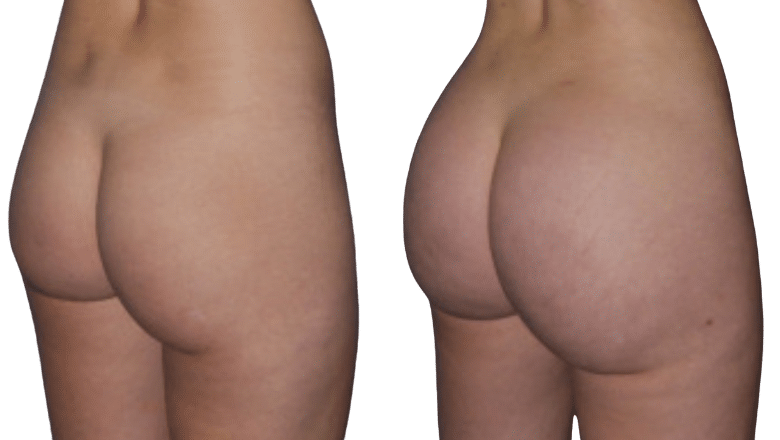
Real Centre for Surgery patient, photographed at least six months after BBL surgery.
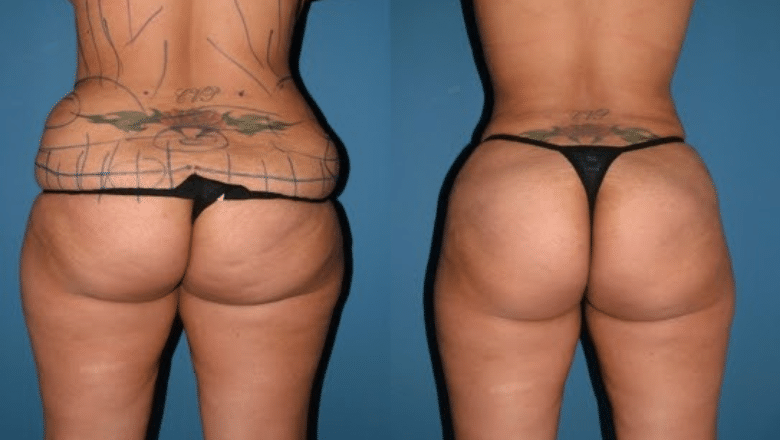
Real Centre for Surgery patient, 360 liposuction with BBL, back view. Individual results vary.
More real results are in our BBL before and after photos gallery.







Is Liposuction Around the Belly Button Safe?
Liposuction on its own has a low rate of serious complications. A 2017 prospective cohort study of 31,010 liposuction procedures in the Aesthetic Surgery Journal ↗ found a major complication rate of 0.7% when liposuction was done alone, while combining it with other procedures raised the risk nearly fivefold[5]. Most navel changes are cosmetic, but redness, heat or discharge from an incision near the navel, a fever or a growing tender swelling should be checked: call Centre for Surgery, or NHS 111 out of hours. Breathlessness, chest pain or coughing blood needs 999. The fat transfer, not the navel, is the higher-risk part of a BBL.
How Do You Fix a BBL Belly Button?
The right fix depends on what is causing the problem, and nothing permanent should be done until healing has settled, usually at around 6 months.
Umbilicoplasty (belly button surgery)
Umbilicoplasty reshapes the navel itself. Through incisions hidden inside the rim, the surgeon removes stretched or excess skin, re-anchors the navel to the deeper tissues to restore its depth and vertical shape, and releases any tight scar. It suits a navel that has become stretched, flattened, puckered or slightly hooded, as long as the skin of the wider tummy is reasonably firm.
At Centre for Surgery, umbilicoplasty takes around an hour (up to two hours if an umbilical hernia is repaired at the same time). It is a day case, usually under local anaesthetic, with sedation or TIVA if you would prefer. Most people return to light daily activities within 48 hours, have a nurse wound check at 7 to 10 days, and avoid heavy lifting and strenuous exercise for 4 weeks. The scar sits inside the navel and fades over around 12 months.
The evidence on reshaping the navel is reassuring. A 2024 systematic review of 41 studies and 588 patients in the Journal of Plastic, Reconstructive and Aesthetic Surgery ↗ found that umbilical reconstruction generally gives pleasing aesthetic results with relatively low complication rates[6].
Other options
- Fat grafting: a small amount of fat can be injected to soften a hollow or step next to the navel.
- Liposuction touch-up: a small area of fat left behind, which makes the navel look off-centre, can be refined.
- Skin tightening: for mild looseness around the navel, skin tightening can be added during the BBL itself, with Argo Plasma usually preferred and BodyTite also available. Neither removes skin, so they will not help a true fold.
- Tummy tuck: where the loose skin extends across the lower tummy, reshaping the navel alone will not lift it. A tummy tuck removes the excess skin and brings the navel out in a new position.
Can I reshape my belly button without surgery?
Not in any lasting way. Swelling-related changes improve on their own, which is why so many people feel their navel “fixed itself” by 3 months. Exercises, creams, taping and navel shapers cannot remove loose skin or restore lost fat. If the change is still there at 6 months, umbilicoplasty is the dependable route.
BBL Belly Button vs Tummy Tuck Belly Button
The two are often confused online, but they are quite different.
After a BBL, your original belly button stays exactly where it is. Nothing is cut around it, unless a small liposuction access point has been placed inside its rim. Any change comes indirectly from the liposuction around it.
After a full tummy tuck, the skin of the abdomen is lifted and pulled down, and the navel, which stays attached to its stalk, is brought out through a new opening in the tightened skin. That leaves a scar around the navel, and its final shape depends on how the surgeon sizes and stitches the new opening. A widely used technique stitches the navel to the deep tissue and brings it through a vertical opening to create depth and a youthful vertical shape[7]. The tummy tuck navel also carries risks a BBL navel does not: in a 2024 series of 200 tummy tucks, partial loss of the skin of the navel occurred in 0.5% and superficial skin loss in 3%[8]. A mini tummy tuck does not move the navel at all.
Our article on what happens to the belly button in a tummy tuck explains the tummy tuck navel in more detail.
Can I get a BBL and tummy tuck at the same time?
Not at Centre for Surgery. A BBL and a tummy tuck are never combined in the same operation, as the recoveries clash: after a tummy tuck you lie bent at the waist on your back, while after a BBL you must keep pressure off your buttocks and sleep on your front or side. The procedures are staged 3 to 6 months apart. Our guide to combining a tummy tuck and BBL explains the order and timing.
Do Men Get a BBL Belly Button?
They can. In a male BBL, fat often comes from the abdomen, flanks and back, but the goal for the navel differs. A 2022 study of male surface anatomy found that the most attractive male navel is a horizontal oval with a slight hood, sitting marginally lower than the average female navel[9]. A horizontal navel that might be called a “BBL belly button” in a woman can look entirely natural in a man, so the plan for the tummy should suit the look you want.
Frequently Asked Questions
What is a BBL belly button?
It is the online term for a navel that looks unnatural after a Brazilian butt lift: stretched wider, flattened, hooded or “frowning”. It is caused by the liposuction of the tummy used to harvest fat, not by the fat transfer, and many of these changes are temporary swelling that settles within 3 to 6 months.
Can you keep your natural belly button after a BBL?
Yes. A BBL does not involve cutting around or moving the navel, so your own belly button stays in place. With careful, even liposuction around it and good skin elasticity, most people find their navel looks the same or neater once swelling has settled.
Does a BBL make your stomach flat?
It can make it flatter, as fat is removed from the abdomen and waist to use in the buttocks. Liposuction does not remove loose skin or tighten separated stomach muscles, though, so a pregnancy-related bulge or overhang will not be corrected. That needs a tummy tuck, staged separately from a BBL.
Why is my stomach big after a BBL?
In the first weeks, swelling makes the tummy look puffy and sometimes bigger than before surgery, often most above the navel. It peaks at 3 to 5 days and settles gradually over 6 to 12 weeks, with the final shape at 3 to 6 months. Wearing your compression garment as advised helps.
Why does my belly button look weird after lipo?
Usually swelling: the navel is tethered to deeper tissue while the skin around it swells, so it looks sunken, smaller or lopsided. Firm bands of healing tissue can also pull on it for a few months. If it still looks stretched, hooded or puckered after 6 months, ask your surgeon about umbilicoplasty.
What is the hard lump near my belly button after lipo?
A firm “marble” or ridge near the navel is usually fibrosis, the internal scar tissue that forms as liposuction heals, and it normally softens over the first few months. A lump that is painful, red, hot or growing should be checked, as should a bulge at the navel that gets bigger when you cough, which may be a hernia.
Brazilian Butt Lift in London
Brazilian butt lift surgery at Centre for Surgery is performed by GMC-registered surgeons at our CQC-regulated Baker Street hospital, rated Good overall by the CQC. Fat is harvested by power-assisted liposuction or VASER and placed only in the layer under the skin, above the buttock muscle, under real-time ultrasound guidance on every BBL. The operation is a day case under TIVA, and your surgeon will plan the liposuction around your tummy, skin quality and navel with you at consultation. The consultant who assesses you is the consultant who performs your surgery, follow-up appointments are included, and we recommend a two-week cooling-off period before you go ahead. Your initial consultation fee is redeemable against the cost of surgery if you go ahead. Current prices are in our BBL cost guide. Finance isn’t available for BBL at Centre for Surgery, so the procedure is self-funded.
Phone: 020 7993 4849 | Address: 95–97 Baker Street, Marylebone, London W1U 6RN
Contact us to schedule a consultation
References
- Lee SJ, Garg S, Lee HP. Computer-aided analysis of the “beautiful” umbilicus. Aesthetic Surgery Journal 2014;34(5):748–756. doi:10.1177/1090820X14533565 ↗
- Govsa F, Nteli Chatzioglou G, Bicer A, Gokmen G. Anatomy-based computer-assisted evaluation for aesthetic new navel formation. Surgical and Radiologic Anatomy 2025;47(1):154. doi:10.1007/s00276-025-03646-4 ↗
- Fell C, Kachare MD, Moore A, Wilhelmi BJ. Does size really matter? A review on how to determine the optimal umbilical size during an abdominoplasty. Eplasty 2023;23:e38. PMC10350878 ↗
- Borille G, Neves PMA, Filho GP, Kim R, Miotto G. Prevention of umbilical sagging after medium definition liposuction. Aesthetic Surgery Journal 2021;41(4):463–473. doi:10.1093/asj/sjaa051 ↗
- Kaoutzanis C, Gupta V, Winocour J, et al. Cosmetic liposuction: preoperative risk factors, major complication rates, and safety of combined procedures. Aesthetic Surgery Journal 2017;37(6):680–694. doi:10.1093/asj/sjw243 ↗
- Guiotto M, Oranges CM, Cherubino M, et al. Indications, outcomes, and complications of neoumbilical reconstruction: a systematic review. Journal of Plastic, Reconstructive and Aesthetic Surgery 2024;88:83–98. doi:10.1016/j.bjps.2023.10.094 ↗
- Lee MJ, Mustoe TA. Simplified technique for creating a youthful umbilicus in abdominoplasty. Plastic and Reconstructive Surgery 2002;109(6):2136–2140. doi:10.1097/00006534-200205000-00054 ↗
- Moradian S, Termanini KM, Jackson BT, et al. Direct subscarpal lipectomy combined with liposuction in abdominoplasty: an analysis of safety and efficacy in 200 consecutive patients. Aesthetic Surgery Journal 2024;44(9):NP654–NP660. doi:10.1093/asj/sjae093 ↗
- Graham KA, Livingston RJ. Ideal male umbilicus: an observational study of surface anatomy and introduction to the SHAPE classification. Aesthetic Plastic Surgery 2022;46(5):2333–2341. doi:10.1007/s00266-022-02798-7 ↗

Related Articles
- What Happens to the Belly Button in a Tummy Tuck?
- What Are the Different Navel Shapes? Belly Button Types Explained
- Benefits of Combining 360 Lipo and BBL
- Can You Combine a Tummy Tuck and BBL?






