


In this guide15 sections
- Key Points
- Can a Blepharoplasty Change the Shape of My Eyes?
- Does Upper Blepharoplasty Change Eye Shape?
- Does Lower Blepharoplasty Change Eye Shape?
- Can Eye Shape Be Changed With Surgery?
- Does Blepharoplasty Make Eyes Bigger?
- Does Blepharoplasty Make Eyes Smaller? Why Eyes Can Look Smaller After Surgery
- Canthoplasty vs Canthopexy: The Surgery That Changes Eye Shape
- Eyelid Surgery for Monolid Eyes: Does It Change Eye Shape?
- Deep-Set Eyes Surgery: What Eyelid Surgery Can and Cannot Do
- Do Hooded Eyes Become More Hooded With Age?
- Is Eyelid Surgery Right If You Want a Different Eye Shape?
- Frequently Asked Questions
- Eyelid Surgery in London
- References
Key Points
- Does eyelid surgery change eye shape? Not the structure of the eye. Blepharoplasty removes or repositions skin, fat and sometimes muscle, so the eye can look more open, but the bony socket, the eyeball and the underlying shape stay the same.
- The eyes can look bigger. In a 2023 study of 168 Chinese patients, the visible area of the eyeball increased after upper blepharoplasty and the distance between brow and lid margin fell.
- Eyes can look smaller for a while. Swelling, bruising and a tight or lowered lid are the usual reasons in the first weeks, and they normally settle as healing progresses.
- Brows can shift. A meta-analysis of upper-eyelid surgery found that the brow sits slightly lower afterwards, by less than a millimetre on average after simple blepharoplasty.
- Canthoplasty and canthopexy are the operations that act on eye shape. They work on the outer corner of the eye, either to reshape it or, in the case of canthopexy, to hold it in position.
- Deep-set, monolid, close-set and wide-set eyes keep their basic shape after eyelid surgery. A double eyelid crease is the main thing that can be added.
People searching for this are usually asking one of two things: will my eyes look different after surgery, and can an operation turn my eyes into a different shape? The honest answer to the first is yes, often noticeably. The honest answer to the second is that standard blepharoplasty (eyelid surgery) refines the lids around your eye shape rather than replacing it, and that a small number of separate procedures act on the corners of the eye.
This guide explains what upper and lower blepharoplasty change, why eyes can look bigger or smaller afterwards, what canthoplasty adds, and where monolid, hooded and deep-set eyes fit in. If you want a full breakdown of the eight eye shapes, our guide to eye shapes covers them in detail.
Can a Blepharoplasty Change the Shape of My Eyes?
Not in the sense of turning one eye shape into another. Eye shape is set by the bony socket, the position of the eyelid corners, how much upper lid is visible, and the fat and skin around them. Blepharoplasty works on the last two: it takes away excess skin, adjusts fat pads and, in some cases, tightens muscle. The framework underneath is untouched.
What does change is how that shape is displayed. When heavy skin is lifted off the lash line, more of the iris and upper lid become visible, the crease is easier to see and the eye appears more open. A 2023 study of 168 patients who had upper blepharoplasty, published in the Journal of Craniofacial Surgery, measured this directly from photographs. The 2023 photo-based analysis of Chinese patients ↗ found that the exposed area of the eyeball increased and the distance from brow to lid margin decreased in all three surgical groups, and the authors concluded that the eyes appear larger afterwards[1]. The eye itself had not grown. More of it was simply on show.
The results also read as a change in how old or tired a face looks. In a survey of 203 observers who rated before and after photographs of 12 women, perceived age fell from around 52 to around 42 years after upper blepharoplasty, and ratings of attractiveness and health rose[4]. It is a small study, but it shows why people describe the result as a different look even though the eye shape is the same.
Does Upper Blepharoplasty Change Eye Shape?
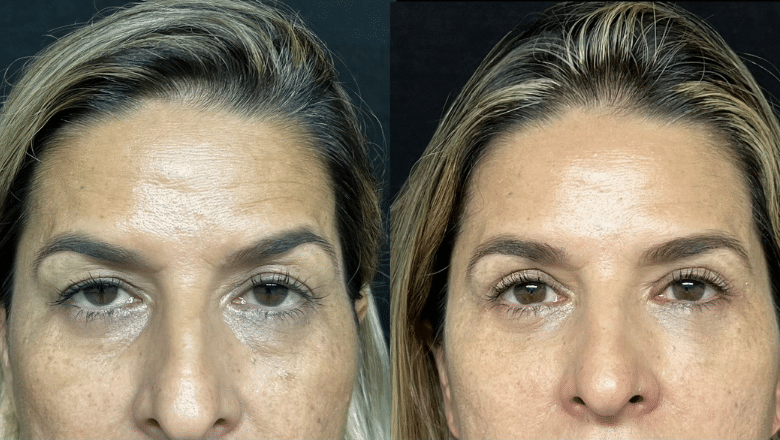
Upper blepharoplasty changes the upper lid, and through it, the upper edge of the eye. It removes excess skin and sometimes fat from the area below the brow, so the lid no longer folds over the lashes. Our guide to hooded eyes explains how that hooding develops, and our comparison of upper vs lower blepharoplasty sets out which lids need which operation.
The typical visible effects are a clearer crease, more lid space and a more open expression. The eye does not become rounder, almond-shaped or more upturned. If the outer corner drooped before, it will usually still sit in the same place afterwards.
Upper eyelid surgery and the eyebrows
The brow and the upper lid move together, so operating on one can nudge the other. A 2023 systematic review and meta-analysis in Aesthetic Plastic Surgery ↗ covering 17 studies recorded a significant drop in brow position after upper-eyelid surgery, averaging 0.67 mm after simple blepharoplasty and larger figures after double eyelid surgery and ptosis correction. Skin excision itself did not affect brow height[2]. In practice this is a reason to assess the brows before surgery. If the brow has descended significantly, a brow lift rather than blepharoplasty may do more of the work, or the two may be combined.
The relationship can work in your favour. A 2022 study of 45 young Asian women who had upper blepharoplasty alone found that, at six months, the position of the eyebrows and the shape of the brow apex had improved, and the proportions of the periorbital area were closer to the aesthetic ideal the authors used[3]. Results will differ from person to person, which is why your surgeon looks at the whole upper face.
Does Lower Blepharoplasty Change Eye Shape?
Lower blepharoplasty targets puffiness, bags and sometimes loose skin below the eye. It is less likely than upper surgery to alter how big the eye appears, but it can change the lower lid line. A review of the technique notes that the transconjunctival approach, through the inside of the lid, suits younger patients with prominent fat bags and no excess skin, while the transcutaneous approach is used when skin has to be removed. Modern techniques also reposition fat to soften the hollow between the lid and the cheek rather than only removing it[5].
The risk worth knowing about is lower lid position. If the lid is weak or too much tissue is taken, it can sag or pull downward, showing more of the white of the eye below the iris, which does alter the eye’s shape. Surgeons assess lid tightness before operating, and may add a canthopexy to support the outer corner, covered below. Our guide to eyelid surgery complications explains what to watch for.
Can Eye Shape Be Changed With Surgery?
Some aspects can, but most cannot. Using the eight common eye shapes as a guide:
- Hooded and monolid eyes: the amount of visible lid and the crease can change.
- Downturned and upturned eyes: only canthoplasty alters the outer corner; blepharoplasty does not.
- Deep-set and protruding eyes: these depend on the bony socket and the eyeball, so surgery on the lids cannot alter them.
- Close-set and wide-set eyes: spacing is set by the skull. A blepharoplasty will not move the eyes closer together or further apart.
Our dedicated guide to the 8 eye shapes and how to identify yours describes each one and how it is usually assessed. For people whose main concern is that the two eyes do not match, eyelid surgery for asymmetrical eyes is a separate question that depends on what is causing the difference.
Does Blepharoplasty Make Eyes Bigger?
It can make them look bigger, but it does not make them bigger. The size of the eyeball and the opening between the lids are largely fixed, so the effect comes from exposing more of what is already there, as the study above showed[1].
The effect varies with how much hooding there was. Someone with a lot of excess upper-lid skin will see a bigger change in apparent eye size than someone with a lighter lid. Combining double eyelid surgery with epicanthoplasty (release of the inner corner fold) increased eye exposure the most in the 2023 study[1]. A 2019 series of 475 patients who had that combination reported well-defined creases, an improved inner corner contour and a significant improvement in the proportions of the palpebral fissure, the opening between the lids, which the authors described as an elongated and more balanced eye shape[11]. That is a more specialised operation than standard blepharoplasty, used mainly in East Asian patients.
If your goal is clearly bigger-looking eyes beyond what removing hooding achieves, talk to your surgeon about whether canthoplasty is appropriate, and about the limits discussed below.
Does Blepharoplasty Make Eyes Smaller? Why Eyes Can Look Smaller After Surgery
Blepharoplasty does not reduce the size of the eye. Even so, eyes can look smaller in the weeks after surgery, which is a common worry and one of the questions that brings people to this page. The usual reasons are temporary:
- Swelling and bruising: swollen lids narrow the eye opening, particularly first thing in the morning.
- A tight or lowered lid: the lid can feel tight and sit lower while tissues soften.
- Brow position: if the brow settles slightly lower, as the meta-analysis above found[2], the space between brow and lid can look different.
- Lower lid support: a lower lid that sits higher after surgery can make the eye look less wide.
Most of these improve as swelling goes down. Our guides to blepharoplasty recovery and blepharoplasty before and after photos show how the eyes look through the early weeks and later. If your lids still look smaller after the swelling has settled, or the eye feels dry or does not close fully, tell your surgeon rather than waiting. Lid position problems, dry eyes and over-correction can all need assessment, and in some cases revision blepharoplasty.
Canthoplasty vs Canthopexy: The Surgery That Changes Eye Shape
If you want to change the shape of the eye rather than the lids, the relevant operations act on the canthus, the outer corner where the upper and lower lids meet.
What is canthopexy?
Canthopexy secures the outer corner of the lower lid to the bone of the orbit without cutting the existing lid tissue. It is mainly a support technique, used with lower blepharoplasty to protect against lid sagging and to maintain the corner’s position. A review of lateral canthal anchoring in Plastic and Reconstructive Surgery describes appropriate canthal anchoring as effective in preventing postoperative lower-lid malposition, ensuring eyelid closure and improving or maintaining proper eye shape, and notes that a canthopexy is effective in many patients, while significant horizontal laxity needs a procedure that also shortens the lid[6].
The key word there is maintaining. In a series of 104 patients who had lower blepharoplasty with a superficial lateral canthopexy, the 2020 retrospective review in Plastic and Reconstructive Surgery ↗ found no significant difference between the intercanthal angle before and after surgery, and the lateral canthal position did not change significantly[7]. A canthopexy is designed to keep the eye shape you have, not alter it.
What is canthoplasty?
Canthoplasty is a more involved procedure that reconstructs the outer corner. It is used for two broad reasons: to correct a lax or malpositioned lower lid, or cosmetically, to lengthen the eye opening or change the angle of the corner. A US review of 288 consecutive lower-lid canthal procedures found that the choice between a simpler canthopexy and a more complex canthoplasty depends on findings such as a negative vector, scleral show and the canthal tilt before surgery, and reported successful outcomes in 86% of cases by surgeon assessment and 91% by patient assessment, with follow-up of at least five years[8].
For purely cosmetic goals, a series of 600 patients (1,050 eyelids) who had lateral canthoplasty through a small incision in the upper lid crease, 244 of them cosmetic, reported rare and minor complications, with 18 patients needing further surgery within two years[9]. A review of cosmetic lateral canthoplasty in East Asian patients notes that the aim is often to enlarge the eye by extending the palpebral fissure and reducing the degree of slant, and that unfavourable results are not uncommon, which is why technique and patient selection matter[10].
Our canthoplasty page explains who the procedure suits, and our guides to canthal tilt and fox eye surgery cover the cosmetic side in more detail. Canthoplasty is not a routine add-on to blepharoplasty, and it is not suitable for everyone.
Eyelid Surgery for Monolid Eyes: Does It Change Eye Shape?
Monolid eyes have little or no visible crease above the lash line. Double eyelid surgery, also called Asian blepharoplasty, creates a crease, which makes the lid look different and often makes the eye look more open. The eye shape beneath stays the same, but the visible change can be large. Our guide to monolid eyes and double eyelid surgery covers the options, and the Asian blepharoplasty page explains the procedure.
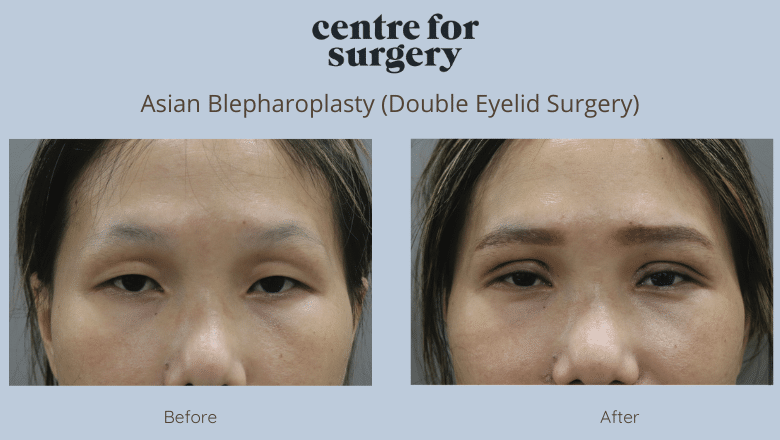
The crease height is not fully predictable. In a study of Asian women aged 18 to 35, the apparent width of the crease one year after surgery was related to the incision width, levator muscle function, skin and muscle thickness, tissue thickness in the upper lid and age, which is why surgeons plan the crease height individually[12]. A review of complications in double eyelid surgery groups problems into patient dissatisfaction, crease problems, lid height problems, suture-related problems and general eyelid surgery complications, and emphasises that understanding the anatomy of the Asian eyelid is the main way to reduce them[13]. Being clear about the crease you want, and seeing realistic before and after photographs, helps avoid disappointment.
Deep-Set Eyes Surgery: What Eyelid Surgery Can and Cannot Do
Deep-set eyes sit further back in the socket under a more prominent brow bone. That is a skeletal feature, so no eyelid operation can change it. Deep-set eyes can still have hooding, particularly with age, because the lid has little room to show. Removing excess skin can give a clearer lid space, but the eyes will still look deep-set afterwards.
For some people with deep-set eyes, the concern is a hollow below the eye rather than the upper lid. Modern lower blepharoplasty can reposition fat to smooth that hollow rather than removing it, as noted above[5]. Whether to do this is a judgement call to make in consultation, as removing too much volume can accentuate hollowing.
Do Hooded Eyes Become More Hooded With Age?
Often, yes. Skin loses elasticity, the brow tends to descend and the tissues around the eye become looser over time, so more skin can fold over the lash line. That is why many people first notice hooding in their 40s and 50s. Surgery treats the skin that is there today and does not stop ageing, so further changes can occur over the following years.
Is Eyelid Surgery Right If You Want a Different Eye Shape?
A consultation is the right starting point. A surgeon will assess your brow position, lid laxity, canthal tilt and the cause of any asymmetry, and tell you plainly whether blepharoplasty, canthopexy, canthoplasty, a brow lift or no surgery is most likely to achieve what you want. Aim for goals that are realistic for your anatomy. Photographs of other people’s eyes are a poor guide to what is possible for yours. Our guide to blepharoplasty for women and men explains how goals and anatomy can differ between patients.
Frequently Asked Questions
Can you change eye shape with surgery?
Partly. Standard eyelid surgery alters the lids and how much of the eye shows, but not the underlying shape. Canthoplasty can change the outer corner, and double eyelid surgery can create a crease. Eye spacing, depth and the size of the eyeball cannot be changed with eyelid surgery.
What is upper eyelid blepharoplasty?
Upper eyelid blepharoplasty is an operation that removes excess skin, and sometimes fat or muscle, from the upper lid through an incision in the natural crease. It treats hooding and heaviness. Our eyelid surgery page describes the procedure.
Does blepharoplasty make eyes bigger?
The eyes look bigger because more of the eye is visible, but the eye itself does not change size. A 2023 photo-based study found the exposed area of the eyeball increased after upper blepharoplasty.
Why do my eyes look smaller after blepharoplasty?
Swelling, bruising and a tight or lowered lid are the usual causes in the first weeks, and they generally improve as healing continues. If the eyes still look smaller once swelling has settled, or you notice dryness or difficulty closing the eye, contact your surgeon.
Does lower blepharoplasty change eye shape?
It can alter the line of the lower lid and the lid-cheek junction. If the lower lid is weak or too much tissue is removed, it may sit lower and show more white below the iris. Surgeons often add a canthopexy to help prevent this.
Does canthopexy change eye shape?
A canthopexy is designed to support the outer corner and hold it in place rather than reshape it. In one review of 104 patients, the lateral canthal position and intercanthal angle did not change significantly after lower blepharoplasty with canthopexy.
Why does my eyelid shape change?
Ageing, weight change, fluid retention, thyroid eye disease, allergies and drooping of the lid muscle can all alter lid shape. If the change is sudden or affects only one eye, it is worth having it checked by a GP or eye specialist.
Do hooded eyes become more hooded as you age?
They commonly do, as skin loosens and the brow descends. How quickly varies between people, and surgery treats the skin present at the time rather than preventing further ageing.
Eyelid Surgery in London
If you would like to know what eyelid surgery could and could not change about your eyes, you can arrange a consultation at our Baker Street hospital. Find out more about eyelid surgery at Centre for Surgery.
Phone: 020 7993 4849 | Address: 95–97 Baker Street, Marylebone, London W1U 6RN
Contact us to schedule a consultation
References
- Lu M, Lin W, Liu J, Wei D, Shen X. Photo-assisted anthropometric analysis of double eyelid blepharoplasty in young Chinese. Journal of Craniofacial Surgery 2023;34(8):2501–2505. doi:10.1097/SCS.0000000000009623 ↗
- Liu R, Sun Y, Huang J, Long X. Brow position change and its potential risk factors following upper blepharoplasty: a systematic review and meta-analysis. Aesthetic Plastic Surgery 2023;47(4):1394–1409. doi:10.1007/s00266-023-03288-0 ↗
- Zhang Y, Xiao Z. Upper eyelid blepharoplasty improved the overall periorbital aesthetics ratio by enhancing harmony between the eyes and eyebrows. Clinical, Cosmetic and Investigational Dermatology 2022;15:1969–1978. doi:10.2147/CCID.S385057 ↗
- Sönmez MM, Solmaz IA, Ertan E. Effects of upper eyelid blepharoplasty on perceived attractiveness, success, and health. Korean Journal of Ophthalmology 2024;38(6):437–440. doi:10.3341/kjo.2024.0092 ↗
- Bhattacharjee K, Ghosh S, Ugradar S, Azhdam AM. Lower eyelid blepharoplasty: an overview. Indian Journal of Ophthalmology 2020;68(10):2075–2083. doi:10.4103/ijo.IJO_2265_19 ↗
- McCord CD, Boswell CB, Hester TR. Lateral canthal anchoring. Plastic and Reconstructive Surgery 2003;112(1):222–237. doi:10.1097/01.PRS.0000066340.85485.DF ↗
- Rohrich RJ, Mohan R. Preventing lateral canthal malposition in modern blepharoplasty. Plastic and Reconstructive Surgery 2020;145(2):324e–328e. doi:10.1097/PRS.0000000000006468 ↗
- Tepper OM, Steinbrech D, Howell MH, Jelks EB, Jelks GW. A retrospective review of patients undergoing lateral canthoplasty techniques to manage existing or potential lower eyelid malposition: identification of seven key preoperative findings. Plastic and Reconstructive Surgery 2015;136(1):40–49. doi:10.1097/PRS.0000000000001363 ↗
- Taban M, Nakra T, Hwang C, et al. Aesthetic lateral canthoplasty. Ophthalmic Plastic and Reconstructive Surgery 2010;26(3):190–194. doi:10.1097/IOP.0b013e3181baa23f ↗
- Kim YJ, Lee KH, Choi HL, Jeong EC. Cosmetic lateral canthoplasty: preserving the lateral canthal angle. Archives of Plastic Surgery 2016;43(4):316–320. doi:10.5999/aps.2016.43.4.316 ↗
- Sun W, Yin N, Song T, Wu D, Li H, Wang Y. A practical technique combining orbicularis oculi muscle resection-based epicanthoplasty and orbicularis-tarsus fixation double-eyelid plasty for cosmetic blepharoplasty. Journal of Plastic, Reconstructive and Aesthetic Surgery 2019;72(12):2009–2016. doi:10.1016/j.bjps.2019.09.012 ↗
- Guo L, Liu J, Li C, et al. Influential factors on crease width post cosmetic blepharoplasty among young Asian women. Aesthetic Plastic Surgery 2025;49(12):3386–3392. doi:10.1007/s00266-025-04853-5 ↗
- Young SM, Kim YD. Complications of Asian double eyelid surgery: prevention and management. Facial Plastic Surgery 2020;36(5):592–601. doi:10.1055/s-0040-1717147 ↗







