


In this guide16 sections
- Key Points
- Does Gyno Go Away? The Short Answer
- Does Gyno Go Away After Puberty?
- Will Gyno Go Away After 18 or in Your 20s?
- How Long Does Gyno Last?
- How Do I Know If My Gyno Is Permanent?
- How to Tell If Gyno Is Going Away
- Does Gyno Go Away After Steroids or Stopping a Medication?
- Does Gyno Go Away With Fat Loss or Exercise?
- Does Having Gyno Mean Low Testosterone?
- Can Gyno Go Away Naturally? Creams, Supplements and Tablets
- What to Do If Gyno Doesn’t Go Away
- Gynecomastia Before and After Photos
- Frequently Asked Questions
- Why Choose Centre for Surgery for Gynecomastia Surgery?
- References
Key Points
- Gyno that starts in puberty usually goes away on its own. European guidelines report that it settles within two years in more than 90% of boys, typically by the late teens.
- Gyno that starts in adulthood usually does not. It often has a cause, such as a medicine, steroids or a hormone problem, and it tends to persist once formed.
- Time is the deciding factor. Gland that has been present for more than about one to two years turns fibrous, and fibrous tissue does not shrink when hormones settle.
- Removing the cause helps early, not late. Gyno from a medicine or a steroid cycle can regress if it is caught while still tender and new.
- Fat loss shrinks chest fat, not gland. If your chest is mostly fat, weight loss will help; if it is gland, it will not.
- No cream, supplement or exercise makes true gyno go away. When it is permanent, surgery is the only reliable way to remove it.
Whether you are asking will gyno go away, does gynecomastia go away on its own, or how long you should wait, the answer depends on two things: what caused it and how long you have had it. This guide explains when gynecomastia goes away naturally, when it is likely to be permanent, how to tell which applies to you, and what to do if it does not settle.
Before you start, it helps to know whether your chest is gland or fat. Our guide to gyno vs chest fat covers the self-check, and the causes of gynecomastia explains why gland forms in the first place.
Does Gyno Go Away? The Short Answer
Sometimes. Gynecomastia in newborn babies and in teenage boys is usually temporary and goes away once hormones settle. Gynecomastia that starts in adulthood, or that has persisted for more than about two years, generally does not go away on its own.[1]
| When it started | Will it go away? | Typical timescale |
|---|---|---|
| At birth | Almost always | Weeks to months, usually within the first year |
| Puberty | Usually | Six months to two years, typically by 17 to 18 |
| After a medicine or steroid cycle | Sometimes, if caught early | Months after stopping, if the tissue is still new |
| Adulthood, no clear cause | Rarely | Usually persists |
| Present for more than two years | Very unlikely | Tissue has usually become fibrous |
Does Gyno Go Away After Puberty?
In most cases, yes. During puberty, oestrogen can rise before testosterone fully catches up, and the breast tissue responds. The European Academy of Andrology guidelines ↗ state that pubertal gynecomastia affects around half of mid-pubertal boys and resolves on its own within 24 months in more than 90% of cases.[1]
It tends to appear at a predictable point. In a 2024 study of more than 530,000 boys aged 12 to 15 ↗, 70% of those diagnosed with pubertal gynecomastia were aged 13 or 14.[2] A smaller study that followed boys every three months found it appeared within a year of their fastest growth spurt.[3] For most boys, that means it has settled by 16 or 17, and pubertal gyno usually resolves by the age of 18, when adult hormone levels are reached.[4]
If you are a teenager, the best approach is usually patience. Our page on teenage gynecomastia explains when surgery is considered for younger patients and why most surgeons wait.
Will Gyno Go Away After 18 or in Your 20s?
Less often. If pubertal gyno is still present at 18, 19 or into your early 20s, it has usually been there for several years, and the chance of it going away on its own drops sharply. The guidelines suggest surgery for long-lasting gynecomastia that has not regressed, rather than more waiting.[1]
Gyno that first appears in your 20s is a different situation. It is more likely to have a cause, such as a supplement, a steroid cycle, cannabis or a medicine, and it is worth a GP review. Our guide to gynecomastia surgery age explains how age affects the decision to operate.
How Long Does Gyno Last?
- Newborn gyno usually fades within weeks and is almost always gone within the first year of life.[1]
- Pubertal gyno usually lasts six months to two years.[1]
- Medication or steroid gyno may settle over several months once the cause is stopped, if the tissue is still new.
- Adult gyno without a clear cause usually lasts indefinitely without treatment.
There is no reliable way to speed up natural resolution. No supplement, cream or exercise programme has been shown to shorten the timeline.
How Do I Know If My Gyno Is Permanent?
Gynecomastia changes character over time. In the early phase the gland is active, swollen and often tender. With time it is replaced by dense fibrous tissue. A classic pathology study of 351 cases described this progression, with recent gynecomastia showing active gland and long-standing gynecomastia showing mainly fibrous tissue.[5] Fibrous tissue no longer responds to hormone changes, which is why it does not shrink.
Your gyno is likely to be permanent if:
- it has been present for more than one to two years
- it has not changed in size for a year or more
- it is no longer tender or sore
- it feels like a firm, rubbery disc under the nipple
- it has not shrunk despite losing weight
Our guide to what gyno feels like describes the texture, and gynecomastia grades explains how size and skin affect treatment.
How to Tell If Gyno Is Going Away
Gyno that is resolving usually becomes less tender first, then softer, then smaller over several months. The lump behind the nipple shrinks rather than spreading, and the nipple puffiness settles. Taking a photo in the same light and position every month or two is the most reliable way to judge change. If nothing has changed over a year, it is unlikely to go away on its own.
Does Gyno Go Away After Steroids or Stopping a Medication?
It can, if it is caught early. The guidelines recommend watchful waiting after a medicine or substance linked with gyno has been stopped.[1] In the HAARLEM study of 100 men followed through a steroid cycle ↗, gynecomastia was seen in 19% during the cycle, and a year after starting, the side effects recorded had returned to their pre-cycle levels.[6] Repeated cycles, or gyno that has been left for many months, are much less likely to settle.
Medicines are estimated to cause 10% to 25% of all gynecomastia.[7] If you think a prescribed medicine is responsible, speak to the doctor who prescribed it rather than stopping it yourself. Our guides to steroid gyno, finasteride gynecomastia, antidepressants and gynecomastia and cannabis and gynecomastia cover each in more detail.
Does Gyno Go Away With Fat Loss or Exercise?
Fat loss shrinks chest fat, but not gland. If your chest is mostly fat, a condition called pseudogynecomastia, losing weight will help and may be all you need. If it is true gland, the lump behind the nipple stays even when the rest of the chest slims down, and it can look more obvious as you lean out.
Exercise works the same way. Training builds the chest muscle underneath, which can push gland forward rather than flatten it. Our guides to whether gyno can go away with exercise and gyno in fit men explain why.
Does Having Gyno Mean Low Testosterone?
Not usually. Low testosterone is one cause, but most men with gyno have normal hormone levels. In an Italian clinic study of more than 4,000 men, only a third of those with gynecomastia had low testosterone.[8] If your gyno started in adulthood, or you have symptoms such as low libido, tiredness or small or changing testicles, a GP can check your hormones.
Can Gyno Go Away Naturally? Creams, Supplements and Tablets
Products sold online to make gyno go away naturally have no good evidence behind them. Prescription tablets such as tamoxifen are sometimes used by specialists for new, tender gyno, but the European guidelines do not recommend them as a general treatment, and they do not remove gland that has already become fibrous.[1] Our guide to non-surgical gynecomastia treatments sets out what can and cannot help.
What to Do If Gyno Doesn’t Go Away
If your gyno has not settled, the first step is a GP review, especially if it started in adulthood. See a doctor promptly if the swelling is on one side only and feels hard or fixed, if there is nipple discharge or skin change, or if you notice any change in your testicles. Our guides to one-sided gynecomastia and gynecomastia and breast cancer explain what is reassuring and what is not.
Once any cause has been dealt with, gyno that has persisted is treated with surgery. Gynecomastia surgery removes the gland and any excess fat, usually through a small incision at the edge of the areola, often combined with VASER liposuction. Gland that has been removed does not grow back unless the cause continues, as explained in can gynecomastia come back after surgery? Our guides to gynecomastia surgery cost, gynecomastia recovery and whether gyno surgery is worth it explain the next steps.
Gynecomastia Before and After Photos
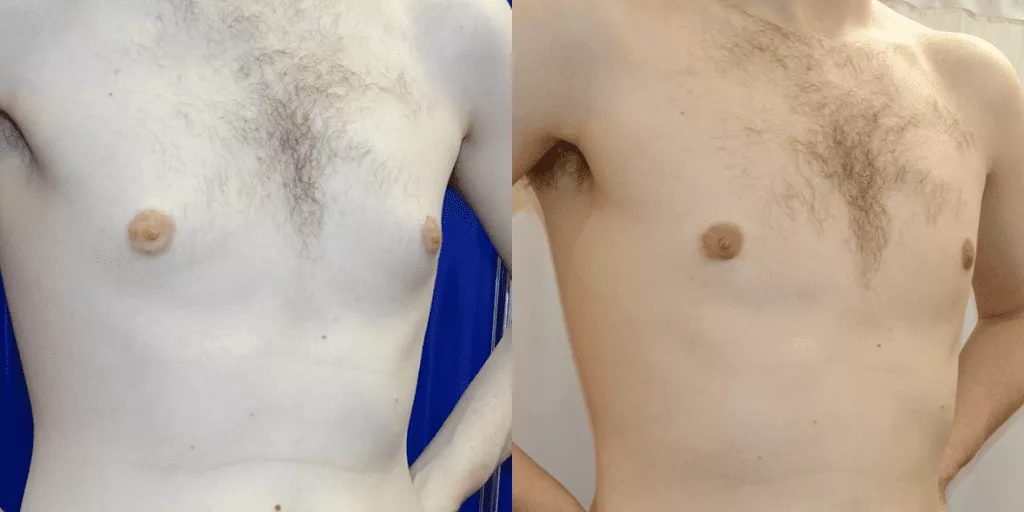
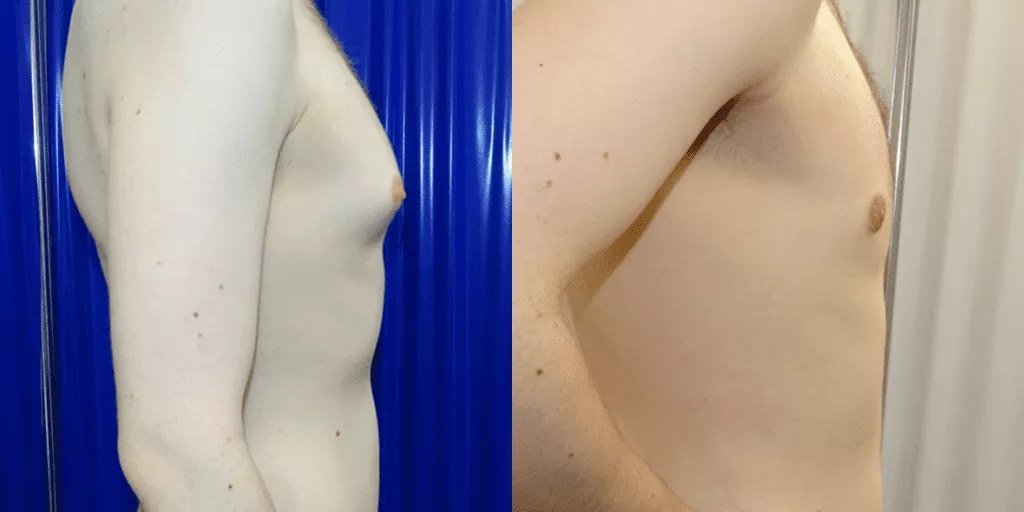
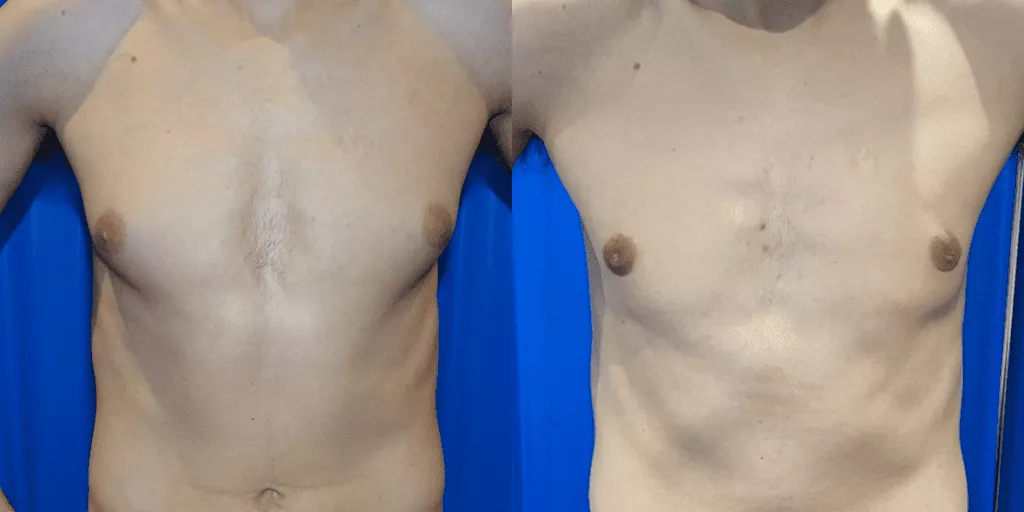
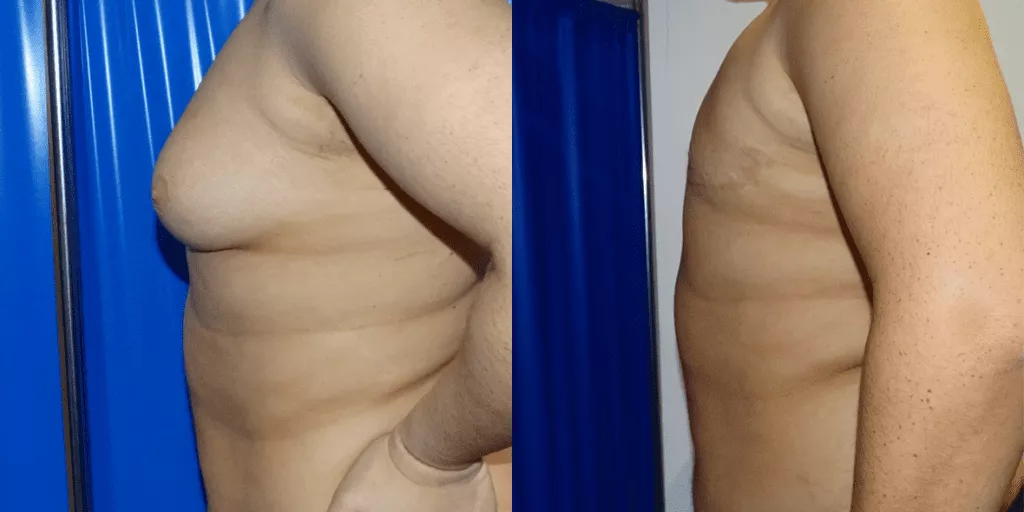
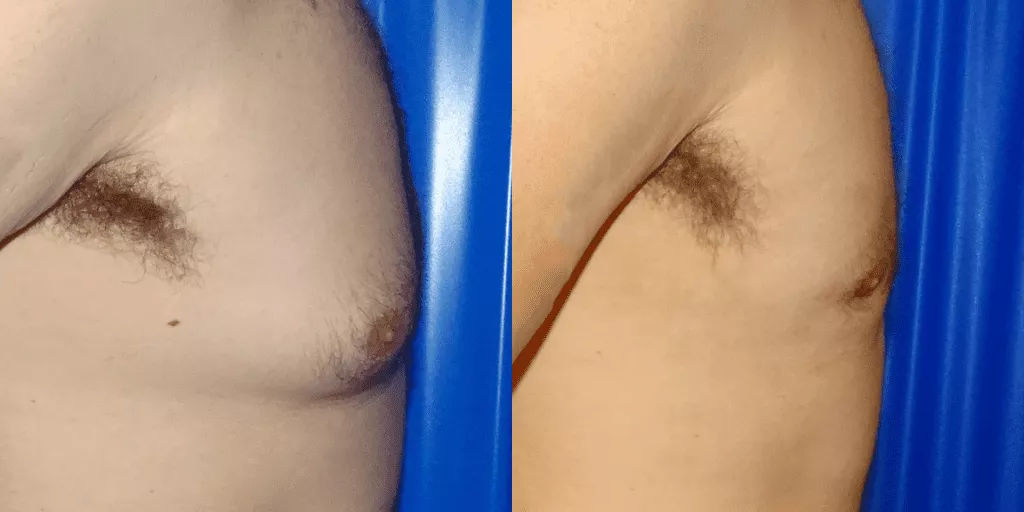
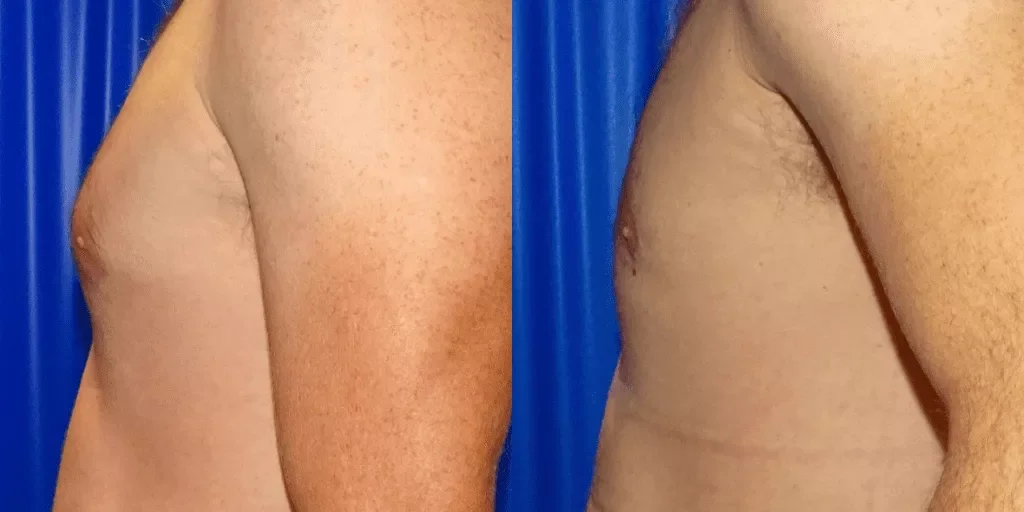
When gyno does not go away on its own, surgery gives a permanent result. These are real Centre for Surgery patients, and more are in our gynecomastia before and after photos gallery.
Frequently Asked Questions
How long does gyno last?
Pubertal gyno usually lasts six months to two years. Gyno from a medicine or steroid cycle may settle over several months after stopping, if it is caught early. Gyno that starts in adulthood without a clear cause, or that has been present for more than two years, usually lasts indefinitely without treatment.
Will gyno go away after 18?
Sometimes, but it becomes less likely. Most pubertal gyno has resolved by 18. If it is still present after that and has been there for more than two years, it has usually become fibrous and is unlikely to go away on its own.
Does gyno go away at 19 or in your 20s?
Occasionally, if it started late in puberty and is still recent. Gyno that has lasted since your early teens, or that first appeared in your 20s, usually needs either its cause treating or surgery.
How do I know if gyno is permanent?
Gyno is likely to be permanent if it has been present for more than one to two years, has stopped changing, is no longer tender, and feels like a firm disc under the nipple that has not shrunk with weight loss.
How can I flatten my gyno?
A compression vest or binder can flatten the chest under clothes, but the effect is temporary. Losing fat helps if the chest is mostly fat. The only way to permanently flatten true gland is to remove it surgically.
Does gyno go away with fat loss?
Only the fat part. Weight loss reduces chest fat, but the gland behind the nipple stays, and it can look more obvious once the surrounding fat has gone.
Does gyno go away after steroids?
Sometimes, if it is caught early and the cycle is not repeated. Gyno that has been present for months, or that keeps returning with each cycle, usually needs surgery once steroid use has stopped.
Do most bodybuilders have gyno?
Not most, but it is common among men who use anabolic steroids. In one study of men followed through a single cycle, 19% developed gynecomastia. Our guide to bodybuilder gynecomastia explains more.
Does having gyno mean low testosterone?
Not usually. Most men with gyno have normal testosterone. Low testosterone is one possible cause, which a GP can check with a blood test if your gyno started in adulthood or you have other symptoms.
Why Choose Centre for Surgery for Gynecomastia Surgery?
We treat every grade of gynecomastia, including grade 3 to 4 and revision cases after surgery elsewhere, with VASER or power-assisted liposuction and gland removal matched to your chest. Surgery is performed by GMC-registered plastic surgeons at our CQC-regulated hospital at 95–97 Baker Street, which has been caring for patients for over 10 years, and the surgeon who examines you at consultation is the surgeon who performs your operation. If your gyno may still settle on its own, or needs a GP review first, your surgeon will tell you. When you are asleep, your anaesthetic is TIVA given by a consultant anaesthetist, and almost all of our operations are day cases. Our other options for men are on our surgery for men page. We recommend a two-week cooling-off period before any surgery, and we publish our clinical outcomes and patient safety data.
Finance is available through Chrysalis Finance, subject to status. See our finance options page for details.
Phone: 020 7993 4849 | Address: 95–97 Baker Street, Marylebone, London W1U 6RN
Contact us to schedule a consultation
References
- Kanakis GA, Nordkap L, Bang AK, et al. EAA clinical practice guidelines: gynecomastia evaluation and management. Andrology 2019;7(6):778–793. doi:10.1111/andr.12636 ↗
- Berger O, Hornik-Lurie T, Talisman R. Pubertal gynecomastia incidence among 530,000 boys: a cross sectional population based study. Frontiers in Pediatrics 2024;12:1367550. doi:10.3389/fped.2024.1367550 ↗
- Limony Y, Friger M, Hochberg Z. Pubertal gynecomastia coincides with peak height velocity. Journal of Clinical Research in Pediatric Endocrinology 2013;5(3):142–144. doi:10.4274/Jcrpe.958 ↗
- Lazala C, Saenger P. Pubertal gynecomastia. Journal of Pediatric Endocrinology and Metabolism 2002;15(5):553–560. doi:10.1515/jpem.2002.15.5.553 ↗
- Bannayan GA, Hajdu SI. Gynecomastia: clinicopathologic study of 351 cases. American Journal of Clinical Pathology 1972;57(4):431–437. doi:10.1093/ajcp/57.4.431 ↗
- Smit DL, Buijs MM, de Hon O, den Heijer M, de Ronde W. Positive and negative side effects of androgen abuse. The HAARLEM study: a one-year prospective cohort study in 100 men. Scandinavian Journal of Medicine & Science in Sports 2021;31(2):427–438. doi:10.1111/sms.13843 ↗
- Deepinder F, Braunstein GD. Drug-induced gynecomastia: an evidence-based review. Expert Opinion on Drug Safety 2012;11(5):779–795. doi:10.1517/14740338.2012.712109 ↗
- Maseroli E, Rastrelli G, Corona G, et al. Gynecomastia in subjects with sexual dysfunction. Journal of Endocrinological Investigation 2014;37(6):525–532. doi:10.1007/s40618-014-0055-z ↗