


In this guide15 sections
- Key Points
- What Do the Internal Stitches in a Tummy Tuck Hold Together?
- Can You Tear Internal Stitches After a Tummy Tuck?
- Symptoms of Torn Internal Stitches After a Tummy Tuck
- Torn Stitch, Swelling or Seroma? How to Tell What You Have
- Tummy Tuck Stitches Poking Out: Spitting Sutures
- What Happens If Internal Stitches Tear?
- What to Do If You Think You Have Popped a Stitch
- What Causes Internal Stitches to Tear After a Tummy Tuck?
- How to Avoid Tearing Stitches After a Tummy Tuck
- How Long Do Tummy Tuck Stitches Take to Heal?
- Can You Tear Stitches Months or Years After a Tummy Tuck?
- Frequently Asked Questions
- Tummy Tuck Aftercare at Centre for Surgery
- References
Key Points
- Torn internal stitches after a tummy tuck are uncommon. In an analysis of 25,478 abdominoplasties, the major complications were mostly bleeding, infection and blood clots; a stitch giving way is far down the list.
- A tummy tuck has three layers of stitches: the muscle repair, the deeper tissue layer and the skin. Which one is affected decides what you notice and what needs doing.
- The classic sign of a popped internal stitch is a sudden sharp pain, sometimes with a pop or tearing feeling, followed by new swelling or a bulge that was not there before.
- Most worrying changes turn out to be something else: normal swelling, a seroma (a fluid collection), a stitch working its way out of the skin, or a small wound opening that heals with dressings.
- If you think you have torn a stitch, call us the same day. Rest, support your tummy with your garment, take a photo and describe what happened. Severe pain, rapidly growing swelling, fever, or chest pain or breathlessness need urgent help.
- Protecting the repair is mostly about avoiding strain in the first six weeks: no heavy lifting, splinting your tummy when you cough or sneeze, avoiding constipation, wearing your compression garment and not smoking.
Torn internal stitches after a tummy tuck are one of the things patients worry about most in the first few weeks, usually after a cough, a sneeze or a moment of reaching too far. The worry is understandable: the internal stitches hold your tummy tuck muscle repair together while it heals, and the result depends on them. The reassuring part is that a stitch genuinely tearing is uncommon, and most of the twinges, bulges and leaks people search for at two in the morning are part of normal healing or something minor.
This guide explains what the internal stitches in a tummy tuck actually do, the symptoms of torn internal stitches, how to tell a popped stitch from swelling or a seroma, what happens if a stitch does give way, and how to protect your repair during tummy tuck recovery. If you are reading this because something has changed today, the section on what to do if you think you have popped a stitch is the place to start.
What Do the Internal Stitches in a Tummy Tuck Hold Together?
A full abdominoplasty is closed in layers, and each layer has its own stitches with its own job.
- The muscle repair (plication). When the six-pack muscles have drifted apart after pregnancy or weight change, a condition called diastasis recti, your surgeon stitches the tough sheath over them back together down the middle of the tummy. These are the stitches most people mean when they talk about internal stitches. They are either permanent or very slowly dissolving, because the repair needs support for months.
- The deeper tissue layer. Dissolvable stitches close the fibrous layer under the fat and, in many techniques, tack the skin flap down to the muscle wall to reduce the space where fluid can collect. These are sometimes called quilting or progressive tension sutures.
- The skin. The scar line is usually closed with dissolvable stitches buried just under the skin, sometimes with skin glue or tapes on top. Stitches holding a drain in place, if you have drains, are removed when the drains come out.
Mini and extended operations use the same layers in different amounts. A mini tummy tuck may involve a shorter muscle repair or none at all, while an extended tummy tuck has a longer scar and more tissue to support. Whatever the operation, every layer needs time to knit together before it can take full load.
Can You Tear Internal Stitches After a Tummy Tuck?
Yes, but it is uncommon. The largest picture of tummy tuck complications comes from the 2015 CosmetAssure analysis of 25,478 abdominoplasties ↗. Major complications, defined as those needing a hospital visit, admission or another operation, occurred in 4.0% of patients, and the commonest were haematoma (a collection of blood), infection and blood clots[1]. The most frequent problem of all after a tummy tuck is a seroma, a collection of clear fluid under the skin[2]. A muscle repair stitch giving way is much less common than any of these.
Where the repair does fail, it is often gradual rather than sudden. A Dutch study that scanned women an average of five years after their tummy tuck found that when the muscle repair had been done with dissolvable stitches, 40% had some residual or recurrent separation[3]. A later study from Newcastle, using permanent nylon stitches, found no recurrence on ultrasound at a year in 28 patients[4]. The choice of stitch is your surgeon’s, and the lesson for patients is simpler: the repair is strongest when it is protected while it heals.
Symptoms of Torn Internal Stitches After a Tummy Tuck
The signs depend on which layer is affected, but the pattern people describe is consistent. Contact your surgeon if you notice:
- A sudden, sharp pain in one spot, especially if it came on with a cough, sneeze, vomiting, lifting or straightening up quickly.
- A pop, snap or tearing sensation inside the tummy at the same moment.
- New swelling or a bulge that was not there before, particularly a ridge or bulge down the middle of the tummy that is more obvious when you strain or stand up.
- Swelling on one side that grows quickly, becomes tight or turns purple, which can mean bleeding.
- A gap opening in the scar line, or fluid leaking through the wound.
- Signs of infection: spreading redness, heat, increasing pain, cloudy or smelly discharge, or a fever.
What does a torn internal stitch feel like?
Most people describe a sudden, localised pain, sharper than the general ache of recovery, at the moment of a particular movement. Some feel or hear a small pop. The ordinary soreness of healing is different: it is spread across the tummy, it improves a little each day, and it does not suddenly get worse. Tightness, pulling, tingling and numbness above the scar are all normal in the first weeks, as the nerves and tissues settle.
What does a popped internal stitch look like?
Often there is nothing to see. When there is, it is usually a new bulge, an area of swelling that was not there the day before, a change in the shape of the tummy compared with the other side, or bruising that appears after the event. A popped skin stitch is easier to spot: a small gap or opening in the scar, sometimes with a little clear or blood-stained fluid.
Torn Stitch, Swelling or Seroma? How to Tell What You Have
Many of the changes people worry about after a tummy tuck look or feel alike at home. This is a rough guide only; your surgeon or nurse needs to examine you to be sure.
- Normal swelling builds gradually, is worse at the end of the day and below the belly button, and improves week on week. It is usually even on both sides.
- A seroma is a soft, sometimes sloshing swelling, typically low down above the scar, that appears or grows over days. It is the commonest complication and is often drained with a needle in clinic. Our guide to tummy tuck seroma explains the treatment.
- A haematoma is a firm, tense, often painful swelling that appears quickly, usually in the first day or two, with bruising. It needs to be seen urgently.
- A torn muscle repair stitch tends to follow a definite event, with sudden pain, and a bulge down the centre of the tummy that pushes out when you strain.
- A wound opening is a gap in the scar line, usually small, most often at the centre of the scar where tension is greatest.
- Infection brings spreading redness, heat, worsening pain, discharge and sometimes fever.
The signs of a bad tummy tuck guide covers longer-term problems with the result, as opposed to these early complications.
Tummy Tuck Stitches Poking Out: Spitting Sutures
A small white or clear thread poking through the scar a few weeks after surgery is usually a buried dissolvable stitch working its way out, often called a spitting suture. It is common, it is not a torn stitch, and it is not a sign that the deeper repair has failed. You may see a small red spot or pimple on the scar first.
Do not pull it or cut it yourself. Keep the area clean and dry and let us know: a nurse can usually trim or remove it in a moment, and the spot heals quickly afterwards. If the area becomes red, hot or swollen, or keeps discharging, it needs to be checked for infection.
What Happens If Internal Stitches Tear?
What happens next depends on which layer has given way.
- Skin stitches: a small wound opening is usually treated with dressings and heals from the base up over a few weeks. Larger openings sometimes need closing again. The scar may be a little wider, and any lasting difference can be improved later; our guide to tummy tuck scars covers how scars mature.
- Deeper tissue stitches: these are more likely to lead to a seroma than anything you can see, and are managed in the same way.
- Muscle repair stitches: a small, early tear may be watched closely. A clear loss of the repair, with a bulge returning, is usually corrected with a further operation once the tissues have settled, using the original scar. Occasionally the bulge turns out to be a hernia, which needs its own repair; see our guide to combining a tummy tuck with hernia repair.
A torn stitch rarely ruins a tummy tuck result when it is caught and managed early. The worst outcomes come from waiting weeks to mention a change.
What to Do If You Think You Have Popped a Stitch
- Stop and rest. Lie down with your knees bent and a pillow underneath them to take tension off the tummy.
- Support the area. Keep your compression garment on, and hold a cushion against your tummy if you need to move.
- Note what happened and take a photo. When it happened, what you were doing, what you felt, and how the area looks now. A photo taken in good light helps the team judge how urgent it is.
- Call us the same day. For the first 24 hours after surgery you have your surgeon’s direct number, written on your discharge summary. After that, our phone line is open 9am to 6pm, Monday to Saturday, on 020 7993 4849. Out of hours, call NHS 111.
- Do not wait if it is urgent. Call 999 or go to A&E for severe or rapidly worsening pain, swelling that is growing quickly, heavy bleeding, a fever with spreading redness, or chest pain, breathlessness or coughing up blood, which can be signs of a blood clot in the lungs ↗. A painful, swollen calf can be a deep vein thrombosis ↗ and also needs prompt assessment.
What Causes Internal Stitches to Tear After a Tummy Tuck?
Stitches give way when the force on them exceeds what the healing tissue can hold. The common reasons are:
- Sudden straining: a violent cough, sneeze or bout of vomiting, especially without splinting the tummy; straining on the toilet when constipated, which painkillers make more likely.
- Lifting and twisting too soon: carrying children, shopping or laundry, or moving furniture in the first weeks.
- Straightening up too early. Walking slightly bent forward for the first week or so is normal and protective; our guide to being hunched over after a tummy tuck explains why.
- Returning to exercise too early, particularly core work, running and weights.
- Poor healing. Smoking is the biggest avoidable factor. In a 2003 study of 132 abdominoplasties ↗, 47.9% of smokers had wound healing problems compared with 14.8% of non-smokers[5]. A higher body mass index also raises the risk of complications after cosmetic surgery[6], as do diabetes and infection.
- Pressure from underneath, such as a large seroma or haematoma pushing on the repair.
How to Avoid Tearing Stitches After a Tummy Tuck
Most of protecting your repair is simple and practical:
- Splint your tummy with a cushion or folded towel when you cough, sneeze, laugh or get up.
- Get out of bed by rolling onto your side and pushing up with your arms, rather than sitting straight up.
- Lift nothing heavier than a full kettle for the first few weeks, and avoid carrying children until your surgeon says it is safe.
- Prevent constipation with fluids, fibre and gentle walking, and ask about a stool softener while you are taking painkillers.
- Wear your compression garment as advised; our guide to compression garments after a tummy tuck explains the fit. Garments are purchased separately and confirmed with you in advance.
- Walk little and often from the first day, which protects against blood clots without straining the repair; see how to walk after a tummy tuck and sleeping positions after a tummy tuck.
- Stop smoking and vaping nicotine at least four weeks before and four weeks after surgery. Our guide to smoking and cosmetic surgery explains why it matters so much for the tummy.
- Return to exercise in stages, leaving core exercises and heavy weights until your surgeon is happy; see resuming exercise after cosmetic surgery.
Good preparation helps too. Our guide to preparing for abdominoplasty covers stopping smoking, organising help at home and getting your recovery space ready.
How Long Do Tummy Tuck Stitches Take to Heal?
The skin stitches and deeper dissolvable stitches start to break down within a few weeks and are usually gone within two to three months, depending on the material. The scar itself is strong enough for normal daily life after a few weeks, but healing tissue takes around three months to approach its full strength, and the scar continues to mature for a year or more.
The muscle repair is the slowest part. It is most vulnerable in the first six weeks, which is why lifting and core exercise are restricted for that period, and it continues to strengthen for several months as scar tissue forms along the stitch line. Your surgeon will tell you when it is safe to build up to full activity.
Do internal stitches dissolve after a tummy tuck?
The deeper tissue and skin stitches are usually dissolvable. Muscle repair stitches are often permanent or very slowly dissolving by design, because the repair needs long-term support; permanent stitches stay in place and do not need removing.
What if internal stitches don’t dissolve?
Occasionally a dissolvable stitch is slow to break down and works its way to the surface as a spitting suture, or a firm small lump can be felt along the scar for a few months. Neither is usually a problem. If a stitch is sore, red or keeps discharging, it can be removed.
Does it hurt when internal stitches dissolve?
Not usually. Dissolving happens slowly and is not something most people feel. Itching, tingling and occasional twinges along the scar are common during healing and are more to do with nerves recovering than stitches dissolving.
Can You Tear Stitches Months or Years After a Tummy Tuck?
Once the repair has healed, a sudden tear is very unlikely. A bulge that appears months or years later is more often a gradual return of muscle separation, a new hernia, weight gain, or the effect of a later pregnancy, which stretches the repaired muscles again. That is why we advise finishing your family before a tummy tuck.
Tummy tuck muscle repair failure symptoms
A failed or loosened repair usually shows as a bulge returning between the ribs and the belly button, most obvious when you sit up or strain, a loss of the flatter, firmer feel the operation gave you, or a soft gap you can feel down the middle. An ultrasound scan can measure the gap. Where the repair has genuinely loosened, it can be tightened again; our guide to revision cosmetic surgery explains what that involves.
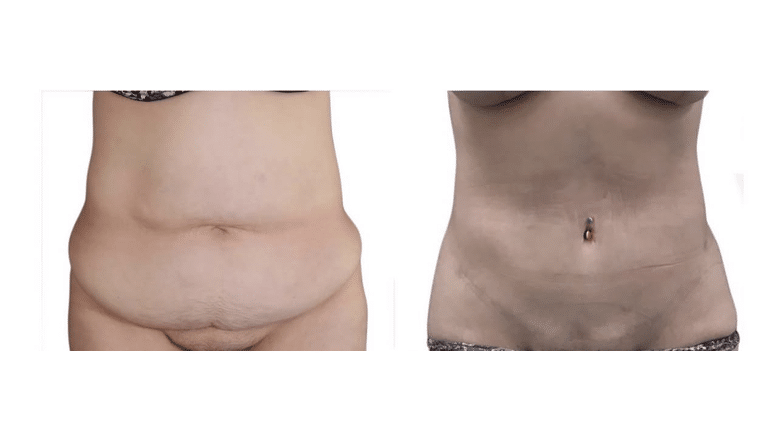
More results are in our tummy tuck before and after gallery.
Frequently Asked Questions
How can I tell if I ripped internal stitches after a tummy tuck?
The usual signs are a sudden sharp pain at a specific moment, sometimes with a pop, followed by new swelling or a bulge, often down the middle of the tummy. Gradual swelling that improves day by day is far more likely to be normal healing. If you are unsure, call us and describe what happened.
What happens if internal stitches tear?
It depends on the layer. A small skin opening usually heals with dressings, a deeper tear may lead to a fluid collection, and a muscle repair that has clearly given way is usually corrected with a further operation once the tissues have settled.
What does a torn internal stitch feel like?
A sharp, localised pain that is different from the general ache of recovery, often after a cough, sneeze or lift, and sometimes with a popping or tearing sensation.
What should I do if an internal stitch pops?
Rest with your knees bent, keep your compression garment on, take a photo and call us the same day. Go to A&E or call 999 for severe pain, rapidly growing swelling, fever with spreading redness, or chest pain and breathlessness.
Can coughing or sneezing tear tummy tuck stitches?
A forceful cough or sneeze puts real strain on the repair, especially in the first two weeks. Holding a cushion firmly against your tummy as you cough or sneeze spreads the pressure and protects the stitches.
How long does it take for internal stitches to heal completely?
The repair is most vulnerable for the first six weeks and keeps gaining strength for around three months. Scars continue to mature for a year or more.
Do internal stitches heal faster than external stitches?
No. The skin usually seals within a couple of weeks, but the deeper layers, and the muscle repair in particular, take much longer to reach full strength, which is why activity limits last longer than the wound looks like it needs.
When can I lift things after a tummy tuck?
Light objects only, nothing heavier than a full kettle, for the first few weeks, building up gradually. Heavy lifting and core exercise usually wait until at least six weeks, and your surgeon will confirm when.
Is it normal to have a hard lump along my tummy tuck scar?
Firmness along the scar and above it is common for several months as swelling settles and scar tissue forms. A lump that is growing, hot, painful or discharging should be checked.
Tummy Tuck Aftercare at Centre for Surgery
At Centre for Surgery, tummy tucks are performed by GMC-registered plastic surgeons at our CQC-regulated Baker Street hospital, usually under TIVA. The surgeon who assesses you at consultation is the surgeon who performs your operation. Follow-up appointments are included in your quotation, and our nursing team stays in contact with you over the first two weeks, so there is always someone to call if something changes. To read more about the operation itself, see our tummy tuck page, or our guide to tummy tuck risks.
Phone: 020 7993 4849 | Address: 95–97 Baker Street, Marylebone, London W1U 6RN
Contact us to schedule a consultation
References
- Winocour J, Gupta V, Ramirez JR, Shack RB, Grotting JC, Higdon KK. Abdominoplasty: risk factors, complication rates, and safety of combined procedures. Plastic and Reconstructive Surgery 2015;136(5):597e–606e. doi:10.1097/PRS.0000000000001700 ↗
- Li H, Wu B, Tan X, et al. Comparative efficacy of seroma prevention strategies in abdominoplasty with liposuction: a systematic review and Bayesian model-based network meta-analysis. Aesthetic Plastic Surgery 2026;50(12):4717–4729. doi:10.1007/s00266-026-05610-y ↗
- van Uchelen JH, Kon M, Werker PM. The long-term durability of plication of the anterior rectus sheath assessed by ultrasonography. Plastic and Reconstructive Surgery 2001;107(6):1578–1584. doi:10.1097/00006534-200105000-00046 ↗
- Tadiparthi S, Shokrollahi K, Doyle GS, Fahmy FS. Rectus sheath plication in abdominoplasty: assessment of its longevity and a review of the literature. Journal of Plastic, Reconstructive & Aesthetic Surgery 2012;65(3):328–332. doi:10.1016/j.bjps.2011.09.024 ↗
- Manassa EH, Hertl CH, Olbrisch RR. Wound healing problems in smokers and nonsmokers after 132 abdominoplasties. Plastic and Reconstructive Surgery 2003;111(6):2082–2087. doi:10.1097/01.PRS.0000057144.62727.C8 ↗
- Gupta V, Winocour J, Rodriguez-Feo C, et al. Safety of aesthetic surgery in the overweight patient: analysis of 127,961 patients. Aesthetic Surgery Journal 2016;36(6):718–729. doi:10.1093/asj/sjv268 ↗







