


In this guide15 sections
- Key Points
- What Is the Best Facial Rejuvenation Treatment for Your Concern?
- What Is Facial Rejuvenation?
- Non-Surgical Facial Rejuvenation: What Works and What Does Not
- Surgical Facial Rejuvenation: Facelift, Neck Lift, Eyelid Surgery and Brow Lift
- Surgical vs Non-Surgical Facial Rejuvenation: Which Is Better?
- What Is the Best Facial Treatment for a 60-Year-Old Woman?
- What Is Full Facial Rejuvenation, and Can You Combine Treatments?
- How Long Does Facial Rejuvenation Last?
- Is Facial Rejuvenation Worth It?
- How Much Does Facial Rejuvenation Cost?
- What Happens at a Facial Rejuvenation Consultation?
- Frequently Asked Questions
- Facial Rejuvenation in London
- References
Key Points
- What is the best facial rejuvenation treatment? There is no single best option. The right treatment depends on what is changing: skin quality, expression lines, lost volume, sagging tissue or the eyes.
- Non-surgical facial rejuvenation (anti-wrinkle injections, dermal fillers, laser and radiofrequency) suits early to moderate signs of ageing, with little or no downtime and results that fade over months.
- Surgical facial rejuvenation (facelift, neck lift, eyelid surgery and brow lift) is the only way to reposition sagging tissue and remove excess skin, with results that last for years.
- Heavy jowls, neck bands and hooded eyelids are not corrected by injectables, lasers or radiofrequency, however many sessions you have.
- Full facial rejuvenation often combines treatments, for example surgery for structure and skin treatments for texture and tone.
- A consultation comes first. You are assessed by a GMC-registered surgeon at our CQC-regulated Baker Street hospital, and costs are confirmed in writing afterwards.
Facial rejuvenation covers any treatment that makes an ageing face look fresher, firmer or more rested, from a course of laser sessions to a full facelift. The question people type into Google is usually “what is the best facial rejuvenation treatment?”, and the honest answer starts with a second question: what exactly is bothering you? Fine lines, hollow cheeks, jowls and a heavy upper eyelid are four different problems, and they respond to four different kinds of treatment.
This guide compares surgical and non-surgical facial rejuvenation side by side, explains what each treatment can and cannot do, and shows how treatments are combined. If you are mainly worried about sagging skin on your face, or you want an overview of the anti-ageing treatments at Centre for Surgery, those guides go into more depth, and our facial rejuvenation surgery hub lists every operation we perform.
What Is the Best Facial Rejuvenation Treatment for Your Concern?
The simplest way to choose is to match the treatment to the problem. Skin that looks tired, crinkled or uneven has lost quality. Lines between the brows or across the forehead are made by muscle movement. Hollow cheeks and under-eye shadows are volume loss. Jowls, a blunted jawline and neck bands are tissue that has descended. Heavy upper eyelids and low brows are a structural change around the eyes.
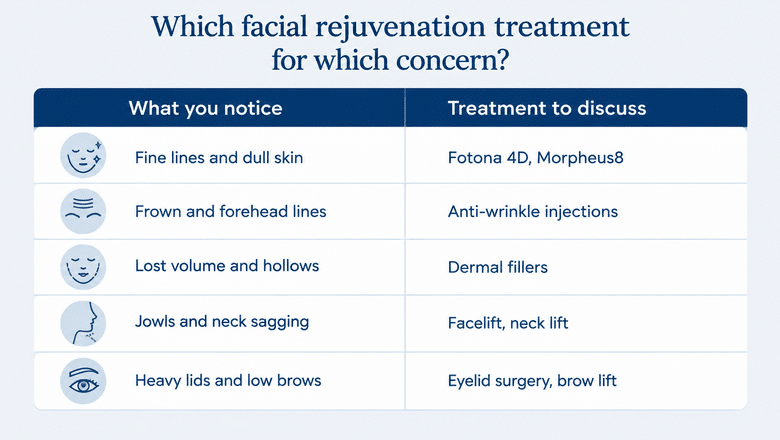
Most faces show a mix, which is why the best facial rejuvenation treatment for one person is rarely the best for another. A 45-year-old with early jowls and fine lines needs a different plan from a 65-year-old with a heavy neck, and both differ from a 38-year-old whose main concern is tired-looking eyes. The sections below take each group of treatments in turn.
What Is Facial Rejuvenation?
Facial rejuvenation is the umbrella term for restoring a younger-looking face. The word “rejuvenation” is used for both surgical and non-surgical treatments, which is why searches for face rejuvenation treatments return everything from facials to facelifts. In practice it means treating one or more of the five changes of ageing: thinner, lined skin, muscle-driven lines, volume loss, tissue descent and changes around the eyes. A single treatment seldom handles all five, so “full face rejuvenation” usually means a plan that combines more than one.
Non-Surgical Facial Rejuvenation: What Works and What Does Not
Non-surgical facial rejuvenation covers injectables, laser and radiofrequency energy, and skin-quality treatments. Its strengths are no incisions, short recovery and the ability to start early. Its limit is that it cannot lift or remove tissue, so it works well on early to moderate changes.
Anti-wrinkle injections for frown lines and crow’s feet
Anti-wrinkle injections relax the small muscles that crease the skin when you frown, squint or raise your brows. They suit expression lines in the upper face. A 2023 systematic review and meta-analysis of 14 randomised trials in Aesthetic Surgery Journal ↗ found onabotulinumtoxinA very effective for glabellar (frown) lines, crow’s feet and forehead lines, with people returning to their pre-treatment status after about 182 days[3]. An earlier review of randomised trials reported a peak effect around one month and results lasting four to six months, with drooping of the eyelid in 0 to 5.4% of people treated for frown lines[4]. Injections do not tighten sagging skin or lift jowls.
Dermal fillers and the liquid facelift
As we age we lose volume as well as elasticity, particularly in the cheeks, temples and under the eyes. Dermal fillers replace that volume, and well-placed cheek fillers can also lend gentle support to the mid-face. Treating several areas in one visit is sometimes called a liquid facelift. In a 2010 prospective study in Dermatologic Surgery ↗, ten women treated with several syringes of hyaluronic acid were judged by blinded dermatologists to look between 6.1 and 7.3 years younger two to four weeks later[5]. That was a very small study measured at an early point, and fillers gradually break down, so the result is not permanent.
Fillers also have risks. The most serious is accidental injection into a blood vessel, which can cause skin damage and, rarely, visual loss, and a 2026 review stresses that early recognition and prompt treatment with hyaluronidase are essential[6]. That is a reason to choose a clinical setting where these events can be managed, and to avoid using filler to try to correct sagging that needs surgery. Our comparison of dermal fillers vs facelift surgery sets out where the line falls.
Fotona 4D laser and SmoothEye for skin tightening and fine lines
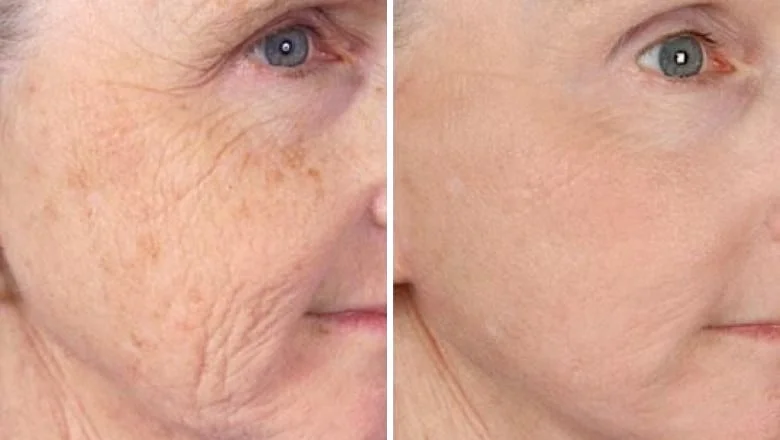
Laser treatment improves skin quality rather than structure. Fotona 4D is a non-surgical laser face lift that uses two laser wavelengths in four steps, one of them from inside the mouth, to firm mild laxity and refine texture. It is given as a course of two or three sessions about a month apart, with little or no downtime. SmoothEye uses a non-ablative erbium laser on thin, crepey eyelid skin and crow’s feet, and our guide to laser eyelid tightening explains what to expect. For deeper pigmentation and surface damage, erbium laser skin resurfacing is a stronger option with a longer recovery. Laser results build gradually and need maintenance, and they will not lift heavy jowls or remove hooded eyelid skin.
Morpheus8 and FaceTite for mild to moderate laxity
Morpheus8 combines microneedling with radiofrequency heat to tighten skin and improve texture and acne scarring; it is usually given as three sessions four to six weeks apart, and the effect typically lasts 12 to 18 months. Our guide to Morpheus8 on the face covers it in detail. In a 2024 randomised split-face study of 21 patients in the Journal of Cosmetic Dermatology ↗, microneedle radiofrequency produced a measurable reduction in midface volume and fewer wrinkles on the treated side, sustained at six months, with no long-term side effects[7]. For slightly more laxity along the jawline and neck, FaceTite is a minimally invasive radiofrequency procedure, and our overview of radiofrequency skin tightening explains the differences. A small prospective study of patients whose jowls and neck had loosened again after a facelift found radiofrequency treatment gave useful improvement without a repeat operation, although only nine patients completed it[8].
Skin boosters, Profhilo and polynucleotides
Some treatments are aimed at hydration and skin quality rather than shape. Profhilo, skin boosters and polynucleotide treatment suit people whose main complaint is dry, thin or crepey skin. They improve how skin looks and feels, and they are a reasonable early step, but they do not change facial contour.
Surgical Facial Rejuvenation: Facelift, Neck Lift, Eyelid Surgery and Brow Lift
Surgery is different in kind, not just in degree. It repositions the deeper tissues that have descended, removes excess skin and fat, and tightens the structures that give the face its shape. That is why it is the right choice when ageing has gone beyond early changes, and why the result lasts years rather than months.
Facelift for jowls, a soft jawline and sagging cheeks
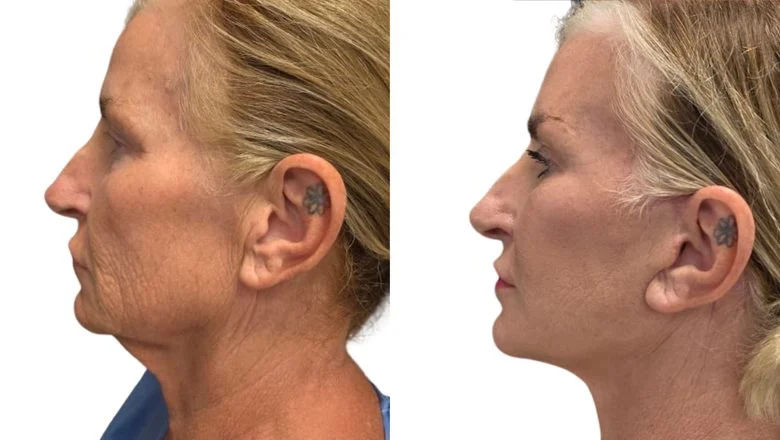
A facelift lifts and tightens the deeper tissues under the cheeks, jowls and jawline and is usually done with a neck lift. A full facelift with neck lift takes three to four hours under TIVA (total intravenous anaesthesia), you go home the same day, sutures come out at about a week, and most people take 10 to 14 days off work. The first result is visible at two to three months and the final result at six to twelve months. Our guides to types of facelift and deep plane vs SMAS facelift explain the techniques, and a 2025 systematic review and meta-analysis in Aesthetic Plastic Surgery ↗ of 21 studies and 2,896 patients found patient satisfaction of 94.4% for deep plane facelifts and 87.8% for SMAS facelifts, with complication rates of 17.2% and 10.3%[1]. Both techniques give high satisfaction, and the review reflects the trade-off between a deeper operation and a higher complication rate.
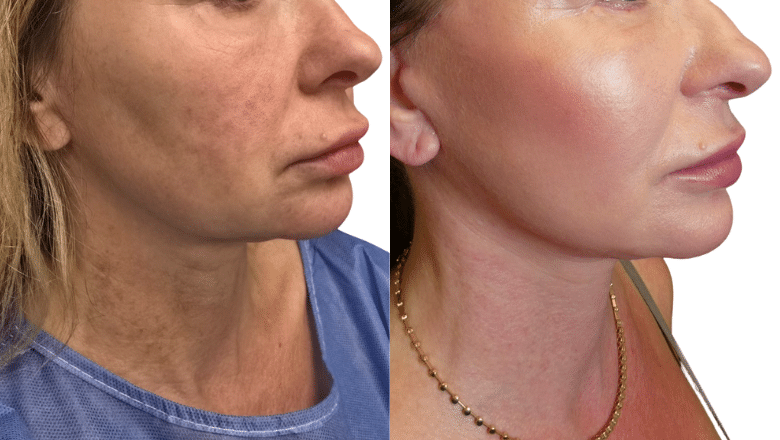
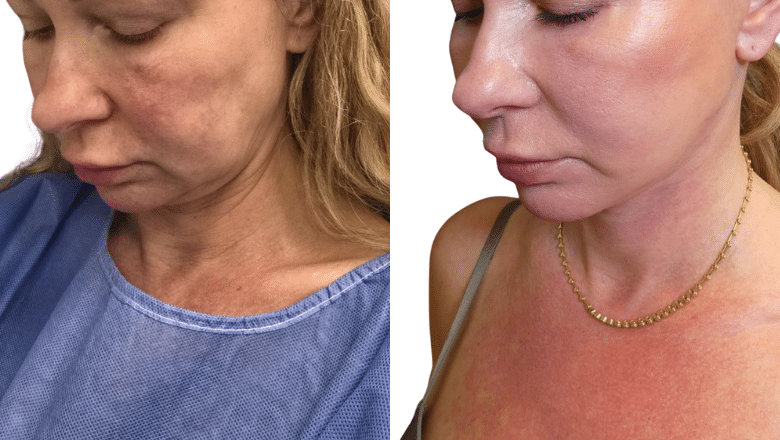
For earlier jowling, a mini facelift is a shorter operation, usually under local anaesthetic with or without sedation, and our guide to facelift vs mini facelift compares them. Short-scar suspension lifts have good satisfaction but limited effect on the neck, so a heavy neck usually needs more than a lighter operation can give[2]. For recovery detail, see our guides to facelift recovery and what to expect from a facelift.
Eyelid surgery for heavy or tired-looking eyes
When the main concern is a hooded upper lid or bags below the eyes, blepharoplasty (eyelid surgery) removes excess skin and fat, and Centre for Surgery also corrects drooping of the upper eyelid itself (ptosis). Eyelid operations here are done under local anaesthetic with or without sedation, or TIVA. Our guide to how to fix tired-looking eyes sets out the options from injectables to surgery.
Brow lift for droopy eyebrows
A low or sagging brow can make the upper lids look heavier than they are, and lifting it can open the eye area in a way eyelid surgery alone cannot. A brow lift is worth discussing alongside eyelid surgery, and our article on droopy eyebrows explains how to tell which you need. Dedicated planning matters here because brows, lids and forehead all interact.
Neck lift, chin and neck liposuction and facial fat transfer
A softened jawline and neck bands are often the first thing people want to change. A neck lift tightens the muscle and skin, while chin and neck liposuction suits a fuller neck with good skin tone. Where hollowing is the issue, facial fat transfer restores volume using your own tissue. If your hairline is the concern, hairline lowering is a separate surgical option.
Surgical vs Non-Surgical Facial Rejuvenation: Which Is Better?
Neither is better in general; they solve different problems. Non-surgical treatment gives subtle improvement, a short recovery and the flexibility to repeat or adjust, which suits early ageing and people who are not ready for an operation. Surgery gives a larger and longer-lasting change by repositioning tissue, which suits advanced laxity, at the cost of a longer recovery and the risks that come with any operation.
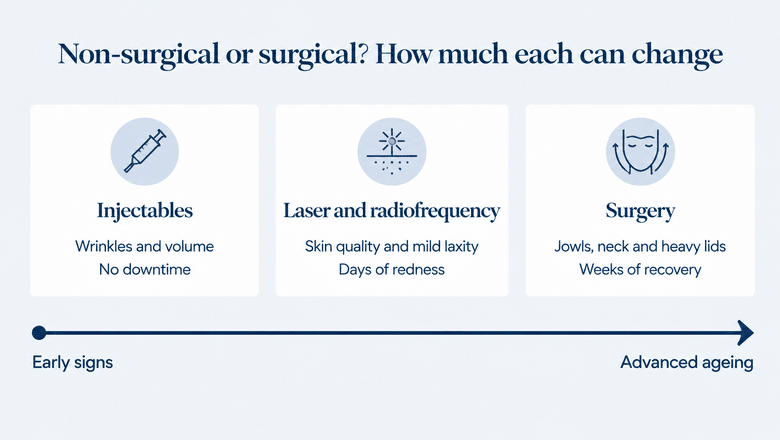
The practical test is whether the problem is surface or structure. If you can pinch and lift your jowls in the mirror and see the improvement, the tissue has descended and surgery is the lasting answer. If the concern is texture, tone, fine lines or small hollows, non-surgical treatment is the proportionate choice. Starting non-surgically does not rule out surgery later, and good non-surgical care in your 30s and 40s can delay it.
Are thread lifts a good alternative to a facelift?
Thread lifts are often searched for as a non-surgical facelift. We do not offer them at Centre for Surgery. The lift from threads is modest and tends to fade, and where laxity is enough to bother you, a surgical lift or a radiofrequency treatment is a more reliable choice. If you have been quoted for threads elsewhere, bring the details to a consultation and you can be told plainly whether they would help.
What Is the Best Facial Treatment for a 60-Year-Old Woman?
Age is a rough guide to what has changed, not a rule. By the sixties most people have some combination of volume loss, skin laxity and descent of the jowls and neck, which is why the question “what is the best non-surgical facelift for over 60?” has an uncomfortable answer: injectables and energy treatments can improve skin quality and soften lines, but they will not replace the lift that a facelift gives. Our guides to the best age for a facelift and to crepey skin look at this in more detail.
In practice the age bands tend to look like this:
- Late 20s to 30s: prevention and skin quality. Anti-wrinkle injections for expression lines, skincare and, if wanted, skin boosters.
- 40s: early laxity and volume loss. Fotona 4D or Morpheus8 for skin quality, fillers for hollows and, for some, eyelid surgery or a mini facelift.
- 50s: descent becomes visible. Facelift and neck lift, with or without eyelid surgery or a brow lift, plus skin treatments for texture.
- 60s and beyond: fuller structural change. A facelift with neck lift is usually the most effective option, with non-surgical treatments maintaining skin quality afterwards. Fit and healthy people in their sixties and seventies are often good candidates.
What Is Full Facial Rejuvenation, and Can You Combine Treatments?
Full facial rejuvenation means treating the whole face rather than one feature, and it nearly always involves a combination. A typical surgical plan might pair a facelift and neck lift with eyelid surgery or a brow lift, and a typical non-surgical plan might pair injectables with a course of laser or radiofrequency treatment. The two approaches work well together: surgery restores structure, and skin treatments afterwards keep the surface looking fresh. Our guide to procedures that complement a facelift sets out sensible pairings, and the article on non-surgical facelift procedures in London covers the non-surgical side in depth.
Order matters. Skin treatments such as Morpheus8 are generally planned before or well after an operation, and fillers are usually adjusted once swelling from surgery has settled. Your surgeon will sequence treatments so they do not interfere with each other.
How Long Does Facial Rejuvenation Last?
Duration depends on the treatment, and it helps to think of it as a spectrum:
- Anti-wrinkle injections: typically four to six months[3][4].
- Dermal fillers: several months to a couple of years, depending on the product and the area, as the filler is gradually absorbed.
- Laser and radiofrequency: results build over weeks to months and are typically topped up once or twice a year. Morpheus8 typically lasts 12 to 18 months.
- Surgery: several years. A facelift does not stop ageing, but you continue to look younger than you would have without it. Our guide to how long a facelift lasts gives timeframes by technique.
None of these treatments stops the clock, which is why ongoing skincare, sun protection and not smoking make as much difference to long-term results as the treatment itself.
Is Facial Rejuvenation Worth It?
Whether it is worth it depends on what you want, what you are prepared to go through and what you can realistically expect. People most often report being happy when the treatment matches the problem and the expectations were realistic, and least happy when a non-surgical treatment was used to try to correct something that needed surgery, or the other way round. Satisfaction in the facelift literature is high, as the review above shows[1], but every treatment carries risks: bruising and swelling for injectables, temporary redness for laser, and for surgery the risks of any operation, including infection, haematoma, scarring and nerve injury. Our article on facelift complications sets out the risks honestly and how they are managed.
How Much Does Facial Rejuvenation Cost?
Costs vary widely because the treatments do. Non-surgical treatments are priced per session or course, and our Skin & Aesthetics price list shows each option. Surgical costs depend on the operation or combination, the type of anaesthesia and whether additional procedures are included, so they are confirmed in writing after your consultation. Finance options are available for surgery. A consultation is the place to compare cost against what each option can realistically change, including over a few years: repeated short-lived treatments can add up to a similar amount to one operation that lasts longer.
What Happens at a Facial Rejuvenation Consultation?
A consultation starts with listening to what bothers you. Your surgeon assesses skin quality, the degree of tissue descent, volume, the neck and the eyes, and tells you plainly whether non-surgical treatment will help or whether surgery is the better route. At Centre for Surgery the surgeon who assesses you is the surgeon who operates, our surgeons are GMC-registered, and operations take place at our CQC-regulated Baker Street hospital. Non-surgical treatments are delivered at the same site after an assessment. If a different treatment would serve you better, or waiting is the sensible choice, you will be told so, and there is a recommended two-week cooling-off period after you consent to surgery. Our guide to anaesthesia for cosmetic surgery explains the options if an operation is planned.
Frequently Asked Questions
How do I rejuvenate my face?
Start by identifying what has changed: skin quality, expression lines, volume, sagging or the eyes. Skin treatments such as laser or radiofrequency improve texture, injectables soften lines and replace volume, and surgery lifts descended tissue. A consultation will show which combination fits your face and how much change to expect.
How long does facial rejuvenation last?
Anti-wrinkle injections last around four to six months, fillers several months to a couple of years, and laser or radiofrequency results build over months and need top-ups. Surgical results last for years. None of them stops ageing, but you continue to look younger than you otherwise would.
What is the best non-surgical facelift for over 60?
For mild laxity, radiofrequency treatments such as Morpheus8 or FaceTite, Fotona 4D laser and carefully placed fillers can improve firmness, texture and volume. They cannot lift heavy jowls or neck bands, so if sagging is the main concern, a surgical facelift is usually the more effective option.
What is the best facial treatment for a 60-year-old woman?
There is no single answer. Many women in their sixties have a mix of laxity, volume loss and skin changes, and the plan is built around which of these bothers them most. A facelift with neck lift is the usual choice for descent, with skin treatments before or after to keep texture and tone fresh.
Is facial rejuvenation worth it?
It can be when the treatment matches the problem and your expectations are realistic. Weigh the likely improvement against the recovery, the risks and how long the result lasts. Our consultation gives you an honest view, including when the sensible advice is not to treat yet.
What is facial aesthetics?
Facial aesthetics describes treatments that improve how the face looks, from injectables and skin treatments to cosmetic surgery. Non-surgical treatments are usually grouped as aesthetic medicine, while operations such as facelift and eyelid surgery come under plastic surgery.
What is the newest facial procedure?
New devices and injectables appear regularly, but newer does not mean better. Established treatments such as injectables, laser, radiofrequency and facelift surgery have the strongest track records, and a new technique is worth considering only if it has evidence behind it and suits your face.
How much does full facial rejuvenation cost?
It depends on which treatments are combined. Non-surgical costs are listed on our skin and aesthetics price list, and surgical costs are confirmed in writing after a consultation, once your surgeon has agreed a plan. Finance options are available for surgery.
Facial Rejuvenation in London
If you would like advice on which facial rejuvenation treatment suits you, book a consultation at our Baker Street hospital. You can explore our facial surgery options or our skin tightening treatments first.
Phone: 020 7993 4849 | Address: 95–97 Baker Street, Marylebone, London W1U 6RN
Contact us to schedule a consultation
References
- Khoury S, Almubarak Z, Khan H, Boldt G, Villemure-Poliquin N, Nichols AC. The deep plane versus SMAS facelift: a systematic review and meta-analysis. Aesthetic Plastic Surgery 2025;49(21):5895–5903. doi:10.1007/s00266-025-05118-x ↗
- Hijkoop LF, Stevens HPJD, van der Lei B. The minimal access cranial suspension (MACS) lift: a systematic review of literature 18 years after its introduction. Journal of Plastic, Reconstructive & Aesthetic Surgery 2022;75(3):1187–1196. doi:10.1016/j.bjps.2021.11.051 ↗
- Rahman E, Mosahebi A, Carruthers JDA, Carruthers A. The efficacy and duration of onabotulinum toxin A in improving upper facial expression lines with 64-unit dose optimization: a systematic review and meta-analysis with trial sequential analysis of the randomized controlled trials. Aesthetic Surgery Journal 2023;43(2):215–229. doi:10.1093/asj/sjac253 ↗
- Gadhia K, Walmsley AD. Facial aesthetics: is botulinum toxin treatment effective and safe? A systematic review of randomised controlled trials. British Dental Journal 2009;207(5):E9. doi:10.1038/sj.bdj.2009.813 ↗
- Taub AF, Sarnoff D, Gold M, Jacob C. Effect of multisyringe hyaluronic acid facial rejuvenation on perceived age. Dermatologic Surgery 2010;36(3):322–328. doi:10.1111/j.1524-4725.2009.01436.x ↗
- Madero-Pérez J, Gil-Martinez M, Arrien L, Nazari S, Pourani MR, Martin-Marfil P, et al. Guide for managing vascular occlusion due to fillers with extended neuro-ophthalmic involvement: a review of diagnosis, classification and treatment. Aesthetic Plastic Surgery 2026;50(11):4387–4404. doi:10.1007/s00266-026-05792-5 ↗
- Liu Y, Yu W, Zhu J, Cen Q, Zhou L, Ma G, et al. Facial tightening using a novel vacuum-assisted microneedle fractional radiofrequency system: a prospective, randomized, split-face study. Journal of Cosmetic Dermatology 2024;23(10):3248–3255. doi:10.1111/jocd.16414 ↗
- Demesh D, Cristel RT, Gandhi ND, Kola E, Dayan SH. The use of radiofrequency-assisted lipolysis with radiofrequency microneedling in premature jowl and neck laxity following facialplasty. Journal of Cosmetic Dermatology 2021;20(1):93–98. doi:10.1111/jocd.13824 ↗