


In this guide15 sections
- Key Points
- What Is the Difference Between Blepharoplasty and a Thread Lift?
- What Causes Hooded Eyes?
- What Is a Thread Lift for Hooded Eyes?
- Do Thread Lifts Work for Hooded Eyes?
- What Does Blepharoplasty Do for Hooded Eyes?
- Blepharoplasty vs Thread Lift: Side-by-Side Comparison
- Brow Lift vs Blepharoplasty: Which Hooded Eyes Treatment Do I Need?
- What Non-Surgical Options Are There for Hooded Eyes at Centre for Surgery?
- Blepharoplasty Before and After for Hooded Eyes
- What Is Recovery Like After Blepharoplasty Compared With a Thread Lift?
- What Happens at a Hooded Eyes Consultation at Centre for Surgery?
- Frequently Asked Questions
- Blepharoplasty and Hooded Eyes Treatment in London
- References
Key Points
- Blepharoplasty vs thread lift: for true hooded eyes, blepharoplasty (eyelid surgery) is the treatment that removes the excess eyelid skin. A thread lift cannot remove skin, and its effect is modest and temporary.
- Centre for Surgery does not offer thread lifts. They are explained here honestly because other providers sell them for hooded eyes. We offer blepharoplasty, brow lifts and ptosis repair, plus dermal fillers and anti-wrinkle injections.
- The cause matters more than the label. Hooded eyes come from excess lid skin, a dropped brow, a weak eyelid muscle (ptosis) or a mix, and each needs a different fix.
- Thread lift evidence is thin. A 2021 meta-analysis found satisfaction fell from 98% straight after treatment to 88% over the longer term, and the studies mostly cover the cheeks and jawline rather than the eyes.
- Blepharoplasty results last years, not months. In a large 2022 cohort of 2,134 patients, satisfaction was high at six months and stayed stable at twelve.
- A fingertip test gives a first clue. If lifting your outer brow by about 5 mm opens the eye, a brow lift may help; if the fold stays, upper blepharoplasty is more likely.
If your upper eyelids look heavy, folded or tired, it is natural to ask whether a quick non-surgical option such as a thread lift could do the job of an operation. The honest answer is that it depends on what is causing the hooding, and for most people with genuinely hooded eyes the problem is skin that only blepharoplasty can remove.
This guide compares blepharoplasty vs thread lift for hooded eyes: what each treatment does, what the research shows, the risks, how long results last and what recovery involves. It also explains where a brow lift fits, because a low brow is often the real culprit. Our guide to non-surgical alternatives to eyelid surgery covers the wider field, and traditional vs non-surgical blepharoplasty compares an operation with laser tightening. Here we stay focused on threads and hooded eyes.
One point up front: Centre for Surgery does not offer thread lifts. We describe them as what other providers sell, so that you can judge the claims you see online, and we then steer you towards the options we do perform.
What Is the Difference Between Blepharoplasty and a Thread Lift?
A blepharoplasty, also called an eyelid lift or eyelid surgery, is an operation. Through a fine incision hidden in the natural upper eyelid crease, the surgeon removes excess skin, and sometimes a little muscle or fat, then closes the wound with fine stitches. The skin that was folding over your lash line is gone, which is why the result is long-lasting. Our guide to upper vs lower blepharoplasty explains which eyelid each operation treats.
A thread lift is a procedure in which fine dissolvable threads, usually polydioxanone (PDO), are placed under the skin with a needle or cannula. Barbed or cogged threads grip the tissue and hold it slightly higher while the thread is present, and the thread then dissolves over several months. Nothing is cut away. The tissue is repositioned, not removed.
That single difference explains most of what follows. Hooded eyelids are usually a surplus of skin, and a thread has no way to take surplus skin away.
What Causes Hooded Eyes?
Hooded eyes describe a fold of skin that droops from beneath the brow and covers part or all of the upper eyelid crease, so the lid looks shorter and the eye smaller or tired. Some people are born with it, since a heavy brow bone, a lower brow or thicker lid skin can run in families. For most, it develops with age. Skin loses elasticity, the brow slowly descends and the fat pads shift. Our full guide to hooded eyes and hooded eyelids goes through the causes in detail.
Three separate problems can look similar in a mirror:
- Excess eyelid skin (dermatochalasis): loose skin hangs over the crease. This is the classic hooded eye, and it is treated by upper blepharoplasty.
- A dropped brow (brow ptosis): the eyebrow has slipped down and pushes the lid skin with it. Removing lid skin alone can leave the heaviness in place, which is why a brow lift is sometimes the better operation.
- A weak eyelid muscle (eyelid ptosis): the upper lid itself sits too low because the levator muscle has stretched. This is not skin at all and needs a different correction, covered below.
Many people have two of these at once. That overlap is the reason a quick online verdict on which treatment to choose for hooded eyes rarely holds up, and why examination matters.
What Is a Thread Lift for Hooded Eyes?
Providers who offer threads for the eye area usually describe two approaches. In the first, threads are placed along or above the eyebrow to raise the brow a few millimetres and so reduce the weight pressing on the lid. In the second, sometimes marketed as an eyelid thread lift or upper eyelid thread lift, threads are placed close to the lid in an attempt to tidy the crease. Neither removes skin. A thread lift for eyes is therefore a mild lifting effect, and it cannot make a heavy hood disappear.
To be clear, Centre for Surgery does not offer thread lifts. If you are comparing clinics, treat any promise that threads will fix hooded eyelids as you would a promise that a cream will, and ask to see unretouched photographs of patients with the same problem as yours.
What is a fox eye thread lift?
The fox eye thread lift is a social-media term for threads placed at the outer corner of the eye and brow to give a lifted, almond-shaped look, with the outer corner tilted upwards. It is a cosmetic effect on eye shape rather than a treatment for hooded lids, and it is temporary. If an upswept outer corner is what you want permanently, canthoplasty (almond eye surgery) is the surgical route, and it is a different operation from blepharoplasty.
Can PDO threads lift the eyebrows?
PDO threads can raise the brow slightly while they hold, and some providers use them for that reason. The lift is small and fades as the thread dissolves. For a lasting change, a brow lift repositions the brow surgically, and our guide to getting an eyebrow lift without surgery explains what non-surgical methods can and cannot do.
Do Thread Lifts Work for Hooded Eyes?
The honest answer is that nobody can promise they do, and the research is limited. Most published studies of thread lifting look at the cheeks, jowls and jawline. Evidence specifically on threads for hooded upper eyelids is thinner still.
What the broader literature shows is useful context. A 2021 meta-analysis of 26 studies in Aesthetic Plastic Surgery ↗ found that satisfaction was 98% straight after facial thread lifting but 88% over the longer term, and the authors advised discussing with patients that the effect may not last[1]. A 2024 systematic review of 12 studies and 818 patients found immediate improvement on standard scoring scales, but the longest follow-up was two years and the authors concluded that long-term efficacy data are lacking[3].
So the fair summary is that threads can give a temporary, modest lift in the right face, and that the evidence for fixing hooded eyelids with them is weak. If your hood is skin, a thread cannot remove it.
What are the side effects and risks of a thread lift?
Thread lifts are often described as low risk, and for most people the problems are minor and temporary. In the 2021 meta-analysis, swelling was reported in about 35% of cases, skin dimpling in 10%, numbness or altered sensation in 6%, visible or palpable threads in 4%, infection in 2% and thread extrusion in 2%[1]. A separate systematic review of 59 articles covering 14,222 patients found facial asymmetry, swelling and bruising the most common effects, with rarer injuries to vessels and glands, and noted that contour irregularities and infections did not always settle on their own[2]. A 2024 review of absorbable threads reported bruising in about 19% and swelling in about 17%[4].
The skin around the eyes is thin, so lumps, visible threads and asymmetry are harder to hide there than on the cheek. Our general guide to fixing tired looking eyes explains why finding the true cause first matters.
How long does a thread lift last?
Absorbable threads dissolve over roughly six to nine months, and the lift people notice usually fades over the following months, with providers commonly quoting around a year. Individual results vary. That compares with years for blepharoplasty, as the next section explains.
What Does Blepharoplasty Do for Hooded Eyes?
Upper blepharoplasty is the standard operation for hooded eyes caused by excess lid skin. The surgeon marks the skin to be removed, makes the incision in your natural crease, removes the surplus and closes the wound with fine stitches. Where a small fat pad is bulging, it can be trimmed or repositioned at the same time. Our blepharoplasty service page sets out the full process.
At Centre for Surgery, eyelid surgery is done as a day case under local anaesthetic with or without sedation, or under TIVA. Upper eyelid surgery alone is commonly done awake under local anaesthetic and takes around an hour to an hour and a half. Our guide to having blepharoplasty awake or asleep explains how the choice is made.
Does blepharoplasty fix hooded eyes?
Yes, when the hood is excess skin in the eyelid itself. It restores a defined crease, shows more of the upper lid and makes the eye look more open. It does not lift a dropped brow, which is why assessment comes first. In a 2022 multicentre cohort study in Aesthetic Surgery Journal ↗ of 2,134 upper blepharoplasty patients, satisfaction with the eyes, the upper eyelids and the decision to have surgery was high at six months, patients felt they looked about 3.3 years younger on average, and results were stable between six and twelve months[5].
How long does blepharoplasty last?
The skin that is removed does not grow back, so the change is long-lasting. Upper eyelid results typically last seven to ten years and often longer, and lower eyelid results often last longer still, although ageing carries on after surgery. Our guides on how long blepharoplasty lasts and whether eyelid surgery results are permanent go through the detail.
What are the risks of blepharoplasty?
Blepharoplasty is surgery and carries surgical risks. Bruising and swelling for a week or two are expected. Dry, gritty or watery eyes are the most common problem and usually temporary. Less commonly there is asymmetry, a visible scar or a lower lid that pulls away from the eye. Loss of vision is very rare: a 2011 survey of UK and US aesthetic plastic surgeons ↗ covering 752,816 operations estimated permanent visual loss at about 1 in 30,000[6]. Our guides to the risks and complications of eyelid surgery and to lumps after blepharoplasty are candid about what can go wrong and how it is managed.
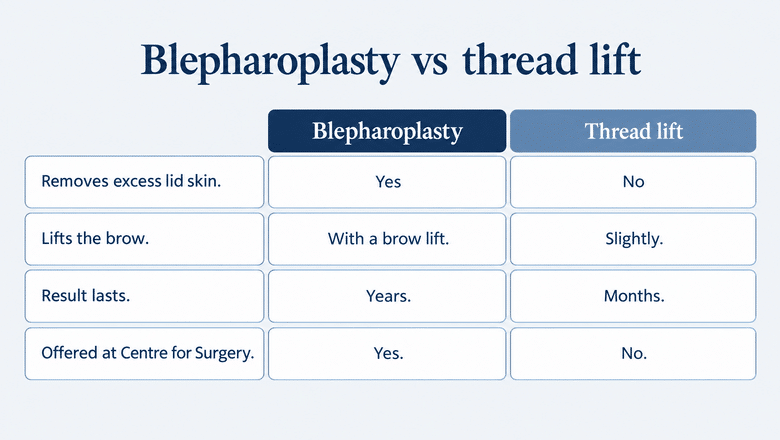
Blepharoplasty vs Thread Lift: Side-by-Side Comparison
- What it treats: blepharoplasty removes excess eyelid skin and, where needed, fat. A thread lift repositions soft tissue slightly and removes nothing.
- Effect on hooded eyes: blepharoplasty reveals the lid and crease. A thread lift gives at most a small brow lift that does not clear a skin hood.
- How long it lasts: blepharoplasty is long-lasting, with upper lid results typically seven to ten years or more. A thread lift lasts months, with threads dissolving within roughly six to nine months.
- Downtime: blepharoplasty needs about a week to ten days before you look presentable at work. A thread lift needs less, but swelling, bruising and dimpling are common.
- Cost: costs depend on the exact procedure and are confirmed in writing after consultation, and finance options are available subject to status. See our blepharoplasty cost guide for what affects the total.
Brow Lift vs Blepharoplasty: Which Hooded Eyes Treatment Do I Need?
Before choosing any treatment, work out whether the heaviness comes from the lid or the brow. A simple home check is the brow position test. Look in a mirror with your face relaxed, then gently lift the outer end of your eyebrow with a fingertip by about 5 mm. If the heaviness eases and the eye opens, the brow has dropped and a brow lift may be what you need. If the fold of skin stays put, the problem is lid skin and upper blepharoplasty is more likely. This is only a first clue, and a surgeon needs to examine you to be sure.
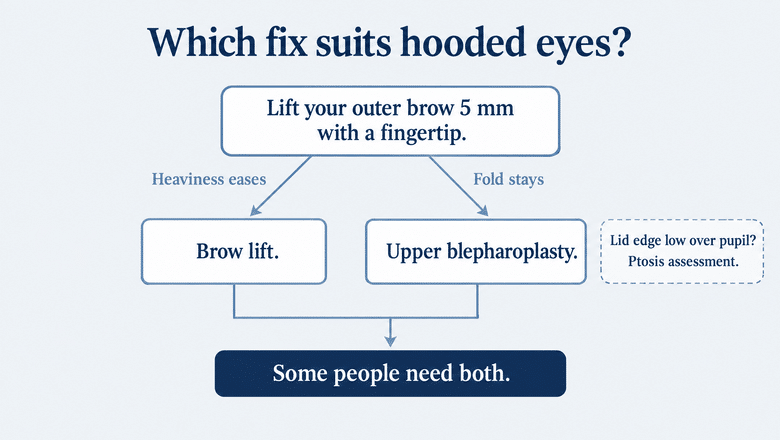
Our comparison of brow lift vs blepharoplasty walks through the test and the decision in full. The two operations are often combined: in a 2024 retrospective study of 278 patients in Plastic and Reconstructive Surgery ↗, a brow lift was performed alongside upper blepharoplasty in nearly a third of cases[7].
Which brow lift technique suits you depends on where the brow has dropped. An endoscopic brow lift suits a moderate drop across the whole brow, a temporal brow lift suits heaviness at the outer brow, and the gliding brow lift is another option. Our guide to droopy eyebrows explains how to tell which type of brow droop you have.
When is ptosis the real problem?
Sometimes the upper lid looks heavy because the lid itself sits too low, not because there is too much skin. In ptosis the levator muscle that lifts the lid has stretched or weakened, so the edge of the lid droops towards or over the pupil. Removing skin does not fix that. We offer ptosis repair, which tightens the lifting muscle or an adjoining muscle, and the same 2024 study found that up to about one in five patients having upper blepharoplasty needed ptosis correction as well[7]. Our guide to droopy eyelids and our page on heavy eyelids explain how ptosis is recognised. If one eyelid has dropped suddenly, or the droop comes with double vision, a headache or a change in the pupil, see a doctor promptly rather than waiting for a cosmetic consultation.
What Non-Surgical Options Are There for Hooded Eyes at Centre for Surgery?
Surgery is not the only route, and an honest consultation covers the gentler options too. We offer anti-wrinkle injections, which can soften frown lines and crow’s feet and, when carefully placed, give the outer brow a subtle lift. We offer dermal fillers, which can restore lost volume under the brow and at the temples, and tear trough filler for hollows beneath the eye. For mild skin laxity, Fotona SmoothEye laser tightens the lid skin and our guide to laser eyelid tightening explains how far it can go.
Injectables and lasers can refresh and tighten, but none of them removes a true skin hood. When the fold is large, surgery matches the problem, and we will say so.
Blepharoplasty Before and After for Hooded Eyes
The photographs below show Centre for Surgery patients. Results vary from person to person, and these images are not a promise of your outcome. More examples are in our blepharoplasty before and after gallery.
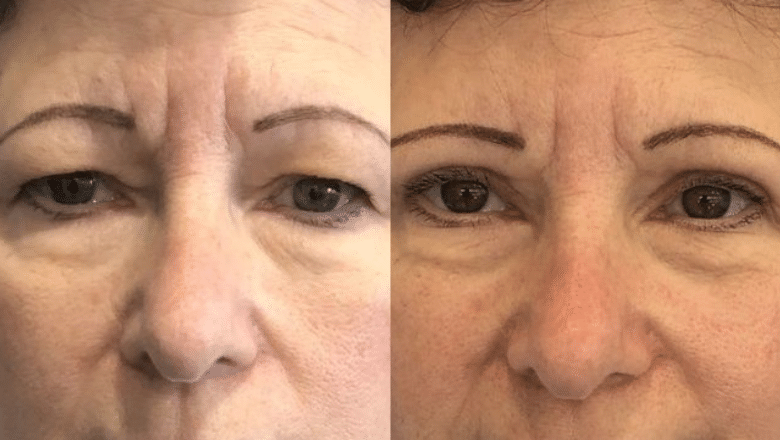
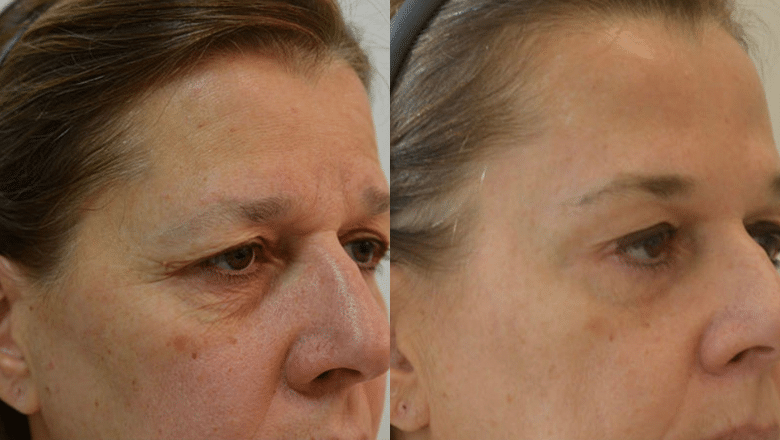
What Is Recovery Like After Blepharoplasty Compared With a Thread Lift?
Recovery after blepharoplasty is short but real. Bruising and swelling peak at days two to four, stitches come out at about a week, and most people take eight to ten days off work, working from home from around day two and returning once bruising can be covered with concealer. Avoid strenuous exercise for six weeks and contact lenses for two to three weeks. The scar sits in the natural crease and fades over six to twelve months. Our blepharoplasty recovery guide goes week by week.
A thread lift usually involves less downtime, which is the main reason people consider it. The trade-off is a smaller, shorter-lived result.
What Happens at a Hooded Eyes Consultation at Centre for Surgery?
You meet the surgeon who will perform your operation, not a sales adviser. All our surgeons are GMC-registered, and the hospital at 95–97 Baker Street is regulated by the Care Quality Commission. The surgeon examines your brows and lids, tests the brow position, checks the strength of the lid muscle and asks about dry eyes, thyroid conditions, previous eye surgery and medication, because some of these change the plan. You are then told plainly whether blepharoplasty, a brow lift, ptosis repair, a combination or a non-surgical option suits you, and sometimes that nothing is needed yet.
If surgery is recommended, a two-week cooling-off period from consent applies, so that you are never rushed. The price is confirmed in writing after the consultation and finance is available subject to status. If you are weighing up who should operate, our guide to choosing an eyelid surgeon lists the questions to ask, and our note on cosmetic vs functional eyelid surgery explains when heavy lids affect vision.
Frequently Asked Questions
Are hooded eyes the same as droopy eyes?
Not always. Hooded eyes usually mean a fold of skin hanging over the lid, while droopy eyes can also mean ptosis, where the eyelid muscle has weakened and the lid edge sits low. The two can coexist, so an examination is needed to tell which you have, because the treatments differ.
Is a blepharoplasty the same as an eyelid lift?
Yes. Eyelid lift is a common patient name for blepharoplasty, also called eyelid surgery. Upper blepharoplasty treats hooded upper lids and lower blepharoplasty treats under-eye bags. Some clinics also use eyelid lift to describe non-surgical tightening, which gives a much smaller change, so check which is meant.
Can PDO threads be used to lift eyebrows?
Some providers use PDO threads to raise the brow slightly, but the effect is small and fades as the threads dissolve over months. We do not offer thread lifts. A brow lift is the surgical option for a lasting change, and anti-wrinkle injections can give a subtle brow lift for suitable patients.
How do I make my hooded eyes look lifted?
It depends on the cause. A dropped brow responds to a brow lift, excess lid skin to upper blepharoplasty, and mild laxity to laser tightening or carefully placed anti-wrinkle injections. Makeup techniques can help temporarily, but they do not change the anatomy. A consultation identifies which approach fits.
How do you get rid of hooded eyelids?
Permanently removing a skin hood needs upper blepharoplasty, which takes out the excess skin through a hidden incision in the lid crease. If the brow has dropped, a brow lift may be needed instead or as well. Creams, massage and eye exercises do not remove hooding.
Do hooded eyes become more hooded as you age?
Usually yes. Skin loses elasticity, the brow gradually descends and the fat pads shift, so hooding tends to increase with age. Sun exposure and genetics play a part. Surgery corrects the hooding that is present but does not stop further ageing, so results are described in years rather than as permanent.
What is the regret rate for blepharoplasty?
We do not know of a single reliable regret figure, and we would be wary of anyone quoting one. What the research shows is high satisfaction: in the 2022 cohort of 2,134 patients, satisfaction with the result and the decision to have surgery was high at six months[5]. Regret is more likely when the wrong operation is chosen or expectations are unrealistic.
What can I do instead of blepharoplasty?
It depends on why you want to avoid surgery and what is causing your hooding. Options include a brow lift for a dropped brow, SmoothEye laser for mild laxity, and anti-wrinkle injections or fillers for brow and temple support. Our guide to non-surgical alternatives to eyelid surgery compares them honestly.
Blepharoplasty and Hooded Eyes Treatment in London
If you are deciding between blepharoplasty, a brow lift or something gentler for hooded eyes, a consultation with a surgeon will establish the cause and give you a clear plan. Find out more about blepharoplasty at Centre for Surgery.
Phone: 020 7993 4849 | Address: 95–97 Baker Street, Marylebone, London W1U 6RN
Contact us to schedule a consultation
References
- Niu Z, Zhang K, Yao W, et al. A meta-analysis and systematic review of the incidences of complications following facial thread-lifting. Aesthetic Plastic Surgery 2021;45(5):2148–2158. doi:10.1007/s00266-021-02256-w ↗
- Pham CT, Chu S, Foulad DP, Mesinkovska NA. Safety profile of thread lifts on the face and neck: an evidence-based systematic review. Dermatologic Surgery 2021;47(11):1460–1465. doi:10.1097/DSS.0000000000003189 ↗
- Riopelle AM, Geisler AN, Eber A, Dover JS. Update on absorbable facial thread lifts. Dermatologic Surgery 2025;51(5):509–514. doi:10.1097/DSS.0000000000004521 ↗
- Ojha AS, Farahbakhsh N, Saikaly SK. An assessment and comparison of adverse effect rates in differing absorbable thread lift suture materials. Dermatologic Surgery 2025;51(3):272–276. doi:10.1097/DSS.0000000000004466 ↗
- Domela Nieuwenhuis I, Luong KP, Vissers LCM, et al. Assessment of patient satisfaction with appearance, psychological well-being, and aging appraisal after upper blepharoplasty: a multicenter prospective cohort study. Aesthetic Surgery Journal 2022;42(4):340–348. doi:10.1093/asj/sjab389 ↗
- Mejia JD, Egro FM, Nahai F. Visual loss after blepharoplasty: incidence, management, and preventive measures. Aesthetic Surgery Journal 2011;31(1):21–29. doi:10.1177/1090820X10391212 ↗
- Falcon Rodriguez L, Kuruoglu D, Salinas CA, et al. Eyelid and brow rejuvenation: technical pearls and outcomes of upper blepharoplasty with or without ptosis correction and brow lift. Plastic and Reconstructive Surgery 2024;154(6):1199–1207. doi:10.1097/PRS.0000000000011324 ↗